Latest Stories
Most recently published stories in Horror.
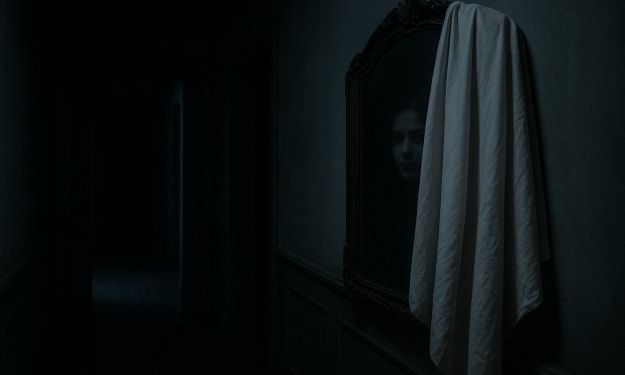
The Mirror Only Shows the Truth at Midnight
The mirror in the hallway was older than the house itself. It had belonged to my grandmother—a heavy, gilded frame carved with roses and vines that seemed to twist on their own in the right kind of light. When she died, it was the only thing she left me, along with a note that said, “Never look at it after midnight.” I thought it was superstition, the kind of strange rule older people invent to make ordinary things seem mystical. For the first few months after moving into her house, I didn’t pay much attention to it. It stood there quietly, reflecting my days in the same dull way any mirror does. But then one night, the clock in the hallway struck twelve—and I heard something move behind the glass. At first, I thought it was the house settling. But then the sound came again—a soft, wet sound, like breathing. I turned toward the mirror and saw my reflection standing perfectly still, even though my hand had just brushed my hair back. It didn’t move. It just stared. I froze. Then, slowly, the reflection smiled. But I hadn’t. I stumbled backward, knocking over the small table beside the mirror. When I blinked, it was gone. The reflection was normal again—my tired face, my shaking hands. That night, I barely slept. The next morning, I tried to convince myself it was fatigue, stress, grief—anything logical. But part of me couldn’t forget the way that other me had smiled, as if she knew something I didn’t. The second time it happened, I was ready. I sat in front of the mirror at 11:50 p.m., waiting, watching. The air felt heavier as the minutes passed, the light from my lamp dimming for no reason. The moment the clock struck twelve, my reflection blinked—and then began to move on its own. It tilted its head, studying me with quiet interest. Then, it raised a hand and pointed behind me. I didn’t want to turn around. But I did. There was nothing there—just the dim hallway stretching into darkness. When I looked back, the reflection had turned its back to me. It faced the hallway inside the mirror, but the reflection of my hallway was different. The wallpaper was torn. The lights flickered. And behind my mirrored self stood something—tall, pale, and formless—its long fingers resting on her shoulders. Then, all at once, the glass began to ripple like water. I fell backward, knocking the lamp to the floor. The light shattered, plunging the room into darkness. When I scrambled to turn on the flashlight on my phone, the mirror was still again. My reflection looked normal—except her eyes. They were no longer mine. They were empty. After that, I covered the mirror with a sheet. I told myself I wouldn’t go near it again. But the thing about forbidden things is—they pull at you. Each night, I’d hear faint whispers from the hallway, a low hum that almost sounded like my name. Sometimes, I’d wake up to find the sheet on the floor, even though I’d tucked it tightly before bed. On the seventh night, I couldn’t resist. I stood in front of it again, flashlight trembling in my hand. Midnight crept in like fog. The moment the clock struck twelve, the mirror shuddered. This time, the reflection didn’t move at all. Instead, words began to appear across the glass, scrawled backward in something dark and wet: “Let me out.” I stepped closer. My breath fogged the surface. I could see something moving inside—shadows twisting and stretching like smoke. Then, a hand pressed against the other side of the glass. It was pale, bloodless, with long fingers that left streaks as it dragged downward. Before I could move, my reflection’s eyes snapped open. “Please,” it whispered, though my lips didn’t move. “It’s your turn now.” The glass cracked. The sound was deafening, like thunder trapped in a cage. The mirror pulsed once—twice—and then the world folded inward. When I opened my eyes, I was standing inside the mirror. Everything looked the same—my house, my hallway—but drained of color. The air was thick, heavy, and I could see her—the version of me—standing on the other side of the glass, staring back with wide, terrified eyes. I pounded on the glass, screaming, but no sound came out. My voice was swallowed by the silence. She reached out and touched the mirror softly, almost apologetically. Then she turned away. The last thing I saw before darkness swallowed me was her covering the mirror again with that same white sheet. Now I understand. The mirror doesn’t show the truth—it trades it. It shows what we refuse to see, what we hide beneath our calm, everyday selves. And once it reveals it, it takes us instead. If you ever come across a mirror that looks too old, too heavy, too still—don’t look at it after midnight. Because the truth doesn’t just reflect. It waits. And one night, when the clock strikes twelve, it’ll look right back.
By LUNA EDITH11 months ago in Horror
The Whispers Beneath the Floor
1. The Move-In When Arif and his younger sister Sana moved into the old colonial house on the edge of Abbottabad, they were just looking for a fresh start. Their father had passed away six months earlier, and the city’s noise was too much for them. The house was large, cheap, and surrounded by towering pine trees. The locals said it had been empty for decades. “Strange sounds at night,” one old man warned Arif at the grocery shop. “And the floor… it talks sometimes.” Arif laughed it off. He didn’t believe in ghosts. Sana, however, felt uneasy from day one. 2. The Whispers Begin The first night passed quietly, but on the second, Sana woke to a faint sound — like someone whispering directly beneath her bed. At first, she thought it was the wind slipping through the cracks of the wooden floor. But the words grew clearer. “Let me out… please…” Sana froze. The voice was thin, hoarse, almost desperate. She held her breath, staring at the floor. Then silence. In the morning, she told Arif, but he brushed it off. “You’re just nervous. These old houses make all kinds of noises.” That evening, though, while reading in the living room, Arif felt a vibration under his feet. It wasn’t an earthquake — it felt like someone knocking from below. 3. The Unearthing Curiosity turned to fear when they discovered a small loose board under the carpet in Sana’s room. Arif pried it open, revealing a dark, narrow crawlspace. A foul smell drifted upward — damp wood and something rotten. He shone his flashlight inside. The beam caught something — a set of old fingernail scratches on the wooden beams, deep and chaotic. As if someone had clawed at the wood for dear life. Then, as he leaned closer, something breathed out of the hole. Not air — a sigh. A human sigh. They both jumped back. The board slammed shut on its own. That night, they couldn’t sleep. The whispers came back, now from every corner of the house. “You opened it… you shouldn’t have opened it.” 4. The Journal The next morning, Arif searched the attic, determined to find out who had lived there before. Beneath old boxes, he found a dusty leather-bound journal. The name on the cover was “Dr. Kamal Hussain – 1952.” Inside were notes about psychological experiments — and entries about “voices in the floor” and “human consciousness trapped by trauma.” One passage chilled Arif to the bone: > “Subject 9 remains buried under the living quarters. The treatment failed. The body may still speak. The whispers never end.” Sana wanted to leave immediately, but a storm had rolled in, cutting the power and blocking the road out of town. 5. The Night of Screams As darkness swallowed the house, the air grew thick. Every light bulb flickered before dying completely. The siblings lit a single candle and stayed in the living room, back to back. Then came the sound — heavy footsteps moving under the floorboards, slow and dragging. The whisper turned into a moan. “You let me out… now let me in.” The candle flame twisted sideways, though there was no wind. The boards beneath Sana’s chair began to bulge — as if something was pushing up from below. Arif grabbed her hand, but before they could run, the floor split open with a loud crack. A blackened hand shot up, its nails jagged, its skin torn. The stench was unbearable. They screamed. Arif smashed the hand with a metal rod, but it kept coming — an entire figure crawling out, its face twisted, eyes white and wet. “He buried me here,” it hissed. “Now it’s your turn.” 6. The Escape Arif yanked Sana toward the door, kicking the rotten boards aside. The storm outside howled as they ran through the rain. Behind them, the house shook violently. Windows shattered, and a chorus of whispers rose into the night like screams from the underworld. When they finally looked back, the house was on fire — not from lightning, but from within, glowing with a deep red light that pulsed like a heartbeat. 7. The Ending A month later, the police investigated. They found no bodies, but the crawlspace under Sana’s room was empty — except for a journal page burned around the edges. It read: > “The subject is no longer contained. The voices have found new hosts.” Sana still wakes up at night, hearing faint whispers beneath her bed — no matter where she sleeps. And sometimes, when Arif stands alone in silence… he swears he hears knocking. From below. Author’s Note Some houses don’t keep memories — they feed on them. And sometimes, when you listen closely enough, the floor beneath you might be listening back.
By Iazaz hussain11 months ago in Horror
Final Queens: Laurie Strode
“Hello Michael. I knew you’d come for me sooner or later…what took you so long?” - Laurie Strode. What would you do if you found out your older brother was a serial killer? Well if horror master John Carpenter was telling your story you’d be Laurie Strode.
By Joe Patterson11 months ago in Horror
Don’t Look at the Stars
It started with the lights. At first, people thought it was beautiful—the way the stars shimmered brighter than they ever had before. The night sky over the small town of Elridge Falls had always been dull, washed out by streetlamps and factory smoke. But on that particular October evening, it looked alive. The news called it a cosmic event, something about radiation and solar winds colliding in the upper atmosphere. Scientists said it was harmless, a spectacle of nature. People came out with blankets and cameras, holding their breath under the vast, glowing sky. But then, they began to disappear. The first was a teenage boy named Daniel Price. He was last seen lying on the hood of his car, staring up at the stars with his headphones on. When his mother came looking for him, all she found was the car door wide open and the faint hum of a song still playing through the speakers. By the next week, three more were gone. No one saw anything. No struggle. No trace. Just empty spaces where people should have been. It didn’t take long before people started to notice a pattern—the ones who vanished were always the ones who had been outside too long, gazing at the sky as if hypnotized. That’s when people started saying it: “Don’t look at the stars.” At first, I thought it was small-town panic. Rumors grow fast when fear takes root. But then I saw it myself. It was just after midnight. I was standing by the old gas station on Highway 12 when I noticed Mrs. Crowley across the road, her head tilted back, eyes wide open. The stars reflected in her pupils like tiny, trembling mirrors. I called out to her, but she didn’t move. She didn’t blink. And then—she was gone. No sound. No movement. Just gone, as if the night had swallowed her whole. After that, no one went out after dark. The streets turned into ghost roads. Curtains stayed drawn. We moved through the world like shadows, whispering about what was happening but never daring to look up. Still, some people couldn’t help themselves. Curiosity is a dangerous thing in the hands of fear. One evening, I found my brother, Sam, sitting on the porch with a beer, eyes fixed upward. “Don’t,” I said quietly. He didn’t turn to me. “They’re so bright tonight,” he murmured. “Almost like they’re watching.” I grabbed his arm. “Sam, stop!” But he didn’t blink. His lips parted, like he wanted to say something else—but no sound came out. For a second, his pupils dilated until they were nothing but black circles reflecting the starlight. Then he vanished, leaving behind only the beer can rolling across the wooden floorboards. That was the night I stopped believing this was something human. The stars had changed. They moved differently now—too slow, too deliberate, as if adjusting their positions to see us better. Some nights, I could swear I saw shapes shifting between them, dark outlines like enormous wings or limbs stretching across the sky. Whatever it was, it wasn’t just light. Some said it was aliens. Others said angels, demons, or something older. But to me, it felt more like the universe itself had opened its eyes and realized we were staring back. Days turned into weeks. The town emptied. Those of us who survived barricaded ourselves indoors, covered our windows, and destroyed every reflective surface we could find. No mirrors. No glass. No reason to catch even a sliver of starlight. The radio stations went silent. The power grid flickered out. The world outside grew darker, quieter, as if sound itself had been erased. Now, only a few of us remain. We communicate in whispers, in letters slid under doors. Some of us have started hearing things—a soft humming, like a voice buried beneath static. When I close my eyes, I can almost make out words, something like: We see you. I haven’t looked up in weeks. I keep my head down, even when I step outside during the day. But the sky feels different now, heavier somehow. Like it’s pressing down, waiting for someone to slip. Two nights ago, I heard my neighbor, Ellie, screaming. I ran to her house, covering my head with my jacket. When I got inside, she was standing in her living room, trembling, her hands clutching her eyes. “They’re in the light,” she whispered. “Not the stars. The space between them.” Before I could ask what she meant, the lights in her house flickered—and she was gone. Now it’s just me. I’m writing this by candlelight, with the curtains pinned shut. I don’t know how much longer I’ll last. Every night, I feel it stronger—the pull to look, to see what’s really up there. Sometimes, I hear my brother’s voice outside the window, calling my name softly, the way he used to when we were kids. I know it’s not him. I know it’s them. The stars aren’t supposed to move, but they do now. Slowly. Patiently. Like eyes adjusting to the dark. If anyone ever finds this, take this one piece of advice— Don’t look at the stars. Because they’re looking back.
By LUNA EDITH11 months ago in Horror
Fatal Change
Stan, a 55-year-old traveling sales agent, is a Bostonian through and through. The Red Sox, Patriots, Celtics and Bruins are the only team’s worth rooting for. In Stan’s world, change can never be a good thing. His third-floor walkup apartment is the same one he and a fellow student originally rented while attending Suffolk University 35 years ago. The roommate moved on. Stan did not. Why leave a place he knows?
By Mark Gagnon11 months ago in Horror
The Photographer’s Last Frame. Content Warning.
The Photographer’s Last Frame Elliot Price believed that photographs could steal time. He said it once, half-jokingly, during a street photography exhibit years ago. But as the years passed, that joke began to sound more like a confession. He had been a photographer for twenty years — wandering streets, chasing light and faces, capturing fleeting moments that others overlooked. His black-and-white portraits of strangers had won awards, but he never took credit for what truly made them haunting: the eyes. Every person he photographed seemed to stare through the frame — alive, yet already fading. --- The First Disappearance It began six months ago. Elliot was at the old market in the city’s east end, taking candid shots of street vendors. One image stood out — a girl in a yellow scarf, smiling shyly as she held a bouquet of wilted flowers. The shot was perfect: the motion, the color, the soft sadness in her eyes. He posted it online that night. The next morning, news broke. A young woman — florist’s assistant, wearing a yellow scarf — had gone missing after closing her shop. At first, he thought it was coincidence. Cities swallow people every day. But then it happened again. A man playing violin near the subway — gone the next day. A woman feeding pigeons on the park bench — vanished without trace. Each time, the photo remained. The world moved on. But the people within the frames stayed frozen — eternally alive in his lens, eternally absent from life. --- The Pattern Elliot tried to stop. He really did. But photography was his pulse. His therapy. When he didn’t shoot, the silence in his head grew unbearable. His late wife used to say that he saw the world in moments instead of years — small stills stitched together into meaning. Her name was Anna, and she had been the first to appear in his photographs long before the curse began. When she died five years ago from heart failure, Elliot couldn’t bring himself to photograph anything for months. Then, one evening, he took her favorite camera — a vintage Nikon she’d gifted him — and wandered the streets. That was when the strange, unexplainable photographs began. The Nikon clicked differently now. A soft whisper followed each shutter. --- The Stranger’s Warning One rainy evening, Elliot attended a small gallery show. A woman, older and graceful, approached him after noticing the signature on one of his displayed photos. “You took this?” she asked, her voice trembling. “Yes,” he said cautiously. “Do you know her?” The photo was of a man sitting on a park bench — taken three weeks prior. “She was my daughter,” the woman whispered. “She disappeared the day after this picture was taken. They never found her.” Elliot’s breath caught. “I’m… I’m sorry.” The woman looked at him, her eyes hard and knowing. “You shouldn’t take pictures of people anymore, Mr. Price. Some things aren’t meant to be captured.” Before he could ask what she meant, she walked away — leaving behind only a faint scent of lavender and dread. --- The Mirror Shot Elliot tried to ignore the growing unease, but his curiosity gnawed at him like hunger. One night, unable to sleep, he turned the camera toward himself — just to test the theory, to prove he wasn’t losing his mind. He stood in front of the mirror, lifted the Nikon, and pressed the shutter. The flash lit the room for an instant. When he looked at the preview screen, his stomach dropped. The image showed not one reflection — but two. His own, and another faint figure standing just behind him, blurry but unmistakable. Anna. Her outline was ghostlike, her eyes full of sorrow. The whisper that followed this shot was louder this time — almost like a sigh. He deleted the photo immediately. Or so he thought. --- The Countdown The next morning, Elliot’s reflection looked wrong. It blinked half a second too late in the mirror. Its movements lagged, like a poorly timed echo. Then his phone buzzed — a notification from his cloud storage. New photo uploaded: DSC_0999.jpg He froze. That was the deleted photo. When he opened it, the image had changed. The blurry figure behind him was clearer now. Anna’s face was visible — sad, beautiful, reaching toward him. And in the corner of the frame, a faint timestamp flickered: 24:00:00 A countdown. He didn’t sleep that night. Every few hours, he checked the photo. The numbers dropped each time — 19:12:44 … 10:05:23 … 03:14:01. He tried smashing the camera. It didn’t break. The metal felt cold and alive in his hands. He threw it into the river. But when he returned home, it was lying on his desk, dry and clean. --- The Last Frame As the timer neared zero, Elliot made a decision. If fate wanted him gone, he would at least decide how. He charged the Nikon one last time and walked to the pier where he had proposed to Anna years ago. The fog was thick, the air heavy with salt and silence. He lifted the camera and aimed it at the horizon, where the faintest light broke through the clouds. “I’m ready,” he whispered. Through the viewfinder, Anna appeared again — standing a few feet away, smiling faintly. He lowered the camera. She wasn’t there. When he raised it again, she was closer. He could almost hear her voice: Stop running, Elliot. His finger hesitated over the shutter. “Will it hurt?” he asked the air. Her smile deepened — tender, familiar. Only for a moment. The shutter clicked. The whisper turned into a roar. --- The Discovery The next morning, a jogger found Elliot’s camera lying on the pier, lens pointed toward the sea. The memory card contained exactly one image — titled DSC_1000.jpg. The picture showed a beautiful sunrise breaking through fog. And standing in the light, hand in hand, were Elliot and Anna — smiling, whole, at peace. The police later searched his apartment. It was clean, orderly. No sign of struggle. But on his desk, beside an old framed photo of his wife, lay a note written in neat, careful handwriting: > “Every photograph captures a moment — and every moment wants to be remembered. I only followed where my memories led. Don’t look for me. I’ve gone where pictures live forever.”
By Abdul Muhammad 11 months ago in Horror
Magda
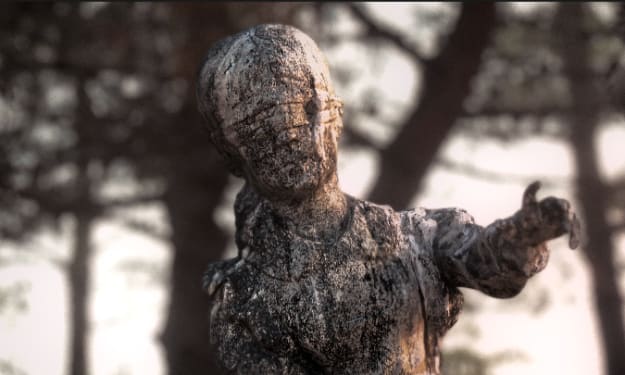
In the shadowy, pine-filled countryside of Greece, there’s an old legend known to the older locals but half forgotten and unknown to the few young people living there. The legend centers around an eerie stone statue of a little girl named Magda, hidden deep in the local dark pine forest.
By Dimitris Galatas11 months ago in Horror
The Man from the Crest
There were many legends that stated there was a mysterious man waving away to boats as they departed from the shores. It's said that those who spotted him from the ships will never see the light of day again, as he waved his final goodbyes to the people onboard.
By Scintei Deniz11 months ago in Horror
The Horse That Bore Bad News
Ciaohme plucked another daisy, smiling as she ran from daisy to daisy, plucking the flowers and putting them into her basket. Her mother watched, smiling at her daughter's industriousness. The young girl saw a pony, a beautiful roan, nibbling at the grass. She ran up to it and put her hand on it. The pony looked up at her; Caiohme saw the pony smile so she smiled back. The pony threw her head back; the girl found her hand was stuck to the pony. The pony galloped off. The girl screamed.
By Jamais Jochim11 months ago in Horror