Latest Stories
Most recently published stories in Horror.
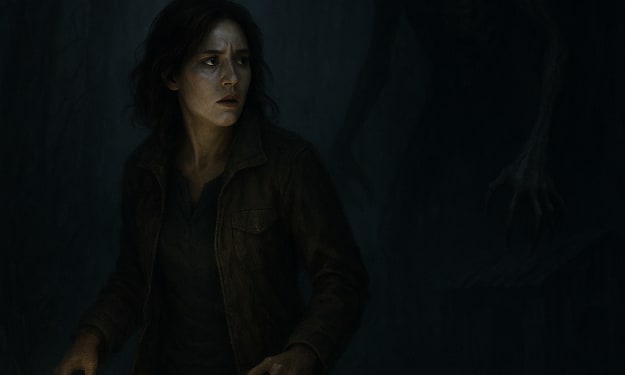
The Last Light on Willow Creek
Willow Creek, Montana, didn’t look like the kind of place where nightmares lived. From the highway, it seemed peaceful—mountains in the distance, tall pines swaying like they were whispering to each other, and a narrow gravel road leading to a handful of houses, a diner, and a closed-down mine that everyone pretended didn’t exist.
By Iazaz hussain10 months ago in Horror
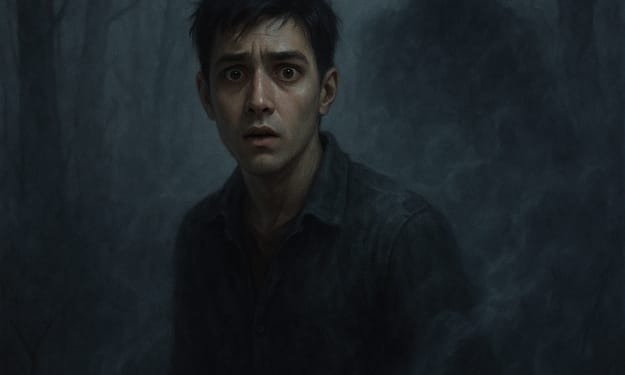
Whispers in the Fog
The village of Kharband was known for two things: its endless blankets of thick white fog, and the strange silence that fell after sunset. No matter how loudly children laughed or how far the goats wandered, the moment the sun slipped behind the mountains, the entire valley grew so silent that even the wind dared not whisper. People said the fog carried voices—voices that didn’t belong to the living. For decades, everyone followed one simple rule: Never go out after dark. Everyone obeyed it… except 19-year-old Haris. Haris had returned to the village after years of studying in the city. He wasn’t one to believe in superstitions. Ghost stories were for children and bored elders. So when he heard the old tales—whispers in the fog, shadows that moved against the wind, people disappearing without a trace—he laughed them off. But the village had not forgotten. And the fog had not forgiven. --- The First Night On his first evening back, Haris sat outside his grandfather’s old mud-brick house sipping chai. As always, the fog rolled in like a living thing, crawling between the trees, swallowing the road, covering the fields. His cousin Sana came running. “Haris! Come inside! It’s getting dark.” He teased her. “Don’t tell me you believe in those stories.” Her face grew pale. “They aren’t stories.” But Haris didn’t listen. Instead, he decided to take a short walk toward the old dried well at the outskirts—just to prove nothing would happen. As he walked deeper into the fog, he heard it—the sound that froze him in place. A whisper. Not wind. Not insects. A whisper that clearly said his name. “Haaa…riiiis…” He spun around, but there was nothing in sight. The fog was so thick he could barely see his own hands. He hurried back home, his heartbeat thundering inside his ears. The moment he reached the door, his grandmother grabbed him by the arm. “You went into the fog?” she asked, her voice trembling. “It’s nothing,” he insisted. She stared at him with horror dripping from her eyes. “The fog remembers every step. And it never lets go.” The Second Night Haris woke the next morning convinced it had been his imagination. But the eerie feeling stayed with him all day. Villagers kept staring at him like he had done something dangerous, something unforgivable. That evening, just as the fog began to thicken, strange things started happening. The goats refused to leave their sheds. Birds flew away in frantic circles before disappearing into the mountains. Even the dogs—always loyal and fearless—hid under porches and whimpered. Just after sunset, Haris heard the whisper again. This time, it came from inside the house. “Haaaariiiis… come back…” He rushed into the hallway, but found no one. The walls were old, made of wood and clay, yet the whisper seemed to seep straight through them. His grandmother put her hand on his shoulder. “Did you hear it?” Haris swallowed hard. “It’s just the wind.” Her eyes filled with pity. “The fog has chosen you.” The Third Night: The Return By the third evening, Haris could no longer pretend nothing was wrong. He avoided going outside, but the fog pressed against the windows like it was searching for a way in. Later that night, Sana knocked on his door. “You’re not safe,” she whispered. “They’re calling you because you stepped on their path.” “Whose path?” She hesitated before speaking. “The ones who never left the fog.” Then she told him the truth—stories the elders never shared with outsiders. Years ago, a group of villagers vanished mysteriously. Some said they got lost in the fog. Others said they were taken. Their bodies were never found. But their voices… their voices were heard every night, calling out from the mist. They wanted company. And now they wanted Haris. The Final Night Haris tried to stay awake, but the exhaustion pulled him under. Around midnight, he awoke to a freezing chill crawling across his skin. The fog was inside the room. It swirled around him like pale smoke. The whispers grew clearer, louder, forming words that chilled his blood. “Come with us…” “You walked our path…” “We’ve been waiting…” Shadowy figures began to form within the mist—faces without eyes, bodies without shape, floating inches above the floor. Haris stumbled backward, but the fog wrapped around his legs like cold fingers. He tried to scream, but his voice dissolved into the icy air. The last thing he saw was a pale hand reaching out of the fog—grabbing him. By the time the sun rose, the fog thinned, the house warmed, and everything was quiet again. The villagers searched everywhere, but Haris was gone. They found only one thing on his bed—a single, frost-covered handprint. No one dared speak his name again. And at sunset, when the fog rolled in, the whispers grew stronger. A new voice had joined them. A voice that called out— “Haaaariiiis…”
By Iazaz hussain10 months ago in Horror
The Lost Terraformer Expedition
By 2275, humanity had established a series of terraforming expeditions to transform barren exoplanets for colonization. One such mission, led by the vessel Pioneer Zenith, arrived at the remote planet Oblivion-6. Its crew of fourteen included Captain Selara Korr, geologist Dr. Elias Vann, engineer Kael Arin, xenobiologist Dr. Liora Chen, and AI specialist Mira Chen, alongside other specialists trained for extreme conditions.
By Razu Islam – Lifestyle & Futuristic Writer10 months ago in Horror
The Whispering Room
The house stood alone at the edge of a calm town. It was tall, contracting, and abnormally tilted, as if it had been observing the ground for a long time. A cold wind continuously appeared to circle it. The proprietor, an ancient man with temperamental hands, given Arif the key but cautioned him, “Don’t open the entryway at the conclusion of the corridor. That room… Doesn’t like visitors.”
By The Academy Awards10 months ago in Horror
10 Horror Novels You Must Read If You've Never Read Horror Novels Before. AI-Generated.
Exploring the horror genre can be an exhilarating experience, especially for beginners. If you've never read a horror novel, you should know that there are stories that will make you a fan of this genre.
By Ninfa Galeano10 months ago in Horror
Pathogen: Ch. 18
It didn't feel as if Marnie had been sleeping long when a light, persistent jiggle on her shoulder woke her up. With a sleepy grumble, she curled tighter to Julian's side, peeking open one bleary eye instinctively. Bianca was standing over her. The other girl looked as tired as Marnie felt, her expression calm and deeply apologetic. Marnie's face arranged itself in a grumpy grimace as she looked around their crappy little motel room. The place wasn't on fire; the feds and/or cops weren't banging on the door; Zombie Trevor was still sitting contentedly on the floor in front of the TV, watching Simpsons reruns and pigging out on beef jerky.
By Natalie Gray10 months ago in Horror
Not From This World
People said he wasn’t from this world. Not in the dramatic, science-fiction way—with glowing eyes or a secret spaceship hidden under the mountains. No, the truth was quieter. Softer. Almost easy to miss. His name was Elias Cruz, and he lived at the far end of my street where the sidewalk cracked into a web of tiny fractures and the old oak trees hung low, like they were tired from holding centuries. Even as kids, we all knew there was something different about him—something gentle, something out of place. While the rest of us chased noise, he chased moments. I first understood it the summer I turned twelve. Our neighborhood hosted its usual Fourth of July parade—kids on decorated bikes, dogs wearing bandanas, adults pretending their paper crowns weren’t slipping off their heads. The whole street was a mess of cheers, sizzling grills, music, and fireworks that came too early because someone always jumped the gun. But Elias? He wasn’t marching or shouting. He wasn’t showing off his new bike. He stood at the edge of his lawn, hands tucked behind his back, watching a tiny girl try to carry a flag bigger than she was. When it slipped from her hand, he walked out, picked it up gently, and taught her how to hold it without letting it drag. He didn’t make a speech. He didn’t call attention to himself. He just smiled. Quiet, warm, like kindness was something he carried in his pocket. My dad watched this from our driveway. “That boy,” Dad said, shaking his head in a way that wasn’t disappointment but admiration, “he’s not from this world.” I didn’t understand then. But I do now. Years passed. We grew up. People moved. The oak trees got trimmed back. And Elias became the kind of person you call when things fall apart. Not because he was loud about helping—but because he showed up, every time, in every small, human way that mattered. When the Hendersons’ garage caught fire, he arrived before the firefighters with bottles of water and blankets. When Mrs. Delgado lost her husband, he fixed her broken mailbox because he knew small things became suddenly heavy during grief. When our school janitor tore his shoulder and had to be out for months, Elias organized a student rotation to clean after class—not for credit, not for attention, but because, in his words, “He’s always been taking care of us.” People like that don’t fit neatly into the world as it is. They fit into the world as it should be. The last time I saw him was the week after my father passed. I had come home, exhausted, cracked open by grief in places I didn’t know I had. The house smelled like old memories and unopened mail. I couldn’t breathe, couldn’t think. I sat on the porch steps and watched the sky turn into the kind of purple that feels like it belongs to its own universe. Then I heard footsteps. Elias didn’t knock. He didn’t ask if I wanted company. He just sat beside me, leaving exactly enough space, the kind that said I’m here, but you don’t have to pretend for me. For a long time, we said nothing. Finally he asked, “Do you want to talk about him?” “No,” I whispered. “Do you want to sit in silence?” I nodded. So he sat with me. Thirty minutes. Maybe an hour. Maybe it was two. Time is strange when you’re grieving—it loosens its grip. Before he left, he placed something beside me: my father’s old lighter, the one he used at every barbecue, the one he tried to stop misplacing every year. “I found it by the fence,” Elias said. “He probably dropped it the last time he grilled.” Then he added softly, “Your dad was a good man.” I felt the truth of that settle inside me in a way no condolences ever had. When he walked back down the street, I realized something: People like him come into our lives the way stars come into night—quietly, naturally, without asking for permission, filling the dark with something that feels a lot like hope. Two months later, he left town. Some out-of-state volunteer program. Disaster relief. Food banks. Community rebuilding. He never posted photos. Never bragged. Never explained more than, “They need hands, and I have two.” And just like that, he was gone. No big goodbye. No spotlight. Just a small note taped to our community center: “Thank you for teaching me what home means. I’ll carry it with me.” People still talk about him sometimes. Not often. Not loudly. Just in those quiet, reflective moments when someone does something kind and someone else murmurs, “That reminds me of him.” He isn’t from this world—that’s what they say. But I think that’s wrong. I think he is exactly from this world. He’s from the part of it we forget about—the part that still believes in honor, in kindness, in showing up, in repairing what can be repaired and holding gently what can’t. People like Elias don’t arrive from another planet. They’re born here. They grow here. They walk quietly among us. They just make the rest of us realize that we could be better. Maybe that’s what honor really is. Not medals. Not speeches. Not recognition. Just the courage to live like you’re carrying a piece of light you refuse to hide. Just the courage to be someone who feels— if only for a moment— not from this world.
By LUNA EDITH10 months ago in Horror
The Portrait
Hunter stood warily in the foyer of the grand old house, a drop of condensation clung stubbornly to his forehead. As he peered around, an unsettling feeling grew in his chest. The doors swayed gently back and forth of their own accord. Light breezes of warm and cool air seemed to duel with each other in the open space. He could swear the walls were writhing, pulsing, as if the house itself was breathing.
By Eric Boring10 months ago in Horror
The Clockmaker’s Last Hour
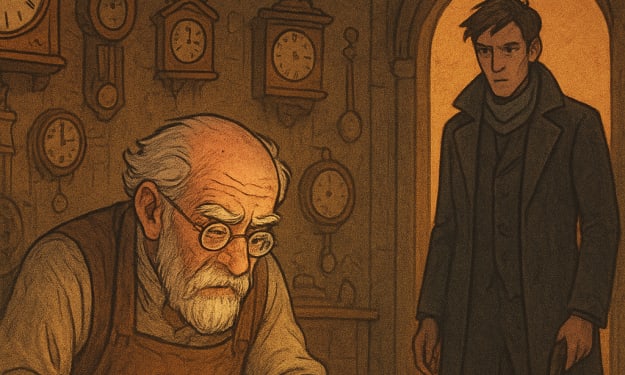
In the heart of an old bazaar, tucked between a spice shop and a forgotten bookstore, stood Rauf’s Clockworks, a tiny shop filled with ticking, chiming, and humming clocks. Some were antique, some handmade, and some—according to rumor—were not entirely from this world. Rauf, the elderly clockmaker, had spent his whole life repairing time, second by second. To the people of the bazaar, he was just a quiet craftsman. But to those who listened closely, time seemed to bend around him. Minutes stretched when he concentrated. Hours passed in the blink of an eye when his focus shifted. It was as though his presence shaped time itself. But Rauf had a secret even deeper than his talent— He was dying. For months, he felt time slipping away faster each day. Not in a poetic sense, but literally: hours vanished, days skipped like faulty tracks on an old tape. Only one clock in the shop kept perfect time—a strange brass pocket watch with a glowing blue core. Rauf had built it many years ago, using gears forged from meteoric metal and energy from a storm no one else saw. He called it Zamana-1, the first and only machine capable of bending time itself. His plan had always been to destroy it one day. No man, he believed, should ever command time. But now, with the end drawing near, Rauf wondered if Time owed him one favor. --- A Stranger at Closing Time One foggy evening, as Rauf turned the sign to CLOSED, the door creaked open. A young man stepped in—tall, tense, and wearing a long coat that looked too heavy for the weather. “I need a clock fixed,” the stranger said. His eyes were sharp, scanning the room like a hunter searching for prey. “We are closed, beta,” Rauf replied gently. The stranger ignored the words and placed a broken silver watch on the counter. “This one stopped working at the exact moment my father died. I want it restored.” Rauf reached for it—and froze. This was no ordinary watch. Its inner gears were identical to those inside Zamana-1. “How did you get this?” Rauf whispered. “My father was your apprentice,” the man said. “You taught him everything. Including your secret.” Rauf’s heart raced. Only one apprentice had ever learned part of the truth—Faizan. But Faizan vanished years ago after trying to steal Zamana-1. The stranger leaned closer. “The watch contains a fragment of the core you made. My father believed you still had the original device.” Rauf stepped back. “I will not help you.” “You don’t have a choice,” the stranger replied, revealing a small pistol. “You’re going to fix the watch, and then you’re going to hand over the real one.” Rauf felt a strange calm settle over him. His life had been long. His purpose nearly fulfilled. He looked at the brass pocket watch—the beating heart of the shop—and made a decision. Time would listen to him one last time. --- The Final Winding Rauf lifted the silver watch and began working. His hands, though old, moved with the precision of thirty years ago. Each twist of the screwdriver echoed louder than it should have. The ticking of the clocks around him slowed… then softened… then fell silent. The stranger frowned. “What are you doing?” Rauf didn’t answer. Instead, he opened the core compartment of the silver watch and removed the small shard inside. It pulsed faintly. Then he reached for Zamana-1. “No!” the stranger shouted, lunging forward. But he was too late. Rauf touched the shard to the core of Zamana-1. The clocks on the walls glowed. The air vibrated. Time shuddered as if startled awake. And everything stopped. --- One Second Forever In the frozen moment, Rauf stood alone. The stranger was trapped mid-step, pistol raised. Dust hovered in the air like tiny stars. Rauf looked around his shop one last time. “I have repaired time my whole life,” he said softly. “Now let me rest.” He pulled the final gear from Zamana-1. Time roared back with the force of a collapsing world. When everything settled, the shop was still. The stranger lay on the floor, disarmed but alive. Zamana-1 was shattered, its pieces dull and lifeless. And Rauf was gone. Not dead. Not vanished. Simply… returned to the moment he had always belonged to—somewhere outside the ticking of clocks. The bazaar people later said the shop felt different, quieter, as if time itself mourned the old clockmaker. But one thing remained certain: No clock in the bazaar ever ran late again.
By Iazaz hussain10 months ago in Horror
SEASON 5 - Whispers from the Lantern: The Keeper's Lament
Chapter 9 The Keeper's face, a distorted, screaming mask of despair, was trapped behind a single, glass lens. He was a man who had lost everything, who had been betrayed by the very thing he had sworn to protect. He was a man who had lost his soul.
By Tales That Breathe at Night10 months ago in Horror