
Last Scene
The Hitchhiker, Season 1, Episode 24 (1986). Dir. Paul Verhoeven.

Reality and illusion—both are intertwined, inseparable. Both are matters of pure conjecture. Both are experienced solely by the YOU you think of as I. After all, you're not accessing reality through someone else's eyes, their sensory inputs.
A frightening thought, a philosophical quandary, is that ultimately we are all ALONE inside our own skulls.
Only our mind exists. That's solipsism, a controversial and hated philosophical position, one most people can't grasp without a sense of confused fury.
Having said all that by way of an introduction to a twenty-two-minute televised Giallo from 1986, The Hitchhiker episode "Last Scene," directed by RoboCop director Paul Verhoeven (who narrates an audio commentary track on my DVD collection), may seem steep philosophically. We do so because the episode, which features LaGena Hart, Peter Coyote, and the redoubtable hitchhiking hunk himself, Page Fletcher, is an exploration of the interplay between reality and illusion, fiction, fantasy, dream, and "real life," as experienced by the actress Leda, who is resurrecting—or transitioning—her career under the tutelage of Peter Coyote (who bears a striking resemblance here to David Cronenberg), who is directing her in a sexy slasher film.
Indeed, the episode (which was broadcast on cable, allowing nudity, profanity, and much violence in 1986) opens with Leda (Hart) making love to a sweaty hunk, her rather impressive breasts exposed. He leaves, and then we have the appearance of the White-Masked Giallo slasher, sporting a zip-up flight jacket and a shiny stiletto.
The camera pulls back, and it is revealed that we're simply on the set of a movie. (Actually, we may have gotten a bit confused here. The opening presages the finale and features Leda turning into a killer herself, slashing someone's neck.)
Leda is not rising to the occasion the way director Alex (Coyote) wants. The producer is worried that she won't be able to get her acting chops up to snuff (no pun intended), and all the while things between herself and the mysterious Mad Slasher Stalker begin to escalate. Receiving a bouquet of roses, she finds a card inside that reads: RIP.
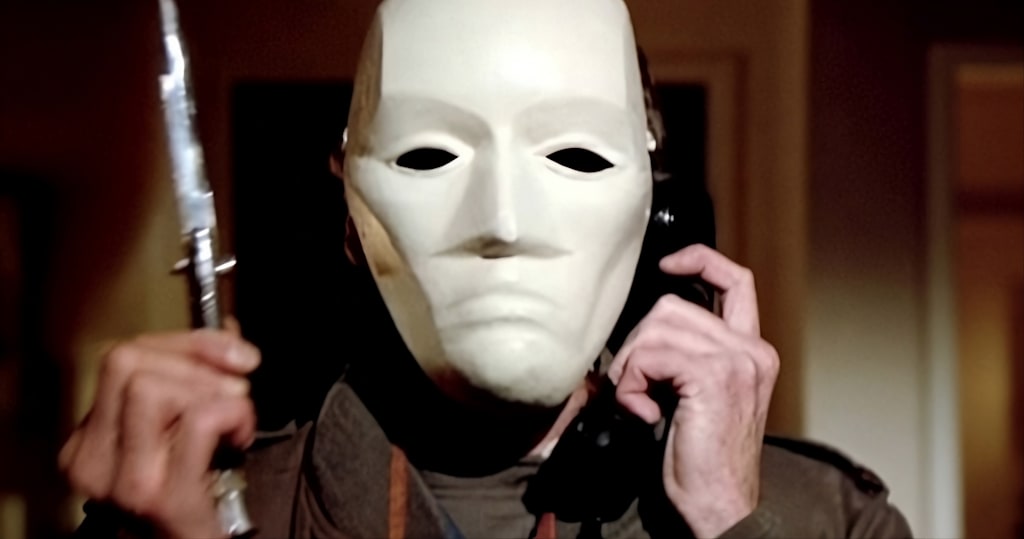
A telephone call from the whispery-breathed menace leads her to look out her window to the apartment across the way. There he stands, in his white, featureless mask, phone in one hand, stiletto in the other. Now he is like an image from fantasy fully born from her psyche, the outward manifestation of all fears and dreams—the vulnerability of womanhood, caught in a role she didn't ask to play, the sum of all terror. Her sexuality, so blatantly exposed as her own weapon in the opening scene, is here used against her.
At a restaurant, dining with Adam, she receives another call. It is from the madman stalking her. Adam erupts. She returns home, and yet another call leads her to look again across at the apartment opposite. It is the masked killer.
She goes next door to the apartment with the police (she was curiously able to tell the number from outside).
She finds not the Giallo killer, but a doddering old man. But, as with everything, all is not what it seems. As in David Lynch's Inland Empire, which came decades later, we pull back the camera on her hysteria, her mounting paranoia, revealing it to be Hollywood illusion. But where does fantasy end and deadly reality begin?
Leda begins to suspect that something is amiss and finds both the white mask and a latex mask of an old man in a production office. What is going on here? (The viewer immediately realizes the old man seen previously could not have simply been an actor wearing a latex mask without being discovered easily.)
Leda undergoes a traumatic breakdown on the set, assaults Alex, and then, donning the White Killer Mask (the formlessness of the features suggests that anything can be projected onto the wearer, any face, or the facelessness of no identity), calls him from across the way. He stares into an apartment window while Leda, the mask fitting bizarrely, almost comically horrifically on her head, with her gorgeous hair spilling out the sides, calls him to a nightclub for the TRUE "Last Scene."
The club is a goth club, with costumed dancers gyrating to 1986 techno while glass exhibits feature mannequins posed in images of submission and tragic pain. Leda is seen dancing hypnotically, the mask on the BACK of her head—and this is key, because, turned as she is, dancing with her back to Alex as he approaches her through the crowd, she has revealed the twin face of psychopathy, projected HER image, a female empowered with the killing intensity of her former pursuer, onto the last scene.
She twirls, revealing the two aspects of her personality now. Now she is directing the fantasy of film, the mirror-image illusion of life that shattered like two halves of a cheap glass, leaving her in a state of suspension between the world of the film, her mind, and her gorgeous flesh.
And we can perhaps leave the reader contemplating that as the last scene.
The Hitchhiker The Last Scene Part 1
The Hitchhiker The Last Scene Part 2
Author's website
Author's YouTube
Cult Films and Midnight Movies
"From High Art to Low Trash" Vol 1
By Tom Baker
Ebook
Silent Scream! Nosferatu, The Cabinet of Dr. Caligari, Metropolis, and Edison's Frankenstein--Four Novels. By C. Augustine
Ebook
Theater of the Worm: Essays on Poe, Lovecraft, Bierce, and the Machinery of Dread, (Paperback)
About the Creator
Tom Baker
Author of Haunted Indianapolis, Indiana Ghost Folklore, Midwest Maniacs, Midwest UFOs and Beyond, Scary Urban Legends, 50 Famous Fables and Folk Tales, and Notorious Crimes of the Upper Midwest.: http://tombakerbooks.weebly.com
Enjoyed the story? Support the Creator.
Subscribe for free to receive all their stories in your feed. You could also become a paid subscriber, letting them know you appreciate their work.
Comments
There are no comments for this story
Be the first to respond and start the conversation.