
"Kyotou O (巨頭オ)": The Single 2channel Post That Has Terrified Japan for 20 Years
Japanese mystery
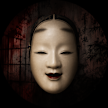
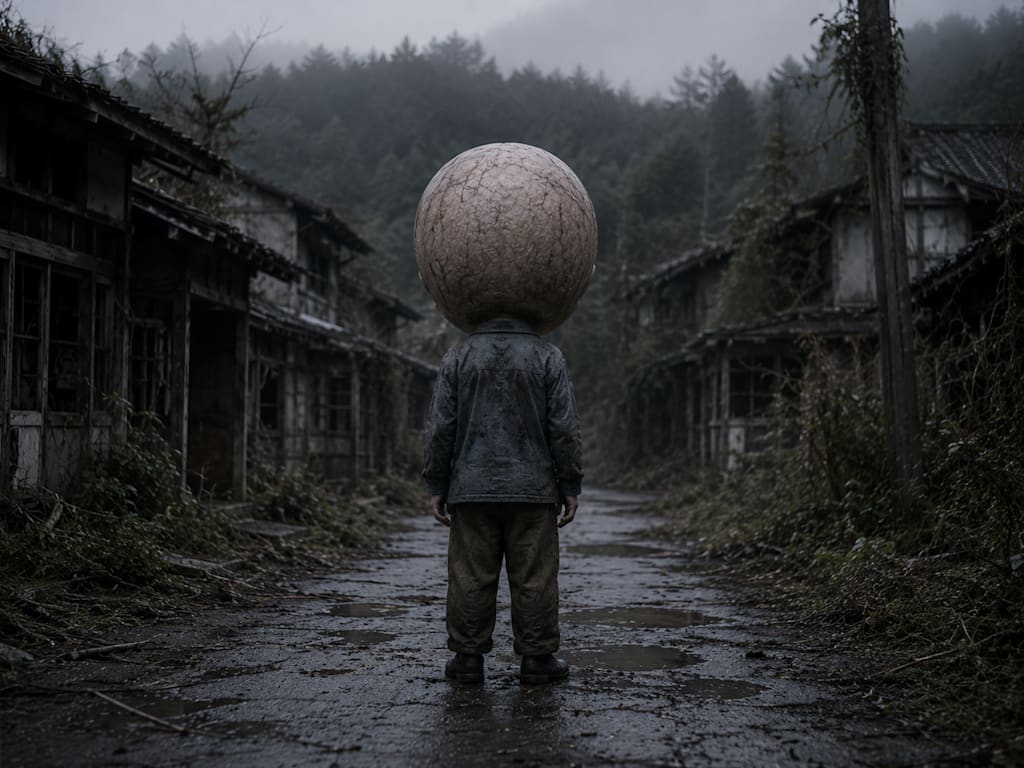
Raw forum logs, 21 lines, and no resolution—why this is the most effective work in the history of Japanese internet horror.
I. Background
February 22, 2006.
A single post written in the 121st thread of the 2channel (2ちゃんねる) Occult board's "Let's gather scary stories that are no joke" (死ぬ程洒落にならない怖い話を集めてみない?) has become a legend in Japan.
However, at the time of posting, it received almost no replies.
Written in a matter-of-fact tone, the content possessed a multi-layered background and a slowly building dread.
A mere 21 lines plunged Japan into terror and remain burned into its memory to this day.
II. Archive
(The author is Japanese, so please forgive any mistakes.)
A few years ago, I suddenly remembered a certain village.
A village with a small inn that I visited when traveling alone.
The heartfelt hospitality had left an impression on me, and for some reason, I suddenly wanted to go there again.
During a long weekend, I drove there alone.
I'm fairly confident in my memory, so I remembered the way.
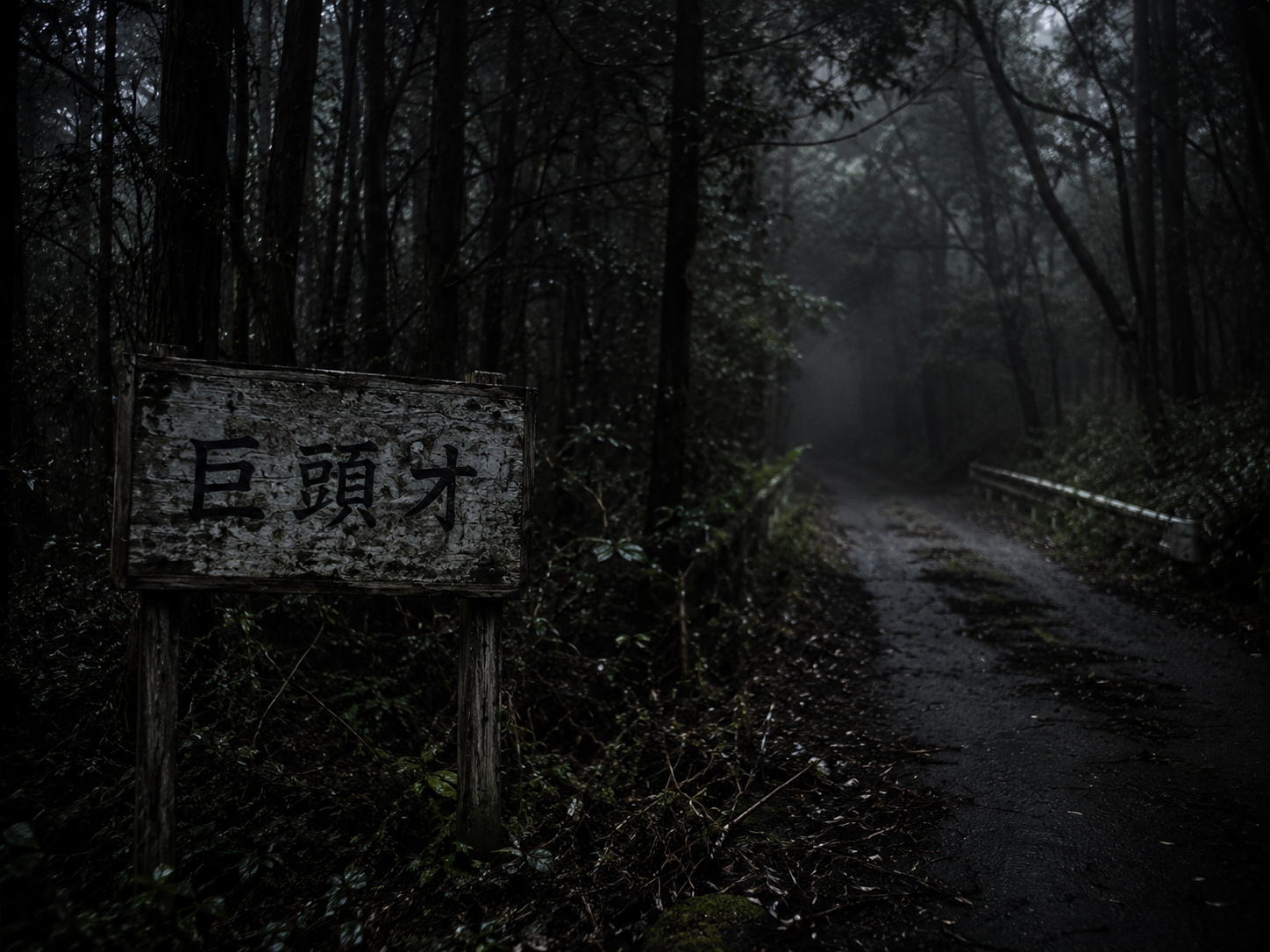
As you get close to the village, there's supposed to be a signboard indicating the location, but when I found it, I thought, "Huh?"
What used to say "○○km ahead" (I think) had become "巨頭オ" (Kyotou O).
A strange premonition and the desire to go see it clashed, but I decided to go anyway.
When I drove in, the village was abandoned, and grass was wrapped around the buildings.
As I was about to get out of the car, from the grass about 20 meters away, a human(?) with a ridiculously large head came out.
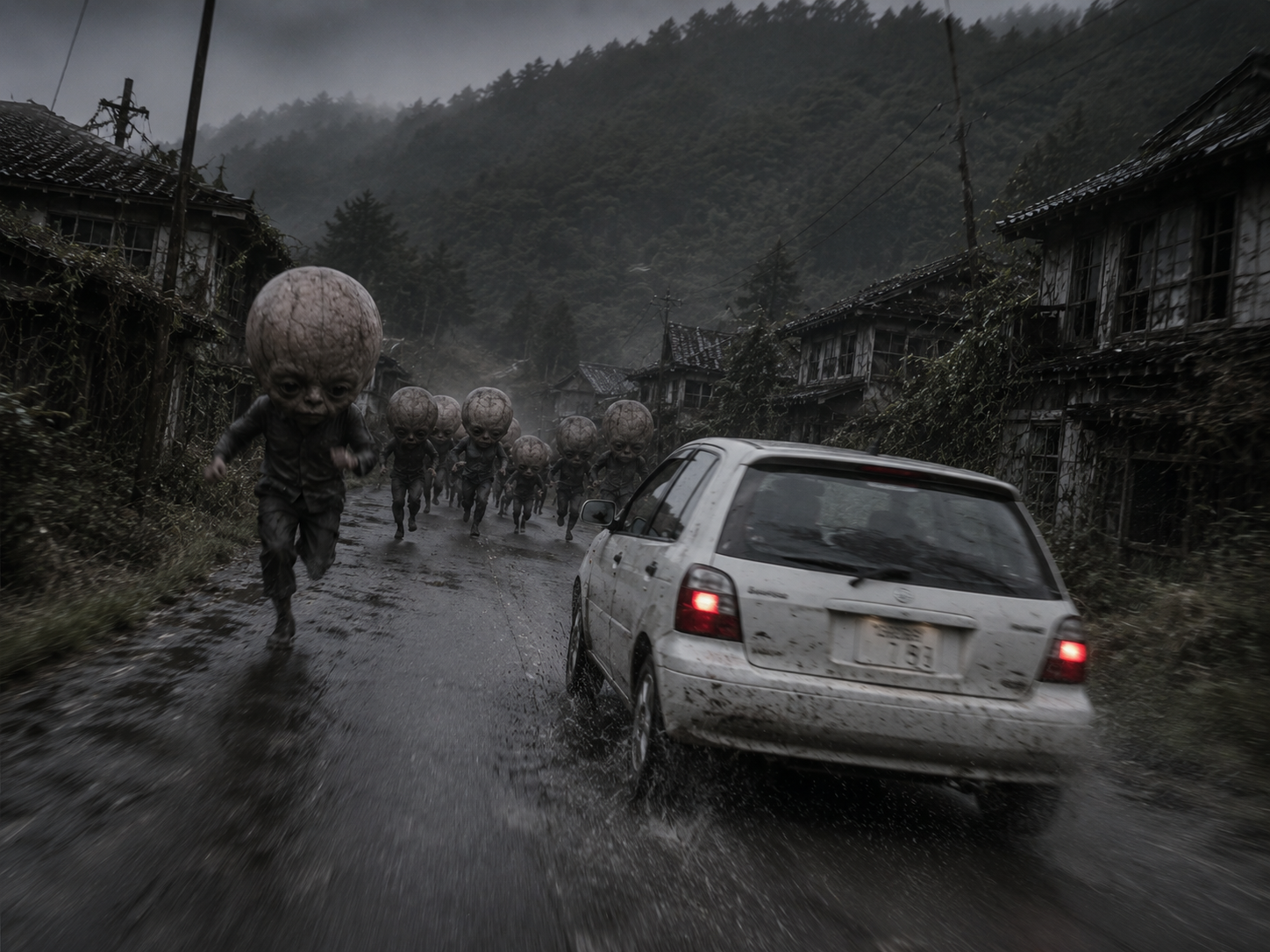
While I was thinking "Eh? Eh?" (え?え?), there were suddenly a bunch of them all around!
What's more, they started chasing me with disgusting movements...
With both hands kept tightly against their legs, swinging their huge heads from side to side.
Thank god I didn't get out of the car.
I reversed the car with terrifying speed and floored it to the national highway at an insane pace.
Even after returning home and looking at a map, the village I went to a few years ago and the place I went to that day were not mistaken.
However, I don't think I'll ever go there again.
Supplement: What is "巨頭オ"?
The three characters written on the signboard. Translated directly into English:
巨 — Large, giant.
頭 — Head.
オ — The Katakana syllable "O".
巨頭 (Kyotou) — "Abnormally large head."
The problem is the third character, オ.
Katakana is a writing system primarily used for loanwords, onomatopoeia, and technical terms. It is not used for place names.
Having Katakana follow Kanji on a road sign is not just rare; it is a categorical deviation.
From a Japanese perspective, this combination of words doesn't even make sense as Japanese in the first place.
In short, it was an otherworldly word, completely unimaginable to a Japanese person.
That is what tickles a bit of curiosity mixed within the terror, and why theories about "巨頭オ" continue to be explored even after so many years.
The most widely supported interpretation among readers is that オ is a part of the Kanji for village, "村" (mura).
If the sign deteriorated over time or part of it was hidden by leaves, it could collapse into a shape resembling the Katakana オ.
If so, wouldn't this place originally have been 巨頭村 (Kyotou Village)?
However, no village with such a name has ever existed in history.
Both Google and ChatGPT throw their hands up in defeat.
Since the word "巨頭" itself isn't used in everyday life, this "巨頭オ" has simply continued to baffle Japanese people for years, and once you know about it, there's no turning back.
You are left unable to crawl out of the uncanny valley.
III. Why Has This Post Survived for 20 Years?
To begin with, the volume of text in this post is far too small.
There is no explanation of who or what the figures are.
There is no lore, no mythology, and no indication of how they came to exist or what they want. Because it is an anonymous message board, the poster cannot be identified. There is no Chapter 2.
Yet, this story has survived 20 years of internet culture, been translated into multiple languages, spawned manga adaptations and YouTube documentaries, and remains a legend.
The reason is structural and can be broken down into three elements.
1. The Signboard as a Linguistic Disconnect
Horror in fiction usually manifests through actions or atmosphere.
What makes "巨頭オ" stand out is that its first act of terror is grammatical.
Before "it" appears, before even reaching the village, the poster encounters something the brain cannot process.
The Japanese on the signboard breaks the very rules of orthography.
"巨頭オ" exists neither as a place name nor as a word.
The Japanese language is particularly vulnerable to this kind of horror.
Kanji + Hiragana (漢字+ひらがな) is commonly used, making it easy for Japanese people to recognize.
However, in modern times, Kanji + Katakana (漢字+カタカナ) is not used, so the brains of people living today judge it as a foreign object.
In other words, the reader's unease began not with the fear of monsters, but with the three characters on the signboard.
2. The Extreme Minimalism of Existence
When the figures finally appear, the description is just 17 words in English.
With both hands kept tightly against their legs, swinging their huge heads from side to side, a human with a ridiculously large head.
That is the entirety of the physical description.
Neither faces nor words are mentioned. The figures chase after them, but no words are spoken, and no intentions are stated.
The horror generated by this incompleteness functioned differently from horror generated by description.
If this had been fully described, what would the contents have been?
The more detailed the content, the easier it is for the brain to process; people interpret what they see how they want to, and it becomes acceptable to each individual.
The uncanny nature of this "巨頭オ" was that it didn't even allow for that.
And even within the minds of those of you who read this post, it takes on a different form for everyone.
That is what is so unsettling.
3. The Threshold of Being Almost Human
In robotics and aesthetic theory, there is a concept known as the Uncanny Valley.
The point is that when a figure becomes sufficiently similar to a human, the remaining differences generate revulsion rather than acceptance.
The figures in "巨頭オ" exist exactly within that realm.
They wear clothes. They walk upright. They have the general structure of humans.
However, the size of their heads and the position of their arms are wrong, and their movements are creepy.
They are not terrifying in a supernatural sense.
They are wrong in a physical, biological sense.
This is neither ghost horror nor supernatural horror.
The deviation from the expected human form registers as a threat before the conscious mind can verbalize why.
That is why the poster's agitation at the moment of encounter—"Eh? Eh?"—is the ultimate expression.
It accurately represents the human mind experiencing a cognitive error upon seeing an object.
4. A Closed Case That Opens Everything
The poster checked the map. The location was correct.
They hadn't taken the wrong road.
The village they visited a few years prior and the place they went that day were the exact same location.
The geography is correct. The village is the correct village.
Yet for some reason, only this time, it was different.
But no further explanation is provided.
The case remains permanently open, permanently unsolved.
The maps match, there is a place that shouldn't exist, and there is only a 21-line text with no period at the very end.
IV. Relic
The original post remains to this day, entirely unaltered.
20 years have passed, and the post functions exactly as it always has.
Kyotou O (巨頭オ).
Does it really exist, or was it just a misunderstanding by the poster?
I should write this down just in case: in Japan, any powders, leaves, or drugs that cause hallucinations are strictly prohibited.
Precisely because it is highly unlikely to be the result of such substances, there is no Japanese person who can simply brush this post off.
About the Creator
Enjoyed the story? Support the Creator.
Subscribe for free to receive all their stories in your feed.
Comments
There are no comments for this story
Be the first to respond and start the conversation.