
'Just Before Dawn' (1981): Oregon Woods, Deliverance Vibes, and an Underrated Survival Horror
Before the slasher genre disappeared into a fog of sequels and increasingly elaborate murders, Jeff Lieberman’s atmospheric horror film took five young people into the Oregon wilderness and discovered that the woods could be every bit as frightening as the monsters hiding inside them.

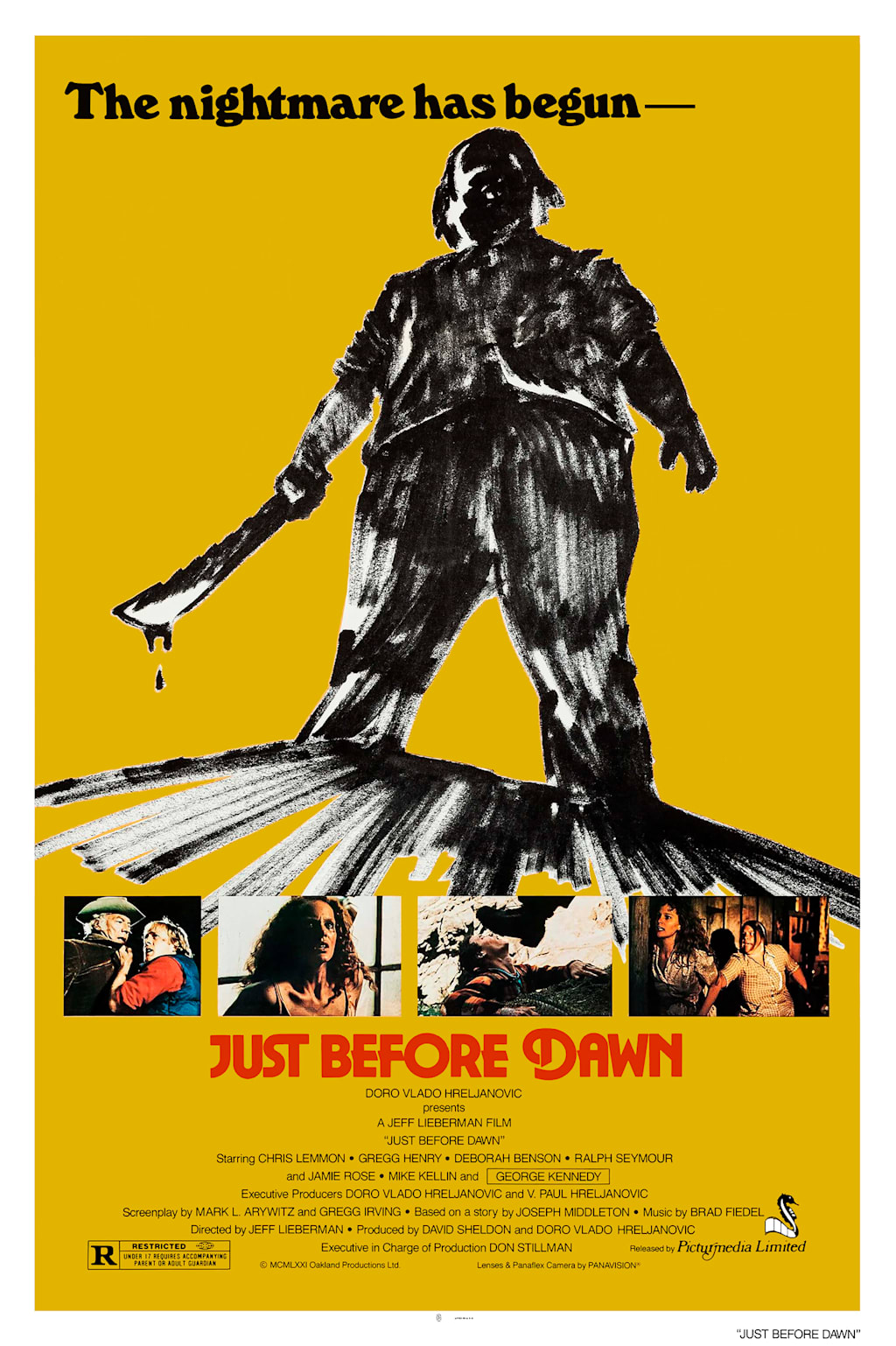
The Woods Were Never Supposed to Be Safe
By 1981, the American horror business had discovered a remarkably efficient formula. Take a group of attractive young people, put them somewhere inconvenient, introduce a killer with an unpleasant collection of hobbies, and wait for the box office receipts.
The success of Friday the 13th had helped establish the commercial appeal of the modern slasher, and filmmakers were scrambling to find new ways to send unsuspecting campers into the great beyond. Sometimes the results were inspired. Sometimes they were merely an excuse to watch people make terrible decisions in increasingly remote locations.
Then there was Just Before Dawn.
Directed by Jeff Lieberman, the man responsible for the wonderfully unpleasant Squirm (1976) and the paranoid science-fiction horror picture Blue Sunshine (1977), Just Before Dawn takes five young people into the mountains of Oregon to investigate inherited property. Their excursion begins as an adventure. It doesn’t stay that way for long.
The group encounters a wilderness that seems to exist outside the comfortable boundaries of civilization. There are strange locals, a forest ranger who knows more about the territory than the visitors do, and a pair of killers who turn the journey into a fight for survival.
On paper, this sounds like familiar slasher territory. Young people go into the woods. Bad things happen. Somebody probably should have stayed home.
But Lieberman had something else in mind.
Rather than treating the wilderness as a convenient backdrop for a series of murders, he wanted the landscape itself to become part of the horror. The film draws on the tradition of Deliverance (1972), where the natural world offers no guarantee of safety and the apparent distance between civilization and savagery proves frighteningly small.
The result is one of the more interesting American horror films of the early 1980s: a movie that understands the difference between putting a killer in the woods and making the woods themselves feel dangerous.
It wasn’t a commercial triumph. It didn’t become the next Friday the 13th. And for years, it occupied that familiar corner of horror history reserved for movies that deserved a little more attention than they received.
Sometimes the best discoveries are hiding in plain sight.
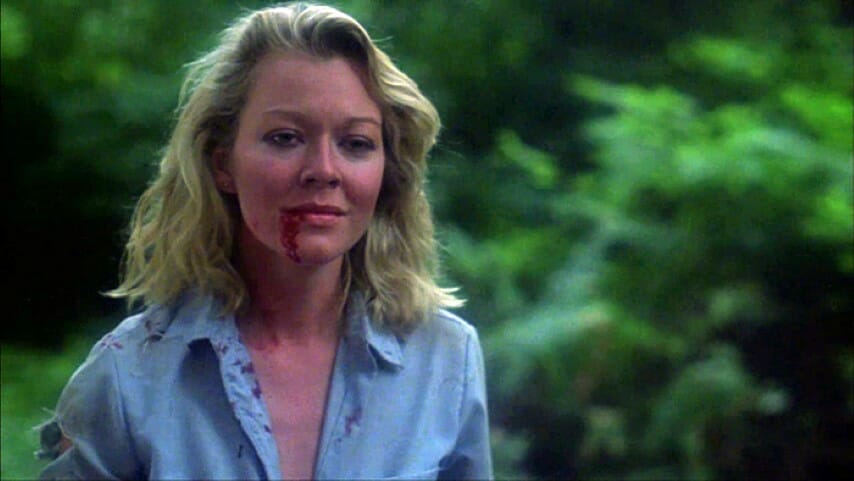
From Tennessee Mountain Murders to the Oregon Wilderness
The story behind Just Before Dawn begins with a different movie.
The original story came from Jonas Middleton, also identified as Joseph Middleton in accounts of the production. Early versions circulated under titles including The Tennessee Mountain Murders and The Last Ritual. The concept originally leaned more heavily into religious imagery, including snake rituals, and was set in the Smoky Mountains.
It was a considerably different proposition from the film that eventually reached theaters.
Lieberman came aboard after establishing himself as a horror director with Squirm and Blue Sunshine. Both films demonstrated his interest in taking familiar genre ingredients and pushing them somewhere stranger. He wasn’t especially interested in making horror that behaved itself.
He substantially reworked the screenplay with Mark Arywitz, using the pseudonym Gregg Irving for his writing credit. The religious material was stripped away, the setting moved west, and the story developed into something closer to a wilderness survival thriller.
The introduction of twin killers gave the film another unsettling dimension. Rather than relying on a single masked figure to carry the threat, Lieberman created a menace that was more difficult to anticipate and harder to escape.
The inspiration was Deliverance, John Boorman’s 1972 film about a group of city dwellers whose outdoor adventure becomes a nightmare.
That comparison matters.
Deliverance wasn’t simply a story about people encountering dangerous rural characters. It was about the collapse of the assumptions that allow people to feel secure in unfamiliar surroundings. Its violence was frightening partly because the characters had no reliable way to understand what was happening to them or how to get out of it.
Lieberman wanted to bring some of that uncertainty into horror.
There was, however, a commercial complication.
Following the success of Friday the 13th, producers naturally wanted recognizable slasher elements. A group of young people in an isolated location, a collection of frightening encounters, and a succession of suspenseful set pieces were all useful selling points.
Lieberman had to accommodate those expectations without losing sight of the survival thriller he wanted to make.
The resulting film sits somewhere between the two traditions. It has the architecture of a slasher, but its most effective moments come from the sense that the characters have wandered into a place where the ordinary rules no longer apply.
It’s a familiar story with an unusually strong sense of place.
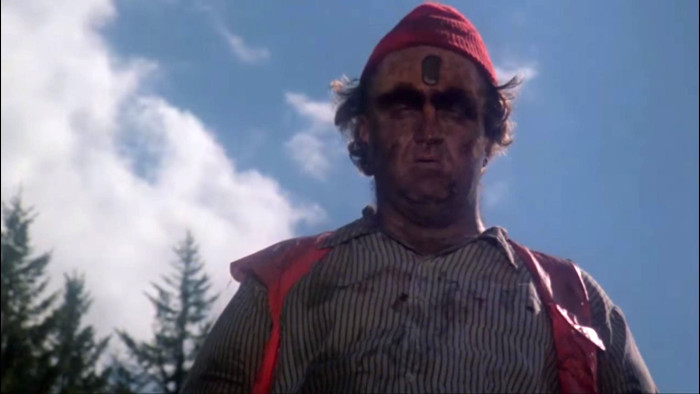
Six Weeks in the Oregon Wilderness
The production of Just Before Dawn brought a New York-based company called Oakland Film Productions to Oregon for what was its first feature film.
The location was more than a logistical convenience. It was central to the picture’s identity.
Filming took place at Silver Falls State Park and in the foothills of the Cascades east of Salem. The region offered the filmmakers the kind of dense, lush wilderness that couldn’t easily be manufactured on a soundstage.
This was not a case of finding a patch of trees, pointing a camera into the foliage, and declaring the production ready for business.
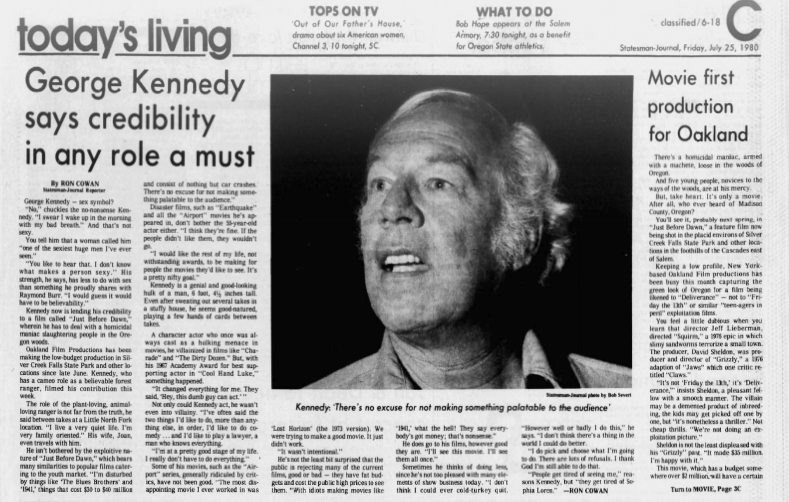
A July 25, 1980, report in the Statesman-Journal documented the production while the filmmakers were still working in Oregon. The contemporary coverage is particularly valuable because it captures the ambitions of the production before the film’s eventual commercial performance or cult reputation could color the story.
The filmmakers wanted something beyond a generic forest setting. As the production coverage put it, the goal was to capture more than just green foliage.
That distinction might sound obvious, but it gets to the heart of why Just Before Dawn works.
The Oregon landscape isn’t interchangeable scenery. The trees, slopes, water, and sheer physical distance between locations give the film a texture that studio-bound horror frequently struggles to reproduce.
The wilderness feels indifferent to the people moving through it. The characters are small against the landscape, and the camera has room to establish the distances that separate them from safety.
When a horror film convinces you that its characters are genuinely far from help, the suspense begins long before the killer appears.
The production was hardly luxurious. The crew worked long days, reportedly between 12 and 14 hours, over approximately six weeks. The budget was around $1 million, a modest sum even by the standards of independent filmmaking.
That meant making the location work count.
The production couldn’t simply solve every problem by building another set or manufacturing a more elaborate environment. It had to take advantage of what was already there.
And what was already there was rather beautiful.
Which, of course, makes the things that happen in the movie considerably less pleasant.
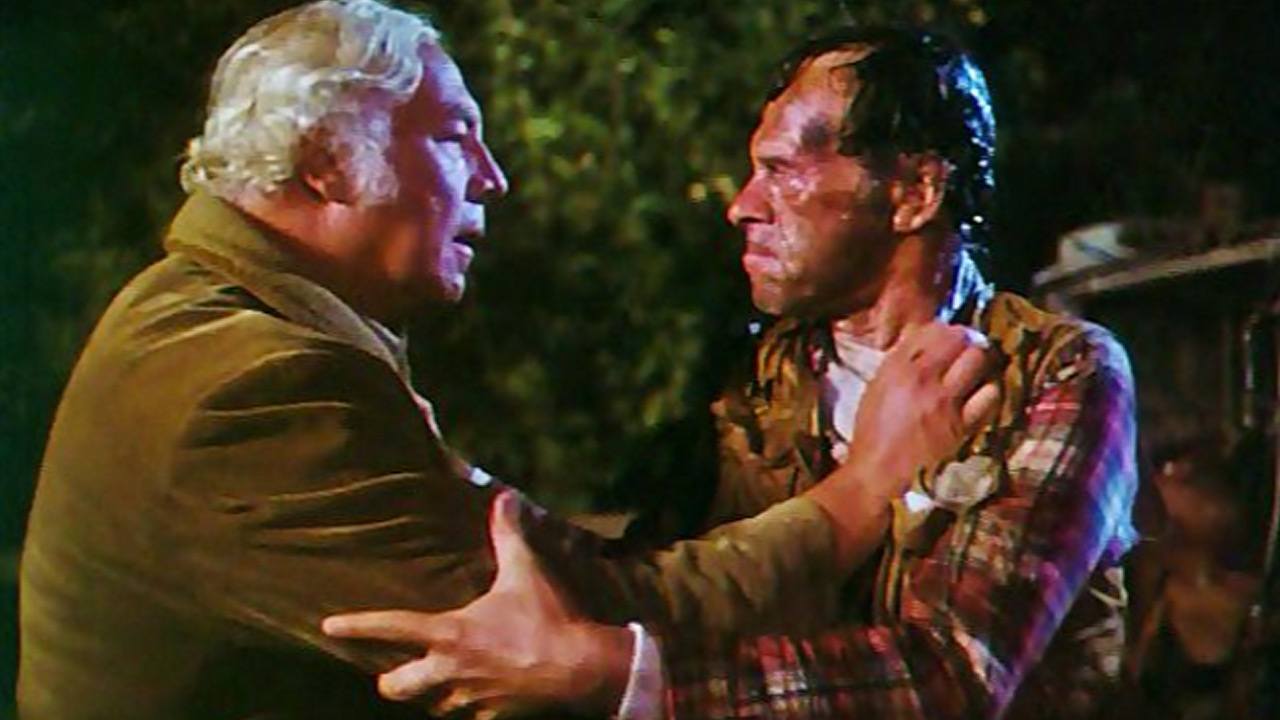
George Kennedy Takes the Horror Seriously
One of the most recognizable faces on the production was George Kennedy, who played forest ranger Roy McLean.
Kennedy was hardly an actor who needed an introduction. By 1980, he had built a substantial career across film and television, including an Academy Award-winning performance in Cool Hand Luke (1967) and his memorable work in the Airport films.
His presence gave Just Before Dawn a recognizable name, but Kennedy was not interested in treating the production as an insignificant detour.
In the July 25, 1980, Statesman-Journal coverage, reporter Ron Cowan spoke with Kennedy about his work and his approach to the role.
Kennedy emphasized the importance of bringing credibility to whatever character he played. It was a practical philosophy, but an important one. Audiences might accept a movie’s premise, however outrageous, if the people inside it behave as though their circumstances matter.
That principle is especially relevant to horror.
A film can ask us to believe in twin mountain killers, improbable survival situations, and a collection of young people who seem determined to ignore every sensible warning. But if the actors treat the material as a joke, the illusion collapses.
Kennedy’s forest ranger provides a connection to the world beyond the young visitors. He understands the environment in a way they do not, and his presence helps establish that the wilderness has its own realities, independent of whatever adventure the newcomers imagined they were having.
Kennedy also discussed the film’s mixture of elements and his preference for not making every performance or dramatic situation entirely palatable to an audience.
It’s an interesting attitude for a production working in the shadow of a commercial horror phenomenon.
The temptation would have been to make everything immediately accessible: establish the characters, provide a few laughs, introduce the threat, and keep the machinery moving.
But the most memorable horror films are often the ones that allow discomfort to linger.
They don’t explain everything. They don’t always give the audience the emotional reassurance it wants. And they understand that credibility sometimes requires allowing a scene to become unpleasant.
Kennedy’s participation wasn’t a guarantee of quality, naturally. Famous actors have appeared in their share of questionable movies. Hollywood has never lacked for evidence.
But his seriousness was appropriate to a film that wanted to be more than a disposable slasher.
Jeff Lieberman’s War Against the Formula
Lieberman’s filmography has always suggested a filmmaker more interested in unusual ideas than in settling comfortably inside a genre.
Squirm turned earthworms into a source of small-town terror. Blue Sunshine took an unsettling premise involving a drug and its delayed effects and developed it into a paranoid horror story.
Neither film was particularly interested in playing things safe.
Just Before Dawn continues that tradition, although its approach is more restrained than the premise might suggest.
The film has killers, isolated victims, and violent confrontations. It knows what audiences came to see. But Lieberman also understands that suspense depends on more than the number of people who die or the ingenuity of the next murder.
A landscape can be frightening. Silence can be frightening. A long stretch of unfamiliar terrain can be frightening when the people crossing it have no idea what waits beyond the next rise.
And the characters need to matter.
The film gives its young travelers room to exist as people rather than treating them as names on a list waiting to be crossed off. Their interactions establish a group dynamic that makes the danger more consequential when the situation deteriorates.
Deborah Benson is particularly important to the film’s eventual impact. Her character’s trajectory complicates the familiar assumptions surrounding the slasher’s final survivor. The film doesn’t simply ask who will remain standing at the end. It allows survival to become part of the character’s development.
That distinction helps Just Before Dawn stand apart from many of its contemporaries.
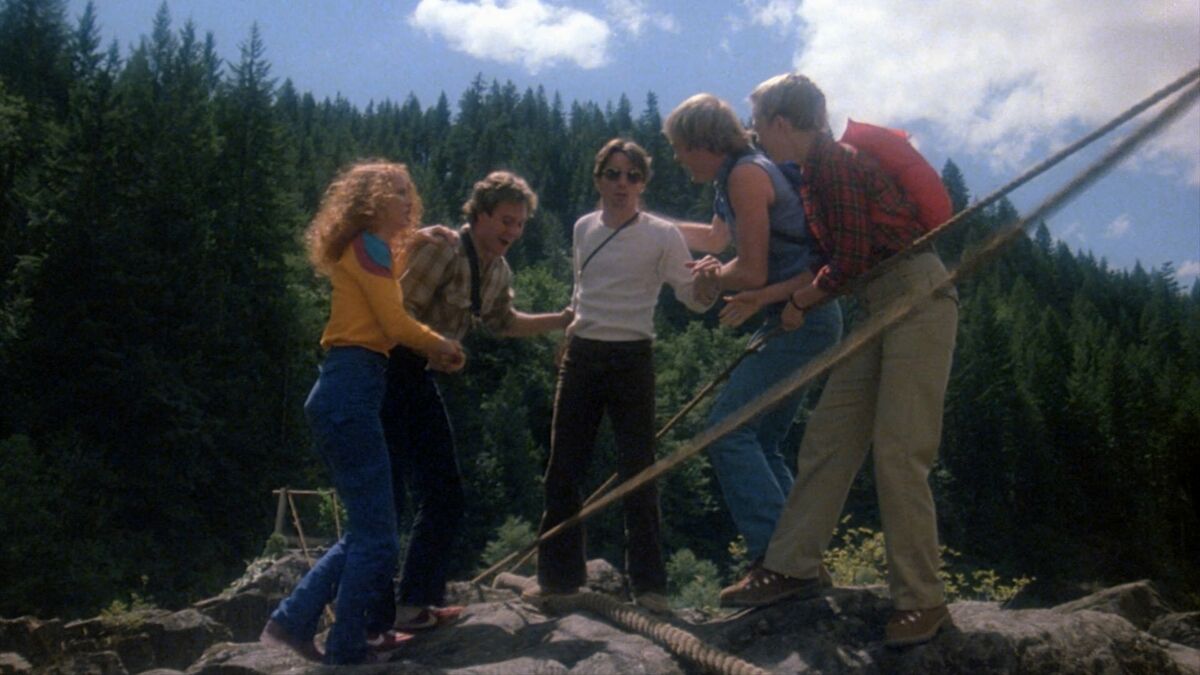
The movie’s atmosphere also benefits from the production’s commitment to practical locations and effects. The rope bridge, in particular, provides an effective example of how a physical environment can become an integral part of a suspense sequence.
It’s a simple idea, really. Put characters somewhere genuinely precarious, and you don’t have to spend the entire scene reminding the audience that they are in danger.
The danger is right there.
Brad Fiedel’s score adds another distinctive ingredient. Fiedel would become much better known for his electronic work on films including The Terminator (1984), but his music for Just Before Dawn already demonstrates an interest in using sound to establish an atmosphere that isn’t entirely comfortable.
The film’s whistling motif is especially memorable, a strange musical presence that helps give the experience an identity beyond the standard orchestral punctuation of a horror score.
These elements don’t transform Just Before Dawn into a lost masterpiece. There are moments when the characters behave according to the requirements of the plot rather than common sense, and the movie doesn’t entirely escape the conventions it wants to transcend.
But its strengths are substantial.
It understands that horror is not simply a matter of showing us something terrible. It’s a matter of creating the conditions under which something terrible becomes believable.
A Modest Release and a Long Afterlife
Just Before Dawn reached American theaters on November 27, 1981, through independent distributor Picturmedia.
The production had hoped for a more substantial commercial opportunity, but a potential connection with Universal ultimately fell through. The film’s theatrical life was limited, and it failed to recover its modest budget.
It was not the kind of result that encouraged Hollywood to declare Jeff Lieberman the next great horror sensation.
The early-1980s market was crowded, and the slasher boom was already producing an enormous number of films competing for the same audience. A movie that didn’t deliver an immediately recognizable franchise, a sensational gimmick, or a particularly aggressive marketing campaign could disappear quickly.
Just Before Dawn largely did.
But the home-video market offered another route to an audience.
As VHS expanded the life of movies beyond their original theatrical engagements, genre fans gained access to films that had received limited distribution or little critical attention. Horror was especially well suited to this afterlife. A movie didn’t have to be a hit in 1981 to find an appreciative audience several years later.
Sometimes all it needed was a striking cover, a recommendation from another horror fan, or a late-night viewing that left somebody thinking about it the next morning.
Just Before Dawn gradually acquired the sort of reputation that theatrical box-office figures cannot measure. Its Oregon locations, unusual atmosphere, performances, and willingness to work outside the strictest slasher conventions made it an appealing discovery for viewers interested in something a little different.
Later home-video releases, including editions from boutique distributors, helped preserve the film and bring it to new audiences.
The film’s reputation has grown considerably beyond its original commercial prospects. Genre enthusiasts have increasingly recognized it as one of Lieberman’s stronger works and an especially effective example of early-1980s backwoods horror.
That doesn’t mean every retrospective judgment should be accepted without question. Cult status can be as indiscriminate as commercial success, and not every neglected movie deserves to be rescued from obscurity.
But in this case, the affection makes sense.
Just Before Dawn offers more than nostalgia for a particular era of horror. It offers evidence of what filmmakers could accomplish when a modest budget was paired with a distinctive setting and a director who understood that atmosphere was not an optional extra.
The Forest Outlasted the Box Office
One of the pleasures of researching older movies is discovering how the people who made them understood their own work before history had a chance to rearrange the narrative.
The July 25, 1980, Statesman-Journal reports capture Just Before Dawn at a particularly interesting moment. Oakland Film Productions was attempting its first feature. The cast and crew were spending long days in the Oregon wilderness. George Kennedy was talking about credibility. The filmmakers were trying to make something more substantial than a generic forest horror picture.
Nobody on that set could know precisely how the film would be received, how quickly its theatrical run would pass, or how many years would elapse before horror fans began reassessing it.
But the ambitions were already there.
The film’s eventual cult following didn’t emerge from nowhere. The qualities that distinguish Just Before Dawn today were present in the production’s original approach: the commitment to real locations, the desire for a more grounded survival story, and the effort to make the environment an active part of the drama.
That is what makes this movie worth revisiting.
Not every forgotten film is secretly a masterpiece. Not every commercial failure was a victim of bad timing. Sometimes a movie disappears because it wasn’t very good.
But sometimes a film gets lost because it arrived in a crowded marketplace, lacked the commercial machinery to distinguish itself, and needed a few decades for the right audience to find it.
Just Before Dawn belongs in the latter category.
It’s not the most famous horror movie of 1981, nor is it the most influential. It doesn’t have the cultural footprint of Friday the 13th, and it doesn’t approach the existential brutality of Deliverance, its most obvious inspiration.
What it has is an identity of its own.
The Oregon woods are beautiful, indifferent, and faintly sinister. The characters are more than disposable victims. The score stays with you. And Lieberman understands that a wilderness can be frightening without turning every tree into a hiding place for a murderer.
Sometimes the scariest thing about being lost in the woods isn’t the monster waiting for you.
It’s the realization that nobody is coming to help.
And that the forest, unlike the movie business, doesn’t care whether you make it out alive.

Discover how Jeff Lieberman’s Just Before Dawn (1981) transformed an Oregon wilderness into a terrifying setting for an underrated survival horror film inspired by Deliverance.
Tags: Just Before Dawn, Jeff Lieberman, Movies of the 80s, 1981 Horror Movies, Slasher Films, Survival Horror, George Kennedy, Oregon Film History, Deliverance, Cult Horror, Forgotten Horror Movies
Sources
Ron Cowan, Statesman-Journal, July 25, 1980. Contemporary interview with George Kennedy discussing his role, acting philosophy, and the production.
Statesman-Journal, July 25, 1980. Companion report on Oakland Film Productions and the filming of Just Before Dawn in Oregon.
Just Before Dawn (1981). The film itself, including its on-screen credits, performances, score, cinematography, and production details.
Jeff Lieberman interviews. Retrospective interviews discussing the screenplay’s development, the influence of Deliverance, and the compromises involved in making the film.
Contemporary reviews and trade coverage. Useful for documenting the film’s original critical reception, distribution, and commercial performance.
Later genre retrospectives and home-video release materials. Useful for discussing the film’s cult reputation and subsequent releases.
About the Creator
Movies of the 80s
We love the 1980s. Everything on this page is all about movies of the 1980s. Starting in 1980 and working our way the decade, we are preserving the stories and movies of the greatest decade, the 80s. https://www.youtube.com/@Moviesofthe80s
Enjoyed the story? Support the Creator.
Subscribe for free to receive all their stories in your feed.
Comments
There are no comments for this story
Be the first to respond and start the conversation.