
Jason Voorhees
We Were Scared of This Man for WHAT?!

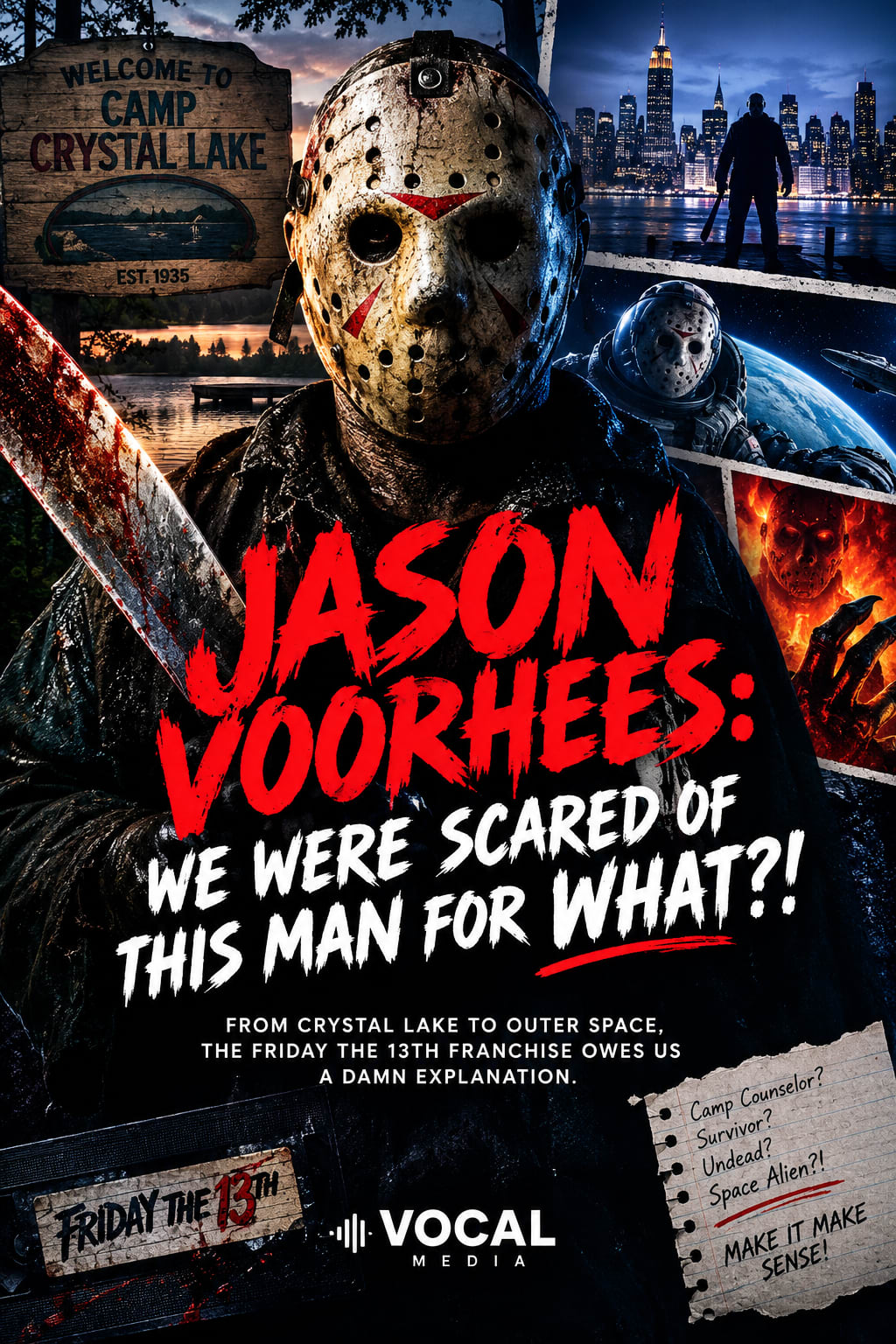
Welcome to THEY HAD US SCARED FOR WHAT?!, my horror retrospective celebrating the iconic horror movies and villains that had us checking under the bed, sleeping with the lights on, and questioning every damn noise we heard in the house. And what better time to revisit these horror classics than Halloween week?! With Halloween falling on Saturday, October 31, we're taking a trip down memory lane to revisit the stories, killers, creepy characters, and unforgettable moments that made horror fans out of us. I'll be breaking down the movies, exploring the villains' motives, revisiting those shocking twists, and adding my own commentary along the way. We're going beyond simply remembering these films; we're looking at what made them terrifying, what still holds up today, and whether some of these villains deserve all the credit—or whether we were just young, impressionable, and scared of our own shadows! 😂 So grab your popcorn, turn on a light if you need one, and join me as we revisit the horror that helped make Halloween what it is. Because after all these years, there's one question we still have to ask: THEY HAD US SCARED FOR WHAT?!
In this installment, we're talking about Jason Voorhees and Friday The 13th!
From Crystal Lake to outer space, the Friday the 13th franchise owes us a damn explanation.
I am a diehard Horror Fan Who Has Questions!!!
Let me tell y'all something. I grew up scared of Jason Voorhees.
That hockey mask? Terrifying.
That slow, heavy breathing? Absolutely not.
The music that started playing whenever he was nearby? Somebody needed to call the authorities because why the hell was that sound alone enough to make you question every decision that led you to that moment?
And Crystal Lake? Listen, you couldn't have paid me to go camping out there. Forget roasting marshmallows. Forget telling ghost stories around a campfire. Forget the beautiful scenery. I would have been perfectly happy sitting at home, behind a locked door, watching everybody else make terrible decisions on television.
Because we all knew the rules.
Don't go into the woods alone.
Don't wander off with your boyfriend or girlfriend.
Don't investigate strange noises.
And for the love of everything holy, if somebody tells you a place has a history of people getting murdered, WHY ARE YOU GOING THERE?!
We understood the assignment. We knew Jason was bad news.
But now that I'm older, I've started revisiting these movies, and I have a few questions.
Actually, I have a whole damn list.
Because somewhere between Crystal Lake and outer space, the Friday the 13th franchise lost its mind, and I'm beginning to suspect that we were so busy being scared of Jason that we never stopped to ask whether any of this made sense.
This man has been stabbed, chopped, drowned, resurrected, blown apart, and dragged to Hell. He has terrorized New York City and eventually ended up in outer space.
OUTER SPACE!
And we're supposed to accept all of this without asking a single question?
Well, the questions have arrived.
Welcome to my horror movie intervention.
Jason Voorhees, please report to the front of the room. We need to talk.
First of All, Jason Wasn't Even the Killer in the First Movie!
Let's start at the beginning.
The original Friday the 13th came out in 1980, and it introduced audiences to Camp Crystal Lake, a summer camp with a disturbing history.
Years earlier, a young boy named Jason Voorhees supposedly drowned because the camp counselors weren't paying attention.
His mother, Pamela Voorhees, never recovered from the tragedy. She blamed the counselors and became determined to prevent the camp from reopening.
Unfortunately for everyone involved, Pamela decided that murder was an appropriate way to express her grief.
So she began killing people.
That's right.
The original killer was Jason's MOTHER.
Not Jason.
His mama!
Imagine growing up thinking Jason was the original problem, only to discover that his mother was the one running around murdering people in the first movie.
Now, I'm not saying Pamela didn't have a reason to be devastated. Losing a child is heartbreaking. But, ma'am, the people you were killing weren't responsible for every bad thing that happened to your son.
And if we're being honest, the counselors weren't the only people who needed to pay attention. Somebody should have been supervising that entire operation.
Nevertheless, Pamela became one of horror cinema's most memorable killers, and the movie's final confrontation established the mythology that would follow Jason for decades.
At the end, Alice survives the attack and escapes onto the lake in a canoe.
Then, in one of the most memorable horror endings of its era, a decayed-looking Jason suddenly emerges from the water and pulls her in.
The audience is left wondering whether Jason is alive, dead, or something else entirely.
But here's the important part: the original movie doesn't establish the complete supernatural mythology that later sequels would build around him.
That came later.
And boy, did it come later.
Jason Finally Gets His Turn
In Friday the 13th Part 2, Jason becomes the central killer.
The story takes place five years after the original movie, and Jason is now living in the wilderness surrounding Crystal Lake.
Apparently, the boy who supposedly drowned didn't drown after all.
Instead, he survived, grew up in isolation, and became a murderous adult.
I have questions already, but let's keep moving.
Jason begins attacking a new group of young people training to become camp counselors. This time, he isn't wearing his famous hockey mask. He wears a sack over his head.
The hockey mask doesn't arrive until the next movie.
So the Jason image we grew up recognizing wasn't even fully established in the first two films.
Think about that.
The original movie's killer was his mother. The sequel made Jason the killer. The third movie gave him the mask that would become his trademark.
Hollywood was building this man one movie at a time.
And somehow, we were all supposed to be terrified of him before the franchise had even settled on exactly who he was.
The Hockey Mask Changed Everything
Friday the 13th Part III arrived in 1982 and gave Jason Voorhees the hockey mask that would become one of horror cinema's most recognizable images.
This was the moment Jason became the Jason we know.
The mask was simple, unsettling, and instantly recognizable. You didn't need to see his face. You didn't need a long explanation. The moment that mask appeared, you knew somebody was in trouble.
But the franchise was also becoming increasingly committed to bringing Jason back, regardless of what happened to him in the previous installment.
Then came Friday the 13th: The Final Chapter in 1984.
And the title suggested that Jason's story was finally coming to an end.
Finally!
We could all go home. Crystal Lake could get some peace. Maybe somebody could turn the camp into a peaceful vacation destination without worrying about a masked man showing up with a machete.
Except the franchise had other plans.
Tommy Jarvis, a young boy who becomes central to the story, fights back against Jason and leaves him apparently dead.
The movie was intended to serve as a conclusion to the series.
But Jason's story wasn't over.
Because Hollywood had discovered a very important lesson: if a horror villain makes money, killing him off doesn't necessarily mean he's going to stay dead.
The Movie Where Jason Isn't Even Jason
Then we get Friday the 13th: A New Beginning in 1985.
And this is where the franchise pulls a little switcheroo.
The story follows an older Tommy Jarvis, who is still struggling with the psychological aftermath of his encounter with Jason.
Murders begin happening again, and it appears that Jason has returned.
Except he hasn't.
The killer turns out to be Roy Burns, a paramedic seeking revenge after his son dies.
Roy is a copycat killer who takes on Jason's appearance.
So now we have a franchise named after a killer whose mother was the original murderer, whose own survival was never fully explained, and whose identity is temporarily borrowed by another man.
I'm sorry, but at some point, somebody in the writers' room needed to stand up and ask, "Are we all following the same story?"
To be fair, the filmmakers were attempting to explore a story without simply bringing Jason back again.
But audiences wanted Jason.
And the movie's decision to make someone else the killer remains one of the franchise's most controversial twists.
Apparently, even Jason needed a stand-in.
Jason Lives: The Franchise Officially Embraces the Supernatural
In 1986, Friday the 13th Part VI: Jason Lives arrived and made a major change to the character.
Tommy Jarvis is convinced Jason could return, so he visits Jason's grave.
During an attempt to destroy the corpse, a lightning strike brings Jason back to life.
And this time, the movie makes the supernatural element much more explicit.
Jason isn't simply a man who survived a childhood drowning and somehow became an extraordinarily resilient killer.
He's an undead monster.
He can sustain injuries that would kill an ordinary person, and he keeps coming back.
The distinction matters because this movie establishes the supernatural direction that the franchise increasingly embraces.
It also raises a question that will follow Jason throughout the rest of the series:
If this man is undead, what exactly does it take to kill him permanently?
The franchise never provides one consistent answer.
Sometimes Jason is defeated. Sometimes he's restrained. Sometimes he appears to die. And then another movie arrives and finds a way to bring him back.
At this point, Jason isn't just a horror villain.
He's an ongoing administrative problem.
Somebody should have been assigned to manage his case.
Now We're Adding Psychic Powers?
Friday the 13th Part VII: The New Blood arrived in 1988.
And because an undead killer apparently wasn't enough, the filmmakers introduced a teenager with telekinetic abilities.
Her name is Tina Shepard, and she has the power to move objects with her mind.
When Tina returns to Crystal Lake, her powers inadvertently bring Jason back.
Yes, we're now mixing supernatural slasher horror with psychic powers.
Jason goes on another killing spree, and Tina eventually uses her abilities against him.
Now, is this an interesting premise? Absolutely.
Is it a major departure from the original story about a grieving mother and her drowned son? Also absolutely.
But by this point, the franchise had moved far beyond its original premise.
The question wasn't whether Jason would return.
The question was what the filmmakers would add to the next installment.
And apparently, the answer was a psychic teenager.
Jason Takes Manhattan: Did Crystal Lake Get Evicted?
In 1989, the franchise released Friday the 13th Part VIII: Jason Takes Manhattan.
This is where Jason leaves the familiar surroundings of Crystal Lake and ends up aboard a cruise ship heading toward New York City.
Eventually, the survivors reach Manhattan, and Jason follows them.
Let me make sure I understand this correctly.
We started with a summer camp.
Then we got a grieving mother, a grown son who supposedly drowned, a hockey mask, an undead resurrection, and a teenage girl with psychic powers.
Now we're taking the masked killer on a cruise?
Who booked this man's vacation?
And why is he following everybody to New York?
To be fair, Jason doesn't teleport to Manhattan. The movie gives him a physical route there aboard the ship.
But the title promises a grand New York adventure, and much of the story takes place before the characters reach the city.
The movie also ends with Jason exposed to toxic waste in the sewer system, causing him to revert to the appearance of a young boy.
And yet, somehow, this isn't the end of Jason Voorhees.
Of course it isn't.
At this point, death is less of a permanent condition for Jason and more of a temporary scheduling conflict.
Jason Goes to Hell: The Movie That Made Me Start Asking Questions
Now we arrive at the ninth movie, Jason Goes to Hell: The Final Friday, released in 1993.
And this is where I need everybody to sit down.
Because the filmmakers didn't just change Jason's location.
They changed what Jason actually is.
At the beginning of the movie, the FBI sets a trap for Jason near Crystal Lake. The operation ends with his body being destroyed in an explosion.
His remains are taken to a federal morgue, where a medical examiner discovers something disturbing about Jason's heart.
The heart begins beating.
The examiner consumes it, and Jason's evil essence takes over his body.
Let me repeat that.
THE MAN EATS JASON'S HEART, AND JASON TAKES OVER HIS BODY.
What happened to the hockey mask? What happened to the familiar undead killer who kept coming back in his own body?
We're now watching a supernatural entity that can possess other people.
Jason's essence moves from one host to another, and the movie introduces an entirely new mythology involving his blood relatives.
His sister, Diana, his niece, Jessica, and Jessica's infant daughter, Stephanie, all become important to the story.
The movie establishes that Jason needs a blood relative to be reborn in his original body.
And this is where I have to ask the writers a question.
Why are we just finding out about all this NOW?
We've spent years watching Jason survive what should have been fatal injuries. We've watched him return from the dead. We've watched him terrorize people around Crystal Lake and travel to Manhattan.
And now you're telling me that this man has a supernatural body-hopping ability and an entire family mythology that can bring him back?
Were we watching the same franchise?
The earlier movies didn't establish these rules. Jason Goes to Hell introduces them as part of its own story.
And that's the problem.
The movie doesn't simply expand what we know about Jason. It changes the rules governing his survival.
The familiar Jason Voorhees is no longer necessarily the person we see on screen.
Sometimes he's another person entirely.
The movie eventually returns Jason to his original body, and the final confrontation ends with demonic hands dragging him into Hell.
Then Freddy Krueger's gloved hand emerges from the ground and pulls Jason's hockey mask down.
Because apparently, even Hell couldn't keep the horror franchises from networking.
Jason X: NASA, Who Approved This?
In 2001, Jason X took the franchise into science-fiction territory.
The movie is set in the future, where Jason is captured and placed in cryogenic suspension.
Centuries later, he awakens aboard a spacecraft and resumes killing.
Then futuristic technology transforms him into an even more powerful version of himself known as Uber Jason.
I'm sorry.
UBER JASON?
Somebody really looked at this franchise and thought, "You know what this man needs? A technological upgrade."
We went from a boy who supposedly drowned at a summer camp to a futuristic killing machine in outer space.
I can't even be mad. At some point, the absurdity becomes part of the entertainment.
But let's take a moment to appreciate how far this franchise traveled.
Crystal Lake was supposed to be the place where Jason's story began.
Now we're hundreds of years into the future, aboard a spaceship, watching Jason become an even more dangerous version of himself.
The man has officially outlived the summer camp, the town, and apparently the entire era in which his original story took place.
Somebody needs to tell Jason that the world has moved on.
He doesn't care.
Freddy vs. Jason: Two Men Who Refuse to Stay Dead
In 2003, Jason finally crossed paths with Freddy Krueger.
Freddy is the supernatural killer from A Nightmare on Elm Street, known for attacking people through their dreams.
Jason is the undead killer who physically hunts his victims.
Freddy manipulates Jason into killing teenagers, hoping that the resulting fear will restore Freddy's own power.
But Jason doesn't cooperate the way Freddy expects.
The two killers eventually turn against each other, and the movie becomes a battle between two of horror's most recognizable villains.
It's a crossover that makes sense as a commercial idea.
Both characters have enormous fan bases, and the prospect of seeing them fight was enough to get horror fans interested.
But from a storytelling perspective, the movie continues the franchise's willingness to treat Jason's supernatural existence as a given rather than explain every detail of how he got there.
And the ending leaves room for more trouble.
Jason emerges from the lake holding Freddy's head, and Freddy's head winks at the audience.
Neither franchise is quite ready to let its villain rest.
The 2009 Reboot: Back to Basics
Finally, in 2009, the franchise returned to Crystal Lake with a reboot.
This version reimagines Jason as a physically formidable killer living in the surrounding wilderness.
The movie follows a young man searching for his missing sister, who disappeared in the Crystal Lake area.
Unlike Jason Goes to Hell and Jason X, this film doesn't rely on the same elaborate body-possession mythology or futuristic technology.
Instead, it returns to the familiar slasher formula.
Jason stalks his victims. People make questionable decisions. The body count rises.
And we're back in the woods.
This is a separate continuity, so it doesn't need to reconcile every development from the previous sequels.
And honestly, after everything we've seen, a return to Crystal Lake feels almost refreshing.
No spaceships.
No body-hopping.
No need to explain how Jason survived a trip to Hell.
Just Jason Voorhees doing what Jason Voorhees does.
So, Were We Wrong to Be Scared of Him?
Not at all.
Jason is an iconic horror villain for a reason.
The hockey mask is instantly recognizable. His imposing presence is effective. The movies helped define the slasher genre, and his image became part of popular culture.
But there's a difference between an iconic character and a consistently written one.
The first few movies establish the basic mythology. Jason Lives embraces his supernatural resurrection. The later sequels continue escalating his abilities and moving him into increasingly unusual settings.
By the time we reach Jason Goes to Hell, the franchise has introduced a new set of rules for how Jason survives.
And by Jason X, we're watching a futuristic version of the character aboard a spaceship.
It's entertaining, but it's also a remarkable departure from the original story.
The franchise's biggest problem isn't that Jason becomes supernatural.
It's that the rules keep changing.
Sometimes he survives because he's extraordinarily resilient. Sometimes he's explicitly undead. Sometimes his essence possesses other people. Sometimes futuristic technology makes him even more dangerous.
The movies rarely stop long enough to establish a consistent explanation for all of it.
And that leaves longtime fans trying to piece together a mythology that was largely created one sequel at a time.
Final Verdict: Crystal Lake, Come Get Your Man!
I still respect Jason Voorhees as a horror icon.
I understand why we were scared of him growing up. The mask, the music, the suspense, and the simple premise of an unstoppable killer stalking people in the woods were effective.
But revisiting the franchise as an adult has raised questions I never thought to ask when I was younger.
Why did the original killer have to be Jason's mother?
How did Jason survive his childhood drowning?
When did he become an undead monster?
Why did the filmmakers decide that he needed to possess people?
And who looked at the ninth movie and thought, "Yes. This is exactly how we should explain Jason's survival"?
I don't need every horror movie to be realistic. I'm perfectly happy to suspend disbelief for a good story.
But if you're going to ask me to believe that a masked killer has survived decades of supposedly fatal injuries, traveled to New York, been dragged into Hell, and ended up in outer space, I reserve the right to ask a few questions.
Because we were scared of this man for YEARS.
We avoided lakes. We side-eyed the woods. We watched people make terrible decisions and swore we'd never be that stupid.
And now I'm sitting here watching Jason Goes to Hell, wondering when the franchise decided that the best way to keep its villain alive was to turn him into a supernatural parasite.
Jason, sir, I need answers.
And while we're at it, somebody needs to explain who keeps financing these trips.
Crystal Lake is calling.
It's time to come home.
Next up in this series: Freddy Krueger.
Because if we're going to start questioning the horror icons we grew up with, we might as well investigate the man who made us afraid to close our eyes.
And I already have questions about that damn sweater.
About the Creator
Dakota Denise
Every story I publish is real lived, witnessed, survived, by myself or from others who trusted me to tell the story. Enjoy 😊
Enjoyed the story? Support the Creator.
Subscribe for free to receive all their stories in your feed. You could also become a paid subscriber, letting them know you appreciate their work.
Comments
There are no comments for this story
Be the first to respond and start the conversation.