

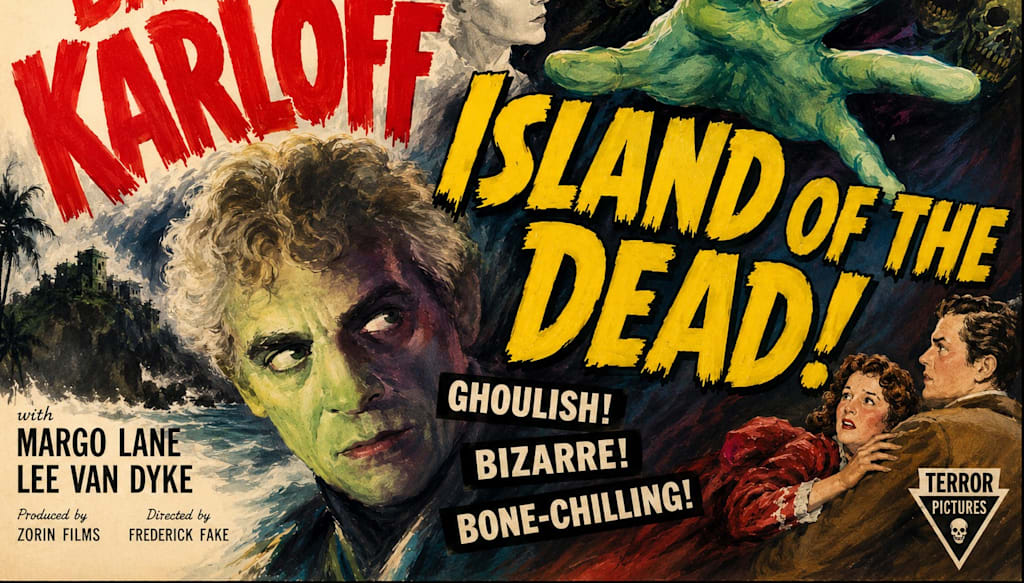
Isle of the Dead is a 1945 film directed by Mark Robson and produced by Val Lewton, who also produced the original Cat People. It stars a grimly dour and sepulchral Boris Karloff as a deranged general, Pherides, who is responsible, apparently, for crimes against the people of Greece sometime before his current duty during the Balkan Wars of 1912.
An American correspondent—who I suppose is not on vacation in this war-torn land (Karloff exits his tent to a catastrophized landscape of dying troops)—joins him on a journey to “The Isle of the Dead” to visit the general’s long-dead wife. Finding her tomb empty and not suspecting she has returned from the grave (the opening title warns viewers of the vorvolaka, an undead creature from ancient Greek myth), the General and the correspondent, hearing the singing of a woman, go to find her. Instead they find Dr. Aubrecht (Jason Robards), a Swiss archaeologist, and his unmerry band of house guests, including the Greek honey Thea (a vorvolaka suspect, played by Ellen Drew), and the stern black-clad household dominatrix of a cold and unforgiving aspect—Madame Kyra, a woman convinced that undead creatures (in the form of Thea) are the reason dear Doctor Drossos comes to quarantine the island, explaining that only the Hot Wind of Hell (i.e., a sirocco) will kill the presumed plague virus.
Karloff loses his shit and goes lurching about, deep dark greasepaint bags under his eyes (which are arched over by impossibly thick brows), and begins to worship the ancient Greek gods at a fire in a birdbath. Thea and Kyra, and the long-suffering, ill wife of Mr. St. Aubyn (who dies forthwith and post-haste, right after the overnight expiration of Englishman Henry Robbins).
Mrs. St. Aubyn (Katherine Emery), it turns out, is endlessly frightened of the prospect of being interred alive (aren’t we all?) as she, like some damned mistress from Poe, finds herself occasionally slipping into cataleptic trances in an era before embalming became a standard practice.
The film presents a scenario in which the quarantined island, waiting for salvation from Nature (that hot sirocco wind), becomes the canvas upon which is painted the deeply symbolic juxtaposition of Karloff’s patriarchal terror pitted against three women—Thea, the suspected vorvolaka (a Val Lewton 1945 heroine if ever there was one), against Kyra, the stern, traditional matriarch who suppresses sexuality and forbids the birth of Thea’s liberated woman-self. This stasis is exemplified by the narcoleptic (literally falling into a suspended, death-like state) Mrs. St. Aubyn, who is afraid of being entombed alive.
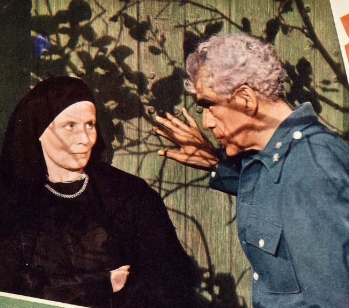
All three characters, it could be argued, are symbolic, metaphorical representations of various stages of psychological development—from the stern, mother-like Kyra, an ancient matriarch who brings with her old-world ignorance and superstition, a woman who understands the role of women in the world as soured, bloodthirsty Eves bringing the plague, disease (read: SIN) into the world. As a vorvolaka, she believes Thea has brought them the curse of the plague—the plague a narrative stand-in for sexual awakening, liberation, modernism. The corruption of the old-world values the superstitious Kyra holds so dear is exemplified by Thea, the young and pretty, sexually unafraid (presumably) woman; the middle stage of this evolution is demonstrated symbolically by the entombed Mrs. St. Aubyn, who is resurrected by dripping water (hint, hint) on the top of her sepulchral womb.
Karloff goes lurching like a madman through the stark, atmospheric, noir-esque backdrop, convinced of the reality of Thea being a vorvolaka, worshipping at the flaming birdbath, wearing darker eye makeup than a chorus line full of Irma Veps. Two parting images: a resurrection from a tomb (emerging from a casket upon which fluid, the drips of passing time, splash like little rivulets of tears), and a woman plunging over the side of the cliff, as The Fool in the Tarot is likely to do. At the end, a woman leaves, such as the Six of Swords, in a solitary boat, headed toward the farthest shore.
And we don’t wish to give away the ending.
Isle of the Dead
Author's website
Author's YouTube
Cult Films and Midnight Movies
"From High Art to Low Trash" Vol 1
By Tom Baker
Ebook
Silent Scream! Nosferatu, The Cabinet of Dr. Caligari, Metropolis, and Edison's Frankenstein--Four Novels.
By C. Augustine
Ebook
Theater of the Worm: Essays on Poe, Lovecraft, Bierce, and the Machinery of Dread, (Paperback)
About the Creator
Tom Baker
Author of Haunted Indianapolis, Indiana Ghost Folklore, Midwest Maniacs, Midwest UFOs and Beyond, Scary Urban Legends, 50 Famous Fables and Folk Tales, and Notorious Crimes of the Upper Midwest.: http://tombakerbooks.weebly.com
Enjoyed the story? Support the Creator.
Subscribe for free to receive all their stories in your feed. You could also become a paid subscriber, letting them know you appreciate their work.
Comments
There are no comments for this story
Be the first to respond and start the conversation.