
Freddy Krueger
You Mean to Tell Me I Can't Even SLEEP IN PEACE?!

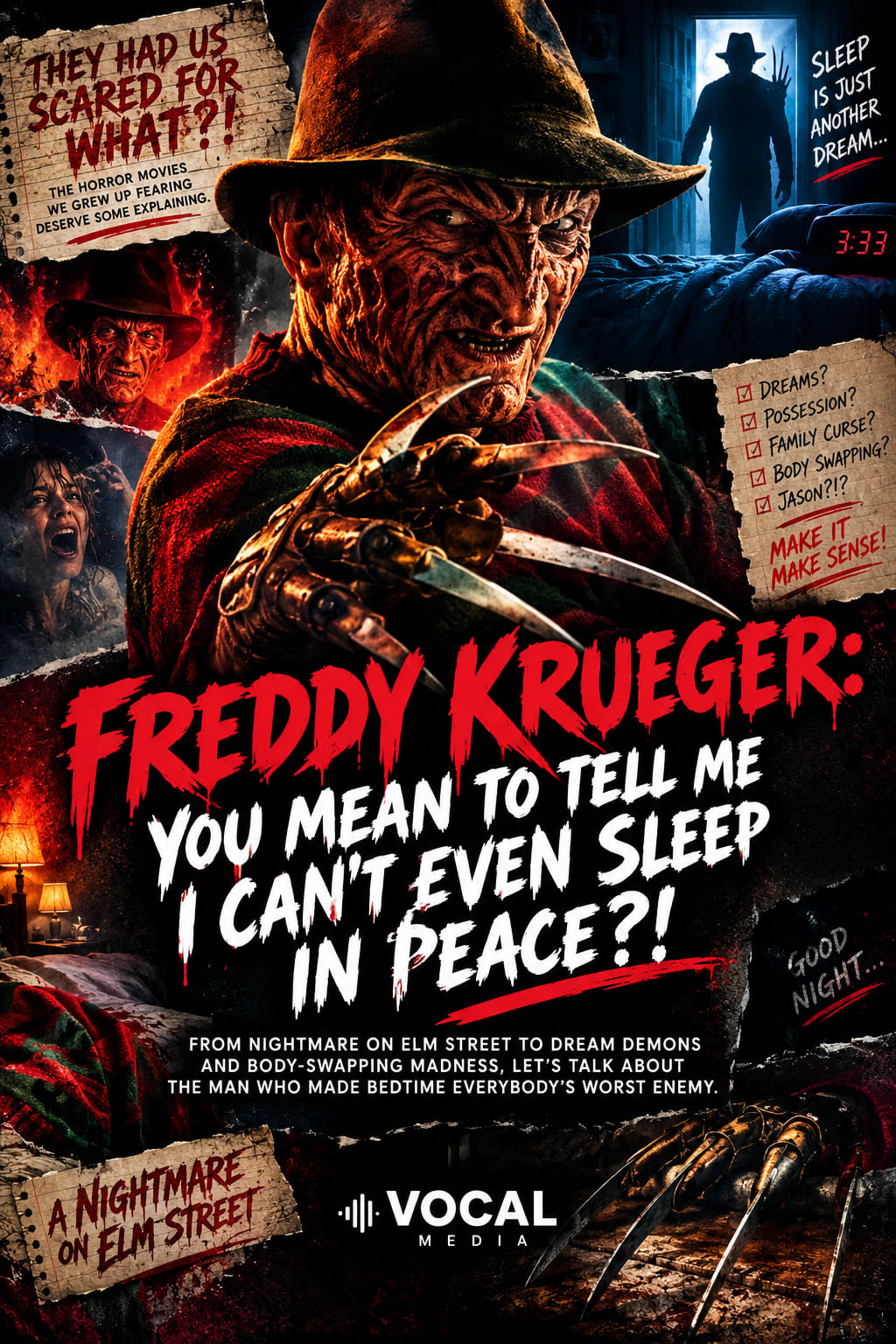
Welcome to THEY HAD US SCARED FOR WHAT?!, my horror retrospective celebrating the iconic horror movies and villains that had us checking under the bed, sleeping with the lights on, and questioning every damn noise we heard in the house. And what better time to revisit these horror classics than Halloween week?! With Halloween falling on Saturday, October 31, we're taking a trip down memory lane to revisit the stories, killers, creepy characters, and unforgettable moments that made horror fans out of us. I'll be breaking down the movies, exploring the villains' motives, revisiting those shocking twists, and adding my own commentary along the way. We're going beyond simply remembering these films; we're looking at what made them terrifying, what still holds up today, and whether some of these villains deserve all the credit—or whether we were just young, impressionable, and scared of our own shadows! 😂 So grab your popcorn, turn on a light if you need one, and join me as we revisit the horror that helped make Halloween what it is. Because after all these years, there's one question we still have to ask: THEY HAD US SCARED FOR WHAT?!
In this installment, we're talking about Nightmare on Elm Street, with Freddy Krueger!
From neighborhood revenge to dream demons, possessed teenagers, and supernatural nonsense, let's talk about the man who made bedtime everybody's worst enemy.
THEY HAD US SCARED FOR WHAT?! INSTALLMENT #2
Let me tell y'all something.
Jason Voorhees had us scared to go camping. We didn't want to be anywhere near Crystal Lake, and after watching enough of those movies, some of us probably wouldn't have gone swimming in a bathtub if somebody told us Jason lived nearby.
But Freddy Krueger?
FREDDY HAD US AFRAID TO CLOSE OUR DAMN EYES!
Think about that for a minute.
Jason has to find you. Michael Myers has to follow you. Ghostface has to call you, chase you, and hope you don't figure out who's underneath that ridiculous costume.
Freddy?
You can lock your doors. You can close your windows. You can sleep with the lights on. You can put a chair underneath the doorknob if that makes you feel better.
That burned-up bastard can STILL show up in your dreams.
YOUR OWN BRAIN IS THE CRIME SCENE!
And the worst part? You cannot simply decide never to sleep again. Eventually, your body is going to demand some rest, and Freddy knows it.
That's what made A Nightmare on Elm Street so terrifying when we were growing up. The place where you should feel safest, your own mind, suddenly becomes the place where you're most vulnerable.
But now that I'm older, I have questions.
Because Freddy isn't just killing teenagers. He's killing the children of people who decided to take justice into their own hands.
And those children didn't do a damn thing!
They didn't burn him alive. They didn't participate in the neighborhood's revenge plot. They weren't even old enough to understand what their parents had done.
They were just trying to live their lives!
And Freddy comes back decades later, apparently determined to make an entire generation pay for their parents' decisions.
SIR, THESE CHILDREN DID NOT SIGN UP FOR YOUR FAMILY DISPUTE!
If you're angry with the people who killed you, why not haunt THEM? Why are you terrorizing their children? What did these teenagers do besides inherit the misfortune of having parents who made a very bad decision?
And don't even get me started on the sequels.
Because just like Jason Voorhees, Freddy's story starts with a genuinely terrifying premise and gradually becomes a collection of supernatural rules, increasingly elaborate explanations, and decisions that make you wonder whether anybody involved stopped to ask, "Wait a damn minute. Does this actually make sense?"
We're going back through the movies, one nightmare at a time.
We're examining the mythology, the family secrets, the dream rules, and the moment when Freddy went from a terrifying supernatural killer to a wisecracking horror celebrity.
So get comfortable.
Actually, don't get TOO comfortable.
Apparently, that's when he gets you.
Welcome back to the horror movie courtroom. Freddy Krueger, your hearing is now in session.
1. A NIGHTMARE ON ELM STREET (1984): THE ORIGINAL NIGHTMARE
Let's start with the movie that introduced us to Freddy Krueger.
Directed by Wes Craven, the original A Nightmare on Elm Street follows a group of teenagers in Springwood who begin experiencing terrifying dreams about a disfigured man wearing a dirty red-and-green sweater and a glove fitted with blades.
His name is Freddy Krueger.
And he isn't simply appearing in their dreams to scare them.
He's killing them.
The movie centers on Nancy Thompson, a teenager who begins investigating the connection between her nightmares and the increasingly disturbing events surrounding her friends.
Nancy discovers that Freddy was a child murderer who lived in the neighborhood.
The authorities arrested him, but a legal technicality allowed him to escape punishment. Enraged by the failure of the justice system, a group of parents took matters into their own hands.
They tracked Freddy down, trapped him in a boiler room, and burned him alive.
Among those involved were the parents of the children Freddy now targets.
And THIS is where the whole situation gets interesting.
Freddy returns as a supernatural killer who attacks their children through their dreams.
Wait a damn minute. WHY ARE THE CHILDREN PAYING FOR THIS?!
Let's establish something important.
Freddy was a child murderer. The parents had every reason to be horrified by what he had done.
But they took revenge into their own hands instead of allowing the legal system to handle the situation.
Years later, their children become Freddy's targets.
And those children weren't responsible for his arrest, his trial, his release, or his death.
They weren't even involved in the decision to burn him alive!
THE PARENTS MADE THE DECISION, BUT THE CHILDREN ARE PAYING THE PRICE.
That's one of the most disturbing aspects of the original premise.
The adults believed they had eliminated the problem. They thought burning Freddy alive would protect their community.
Instead, their actions created another nightmare for the next generation.
And Freddy's revenge doesn't simply target the adults who killed him. He attacks the people they love most.
Now, before anybody starts feeling sorry for Freddy, let me be clear: this man was a child murderer before the parents killed him. The movie doesn't present him as an innocent victim who was minding his own business.
But his supernatural revenge raises an ugly question about inherited guilt.
Why should the children be punished for something their parents did?
They shouldn't.
Unfortunately, Freddy doesn't care about fairness.
He wants revenge, and he has found a way to reach his victims somewhere they cannot easily escape.
Nancy versus Freddy
Nancy eventually discovers that she can fight back.
She learns to stay awake, studies Freddy's behavior, and develops a plan to confront him.
Her strategy involves pulling Freddy out of the dream world and into the waking world, where she hopes he can be defeated.
The final confrontation is a battle of wits and willpower.
Nancy realizes that Freddy's power depends, at least in part, on the fear he inspires. She tries to take that power away by refusing to let him control her.
But the ending is deliberately unsettling, leaving audiences with the impression that Freddy's influence may not be over.
And that ambiguity is part of what makes the original movie effective.
Freddy isn't simply a man with a knife. He's a supernatural threat who invades a place nobody can permanently avoid: sleep itself.
The original verdict: Terrifying premise. Effective villain. A community's buried secret comes back to haunt its children.
But we need to talk about the parents, because the adults of Springwood apparently believed that burning a dangerous man alive would permanently solve their problems.
Congratulations, everybody.
You created a problem that would haunt your children for decades.
Literally.
2. A NIGHTMARE ON ELM STREET 2: FREDDY'S REVENGE (1985): WHY IS FREDDY TRYING TO GET INSIDE THIS BOY?!
Here comes the sequel, and Freddy's mythology starts changing.
Freddy's Revenge follows Jesse Walsh, a teenager whose family moves into the house where Nancy Thompson lived in the first movie.
Jesse begins experiencing terrifying dreams involving Freddy.
But instead of simply attacking Jesse in his sleep, Freddy appears to be trying to take control of his body.
That's right.
Freddy wants to use a living teenager to carry out his murders in the waking world.
Which raises an obvious question.
Freddy, you have an entire supernatural dream world at your disposal, and now you're trying to possess somebody?
WHAT HAPPENED TO THE ORIGINAL PLAN?!
Jesse struggles to understand what's happening to him. He fears that Freddy is taking control, and his attempts to resist become central to the story.
His girlfriend, Lisa, tries to help him fight the supernatural influence.
Eventually, Jesse confronts Freddy, and Lisa helps him resist the possession.
Here's where the franchise gets interesting.
The first movie established Freddy as a killer who attacks people through their dreams.
The second movie expands that idea by making possession central to the story.
Instead of simply invading Jesse's dreams, Freddy attempts to use Jesse's body as a vehicle for his violence.
It's a significant change.
And if you're trying to build a consistent set of supernatural rules, this is where you start asking what Freddy can and cannot do.
Can he kill only in dreams? Can he cross into the waking world? Can he possess someone? Does he need a particular victim?
The franchise is already expanding the mythology.
And we're only on movie number two!
The verdict: A different kind of Freddy story, with possession taking center stage. It pushes the mythology beyond the original film, even if it doesn't feel exactly like the same kind of nightmare.
3. A NIGHTMARE ON ELM STREET 3: DREAM WARRIORS (1987): THE CHILDREN FIGHT BACK
Now we get to one of the most beloved entries in the franchise.
Dream Warriors returns us to Nancy Thompson, who has grown older and is now working with troubled teenagers at a psychiatric institution.
The teenagers are experiencing disturbing nightmares, and Freddy is once again connected to their suffering.
Nancy recognizes the pattern and realizes that the young patients are facing the same supernatural threat she encountered years earlier.
But this time, the teenagers aren't entirely helpless.
They begin learning how to use their individual abilities within their dreams to fight Freddy.
Some discover talents that allow them to defend themselves in ways they couldn't in the waking world.
The group becomes known as the Dream Warriors.
And the story shifts from helpless victims being hunted by Freddy to young people learning how to fight back.
But hold on. Why are these kids involved in this mess AGAIN?
Let's recap.
The parents of Springwood killed Freddy.
Freddy returned to terrorize their children.
Now those children are suffering so badly that they're being treated in an institution, and Nancy has to help them confront the nightmare.
These young people are dealing with problems they didn't create.
And the adults who originally participated in Freddy's death have largely failed to give them the information they need to understand what's happening.
The children are left trying to solve a supernatural mystery that began before they were old enough to understand it.
That's the tragedy underneath the fantasy.
And Nancy's return gives the franchise a stronger connection to the original movie.
She's not just another person who happens to encounter Freddy. She's someone who understands what the teenagers are experiencing because she survived it herself.
What changes about Freddy?
Dream Warriors makes the dream world more elaborate.
The teenagers can develop abilities in their dreams, and the conflict becomes more like a supernatural battle than a straightforward series of nightmares.
Freddy is still dangerous, but the young people discover that their dreams can give them ways to fight back.
The movie also continues building Freddy's mythology by exploring the circumstances surrounding his death and the supernatural forces connected to him.
The verdict: One of the strongest examples of the franchise combining horror with character development. The teenagers aren't merely victims. They become active participants in the fight.
And honestly, after everything their parents' generation set in motion, it's about time these kids got an opportunity to fight back.
4. A NIGHTMARE ON ELM STREET 4: THE DREAM MASTER (1988): FREDDY WILL NOT LEAVE THESE PEOPLE ALONE!
Just when you think the survivors might finally get a break, Freddy returns.
The Dream Master continues the story following the events of Dream Warriors.
Kristen Parker is among the surviving characters, and she discovers that Freddy's threat hasn't ended.
She also has the ability to bring other people into her dreams, which becomes important as Freddy begins targeting a new group of teenagers.
Alice Johnson, one of Kristen's friends, eventually becomes central to the story.
As the killings continue, Alice discovers that she has a role to play in confronting Freddy.
The movie explores how the survivors' experiences affect the people around them, and how Freddy's influence can spread through connections between dreamers.
So now the nightmare is spreading through friendships?
Apparently!
Freddy isn't simply returning to the same location and attacking the same people. The story uses the connections between the characters to expand the conflict.
Alice's development becomes particularly important because she transforms from a relatively quiet teenager into someone capable of confronting Freddy.
The franchise is increasingly interested in the idea that Freddy's victims can acquire abilities or strength through their experiences.
But Freddy's mythology is also becoming more elaborate.
The first movie relied on the terror of an ordinary teenager discovering that her dreams could kill her.
By the fourth movie, the franchise has built a more complicated supernatural system involving dream abilities, returning survivors, and the transfer of power between characters.
That's not automatically a bad thing.
But it does mean the series is moving away from the simple, frightening premise that made the original so effective.
The verdict: Alice becomes an important new protagonist, but the franchise is clearly escalating its supernatural rules.
Freddy isn't just a nightmare anymore.
He's practically running a supernatural franchise of his own.
5. A NIGHTMARE ON ELM STREET 5: THE DREAM CHILD (1989): NOW THERE'S A BABY INVOLVED?!
I need everyone to sit down for this one.
Because The Dream Child introduces another major development.
Alice returns, and the story involves her pregnancy.
Freddy discovers a way to exploit the connection between Alice, her unborn child, and the dream world.
He uses that connection to continue his attacks.
Yes, we're now dealing with a supernatural killer who can use a pregnancy as part of his plan to return and terrorize people.
Freddy has gone from haunting teenagers to possessing one of them to exploiting connections between dreamers.
And now he's trying to use an unborn child's dreams.
SIR.
WHAT IS YOUR PROBLEM?!
Why does Freddy keep finding new ways to survive?
This is one of the franchise's recurring patterns.
Each time the characters appear to defeat Freddy, the next movie introduces another way he can return.
The original movie establishes the supernatural threat.
The second explores possession.
The third develops the dream world into a place where victims can fight back.
The fourth expands the connections between dreamers.
The fifth introduces another supernatural avenue through Alice's pregnancy.
The mythology keeps growing because the franchise needs Freddy to remain dangerous.
But every new explanation also creates more questions about the limits of his powers.
Can Freddy enter anyone's dreams? Can he exploit any supernatural connection? What prevents him from doing this in every movie?
The films don't always give us consistent answers.
And that is where the series begins to feel as though its mythology is being built around whatever the next installment needs.
The verdict: A darker, more surreal installment that continues Alice's story while pushing the supernatural rules even further.
And the question remains: how many different ways can one man come back from the dead?
Apparently, the filmmakers were determined to find out.
6. FREDDY'S DEAD: THE FINAL NIGHTMARE (1991): IS THIS FINALLY THE END?!
The title promises that Freddy's story is finally coming to an end.
We've heard that sort of promise before.
Jason had The Final Chapter. Then he came back.
Jason also had The Final Friday. Then he came back again.
So you'll forgive me if I don't immediately trust a horror movie that promises the final chapter of anything.
In Freddy's Dead, Freddy has effectively taken control of Springwood.
The town's children are gone, and the remaining young people are living with the consequences of his reign of terror.
A young man known as John Doe is discovered outside Springwood with no clear memory of his identity.
He eventually becomes involved in uncovering Freddy's past and the circumstances surrounding his rise as a supernatural killer.
The story introduces Maggie Burroughs, a woman who works with troubled young people and becomes increasingly involved in the mystery.
As the movie progresses, Maggie discovers that she has a personal connection to Freddy.
She is revealed to be his daughter, Katherine Krueger, who was adopted after being separated from him.
And here we go again.
Another family connection!
Freddy's daughter is now part of the story, and his past becomes central to the attempt to stop him.
How did Springwood let this happen?
The movie presents a town that has been devastated by Freddy's influence.
The adults are gone or unable to protect the younger generation, and the community has become a place where the consequences of Freddy's crimes are impossible to ignore.
The children who were supposed to inherit a better future have instead inherited a nightmare.
And the movie uses Freddy's daughter to bring his family history into the conflict.
Maggie eventually confronts Freddy, and the story attempts to bring his reign of terror to an end.
But why does Freddy keep getting away with this?
That's the question that hangs over the entire franchise.
The adults of Springwood killed Freddy because they believed the law had failed.
But their actions didn't solve the problem.
Instead, Freddy returned as a supernatural threat, and the consequences fell on the next generation.
By the time we reach Freddy's Dead, the story has expanded from a neighborhood secret into a catastrophe affecting an entire town.
The verdict: The movie attempts to close the original storyline by exploring Freddy's past and giving his daughter a role in his downfall.
But it also demonstrates how far the franchise has moved from its original premise.
We started with a teenager trying to survive her nightmares.
Now we're investigating Freddy's family history while an entire town suffers the consequences.
That's quite a journey.
7. WES CRAVEN'S NEW NIGHTMARE (1994): WAIT, NOW FREDDY IS REAL?!
Now THIS is where things get interesting.
Wes Craven's New Nightmare isn't simply another chapter in the same storyline.
Instead, the movie plays with the distinction between fiction and reality.
Heather Langenkamp, who played Nancy in the original movie, appears as a fictionalized version of herself.
Wes Craven also appears as himself, and the earlier Nightmare on Elm Street movies exist within the film as movies.
But something frightening is happening.
A supernatural entity has taken on the form of Freddy Krueger, using the character as a way to enter the real world.
Heather begins experiencing disturbing events that blur the boundaries between her life and the horror films she helped create.
The story explores the idea that Freddy isn't simply a fictional villain anymore.
The character has become the face of something older and more dangerous.
So the man who haunted teenagers is now haunting the people who made the movies?!
Yes!
And unlike the earlier sequels, this movie isn't primarily interested in explaining how Freddy can possess another teenager or develop a new dream ability.
It's exploring the relationship between horror stories and the fears they represent.
The movie suggests that the Freddy character has become a vessel for a supernatural force that needs the story to exist.
That gives the film a very different atmosphere from the previous installments.
It also allows Wes Craven to comment on the success of the franchise and the way a fictional monster can become a cultural phenomenon.
The verdict: A clever, unsettling reinvention that steps outside the original continuity.
And for anyone trying to understand the franchise, this is an important distinction: New Nightmare isn't simply another installment in which Freddy returns to Springwood.
It's a separate story that turns the movies themselves into part of the nightmare.
8. FREDDY VS. JASON (2003): TWO MEN WHO REFUSE TO STAY DEAD
Now we get to the crossover.
Freddy Krueger meets Jason Voorhees.
And if you read the first installment of this series, you already know how I feel about Jason's history.
One man has a supernatural dream world.
The other man has spent decades refusing to stay dead.
Somebody thought putting them in the same movie was a brilliant idea.
And honestly, as a horror fan, I understand the appeal.
The story takes place in Springwood, where Freddy has become weakened because people are no longer afraid of him.
He needs fear to regain his strength.
So he manipulates Jason into killing people, hoping that the resulting panic will restore Freddy's power.
But Jason doesn't follow Freddy's plan as neatly as expected.
Jason continues killing, and Freddy realizes that the undead slasher he's unleashed is not a tool he can easily control.
The two eventually turn against each other.
Why does Freddy need Jason?
The movie establishes that Freddy's power depends on fear, and the people of Springwood have tried to suppress their memories of him.
Jason becomes a means of creating new terror in the town.
But the plan backfires when Jason's own killing spree interferes with Freddy's goals.
And now we have a supernatural conflict between two horror icons.
Who wins?
The movie stages a climactic battle between Freddy and Jason, with the survivors caught in the middle.
Jason eventually emerges from the lake holding Freddy's severed head.
But Freddy's head winks at the audience.
Because apparently, even when these two are fighting each other, neither franchise is ready to give its villain a permanent ending.
The verdict: A crossover built around the appeal of seeing two iconic villains collide.
It doesn't resolve every question about either character's mythology, but it gives audiences the confrontation they've been waiting for.
And it proves that if you put two supernatural killers in the same movie, the survivors are probably going to have a very bad evening.
9. A NIGHTMARE ON ELM STREET (2010): A NEW FREDDY, A NEW NIGHTMARE
Finally, we arrive at the 2010 remake.
This film reimagines the original story with a new cast and a different interpretation of Freddy Krueger.
The basic premise remains familiar: teenagers begin experiencing disturbing dreams involving Freddy, and the consequences threaten their lives.
Nancy Holbrook becomes the central protagonist, and she and her friends attempt to understand the connection between their nightmares and Freddy's past.
As the story develops, they discover that their childhood memories may not be what they believed.
The remake introduces a revised version of Freddy's backstory and explores the possibility that the adults in their lives have concealed disturbing information from them.
Once again, the children are left dealing with the consequences of decisions made by adults.
Sound familiar?
The original franchise made the parents' revenge against Freddy central to the story. The remake reworks the backstory, so it shouldn't be treated as a continuation of the original films.
It's a separate interpretation of the premise.
What changes?
The remake adopts a darker visual style and a more serious tone.
It emphasizes the psychological horror of sleep deprivation, shared nightmares, and uncertainty about what is real.
The central question is whether the teenagers can uncover the truth before Freddy's influence destroys them.
The verdict: A new interpretation of the original concept rather than another chapter in the same continuity.
It returns to the idea that a community's hidden past can endanger its children, but it tells that story through a different version of Freddy.
---
NOW LET'S TALK ABOUT THE REAL PROBLEM: WHY ARE THESE KIDS PAYING FOR THEIR PARENTS' MISTAKES?!
This is the part that bothers me most about the original Nightmare on Elm Street storyline.
Freddy was a child murderer.
The authorities arrested him, but he escaped punishment because of a legal technicality.
The parents of Springwood decided they couldn't trust the legal system to protect their children, so they took matters into their own hands and killed him.
Then Freddy returned as a supernatural killer.
And instead of limiting his revenge to the adults who participated in his death, he began targeting their children.
THE PEOPLE WHO MADE THE DECISION WEREN'T THE ONES GETTING HAUNTED. THEIR CHILDREN WERE.
Imagine growing up in a neighborhood where the adults know something terrible happened years ago, but nobody wants to explain it.
You begin having nightmares.
Your friends begin dying.
Your parents become evasive whenever you ask questions.
And eventually, you discover that the nightmare haunting you is connected to something your parents did before you were old enough to understand the world.
That's a horrifying premise.
It also raises questions about guilt, responsibility, and the consequences of revenge.
The parents believed they were protecting their children by eliminating Freddy.
But their actions didn't end the danger.
They simply changed its form.
And when Freddy returned, the next generation became his target.
Now, does that mean the parents deserved what happened?
No.
Does it mean the children deserved it?
Absolutely not.
Freddy's revenge is not justice. It's cruelty directed at people who had nothing to do with his death.
And that's an important distinction.
The children inherit the consequences of their parents' decisions, but they don't inherit the guilt.
That's the tragedy at the heart of the original story.
And it's why the first movie remains so effective.
The teenagers aren't responsible for creating the monster.
They're trying to survive the monster their parents helped bring into existence.
---
FREDDY'S POWERS: WHAT THE HELL ARE THE RULES?!
Let's talk about another problem with the franchise.
Freddy's abilities keep expanding.
In the original movie, he invades dreams and kills his victims through their nightmares.
In Freddy's Revenge, he attempts to possess Jesse and use his body in the waking world.
In Dream Warriors, the teenagers discover that they can develop abilities in their dreams and fight back.
In The Dream Master, connections between dreamers become increasingly important.
In The Dream Child, Freddy exploits Alice's pregnancy as part of his plan.
In Freddy's Dead, the story explores his past and reveals his connection to Maggie.
In New Nightmare, the mythology changes entirely, with Freddy representing a supernatural entity that enters a fictionalized version of reality.
And in Freddy vs. Jason, his ability to manipulate fear becomes central to his plan.
Now, I'm not saying a supernatural horror franchise has to follow the rules of a physics textbook.
But there needs to be some consistency.
If Freddy can do almost anything in a dream, what limits him?
If he can manipulate reality, why can't he simply eliminate every obstacle?
If he can possess someone, why does he need to rely on dreams in every other situation?
The movies offer explanations for individual events, but they don't always establish a consistent set of rules across the entire franchise.
And that's where the mythology becomes confusing.
The original movie's strength came from a simple, terrifying idea: your dreams are no longer safe.
The sequels kept adding to that idea until Freddy's powers became increasingly elaborate.
Some of those changes produced entertaining stories.
Others made the franchise feel as though it was inventing new rules whenever the plot needed them.
And that brings us to the final question.
Did Freddy become less frightening as the franchise went on?
I think there's a real argument to be made that he did.
The original Freddy was frightening because he was cruel, unpredictable, and difficult to escape.
As the franchise progressed, his personality became increasingly theatrical.
He started making more jokes, performing elaborate dream sequences, and turning his victims' fears into elaborate spectacles.
That evolution helped make Freddy a pop-culture icon.
But it also changed the nature of the horror.
The more entertaining Freddy became, the easier it sometimes became to watch him as a character rather than fear him as a threat.
And that's a difficult balance for a horror franchise to maintain.
---
FINAL VERDICT: FREDDY KRUEGER, YOU OWE THESE CHILDREN AN APOLOGY!
Let's give credit where it's due.
The original A Nightmare on Elm Street is built around an excellent horror premise.
A supernatural killer who can reach you through your dreams is frightening because sleep is unavoidable.
You can run from Jason.
You can hide from Michael.
You can try to outsmart Ghostface.
But you cannot permanently avoid sleeping.
And Freddy's connection to the parents of his victims gives the original story an additional layer of horror.
The adults of Springwood believed they had solved a problem by killing Freddy.
Instead, they created a secret that would eventually threaten their children.
That's an effective story about revenge, guilt, and the consequences of refusing to confront the past.
But as the franchise continued, the mythology became increasingly complicated.
Freddy possessed people, manipulated dream worlds, exploited supernatural connections, and eventually became the center of a crossover with Jason Voorhees.
The later films expanded the character in different directions, sometimes successfully and sometimes at the expense of the original premise.
And through all of this, the question remains:
WHY ARE THE CHILDREN PAYING FOR WHAT THEIR PARENTS DID?!
Freddy, if you have a problem with the adults who burned you alive, take it up with the adults.
These teenagers have school in the morning!
They have homework, friendships, relationships, and futures to think about.
They didn't participate in your trial. They didn't vote on your punishment. They didn't light the match.
They inherited the consequences of decisions they had no part in making.
And now they can't even close their eyes without worrying about whether you're waiting for them.
That's not justice.
That's a supernatural family feud, and the children are the ones suffering.
So here's my final verdict.
Freddy Krueger is one of horror cinema's most recognizable villains, and the original film remains an effective nightmare about a community's buried secrets coming back to haunt its children.
But the franchise's expanding mythology sometimes raises more questions than it answers.
And if we're revisiting these movies as adults, we're allowed to appreciate what they accomplished while questioning the decisions that made less and less sense as the sequels continued.
Because we grew up afraid of Freddy Krueger.
We were scared to sleep.
We watched these movies and wondered whether closing our eyes was a terrible mistake.
And now we're old enough to ask the questions we should have been asking all along.
Freddy, sir, I have one final question.
HAVE YOU CONSIDERED THERAPY INSTEAD OF TERRORIZING AN ENTIRE GENERATION?!
Because the children of Springwood have suffered enough.
And after everything we've learned about your history, your powers, and your family connections, I think it's time somebody told you that revenge is not a personality.
THE CASE IS CLOSED.
For now.
Because tomorrow, we're moving on to another horror icon.
And I already know we're going to have questions.
NEXT UP: PENNYWISE.
The clown. The sewer. The children.
Lord, help us.
Because apparently, we cannot have one peaceful October without discovering another fictional adult-sized problem terrorizing children.
And I'm beginning to think the horror movie industry owes these kids some serious compensation.
About the Creator
Dakota Denise
Every story I publish is real lived, witnessed, survived, by myself or from others who trusted me to tell the story. Enjoy 😊
Enjoyed the story? Support the Creator.
Subscribe for free to receive all their stories in your feed. You could also become a paid subscriber, letting them know you appreciate their work.
Comments
There are no comments for this story
Be the first to respond and start the conversation.