
Fortunato's Doom
Poe's The Cask of Amontillado


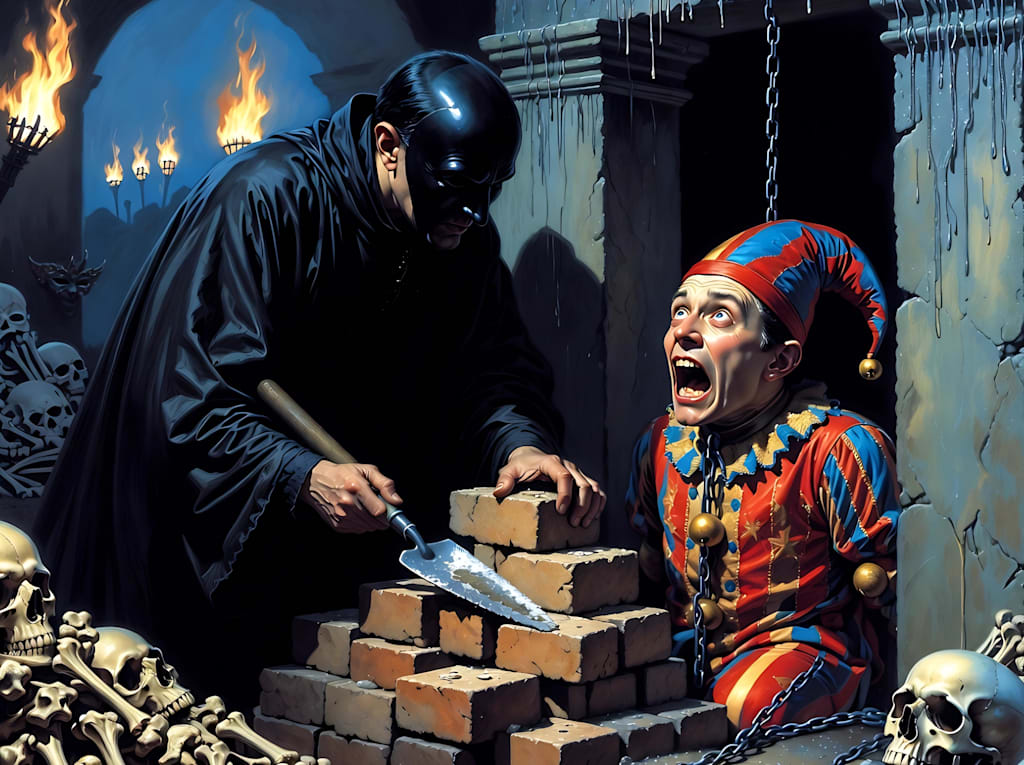
To enact the perfect revenge.
Thus was Montresor’s aim. (His name, incidentally, translates as “Treasure Mountain.” Make of that whatever you will.) One imagines Fortunato, a small, perhaps dwarfish knave dressed in the motley of a court jester, with a pointed cap of bells, looking as if he stepped from a 52-card deck of Aviator Cards, making his way through the streets at dusk during the carnival—drunk, coughing, hacking in his poor health. He is flushed; his feverish face is boiling with daubs of white and red. It is a picturesque grotesque, a sweaty, drooling wonder. And eyeing him, like a vulture in the crowd, circling him as if he were inexorable doom, his boon companion Montresor, who had borne Fortunato’s “thousand injuries” (we can only imagine and conjecture about them) but who bolted upon the perceived insult—and then plotted revenge, one best served cold, and with impunity. “Ah, my friend, I have acquired a pipe of Amontillado. But I have my doubts…”
We can well see the image of Vincent Price, hear the voice of Vincent Price, speaking as a kind, gentle friend, with his deep, resonant, distinctive intonations; just as much as we can hear the voice of Peter Lorre, the weirdly nasal inflections and creeping voice issuing forth from the small, clown-suited man. Around them, the sights and smells of carnival: the dark-costumed and masked revelers, wanton women and drunken men, boys in skeletal garb with their faces made up as if it were Día de Los Muertos. “I am off to see Luchresi.” Montresor baits the trap. The bait is Fortunato’s ego. Luchresi, he thinks, a fool.
“Amontillado,” he exclaims. “At the height of carnival? Impossible!”
“I have my doubts,” responds Montresor. At the mention of Luchresi, Fortunato exclaims, in fiery indignation, his slander that “Luchresi cannot distinguish Amontillado from cooking sherry!”
Fortunato, Montresor explains to us, considers himself an expert on the Italian vintages—which Montresor himself purchases liberally whenever he can. “There are some who claim his taste superior to your own.”
Nonsense, Fortunato assures him. Before the reader is aware, they are leaving the palazzo, the scene of the carnival; we must assume, with skeletal-suited boys adorned with skull-head makeup peering at them from burning torchlight revels. From there to Montresor’s palazzo, where he informs us that, having instructed his servants that they should not leave during his absence, he knew they would immediately make themselves scarce. Leading Fortunato, the unsuspecting lush, into the darkness, they each take a flambeau and, descending the staircase, proceed to journey to the crypts far below—the primal place in the darkness wherein old bones, skeletons of the forgotten (are they ancestors of the Montresors, or their victims?) are piled such as in the charnel catacombs beneath Paris. Downward, downward; there is a secret buried here. Fortunato coughs and hacks. Montresor insists, “Come, we must turn back. Your health is too precious!” The nitre-encrusted walls are sheer poison for the lung ailment Fortunato is so obviously nursing like a snake coiled in his bosom. “I will not die of a cough!” he responds. “Amontillado! Let us go!”
The thought of the delicious wine, the instrument of blotting out the cruel uncertainties, the rusted and blunted edges of a life that is often insufferable, appeals to the little jester, the drunken, hacking, and wheezing wearer of motley, like Fool’s Gold. It is an image of a dream, an imaginary treasure worth traversing the cold, damp, dark and rat-infested, dangerous catacombs heaped with the dried, desiccated remnants of human cadavers. The reader, you and I, are left to wonder at exactly how Montresor and Fortunato made their acquaintance—and what does the term “thousand injuries” imply? There is the subtle hint that Montresor’s familial lineage has decayed—that his is a name and reputation that has been cast upon the rocky coast of disrepute. Conversely, Fortunato may have a place of undeserved prominence, though he is an execrable and odious, insufferable and foolish knave. Montresor says, “I too, am a brother Mason.”
Fortunato blubbers, half-mad with coughing and poor respiration, and drunken desire (and arrogance): “You? A Mason? Impossible.”
The reader is left to conjecture exactly why it is impossible. Montresor produces a trowel, the pointed, vulva-shaped death-bringer foreshadowed. Fortunato is uncomprehending as they discuss the Montresor family coat of arms—a snake biting a golden heel, again, a grim foreshadowing of the revenge plotted against Fortunato. The foot could be the golden heel of the Montresors, the snake their perceived enemies. Contrarily, it might be a reversed image, wherein the serpent so cunningly hidden, Montresor, bites the heel of the more socially “golden” Fortunato. But the image suggests the intertwining between these two energies: the heel stomps the head of the snake, the snake forever bites the heel. “Nemo me impune lacessit.” It means: “No one attacks me with impunity.” This is the family motto. Again, everything points to the inexorable doom of the guileless, naïve Fortunato. Like The Fool in the Tarot, he is about to unsuspectingly walk over a cliff, to be crushed upon impact, like the head of the serpent, dashed amidst the rocks below. Below, as they descend, drinking a draught of liquor strong enough to quell the increasingly harsh coughing spasms suffered by the doomed clown, a recessed tomb, surrounded on three sides by heaped piles of bones (three being a number suggesting perfection, in death also the Holy Trinity), Montresor announces that the Amontillado is “in there. It’s right in there.”
Comically, pathetically, Fortunato (the name, incidentally, suggesting “Fortune,” as in Fate) goes slowly inside. “Where is it? Where is it?” He wants it so badly, he cannot discern the trap that is about to be sprung. Montresor springs upon him, wrapping a chain around him and securing him to the wall. Uncomprehendingly, thinking it is a joke, Fortunato pleads, helplessly: “A jest? We’ll have a good laugh at it later at the palazzo.” Yes, they’re really going to yuk it up.
Fortunato struggles against his iron bonds and begins to cry. With mounting horror, peering wildly in the darkness, he watches as Montresor, casting aside the refuse of bones, reveals a pile of bricks and mortar. He already had his trowel concealed about his person. The silken-masked Montresor, brick by agonizing brick, seals the fate of unfortunate Fortunato, who watches as he is entombed, slowly, ALIVE. The false womb has encircled him with the cold, loveless arms of the grave. The alcoholic fog he earlier experienced has parted; he is now aware that, in the stifling dark, he will die like a slowly fading memory. The catacombs were the snake-crawling (to sink its fangs into the sturdy golden foot) haunted darkness piled high with old bones, the primal, animalistic place in the deep Id wherein all thoughts of murder and revenge, because the instinct to survive is most primitive and darkly hidden beneath the surface of our social conditioning, are heaped with the bones of our ancestors, our victims, our skeletal secrets buried deep beneath the floorboards of the Upper Rooms of our egoistic pretensions toward divinity. Below, old memories of clownish apes and monkey jesters are walled in behind the crude stone vulva from which their births are still born. And Fortunato, exclaiming, “For the love of God, Montresor!” who dies with this on his lips, bore Montresor a “thousand” unspecified injuries and assaults—but his laughter is an echoing memory, in the dark. And Montresor tells us that that skeleton, as far as he is aware, has not been disturbed for half a century.
And nevermore shall it wake with hunger.
Or thirst.
Read my book: Theater of the Worm: Essays on Poe, Lovecraft, Bierce, and the Machinery of Dread by Tom Baker
Read my book: Silent Scream! Nosferatu, The CAbinet of Dr. Caligari, Metropolis, and Edison's Frankenstein--Four Novels by C. Augustine
Ebook
Print book
Author's website
Author's YouTube
About the Creator
Tom Baker
Author of Haunted Indianapolis, Indiana Ghost Folklore, Midwest Maniacs, Midwest UFOs and Beyond, Scary Urban Legends, 50 Famous Fables and Folk Tales, and Notorious Crimes of the Upper Midwest.: http://tombakerbooks.weebly.com
Enjoyed the story? Support the Creator.
Subscribe for free to receive all their stories in your feed. You could also become a paid subscriber, letting them know you appreciate their work.
Comments
There are no comments for this story
Be the first to respond and start the conversation.