
Flight 608
Sixty-nine souls disappeared. Someone has been keeping their seats warm.

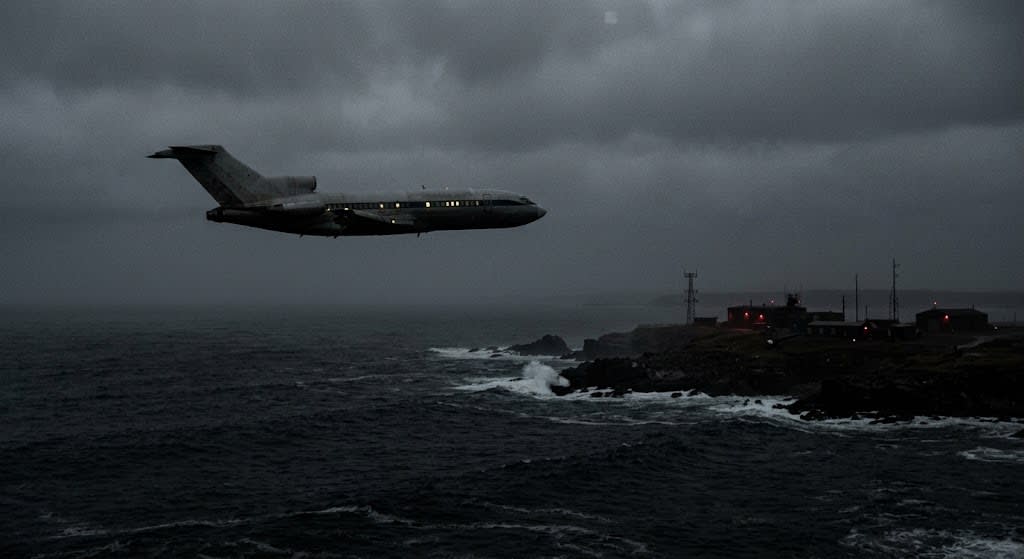
Amos Hensley had spent thirty-one years helping strangers disappear into the Atlantic, and he had never once considered the possibility that the ocean might return them. His job at Blackwood Tracking Station was simple enough to explain to a child and difficult enough to ruin a man’s life. Identify aircraft, record their positions, relay their requests, and maintain a permanent log of every transmission received. The military called the work surveillance. Amos called it bookkeeping for the living, a distinction he considered increasingly important as the years passed. He had learned that a man could endure almost anything provided his employer supplied the correct terminology.
The call came through the northern receiver during a routine sweep of commercial frequencies. The voice belonged to a male pilot, calm and professionally courteous, requesting permission to descend toward the Maine coast. Amos reached for his pencil, wrote the assigned flight number, and stopped with the point pressed against the paper. Flight 608 had vanished over the Atlantic thirty-four years earlier, carrying sixty-four passengers and a crew of five. Its disappearance had produced a federal inquiry, several hearings, three competing theories, and an official report concluding that the aircraft had suffered catastrophic structural failure. Amos had already read the report years ago. He remembered the final sentence because it had been written with the confidence of a verdict.
The pilot repeated his request, then supplied his name. Captain Mathew Gunter.
Amos opened the archived file. Gunter had been forty-six when the aircraft disappeared, a veteran pilot with more than eighteen thousand flight hours. His personnel photograph showed a narrow face, dark hair, and a smile that suggested patience with people who had never learned to read a checklist. Amos enlarged the image on his monitor, listening to the man describe his approach. The voice had the same measured cadence as the recording preserved in the federal archive, down to the slight catch before the captain pronounced his own surname. It was an exact match, not an impression. Amos knew the difference. He had spent his working life separating human certainty from verifiable fact.
Amos lowered the volume and searched the station database for previous contacts bearing the same call sign. The first entry dated from 1992, three weeks after Blackwood began operating under its present designation. The second appeared in 1998, the third in 2004, and the fourth in 2010. Every entry described a request for landing clearance from Flight 608, each signed by a different duty officer. Amos read the names twice. All four men had retired, and three had died. The fourth, a former supervisor named Arthur Bell, had been dismissed after an internal investigation into falsified records.
The current transmission continued. Gunter reported that his instruments indicated a descent rate of six hundred feet per minute, yet his altimeter showed a constant elevation. He requested a visual approach. Amos told him that the station could provide neither a runway nor navigational assistance. Blackwood had no landing facilities. The nearest airport lay more than a hundred miles south, and the surrounding wilderness offered little beyond military property and abandoned logging camps.
Gunter gave a short laugh. “That’s what the last man told me.”
Amos felt a cold sensation pass through him, followed by a flush of embarrassment at his own reaction. Pilots made mistakes. People impersonated missing persons. Old frequencies carried recordings, and sophisticated hoaxes could exploit gaps in official archives. He began listing these explanations in his mind with the brisk efficiency of a clerk sorting correspondence. Each explanation seemed reasonable until he remembered that the transmission was arriving on a frequency reserved for a military tracking system, using a call sign removed from active service decades earlier.
He contacted the regional control center and requested confirmation of any aircraft operating near Blackwood. The controller checked the available returns, then reported an empty sector. Amos supplied the flight number. A pause followed, and the controller asked him to repeat it. After Amos did, the man said that he would consult his supervisor.
While he waited, the receiver clicked.
A woman’s voice came through, faint and strained. She identified herself as passenger Margaret Gunter, age thirty-nine, traveling with her husband on a business trip to Boston. She wanted to know whether the aircraft had reached the coast. Her voice broke as she explained that the other passengers had begun complaining about a smell of seawater. Captain Gunter had ordered everyone to remain seated. The engines were running, the cabin was pressurized, and the instruments appeared normal. Yet the sea could be seen rising toward the aircraft through every passenger window.
Amos checked the archived passenger manifest. Margaret Gunter was listed as the captain’s wife. She had been aboard Flight 608 when it vanished.
“Captain Gunter,” Amos said, “your wife is calling on the cabin frequency.”
The pilot took several seconds to respond. When he spoke again, his professional composure had fractured. He asked Amos to repeat the statement, then demanded to know who had supplied the name Margaret. Amos gave him the information from the archive. The captain began speaking rapidly, insisting that his wife had been asleep for the past hour and that nobody aboard had been told the destination had changed.
A third voice interrupted. This one belonged to a child, a boy of perhaps eight years, reciting a list of names in a careful, schoolroom cadence. Amos heard each name distinctly. He recognized several from the manifest, then several from the station’s archived contact logs. The final name was Arthur Bell.
The child stopped reciting. “Mr. Bell said we have to wait until the man at the station opens the door.”
Amos stood so abruptly that his chair toppled backward. The regional controller returned to the line, demanding an explanation for the unauthorized transmission. Amos ignored him. He searched the station archive for Arthur Bell’s dismissal report, found the file, and opened the final page. The investigation had concerned falsified contact records, unauthorized responses to unidentified aircraft, and the deletion of several hours of recorded transmissions. Bell had claimed that he was following instructions from a superior whose name did not appear on any personnel roster. He had been removed from duty and transferred to an administrative post. Six months later, he had disappeared during a solo fishing trip.
At the bottom of the report, a handwritten note had been scanned into the file. Amos recognized the cramped lettering from the old logbooks. Bell had written a single sentence: We keep telling them to come in.
The receiver clicked again. Captain Gunter asked for landing clearance, and this time Amos heard the desperation in his voice. He said the passengers had begun gathering near the cockpit, demanding answers. Several had noticed that their watches had stopped at the same minute. Others claimed that their relatives were calling them over the cabin speakers, speaking from places they had never visited. Gunter had locked the cockpit door, and the first blows had begun against its outer panel.
Amos reached for the transmitter. He could end the call, report a technical failure, and leave the next shift to deal with whatever remained. His entire career had taught him the value of proper procedure, and his entire life had taught him the value of refusing responsibility when the consequences became inconvenient. He had become very good at both.
Then the boy spoke again. “Mr. Hensley, your name is next.”
Amos froze. The child began reading from a list. Amos heard his full name, his date of birth, and the name of the hospital where he had been delivered. The child recited his employment history, his home address, and the name of the woman who had raised him. Each fact was accurate, each delivered with the same patient precision. Then the child reached the end of the list and announced that Amos had been assigned a seat in the rear cabin.
The regional controller broke into the transmission, ordering Amos to disconnect immediately. Amos turned toward the main console, intending to cut power to the receiver. His gaze fell on the duty log, where a new entry had appeared in his own handwriting. The ink was fresh. The entry carried the current date and a precise time, followed by a description of the incoming aircraft and its request for landing clearance. Beneath the description was a final notation: Clearance granted by operator.
Amos had written it. He remembered doing so. He remembered the pen moving across the page, the pressure of its point, the peculiar relief he had felt upon completing the entry. The memory belonged to him as surely as any other memory, yet he could recall no decision to write those words.
He reached for the logbook and tore out the page. The receiver gave a sharp burst of static, and Captain Gunter spoke with sudden calm. He thanked Amos for the clearance and confirmed that the aircraft was beginning its final descent. In the background, the passengers had stopped shouting. Amos could hear them moving toward the exit in orderly rows, their voices rising in a chorus of gratitude.
The station’s outer door opened.
Amos stared at the entrance, which led into a short corridor ending at the security checkpoint. Beyond the checkpoint lay the access road, the vehicle lot, and the surrounding Maine wilderness. The door stood open, yet the corridor appeared to extend much farther than its construction allowed. At its far end, rows of passengers waited beneath fluorescent fixtures, carrying luggage and wearing the expressions of people relieved to have reached a destination after an unpleasant journey.
Captain Gunter thanked him once more. Then the pilot added, in the same courteous tone, that the station had been selected as the point of arrival because every passenger required an official witness. The disappearance had been an administrative error, he explained. The passengers had remained in transit for thirty-four years, and the records needed to be corrected.
Amos looked at the names on the duty log. Each previous operator had signed the arrival entry. Each had granted clearance. Each had left the station before the aircraft reached its destination, and each had subsequently disappeared from the public record. Blackwood had continued to function, staffed by replacements who knew nothing of the earlier calls. The process had repeated itself until the station had become part of the flight plan.
The first passenger crossed the checkpoint. Margaret Gunter followed, carrying a small handbag and wearing the same clothes shown in her archived photograph. She glanced at Amos and offered a polite smile, like he was a hotel clerk who had found her reservation. The boy came next, still holding his list. He looked directly at Amos and placed a final mark beside the operator’s name.
Captain Gunter’s voice returned over the receiver. “We have reached our destination, Mr. Hensley. Please prepare for departure.”
Amos tried to answer, yet the transmitter had gone dead. The passengers continued past him in orderly silence, their shoes tapping against the corridor tiles. One by one, they vanished through the station’s inner doorway, leaving behind the faint smell of seawater and the sound of distant engines.
When the last passenger had passed, the aisle returned to its proper length. The outer door closed, the receiver resumed its routine static, and the regional controller called to confirm that the sector remained clear. Amos sat down, opened the duty log, and entered the final notation in his own handwriting.
Flight 608 had landed.
He signed his name under the entry, placed the pen beside the logbook, and waited for the next transmission.
About the Creator
Nolan Reed
I write true stories, including unsolved mysteries and events that actually happened.
Enjoyed the story? Support the Creator.
Subscribe for free to receive all their stories in your feed.
Comments
There are no comments for this story
Be the first to respond and start the conversation.