
'Def-Con 4' (1985): From Orbital Ideas to Post-Apocalyptic Clichés
Paul Donovan’s low-budget Canadian science-fiction film begins with the promise of a thoughtful examination of nuclear annihilation before crash-landing in the familiar territory of cannibals, sadists, and post-apocalyptic despots.

A Thinking Man’s Apocalypse. For About Fifteen Minutes.
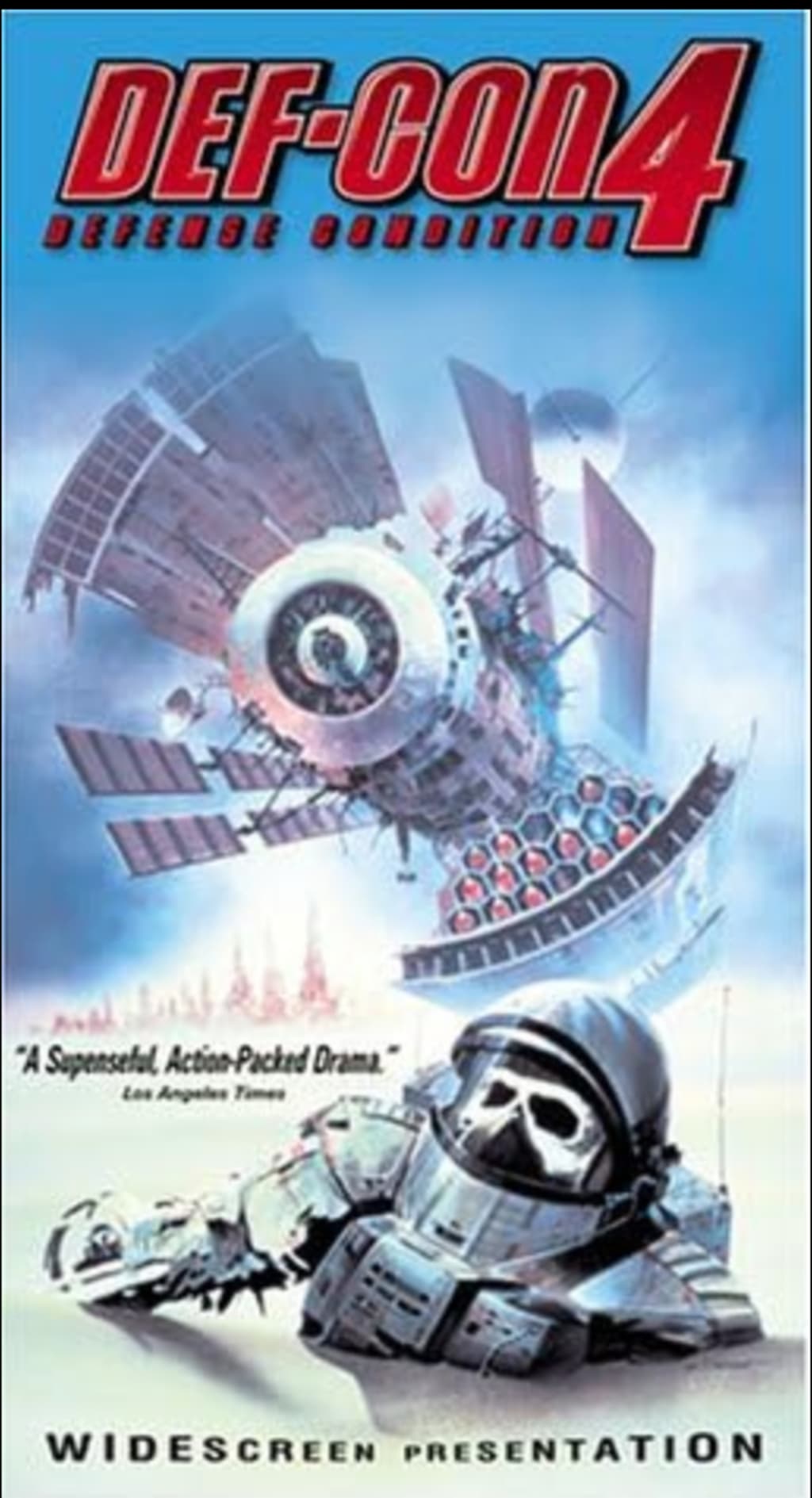
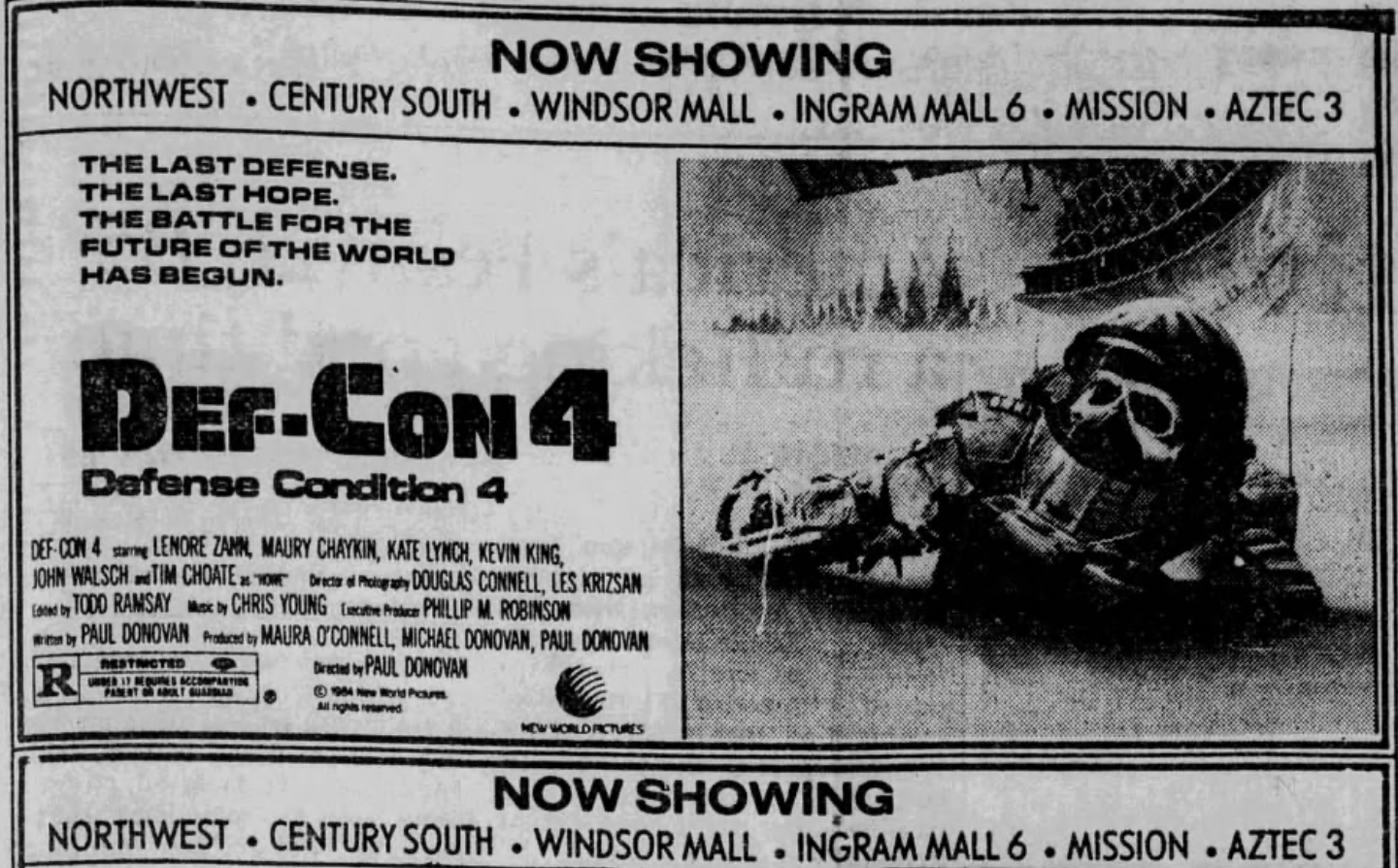
There’s something wonderfully misleading about the poster for Def-Con 4.
It promises a world reduced to its ugliest essentials, a science-fiction nightmare in which humanity has managed to do what humanity has always threatened to do: blow itself to pieces. The title suggests military precision, nuclear brinkmanship, and the sort of catastrophe that makes every surviving human being reconsider the wisdom of having survived.
Then you watch the movie.
Well, that’s where things get complicated.
Released in 1985, Def-Con 4 arrived during a decade when the possibility of nuclear annihilation wasn’t simply a science-fiction conceit. It was part of the cultural background noise. The Cold War was still grinding along, Ronald Reagan was in the White House, and popular cinema had developed a healthy appetite for imagining what happened after the missiles flew.
Some filmmakers approached the apocalypse as a philosophical question. Others saw an opportunity to put leather-clad maniacs in the desert and see how long an audience would tolerate people behaving like monsters.
Def-Con 4 attempts to have it both ways.
Directed primarily by Canadian filmmaker Paul Donovan, the movie begins with an intriguing premise: three astronauts aboard a secret military space station witness a nuclear war destroy civilization below them. Eventually forced to return to Earth, they discover that the world they knew has been replaced by something considerably less welcoming.
The opening suggests a film interested in isolation, the psychological consequences of nuclear war, and the awful realization that surviving the end of the world might not be much of a victory.
Contemporary critics noticed that promise. They also noticed how quickly the film squandered it.
Robert W. Butler, reviewing the movie for The Star, awarded it a mere one-and-a-half stars. The opening minutes, he suggested, offered the possibility of a thinking person’s science-fiction film, only for the picture to deteriorate into the usual post-Armageddon clichés.
That is a fairly concise description of Def-Con 4’s central problem.
The movie starts by looking into the abyss. Before long, it seems more interested in showing us what somebody has dragged out of it.
Cold War Anxiety on a Canadian Shoestring
Def-Con 4 emerged from Salter Street Films, the Halifax-based production company associated with Paul Donovan and his brother Michael Donovan.
The production was a modest undertaking, reportedly made for approximately $800,000. That figure puts the film’s ambitions into perspective. This wasn’t a Hollywood blockbuster with an army of effects technicians, elaborate sets, and enough money to destroy several miniature cities before lunch.
It was an independent Canadian production attempting to build an entire post-nuclear world with limited resources.
The premise gave the filmmakers an advantage. Beginning in space allowed them to establish distance from the catastrophe before bringing the surviving characters down to Earth. The astronauts could observe the destruction from above, trapped between the relative security of their station and the knowledge that everything awaiting them below might already be gone.
It’s an effective dramatic arrangement. Their isolation is both physical and emotional. They can watch the end of civilization, but they cannot stop it. And when they finally return, the familiar world that gave their lives meaning has disappeared.
That’s considerably more interesting than simply starting with a motorcycle gang chasing somebody through a ruined shopping mall.
The film also belongs to a distinctly Canadian corner of 1980s genre filmmaking often described as Canuxploitation. Canadian producers and filmmakers were making inexpensive horror, science fiction, and exploitation pictures that could travel internationally, sometimes finding commercial life in American theaters and the rapidly expanding home-video market.
The international marketplace didn’t necessarily demand polished masterpieces. It demanded concepts that could be communicated quickly, posters that looked exciting from across a video store, and movies that delivered enough genre material to satisfy an audience looking for something lurid.
Def-Con 4 had a premise that practically sold itself.
A secret space station. World War III. A devastated Earth. Cannibals. A desperate fight for survival.
The trouble was that the more familiar the movie’s world became, the less interesting its ideas seemed.
A Note About the Title
The title deserves a small clarification.
DEFCON is the United States military’s Defense Readiness Condition system, which uses five levels of readiness. DEFCON 5 represents normal peacetime readiness, while DEFCON 1 represents maximum readiness for imminent or ongoing hostilities.
The numbers run in the opposite direction from what an uninitiated audience might expect: the lower the number, the higher the readiness.
The film’s title invokes that system to suggest an approaching catastrophe, although the title itself should not be mistaken for a precise description of a particular real-world alert condition.
It’s a catchy title, regardless. In the world of 1980s video-store marketing, a little military-sounding menace could go a long way.
Building the End of the World in Nova Scotia
Paul Donovan wrote Def-Con 4 and handled its principal directing duties, working alongside producer Michael Donovan and Maura O’Connell.
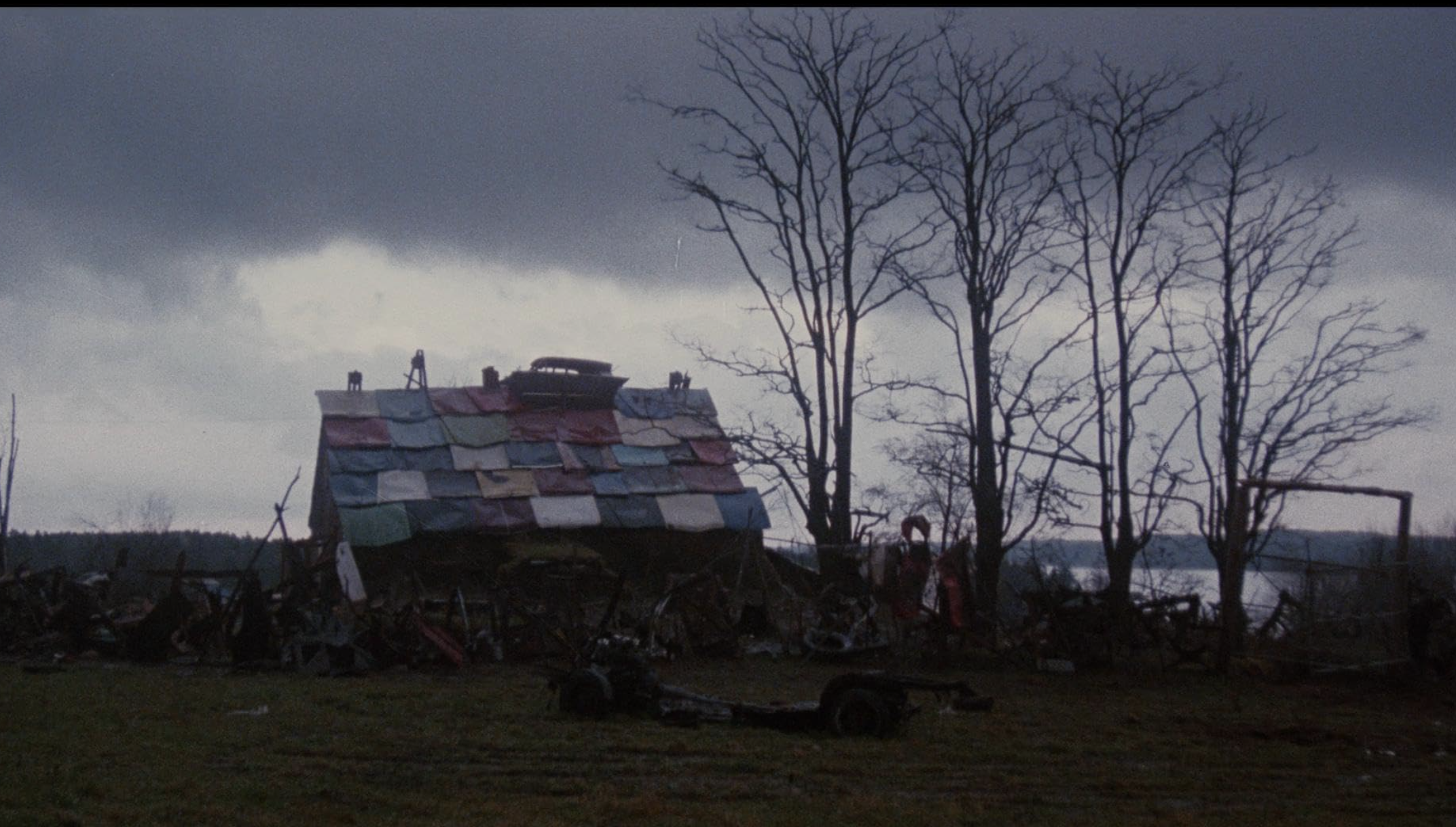
The production was filmed largely in Nova Scotia, including locations around Halifax. Among the less glamorous locations was a Halifax junkyard, the sort of place that could become a ready-made post-apocalyptic landscape with the right framing, some atmospheric lighting, and a convincing amount of industrial debris.
There is an undeniable resourcefulness to this kind of filmmaking.
When you don’t have the money to build a ruined civilization from scratch, you find places that already look as though civilization has given up.
The film’s directing credits can also be confusing. Paul Donovan is generally identified as its principal director, but Digby C. Cook worked on the news segments, while Tony Randel contributed to additional portions. The varying credits reflect the film’s segmented production rather than a conventional arrangement in which one director necessarily handled every sequence.
The cinematography was credited to Douglas Connell and Les Krizsan. Christopher Young supplied the score, an early entry in a career that would eventually make him one of the more recognizable composers working in film music, particularly in horror.
Young’s involvement is one of the more interesting footnotes in the production’s history. A movie can have problems with pacing, characterization, and storytelling while still benefiting from a composer who understands how music can establish atmosphere.
The cast included Tim Choate as Howe, Kate Lynch as Jordan, and John Walsch as Walker. Maury Chaykin played Vinny, with Lenore Zann as J.J. and Kevin King as Gideon.
It’s a cast assembled to populate a world in which the usual social rules have collapsed. Some characters are trying to preserve their humanity. Others have discovered that the end of civilization offers opportunities for people who never had much use for humanity in the first place.
That conflict ought to provide plenty of dramatic material.
Whether the film makes the most of it is another question.
Three Astronauts and One Very Unhappy Planet
The premise of Def-Con 4 is more interesting than its eventual reputation might suggest.
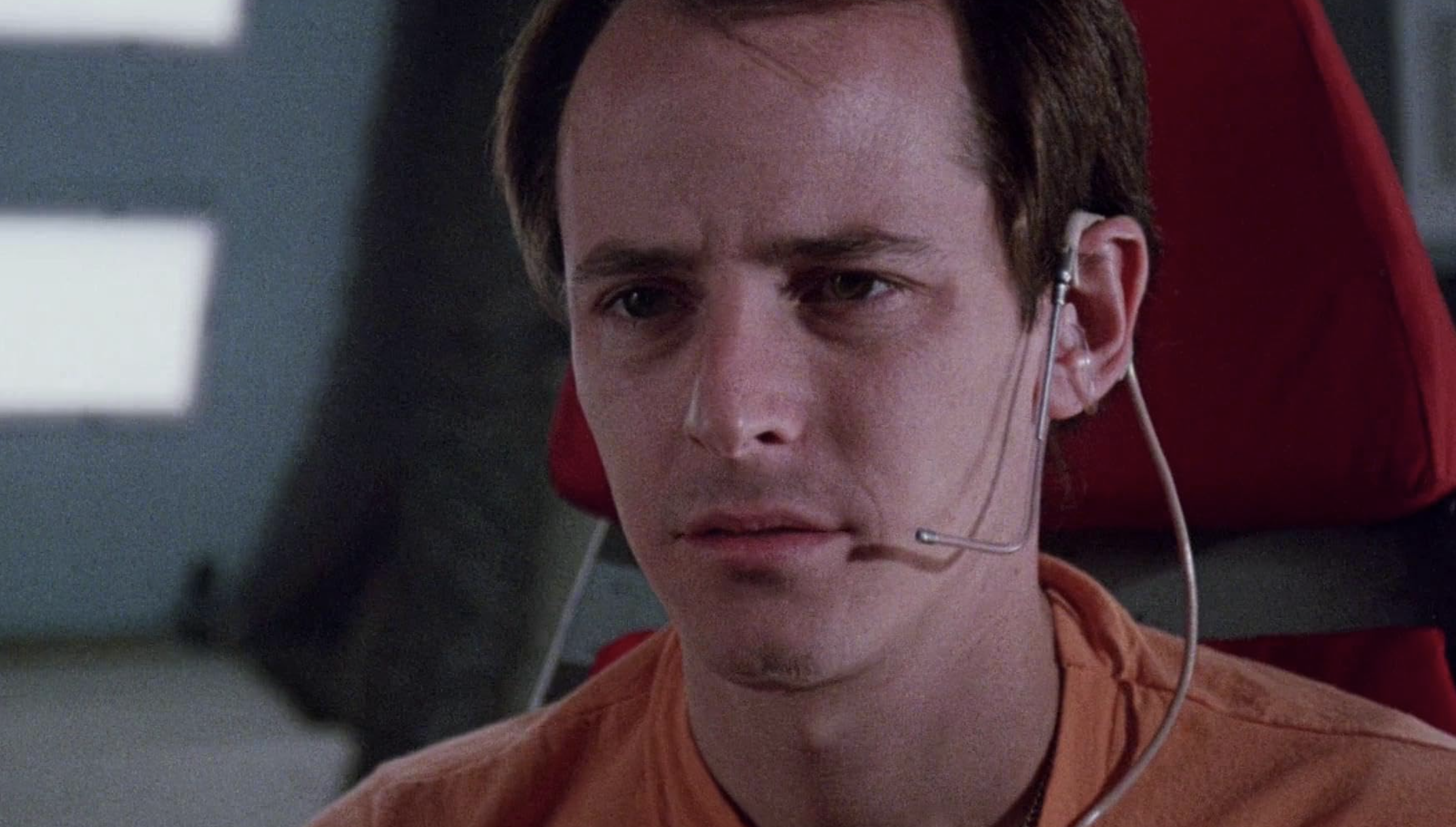
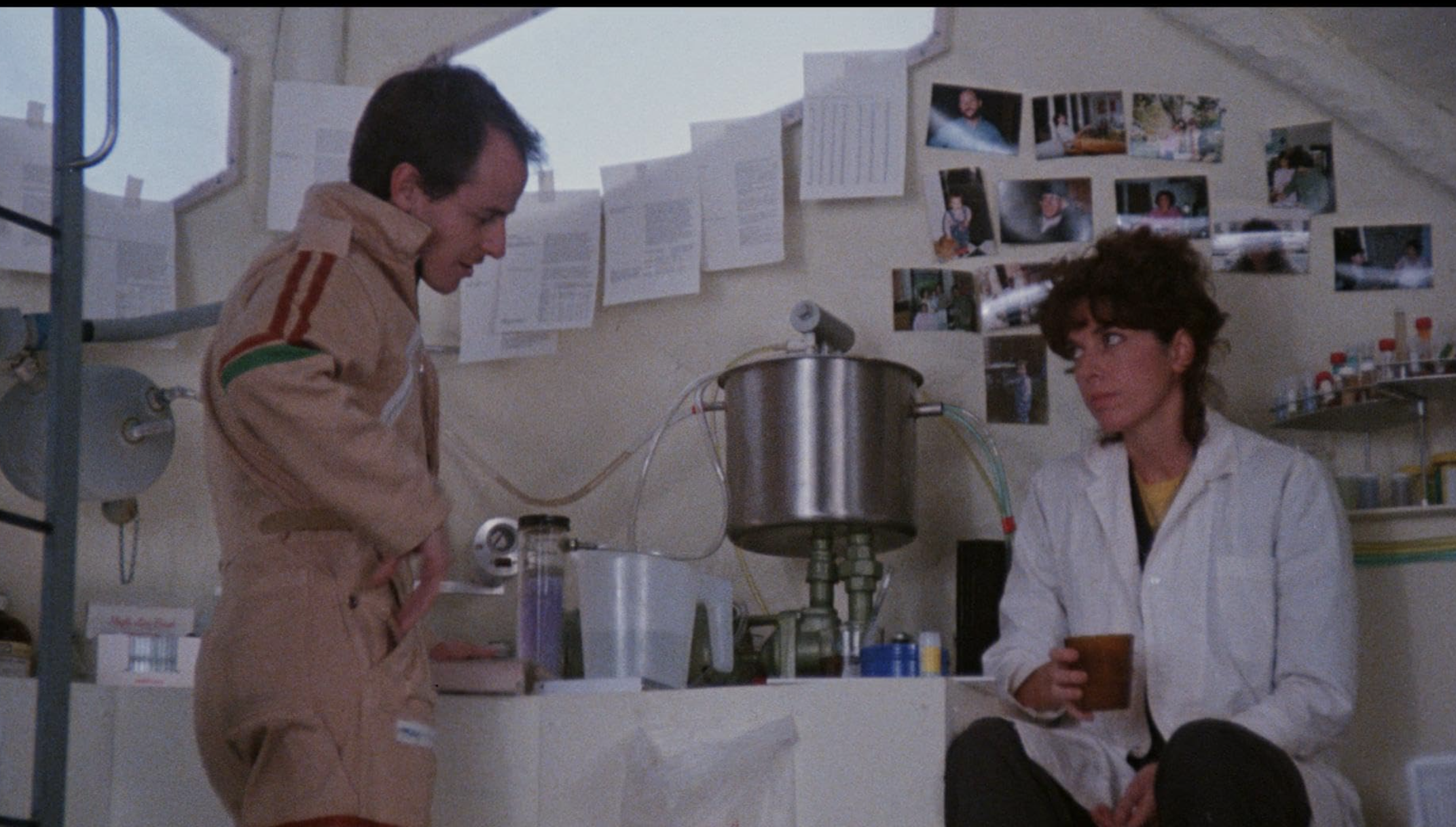
Three astronauts—two men and a woman—are stationed aboard a secret, nuclear-armed military installation in orbit. They are isolated from the ordinary world even before the catastrophe begins, their lives governed by routine, machinery, and the strange emotional distance that comes from looking down at a planet you cannot touch.
Howe, played by Tim Choate, receives taped messages from his wife. Those recordings provide a personal connection to the life he has left behind, turning the impending disaster into something more immediate than a map full of flashing lights.
For Howe, the end of the world isn’t an abstract geopolitical event. It threatens the person waiting for him at home.
Then the missiles fly.
In the film’s scenario, a Libyan hijacking of nuclear missiles helps trigger the global catastrophe. The astronauts watch the destruction unfold from above, with the scale of the disaster made all the more disturbing by their inability to intervene.
Eventually, their orbiting refuge ceases to offer a viable escape. The survivors must return to Earth, crash-landing in a devastated Nova Scotia.
And this is where the movie begins to change.
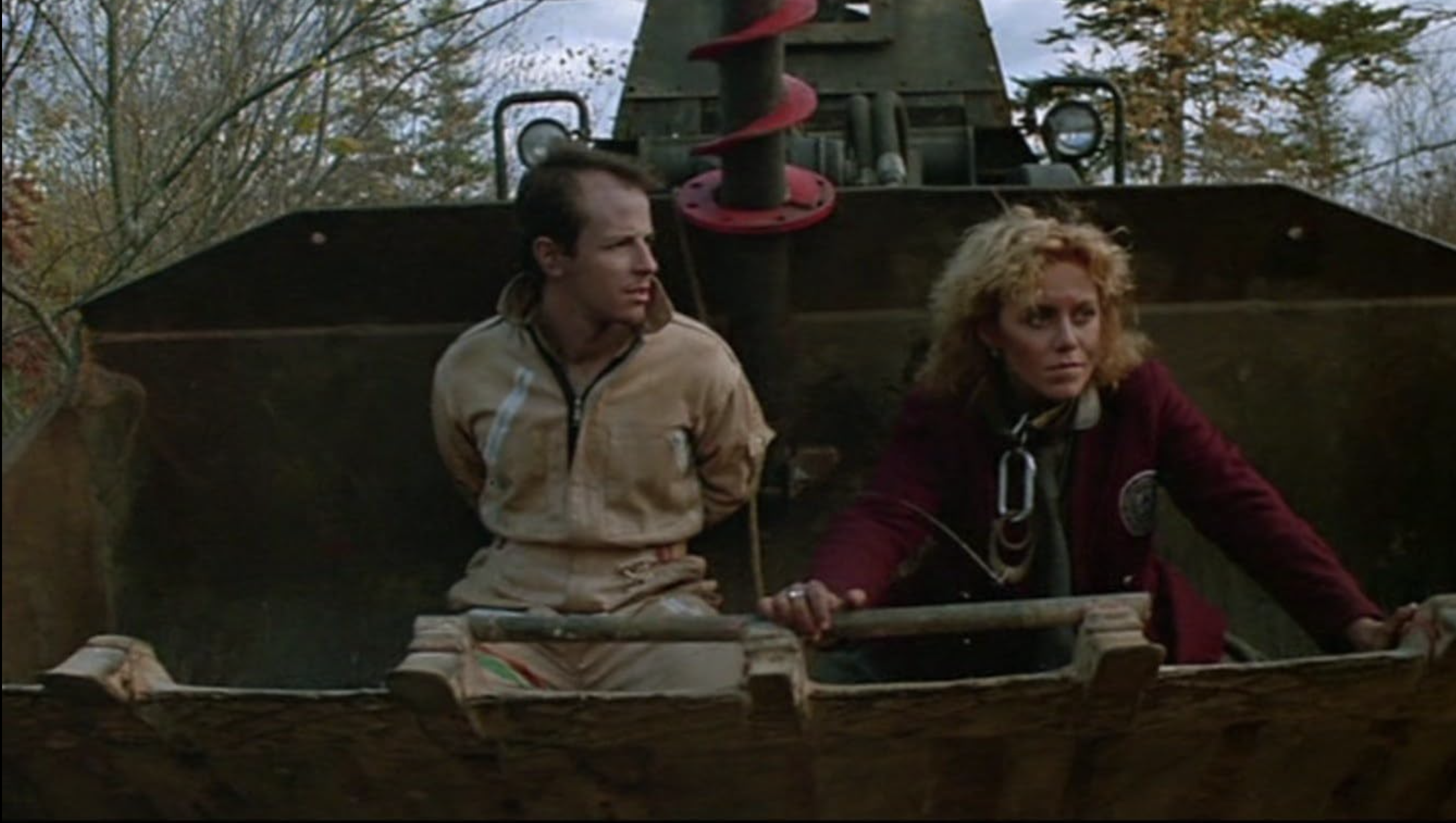
The astronauts encounter people known as terminals, radiation-crazed cannibals whose existence turns the wasteland into a place of immediate physical danger. They also cross paths with a survivalist and discover a fortified community ruled by a teenage despot whose preppy appearance makes him an especially peculiar specimen of post-apocalyptic authoritarianism.
The world has become a collection of competing little kingdoms, each governed by whoever possesses the most weapons, the least conscience, or the strongest appetite for controlling other people.
There is also a race against a countdown, with the survivors searching for a safe zone while attempting to navigate a landscape in which virtually everyone seems determined to make their lives more difficult.
It’s a familiar collection of post-apocalyptic ingredients.
The question is whether familiarity can be transformed into something meaningful.
In Def-Con 4, the answer becomes increasingly uncertain as the film moves away from the astronauts’ isolation and toward the uglier spectacle of survival in a world without rules.
The Critics Saw the Crash Coming
The contemporary reviews are especially revealing because they document the gap between what Def-Con 4 appears to promise and what it eventually delivers.
The film wasn’t simply dismissed because it was inexpensive or because its special effects couldn’t compete with a major studio production. Its more interesting qualities were recognized, at least initially.
The problem was that the movie couldn’t sustain them.
Robert W. Butler: The Promise of a Thinking Man’s Science-Fiction Film
In his review for The Star, Robert W. Butler awarded Def-Con 4 one-and-a-half stars.
His reaction followed a recognizable trajectory. The opening minutes suggested a film interested in ideas rather than hardware, with the astronauts’ isolation and their awareness of the nuclear devastation below providing the foundation for a more thoughtful examination of the apocalypse.
Then the film deteriorated into familiar territory.
Butler took particular issue with the roaming cannibalistic mutants, the feudal dictatorship ruled by a preppy-looking despot, and the accumulation of sadism and killing.
The juxtaposition is almost comical. Here is a movie that begins with the unimaginable scale of nuclear war and ends up presenting us with a wasteland populated by familiar exploitation-film nasties.
The opening asks us to contemplate the fragility of civilization.
The second half seems content to throw civilization into a ditch and see who comes along to kick it.
Butler’s review captures the central disappointment of Def-Con 4: the sense that the filmmakers had stumbled onto an interesting idea but couldn’t resist replacing it with a collection of genre conventions.
Steven Rea: An Apocalypse Without Much Beneath the Surface
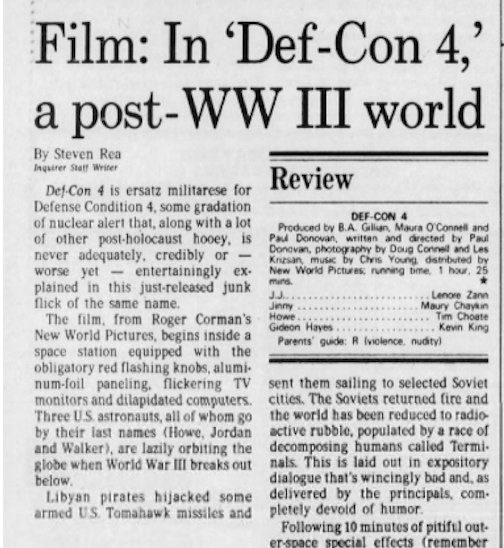
Steven Rea was similarly unimpressed, describing the picture in terms that connected its nuclear-alert premise to the familiar conventions of post-holocaust cinema.
His review also placed the film within the New World Pictures distribution landscape, where inexpensive genre productions could find theatrical exposure before moving into the home-video market.
That context matters.
Def-Con 4 wasn’t operating in isolation. It belonged to a commercial environment in which science-fiction and horror movies could be built around a strong central image or an easily communicated premise, then marketed to audiences who knew roughly what they were buying.
The movie’s space-station opening gives it an appealing hook. Its descent into post-apocalyptic disorder supplies the expected genre merchandise.
But a strong hook is not the same thing as a strong film.
Rea’s reaction points toward the thinness of the finished picture, suggesting that its ingredients never quite develop into the substantial drama its opening appears to promise.
It’s the cinematic equivalent of ordering an elaborate meal based on the menu description and discovering that the kitchen has run out of everything except the garnish.
Richard Duckett: A Con from Start to Finish
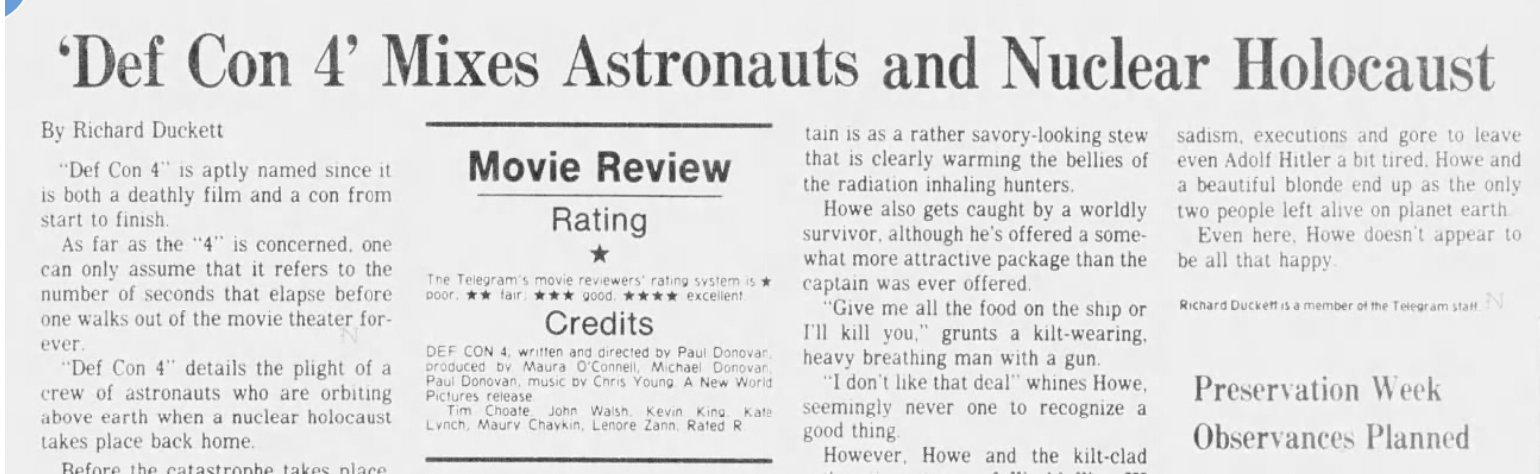
Richard Duckett’s review in the Telegram was even harsher, awarding the film one star.
He played on the title itself, treating Def-Con 4 as both a deathly cinematic experience and a con from start to finish.
Duckett found little to praise beyond the early passages. As the story progressed, he objected to the characters, the increasingly absurd developments, and what he regarded as serious shortcomings in the editing and direction.
He was particularly troubled by the film’s escalating viciousness: the sadism, executions, and gore that increasingly dominate the picture.
His reaction was not simply that the movie was violent. Violence, after all, was hardly an unexpected feature of post-apocalyptic cinema in 1985.
The problem was the apparent pointlessness of it. The ugliness accumulates without necessarily adding much insight into the people inhabiting this ruined world.
By the end, Duckett’s patience had evaporated. His closing observation about Howe and a beautiful blonde being left as the last survivors, neither appearing particularly happy about the arrangement, gives the film’s conclusion a distinctly sour aftertaste.
That’s a remarkably unenthusiastic way to end a movie about the struggle to survive.
Then again, Def-Con 4 doesn’t seem particularly interested in making survival look like a desirable outcome.

What Later Viewers Found in the Wreckage
Not every subsequent assessment has been quite so severe.
TV Guide has awarded the film three out of five stars, and later genre enthusiasts have found things to appreciate in its atmosphere, its ambitions, and Christopher Young’s score.
Those reassessments aren’t necessarily incompatible with the original reviews.
A film can be uneven and still possess interesting qualities. Its limitations can even become part of its appeal, particularly for viewers interested in the peculiar ways inexpensive genre movies tried to imagine the future.
The opening sequences remain the strongest argument for taking Def-Con 4 seriously. The astronauts’ separation from Earth provides a perspective that many landlocked post-apocalyptic films lack. Before the movie becomes preoccupied with the behavior of the survivors, it gives us a glimpse of the terrible scale of what they have lost.
That’s something.
It’s just not enough to rescue everything that follows.
From Theaters to the Video Store
Def-Con 4 received a limited U.S. theatrical release through New World Pictures on March 15, 1985.
Its reported domestic theatrical gross was approximately $1.057 million, a modest result that reflects the film’s limited commercial reach. It was never positioned as a major science-fiction event, and its financial performance didn’t establish it as a breakout success.
The home-video market offered a different kind of opportunity.
By the mid-1980s, inexpensive science-fiction and horror movies could enjoy an afterlife beyond their initial theatrical runs. A title that failed to make much noise in theaters might still find an audience through video rentals, television exposure, and the steady circulation of genre recommendations.
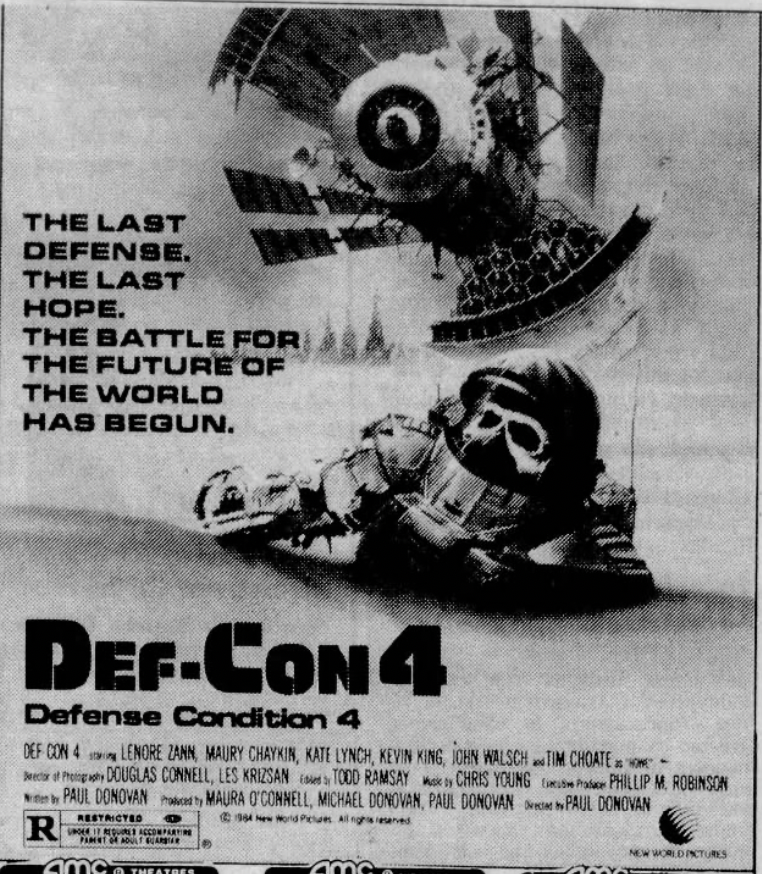
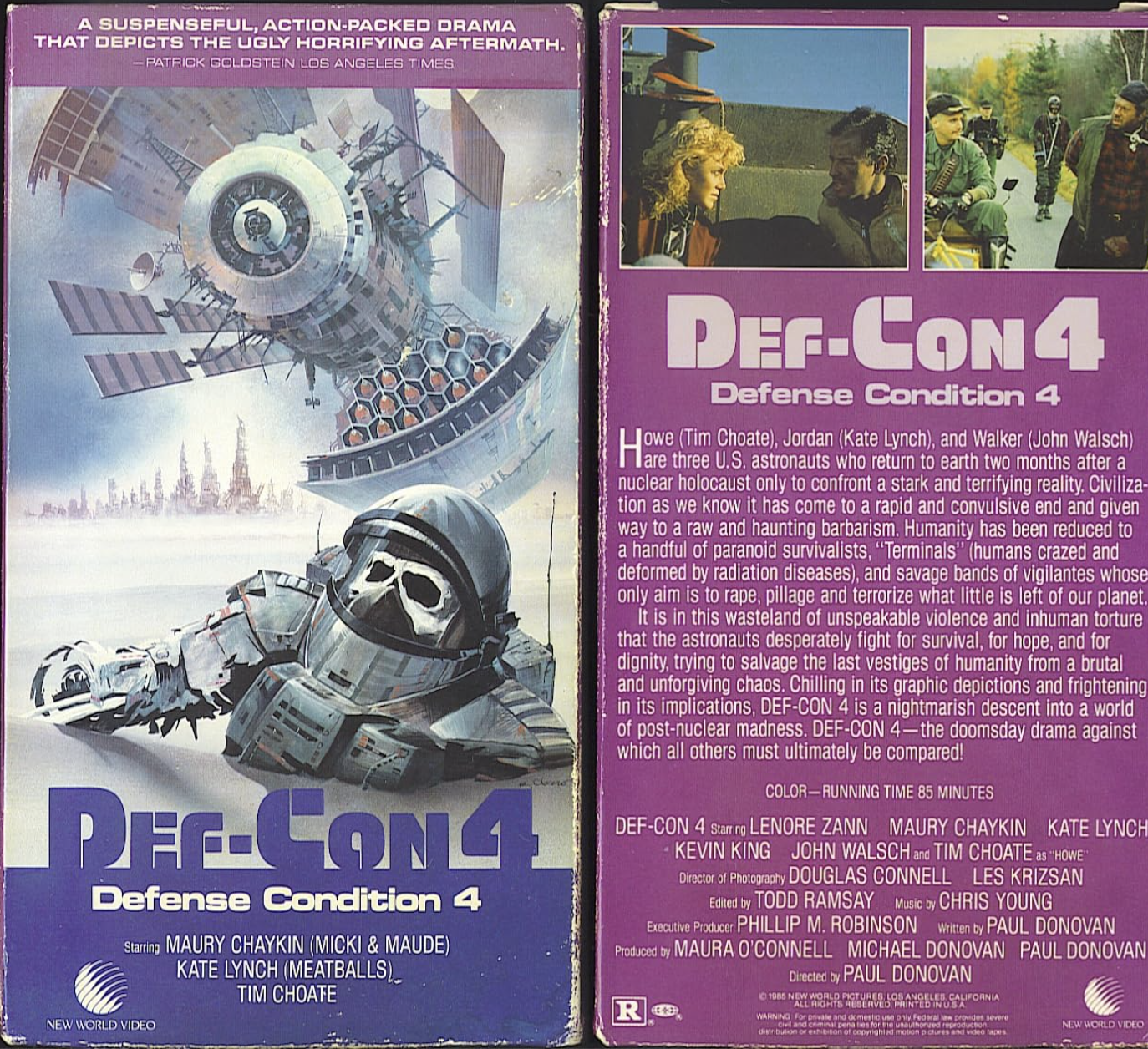
The poster and VHS packaging could be important parts of that process. A film didn’t have to be famous to attract attention. It needed to look as though something interesting might happen if you spent an evening watching it.
Def-Con 4 had that advantage. The title suggested a military emergency, while the imagery promised a world in which the familiar structures of society had collapsed.
The movie’s actual scale was much smaller than its premise, but that was hardly unusual for the era’s independent science-fiction productions.
New World Pictures had experience distributing films that traded on strong genre identities, and Def-Con 4 fit comfortably into that ecosystem.
The result was not a major theatrical success, but the film remained available for discovery by viewers interested in the less polished corners of 1980s genre cinema.
Sometimes that’s how these movies survive. Not through a spectacular opening weekend or a wave of critical acclaim, but through a battered VHS tape, an intriguing cover, and the curiosity of somebody who wants to see what all the fuss was about

The People Who Survived the Movie
One of the pleasures of revisiting forgotten genre films is seeing the careers that continue beyond the credits.
Paul Donovan went on to create Lexx, the Canadian-German science-fiction series that developed a distinctive following through its eccentric characters, unusual humor, and willingness to wander far beyond conventional television science fiction.
Looking back, Def-Con 4 becomes an interesting early marker in a career that would continue exploring strange worlds and the peculiar behavior of the people inhabiting them.
Christopher Young, meanwhile, went on to build an extensive career as a film composer, becoming particularly associated with horror and suspense. His participation in Def-Con 4 offers another reason to pay attention to a film that otherwise might be easy to dismiss.
Maury Chaykin continued building the character-actor career that made him a familiar presence across film and television. Lenore Zann later entered politics in Canada, serving as a member of Parliament.
These aren’t reasons to pretend Def-Con 4 is better than it is. A movie doesn’t become a masterpiece because somebody involved eventually does excellent work elsewhere.
But these connections give the film a place within a larger history of Canadian filmmaking and the careers that developed around it.
They also remind us that low-budget productions are rarely isolated curiosities. They are part of working lives, professional experiments, and the sometimes unpredictable routes through which filmmakers learn their craft.
An Apocalypse That Doesn’t Quite Add Up
The most interesting thing about Def-Con 4 may be the distance between its opening and its conclusion.
At first, the movie has a legitimate science-fiction question on its hands: what happens when people who have been physically removed from the world are forced to return to it after civilization has destroyed itself?
The astronauts aren’t merely survivors. They are witnesses. Their experience of the catastrophe is shaped by distance, helplessness, and the gradual disappearance of the world that once made their lives intelligible.
That could have sustained an entire film.
Instead, Def-Con 4 increasingly resembles the post-apocalyptic pictures it initially seemed capable of improving upon.
The cannibals arrive. The tyrants take control. The survivors stumble through a landscape in which brutality becomes the dominant language. The philosophical implications of nuclear annihilation give way to the familiar mechanics of people trying to avoid being murdered.
There is nothing inherently wrong with that approach. Post-apocalyptic fiction has always been fascinated by the question of whether humanity deserves another chance.
But the best examples use their ruined landscapes to reveal something about the societies that created them. The apocalypse becomes more than an excuse to strip civilization away. It becomes a way of examining what civilization was hiding.
Def-Con 4 occasionally gestures in that direction. Its opening understands that the destruction of a world is also the destruction of a set of relationships, assumptions, and emotional attachments.
Its later passages are less interested in what those losses mean than in what the survivors might do to one another.
The difference is substantial.
A nuclear war is a civilization-ending event. A bunch of unpleasant people fighting over the remains is merely a bad day in the wasteland.
And if that’s all a post-apocalyptic movie has to offer, there are better examples to choose from.
The Verdict: Worth a Look, Not a Revelation
Def-Con 4 is not a hidden masterpiece waiting for the right critic to discover it.
The contemporary reviews were harsh, but they weren’t entirely wrong. The film begins with an intriguing premise, establishes an effective atmosphere of isolation, and hints at a more thoughtful examination of life after nuclear annihilation. Then it gradually abandons those strengths in favor of familiar post-apocalyptic violence and increasingly outlandish characters.
Its modest budget explains some of its limitations. It doesn’t explain all of them.
The more serious problem is that the film never quite decides what it wants to be. It has the ingredients for an interesting science-fiction drama, but it also wants to deliver the cannibals, despots, and vicious survival scenarios that audiences associated with the post-Mad Max landscape.
The result is a movie caught between two impulses, neither of which completely wins.
For viewers exploring 1980s apocalypse cinema, Def-Con 4 is still worth watching. The opening provides a glimpse of the film that might have been, while the later sections offer a snapshot of the era’s taste for increasingly grim visions of human behavior.
Its Canadian production history also makes it a worthwhile footnote in the development of independent genre filmmaking.
And if the movie eventually collapses under the weight of its own clichés, at least it gives us something to think about.
Mostly, that is.
Def-Con 4 reminds us that the end of the world was a remarkably popular subject in the 1980s. Filmmakers kept imagining the final day of civilization, then sending their characters stumbling through the wreckage in search of food, shelter, and someone to distrust.
Some found something meaningful in the ruins.
Others found a junkyard, a few cannibals, and a preppy kid with delusions of grandeur.
Paul Donovan’s film starts by suggesting it might belong to the first category. By the end, it has drifted rather decisively into the second.
That’s not enough to make it a classic.
It is enough to make it an interesting relic of a decade when the fear of nuclear annihilation could inspire both serious reflection and some truly peculiar cinematic choices.
Movies of the 80s verdict: An ambitious Canadian science-fiction oddity with an intriguing opening, a memorable atmosphere, and a second half that never quite lives up to the promise. Worth a look for genre completists, but don’t expect a lost masterpiece.

About the Creator
Movies of the 80s
We love the 1980s. Everything on this page is all about movies of the 1980s. Starting in 1980 and working our way the decade, we are preserving the stories and movies of the greatest decade, the 80s. https://www.youtube.com/@Moviesofthe80s
Enjoyed the story? Support the Creator.
Subscribe for free to receive all their stories in your feed.
Comments
There are no comments for this story
Be the first to respond and start the conversation.