
Dark Shadows: The Beginning (Part 1)
Season One, Episodes 1-87

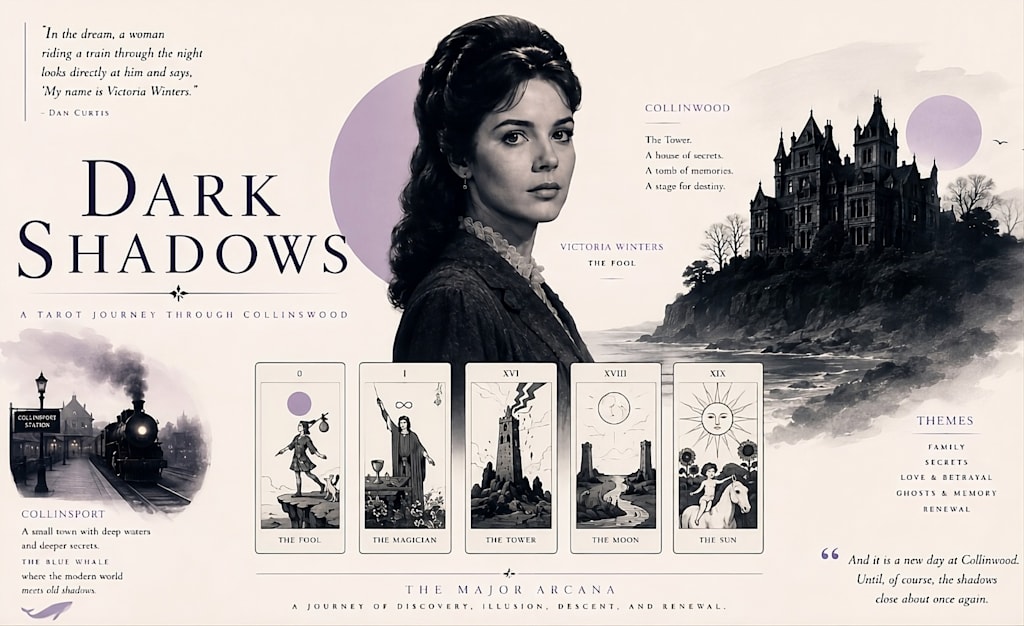
Producer Dan Curtis confessed that the concept of "Dark Shadows," the all-time cult hit vampire soap opera from the mid-Sixties and early Seventies that spawned a pop cultural frenzy and inspired imitators and feature films, came to him in the desolate spaces between waking and dreams. In the dream, a woman riding a train through the night looks directly at him and says, quite simply: "My name is Victoria Winters.".
It's a name he remembered upon awakening, and it's one that after eighty or so odd episodes of season one even the casual viewer cannot forget, as she repeats it during the opening narration every time. Vickie is played by the beautiful, if traditional, conservative, and obviously naive Alexandra Moltke, a woman that recalls an era long in the past; she looks as quaint today as a Baptist Sunday School teacher passing out punch and cookies to the kiddies in 1966.
Her journey—her point of embarkation is the foundling home in which she was raised—is to Collinsport, a small, idyllic, and strange Yankee bucolic home of canneries and a seaside port, a place where fishing and fishermen rule the roost, and there is a swinging outpost of modern times in the form of the little tavern called "The Blue Whale," the name certainly a sly joke on the oppressive nature of the forgotten downhome Maine coastal burg.
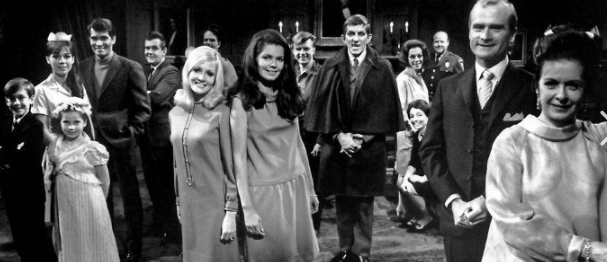
Whaling, or rather here, "wailing," seems to suggest the ghosts of the past. It is to these ghosts, on a lonely, nightbound train, that Vickie travels—starting out as The Fool, the unnumbered card of the Tarot whose journey begins anew, always, turning over the genesis of development, as The Fool proceeds, hopefully, to his (here her) place of power—The Magician, numbered as Card One in the Twenty-Two Major Arcana, the "Inner Veil." What mysteries will Vickie here divine? She meets with her, on the train, the companion boon of The Fool, a literal Magician, a master of misdirection, the ruggedly handsome Burke Devlin (Mitchell Ryan), whom she meets in front of the train station cum diner where Maggie Evans (Katherine Leigh Scott) warns her that, if she were her, she'd "get right back on that train and leave this town."
But therein lies no progression. That's stasis, The Hanged Man, or the Eight of Swords, the woman (usually a woman) who cannot proceed due to confusion. If Vickie was even the Two of Swords or Wands (both indicating alternate decision, dual pathways), she chose, after conferring with the devilishly handsome Devlin, to continue onward to her mysterious destination—Collinwood, the ancient house upon the hill wherein the most important bloodline of the little burg—the cursed bloodline from which, later, would erupt witches and vampires as well as ghosts and other evils—resides (although there is an abandoned "Old House" suggestive of the buried past of our own subconscious, primal regrets).
Vickie has been hired and called forth mysteriously by Elizabeth Collins Stoddard (Joan Bennett), or her brother Roger (Louis Edmonds), to the old house, representative figuratively as The Tower Trump and also literally as it is a domicile. It is rocked by agitations and turbulence, much as The Tower in the Tarot, but these are hidden bolts of energy and intrigue that course beneath the surface like slithering, silver-coiled serpents—bringing with them the memories and buried intrigues, the "plots within plots" that motivate and drive the characters, acting as whirlpools of spectral manifestation to drive forward the narrative of a cursed, Lovecraftian line, whose buried degeneracy is manifest in the fact of Devlin's returning, after five years in prison for a crime he did not commit, and a tour of exotic ports, to, we assume, reap revenge on Roger, who married the girl he loved after condemning him to his jail cell for the crime that Roger was guilty of—vehicular manslaughter.
The Empress Elizabeth Collins-Stoddard, and her stand-in Emperor Roger, surely a kind of metaphysical incest, preside over the tomb-like, desiccated dead womb, cold, dusty, cavernous and gloomy vulva of living death that is Collinwood, the Great House that patriarch Josiah Collins established in the Seventeen hundreds (his stern, oppressive portrait hangs over the fireplace), a place rife with ghosts that we hear and see.
Also here is "Kitten," the beautiful Carolyn Stoddard (Nancy Barrett), whose Uncle Roger and Aunt Elizabeth act as parental stand-ins, taking a dim view of her modern, Sixties liberties, her choice of Joe Haskell as beau, and her headstrong, rebellious, dare we say "liberated" ways. She's often at loggerheads with Roger's young son David, The Divine Child (Fool. The Sun) whose angry, hurt little boy soul is pining forever for his lost, seemingly vanished "Mother.".
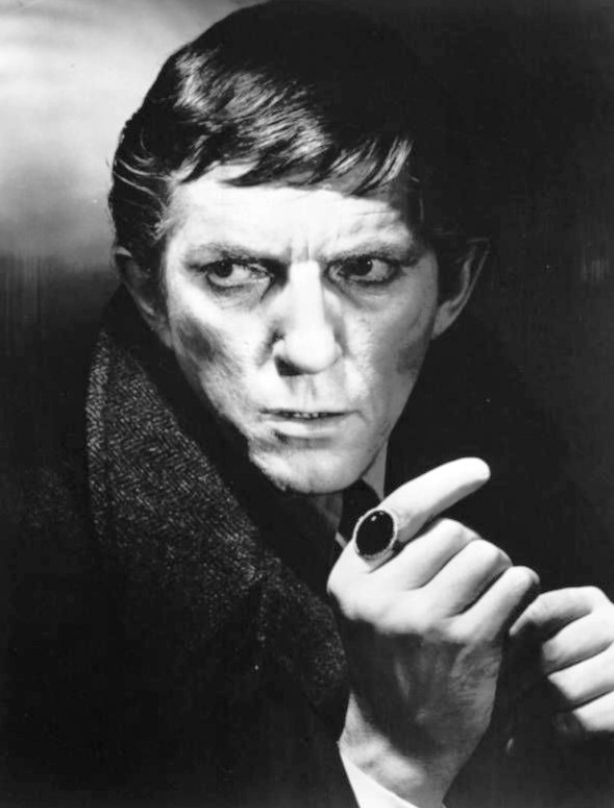
The show begins, the saga unfurling across the span of years. Burke Devlin (Mitchell Ryan), whom Vickie meets at the train station during the first episode, has returned to town after a stint of five years in prison. Leaving prison to become a self-made man and a world traveler, Burke, now a millionaire, has returned to Collinsport for reasons that seem shadowy at best—The Hermit he exemplifies has returned to his place of sojourn. Confronted in his mid-transit, he is The Devil dropped into the mix, perched at the cusp of Chapter One—The Magician trump.
The first wheel of the Cross could easily be seen to be The Moon—the journey into unknown waters, crossed by The Hermit. Below, on the pathway, the stasis of the Eight of Swords, suspension in the form of The Hanged Man, as Collinwood itself could be seen as the tomb-like, death-like suspension of the Five of Swords. Above, looking down, at least as far as the first leg of the journey is anxiety, the Nine of Swords. Before us, the Ten of Swords, but doubled with the Sun on one side, The Devil on the other.
A State of Mind and Unreason
Collinsport is cold, rigid; it's a place caught in the perpetual timewarp of televised "reality." It seems to be one street long. The Blue Whale may sit on the edge of the dock, reflecting the illumination of the deep, deathless sea. It's simply another point of egress into the dream being spun here, wholecloth, from the fabric of gothic nightmares past. Burke has returned, The Hermit come home, because Roger, the dispossessed Emperor, is held responsible for his conviction for manslaughter—Burke and he were drunk in the vehicle that struck another, killing a man. Burke was convicted in Roger's stead—was Roger driving? Roger marries Burke's sweetheart, the mysterious Laura, who will appear later as the mysterious sacred mother of David at the end of the season.
Burke's reasons for returning seem bent on revenge. He is introduced in the mix of characters that can be mixed and remixed like a song, thrown into different plot lines, story arcs, revealed and recreated, ever redrawn.
Roger is understandably upset, thinking Devlin has come to reap ultimate revenge for his betrayal. Meanwhile, young David, Vickie's charge as a governess, a troubled, spoiled little boy who is weirdly confined to the gloomy old manse—no playmates or friends, homeschooled, and missing his mother, the idea of which he deems to hold sacred—is reading his curious mechanical magazines when Roger's car, missing a crucial element mechanically, is mysteriously seen to have no brakes. Nearly killed, Roger blames Devlin, when all signs point to David as being the one who sabotaged the car and nearly cost his father his life.
That storyline is quickly dismissed with—Sam Evans, the alcoholic father of waitress Maggie (Katherine Leigh Scott) becoming the foil for the devilish Devlin, insomuch that he is commissioned to paint Burke's portrait. We proceed to the story arc of the murdered Bill Malloy, found washed up on the beach at Widow's Hill (the literal jumping-off point for old Collins family wives, and others, pining for their men who did not return from their sea voyages), with a distinctive ink pen beside him. The question of whether or not this absurd plot point (literally the Eight of Wands, insofar as it is a communication device) is enough to convict whoever possesses it of murder—is a salient one here. Roger, then Vickie both possess the rather ludicrous object, which becomes a red herring or MacGuffin, what-have-you. Bill Malloy is mostly remembered for his famous back lying half-submerged at the edge of the water, yet his ghost, singing the old sea shanty "What Do You Do With a Drunken Sailor" makes an appearance to Vickie as David has locked her away in the hidden, closed-off section of the house (read: subconscious)
Malloy's fate as a body washed up upon the water is the subject of the story arc for the episodes marching up toward 123 or thereabout, as an absurdly important, unique fountain pen, one found by Vickie, confiscated by Roger, and which has bizarre, unexplained importance (or, if it was explained at least, this author cannot see it) becomes the central piece of evidence, the McGuffin or "Red Herring" tying Roger to Malloy's death (presumable murder)....The pen is a communication device, but what is it communicating here? The Page of Wands promises communication, and also rebirth.
Vickie is imprisoned by the insane handyman Matthew Morgan in the Old House, apparently forever the weeping, nightmare-infused Nine of Swords; but here, there is no defeat. Matthew Morgan, who it is revealed murdered Malloy out of confused or misplaced loyalty to Elizabeth, the Empress, is bested by a coterie of Collins ghosts that arise in time to stop him from violently murdering Vickie....
And then all of this is forgotten just as quickly. There are brooding secrets buried beneath the surface, old houses and locked rooms being the repository of fears, buried anxieties, and deep, inherited moral turpitude, family "curses" passed down through generations, explored in the deep representation of their outward influence through the aegis of a character such as Vickie, whose midnight train ride into darkness summons the Collins demoniac, the spirit of turbulent malfeasant haunting represented as the Tower that eternally shakes the foundation, even as the Sunshine of a new tomorrow beckons—beckons in the form of David, the supernatural scion of Laura Collins, his mother, "The Phoenix."
Fire Walk With Me
It may seem strange to borrow a phrase from a cult TV hit of the Nineties, Twin Peaks, to use as a section heading for this essay on Dark Shadows, a series that preceded it by over twenty years, but it is actually appropriate enough. Laura Collins (née Laura Murdoch) reveals herself as an unknowing revenant, a supernatural being that self-immolates, only to be reborn century after century—and the supernatural mother of Little David Collins, the bright Child of the Sun, the supernatural infant and Fool riding the white horse of tomorrow into a new dawn.
David becomes haunted by images of his sacred mother, his High Priestess. Oddly, he has formed an attachment, at the "Old House" (that buried place of sin and secrets, of tormented bloodlines, cursed in the shadow of the Id), with the ghost of Josette Collins, which occasionally descends as a misty, diaphanous revenant from the portrait that hangs of her above the fireplace. David is also a prognosticator, a medium or go-between, hefting a crystal ball and infused with the same solitary, restless confusion that marks all calumniators and intercessory communicators with the departed. He is The Divine Child of the Sun made manifest.
His mother, who has been discovered interred in the mausoleum presided over by a strange, doddering old man that seems to actually live there (by Victoria and her lawyer boyfriend Frank), has a backstory that is long and complicated. In the early episodes, she has returned to Collinwood to reclaim David, her son, from Roger, her ex-husband and the man she was with when they had the fatal crash that sent Burke Devlin to jail for manslaughter. A locket the modern Laura is wearing (she has returned from Phoenix, a former patient suffering alcoholism in a rehab, with a mysterious death, a body of a "Laura Collins" found in the ashes of a burned apartment) is recognized by Vickie as one that is sent to her from the Phoenix police (incidentally, she survived the Phoenix period by checks sent to her from Elizabeth Collins Stoddard).
The modern, reincarnate Laura, resurrected, seems as confused about the nature of her being. She begins to make herself known to David through hs psychic nighttime visions, a floating specter at night, of a body he visits by day in an old shack on the property (the memory has come to perch and lie just at the threshold of waking life).
Trapping him in the burning place, in a scene quite alive and effective beacuse fo the harsh video effects of the era, she asures him the "Sun brings warmth...fire brings life, David!" (Not a verbatim quote.)
DAvid, transfixed, is rescued from burning to death by Vickie. Then, the mystery is forgotten, and, as much as David, The Sun, would suggest, he has left behind the Sacred Mother for Vickie, the mother substitute. And it is a New Day at Collinwood.
Until, of course, the shadows, dark and darker, close about once again.
Dark Shadows 50Th Anniversary Trailer (Re-Uploaded)
Author's website
Author's YouTube
Cult Films and Midnight Movies
"From High Art to Low Trash" Volume 1 (Paperback Edition)
By Tom Baker
Paperback
Ebook
Silent Scream! Nosferatu, The Cabinet of Dr. Caligari, Metropolis, and Edison's Frankenstein--Four Novels. By C. Augustine
Ebook
Paperback
Theater of the Worm: Essays on Poe, Lovecraft, Bierce, and the Machinery of Dread, (Paperback)
About the Creator
Tom Baker
Author of Haunted Indianapolis, Indiana Ghost Folklore, Midwest Maniacs, Midwest UFOs and Beyond, Scary Urban Legends, 50 Famous Fables and Folk Tales, and Notorious Crimes of the Upper Midwest.: http://tombakerbooks.weebly.com
Enjoyed the story? Support the Creator.
Subscribe for free to receive all their stories in your feed. You could also become a paid subscriber, letting them know you appreciate their work.
Comments
There are no comments for this story
Be the first to respond and start the conversation.