
Current Occupant Missing
Every version of her life has been carefully preserved, but one display remains empty

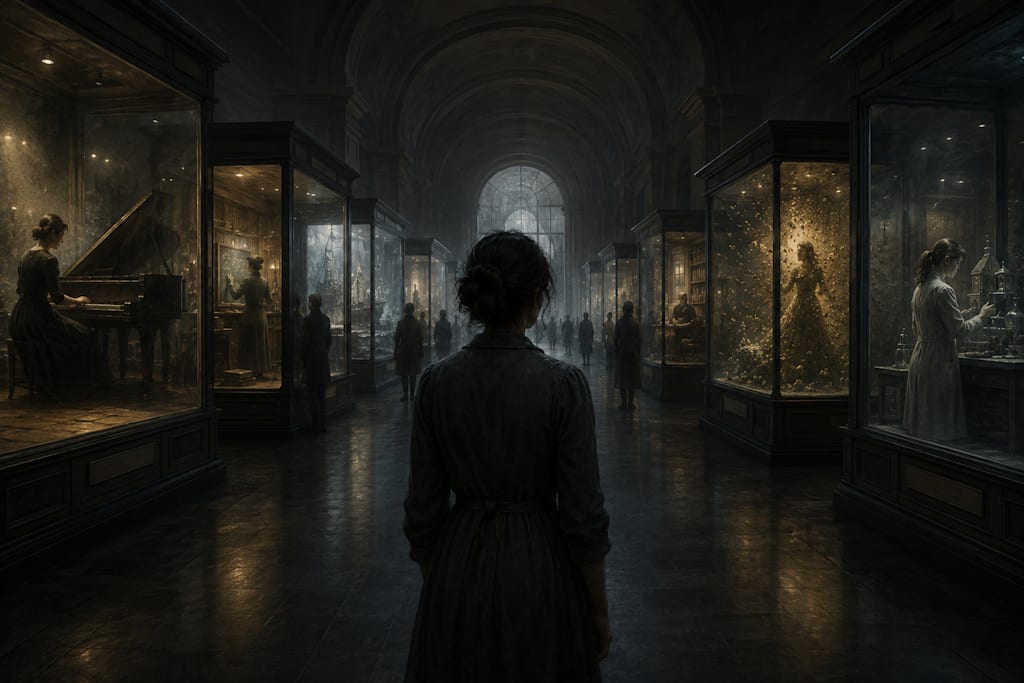
The museum occupied the exact spot where the grocery store should have been. And even though I knew I was dreaming, that fact disturbed me so much more than the sudden appearance of the museum itself.
I remembered parking beneath a flickering streetlamp, as well as the impromptu shopping list folded neatly inside my pocket. Bread, coffee, mushrooms for that omelet I'd been meaning to make.
The parking lot remained exactly where it should have been, as did the neighboring businesses I'd been to so many times in the past. My gaze drifted toward the shopping cart that had been sitting abandoned near the curb for weeks, one wheel turned sideways. Every detail surrounding the grocery store was right there, perfectly intact.
Only the grocery store had vanished.
In its place stood a building large enough to contain entire weather systems. Its stone façade dissolved into a sky that was the strange, bloodless color of old paper, and tall, polished bronze letters hung above the entrance:
MUSEUM OF LOST FUTURES
I was apparently all alone in my confusion, because all around me, other people entered the building completely without hesitation.
A woman carrying a bag of oranges strolled through the doors as naturally as you please, and a pimply teenager followed while scrolling through his phone. An elderly couple passed beneath the sign arm in arm. Not one of these people pointed or even paused, and nobody seemed particularly concerned by the fact that an enormous museum had materialized overnight where all the frozen pizzas and discount produce had been the day before.
I stood there for several moments, hoping someone else might acknowledge the sheer absurdity of the situation in some small way. Surely a museum dedicated to lost futures could not simply appear between a pharmacy and a pet store without sparking some sort of commentary.
But none arrived, so eventually I followed the crowd inside.
*
The lobby resembled a train station designed by ancient archivists. Dust drifted languidly through shafts of pale light, while stately vintage clocks hung from distant walls, no two displaying the same time. And somewhere deep within the building, heavy pages turned, the sound echoing through the vast interior like waves breaking against a distant shore.
A woman sat behind an information desk carved from dark wood, a ledger the size of a tombstone open in front of her. She smiled when she noticed me approaching.
"Welcome back."
"I've never been here," I corrected her, laughing nervously.
But her expression remained the same. "That's what they usually say."
Then she handed me a map, the paper strangely warm underneath my fingertips but appearing ordinary enough regardless. Then I unfolded it. And unfolded it again. And again.
As I continued, the structure and layout of the museum continued to sprawl and expand across the page as naturally as you please.
Entire wings emerged from hidden folds. Corridors branched into districts, and districts branched into regions. It felt like the very architecture itself was less concerned with physical space than it was possibility, and even in my confusion, a few gallery titles caught my eye:
- "Lives Nearly Lived"
- "Regrettable Diversions"
- "Timelines Lost to Chance"
- "The Hall of Noble Mistakes"
- "People You Almost Became"
And then there was the final title, which confidently occupied nearly a quarter of the map all by itself.
I looked up at the woman behind the desk to ask a question, hoping I would sound natural and unbothered when I did so. But she had already returned to her ledger, the scratching of her pen sounding strangely final. So, I moved deeper into the museum and hoped for the best.
*
The first gallery contained multiple glass display cases, artfully arranged beneath high, vaulted ceilings.
The visitors wandered quietly among them, some carrying notebooks into which they feverishly recorded impromptu observations. Others preferred to trust their experience to audio guides, listening intently with furrowed brows as they strolled along. A few stood with their hands clasped loosely behind their backs, studying individual exhibits with the solemn concentration people usually reserve for relics.
The display case nearest to me displayed a woman performing on a stage, her eager hands dancing across the keys of a baby grand piano that was the color of walnut shells.
And for a moment, I simply admired the scene. Warm lights illuminated the woman's face, dewy with perspiration, as a captivated audience filled the seats beyond. Then I looked closer and immediately realized the woman on stage was me.
A brass plaque rested beneath the glass.
SHANNON HILSON
Musician (1976–Present)
The woman inside the display lifted her gaze as she played, and for one impossible moment, our eyes met. Mystified and disoriented, I hurried to the next cluster of exhibits.
*
There, I found another version of myself lecturing with confidence in a spacious university hall. Further along stood a version of me who had apparently become a marine biologist, hard at work aboard a research vessel. I had the vague impression that she was on the verge of translating the secret language of blue whales into plain English.
Then I encountered myself as a novelist. Then, a documentary filmmaker. Then a woman, perpetually smelling of incense, who had been spending her life restoring forgotten churches all over the world.
The displays disturbed me less because they were impossible and more because they were actually at least somewhat plausible. Each life felt achievable and aligned with the patchwork ghosts of notions I'd briefly entertained many, many years ago when the winding road of life still stretched long in front of me.
A different city. A barely remembered conversation. A choice I almost made. And the deeper I traveled into the twisted network of galleries, the stranger (and less plausible) the exhibits became.
*
One version of me lived beneath a velvet blue ocean suspended inside a cathedral of whale bones. Another appeared to be made entirely of bees, the industrious little insects moving continuously across her form, separating occasionally to reveal an eye, a hand, or the outline of a smile before dissolving again into sheer motion.
One display contained a woman whose skin opened freely into small doors where another person might carry ordinary scars. And through those doors I glimpsed impossible landscapes — deserts laid out beneath glowing green moons, forests growing upside down, cities assembled entirely from glass lungs.
And all the other visitors passed quietly between the exhibits.
At first, I assumed they were lost in their own thoughts as they admired the displays, but eventually I realized they were looking at me. An elderly man tipped his hat as he passed, and a child eating an ice cream cone pointed excitedly. A plump, raven-haired woman carrying a guidebook paused for several seconds to jot something down before continuing on her way.
None of them looked surprised, either. In fact, something about all of them looked and felt so familiar, as though we'd met before.
And the museum continued to grow larger the deeper I traveled. Metastasizing. Entire worlds blooming to life behind every pane of glass. One gallery contained a city constructed inside the ribcage of a sleeping giant, while another housed a version of me who had never learned to speak.
She sat alone in a white room, and her plaque offered no explanation. Only a title:
THE SILENT PATH
She watched me cross the gallery, her gaze never once wavering. Something about her expression disturbed me — something I, at first, mistook for fear. Then I realized it was actually recognition.
*
Eventually, I reached an entire gallery bearing my own name. But it stood empty except for a single enormous display case resembling a small apartment.
Inside were a heavy antique desk, a sagging bookshelf filled with leather volumes, a secondhand bed that didn't fit the rest of the room at all, and a sundry scattering of personal possessions arranged with obsessive precision. The space managed to look both inhabited and abandoned at the same time, as if its occupant had stepped out briefly at some indeterminate point in the past and simply forgotten to return.
A brass plaque hanging beside the glass read:
SHANNON HILSON
CURRENT OCCUPANT MISSING
I stared intently at the words until they began to blur and melt before my eyes, and I had the odd suspicion that the exhibit itself was somehow staring back.
I felt my eyes drifting instinctively toward certain books, objects, and details. A battered Moleskine notebook rested open on the desk, and I realized that I knew what would be written on the next page before I reached the glass. A jacket hung near the door, and I knew exactly how it would feel beneath my fingers if I touched it.
An old photograph of people only half remembered sat on a shelf, and although I couldn't quite make out everything in the image, I knew it belonged there just the same.
I also noticed that the other visitors in the room had become noticeably more interested. People gathered quietly around the entrance to the gallery — my gallery. They whispered to one another, and I noticed several whose eyes were darting excitedly between the interior of the exhibit and me.
A young girl in a red, crushed velvet coat tugged on her mother's sleeve. "Is that her?"
Her mother smiled lovingly, her eyes full of warmth sparked by the child's innocent curiosity. "I think so."
*
I looked again at the plaque and read it again. Very carefully this time:
CURRENT OCCUPANT MISSING
I realized the wording really bothered me. Because it didn't say "former occupant" or "deceased occupant".
Current. Missing.
That distinction seemed profoundly important, especially in light of the bed, the books, the desk, the jacket, and everything else the room contained. And it was at that moment that a terrible thought began to take shape.
The room wasn't displaying a life. It was waiting for one.
*
Suddenly, a rush of information came flooding back all at once.
The lobby, the curiously expanding map, the suspiciously aloof woman with the ledger. The strange, distant familiarity of the building, and all of the visitors who kept staring so very intently.
And it was then that I realized the museum had never mistaken me for an exhibit. It was I who had mistaken myself for a visitor. The room beyond the glass was my room, and it was waiting for me. Had been waiting for me for God only knows how many eons.
A voice spoke somewhere behind me. "Ah," it said with satisfied recognition. I turned to see the woman from the information desk standing near the entrance, holding her ledger tightly against her chest.
"Welcome back," she said softly.
The very next moment, the museum darkened, the galleries dissolved, the visitors vanished, and all of my strange surroundings disappeared as I woke with a gasp. The familiar feeling of sweet relief cascaded over me as I realized it was time to start another day — another blissfully ordinary day.
Then I noticed the smell in the air. It was the aging, comatose smell of dust, combined with old paper and fresh rainwater. The scent from the museum.
I sat up, realizing that the room around me looked alarmingly familiar.
Shelves sagging with age under the weight of countless leather volumes, personal belongings resting exactly where they should be, and a weathered jacket hanging casually by the door.
Yet everything felt curated and preserved, as opposed to lived in.
As I rose and crossed the room, I saw the pristinely maintained glass stretching from floor to ceiling. Beyond it lay a gallery, with visitors wandering past underneath soft museum lighting.
A child holding an ice cream cone stopped and pointed, while an elderly man removed his hat in quiet contemplation. A dark-haired woman carrying a guidebook smiled thoughtfully, and my eyes drifted toward the plaque mounted beside the enclosure.
The brass gleamed beneath the lights, polished to an absolutely spotless professional shine:
SHANNON HILSON
CURRENT OCCUPANT FOUND
About the Creator
Shannon Hilson
Pro copywriter and storyteller chasing wonder and weirdness. Fiction, poetry, and occasional personal reflections live here.
✒️ Find me elsewhere via my Linktree
✒️ For business purposes and formal inquiries, please use my contact form
Enjoyed the story? Support the Creator.
Subscribe for free to receive all their stories in your feed. You could also become a paid subscriber, letting them know you appreciate their work.
Comments
There are no comments for this story
Be the first to respond and start the conversation.