
CHUCKY: WHO KEEPS LETTING THIS DOLL OUTSIDE?!
THEY HAD US SCARED FOR WHAT?!

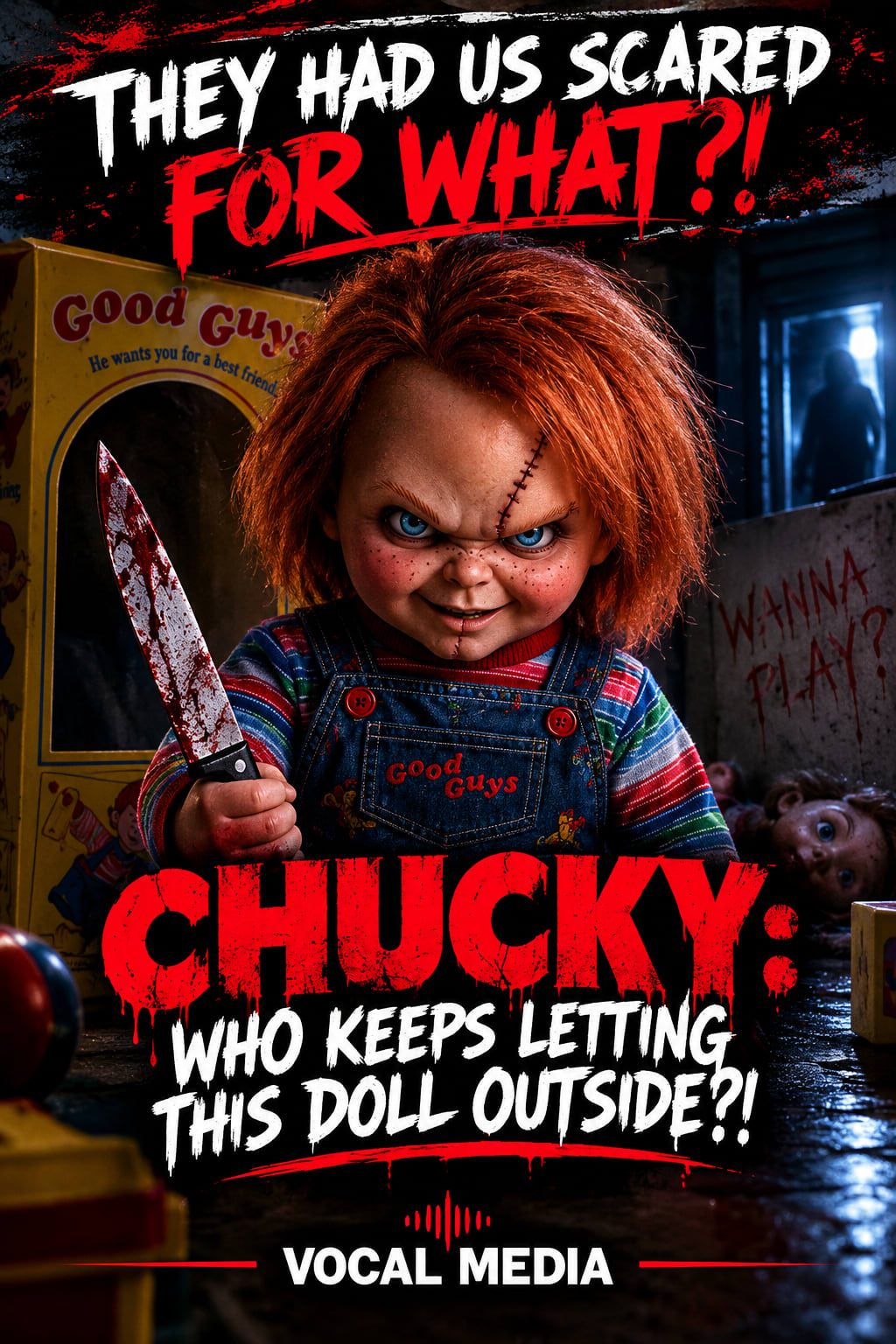
Welcome to THEY HAD US SCARED FOR WHAT?!, my horror retrospective celebrating the iconic horror movies and villains that had us checking under the bed, sleeping with the lights on, and questioning every damn noise we heard in the house. And what better time to revisit these horror classics than Halloween week?! With Halloween falling on Saturday, October 31, we're taking a trip down memory lane to revisit the stories, killers, creepy characters, and unforgettable moments that made horror fans out of us. I'll be breaking down the movies, exploring the villains' motives, revisiting those shocking twists, and adding my own commentary along the way. We're going beyond simply remembering these films; we're looking at what made them terrifying, what still holds up today, and whether some of these villains deserve all the credit—or whether we were just young, impressionable, and scared of our own shadows! 😂 So grab your popcorn, turn on a light if you need one, and join me as we revisit the horror that helped make Halloween what it is. Because after all these years, there's one question we still have to ask: THEY HAD US SCARED FOR WHAT?!
In this installment, we're talking about Chucky!
And let me tell you something: Freddy Krueger comes after you in your dreams, Jason Voorhees hangs around the woods, Michael Myers won't stop walking after people, and Ghostface keeps calling folks who apparently never learned to hang up on suspicious strangers.
But Chucky?
CHUCKY IS A DAMN DOLL.
A little redheaded doll with freckles, overalls, and a face that looks like he should be sitting on a shelf at a toy store. Yet somehow, this pint-sized menace managed to terrorize families, ruin childhoods, build a murderous relationship, start a family of his own, and become one of horror's most recognizable villains.
And the wildest part? He started out as a human serial killer.
So before anybody tells me they can't sleep because a doll is looking at them funny, let's talk about how this whole mess started.
FIRST, WHO THE HELL IS CHUCKY?
Chucky's real name is Charles Lee Ray.
Before he became the infamous Good Guy doll, Charles was a human serial killer who found himself in a desperate situation while being pursued by police. With his life on the line, he used a voodoo ritual to transfer his soul into a nearby doll.
And just like that, a children's toy became a vessel for a very dangerous man.
The doll's innocent appearance is part of what makes Chucky so unsettling. He's not some enormous creature lurking in the shadows. He's small enough to fit in a child's arms, can be carried around like a toy, and can hide in places where nobody would expect a grown criminal to be.
Unfortunately, he also has the personality of a man who has never once considered therapy, accountability, or simply minding his own damn business.
Chucky is voiced by Brad Dourif, whose performance helped make the character memorable. He gives Chucky a distinctive voice, a wicked sense of humor, and the kind of personality that makes you want to throw the entire doll into a locked storage unit.
And yet, we keep watching him.
Why?
Because Chucky is funny, unpredictable, manipulative, and dangerous. Unlike some horror villains who barely speak, Chucky will insult you, argue with you, make jokes at your expense, and apparently find time to complain while he's terrorizing everybody around him.
He is the horror equivalent of that one person who causes all the problems and then has the nerve to ask why everybody is upset.
And the franchise keeps finding new ways to bring him back.
Let's get into the movies.
1. CHILD'S PLAY (1988): WHEN A TOY BECOMES A WHOLE CRIME SCENE
The original Child's Play introduces us to Andy Barclay, a young boy who wants a Good Guy doll for his birthday.
His mother, Karen, is raising him on her own and wants to give her son something that makes him happy. When she manages to obtain the doll, Andy is thrilled.
And why wouldn't he be?
The Good Guy doll is colorful, friendly-looking, and marketed as a toy children can love.
What Karen doesn't know is that this particular doll contains the soul of Charles Lee Ray.
Andy names the doll Chucky, and the trouble begins.
At first, Chucky appears to be a perfectly ordinary toy. But strange things start happening, people begin dying, and Andy insists that his doll is responsible.
Naturally, the adults don't believe him.
Because apparently, when a child tells you that his doll is doing things a doll shouldn't be doing, the reasonable response is to assume the child is lying.
Now, to be fair, if a little boy told me his toy was a serial killer, I would have questions, too. But after enough suspicious events, somebody should probably start asking why the doll keeps appearing wherever the trouble happens.
Instead, Andy finds himself caught between a murderous doll and adults who struggle to accept what he's telling them.
Karen eventually discovers the truth, and she and Detective Mike Norris must confront the fact that Chucky is not an ordinary toy.
Meanwhile, Chucky has a problem of his own.
He doesn't want to spend the rest of his existence trapped inside a doll. He wants to transfer his soul into Andy's body so he can become human again.
And that is where things get particularly disturbing.
Chucky initially believes the doll's body will serve as a temporary hiding place. But as time passes, he discovers that the longer he remains inside the doll, the more difficult it becomes to escape.
Andy becomes his target because Chucky needs a human host.
Think about that for a minute.
A child gets a birthday present, and the present turns out to be a grown man who wants to take over his body.
Imagine asking your mother for a toy and ending up needing a police investigation.
Karen thought she was buying a doll. She got a supernatural criminal with anger issues.
The original film works because it makes the familiar feel threatening. Dolls are supposed to sit still, smile, and look cute. Chucky takes that childhood comfort and turns it into something suspicious.
Suddenly, every doll in the room deserves a background check.
The original film also establishes one of the franchise's most important ideas: Chucky isn't dangerous because he's a doll. He's dangerous because the person inside the doll is still Charles Lee Ray.
The toy is just the packaging.
And unfortunately, this packaging comes with a body count.
By the end, Chucky has been badly damaged, but the film makes one thing clear: destroying the doll doesn't necessarily mean the danger is gone.
Chucky isn't just a toy you can throw away. He's a problem that refuses to stay solved.
2. CHILD'S PLAY 2 (1990): WHY DID ANYBODY THINK REBUILDING THAT DOLL WAS A GOOD IDEA?
You would think that after the events of the first movie, the company responsible for making Good Guy dolls would want to stay as far away from anything connected to Chucky as possible.
You would think.
But no.
The company wants to restore its reputation after the disturbing events associated with the doll. So workers reconstruct Chucky using the damaged doll's remains.
And just like that, somebody has given the nightmare a second chance.
WHO APPROVED THIS PROJECT?
Was there no meeting? No safety review? No employee willing to stand up and say, "Hey, remember that doll associated with multiple deaths? Maybe let's not put it back together"?
Apparently not.
Chucky returns, still determined to transfer his soul into Andy Barclay.
Andy is now living with a foster family after the events of the first film. His mother has been separated from him, and he is struggling to rebuild his life while adults continue to doubt his account of what happened.
That is one of the darker aspects of the early films. Andy isn't simply dealing with a supernatural threat. He's also dealing with the consequences of being a child whose experience is difficult for other people to believe.
Chucky, meanwhile, is not interested in allowing Andy to enjoy a peaceful childhood.
He tracks the boy down and resumes his pursuit.
Andy eventually receives help from Kyle, an older foster sibling who begins to recognize that something is seriously wrong.
The sequel builds on the first movie's central conflict: Andy knows the truth, but the people around him must catch up before Chucky gets what he wants.
And because Chucky is now back in a newly assembled body, the threat isn't going away just because somebody previously thought they had destroyed him.
This sequel also makes the franchise's formula clear.
Chucky has a goal. Andy is in danger. The adults are behind the curve. And the doll keeps finding ways to return.
At this point, I have questions for the toy company.
How many times does a product have to be connected to a string of horrifying events before somebody pulls it from the market?
Imagine the recall notice:
Dear customers, please return your Good Guy doll. It may contain the soul of a serial killer.
I don't think a coupon would make up for that inconvenience.
Still, the sequel succeeds because it keeps Andy at the center of the story. He's a child who wants to be believed, while Chucky is a relentless threat hiding behind a familiar face.
And once again, Chucky proves that being small does not mean being harmless.
The doll has returned, the adults still need convincing, and Andy deserves a birthday present that doesn't require emergency services.
3. CHILD'S PLAY 3 (1991): CHUCKY HAS BEEN WAITING YEARS TO START THIS MESS AGAIN
By the time we reach Child's Play 3, Andy Barclay is older.
Years have passed since his previous encounters with Chucky, and Andy is now a teenager attending a military academy.
He is trying to move forward with his life, but the past has not finished with him.
The Good Guy doll line is being revived, and Chucky's remains become part of the process once again.
I need somebody to explain the logic behind this company's decisions.
You had one job: make toys.
Somewhere along the way, your product became associated with a supernatural serial killer, and your response was to keep manufacturing the dolls.
At this point, the Good Guy company isn't a toy manufacturer. It's an accomplice with a marketing department.
Chucky returns and continues pursuing Andy, but the film also introduces another young character into the danger: Ronald Tyler, a boy at the military academy.
When Chucky discovers Tyler, he sees another opportunity to escape his doll body.
His obsession with becoming human remains central to the story. He needs a suitable human host, and he is willing to manipulate the people around him to achieve that goal.
Andy, meanwhile, must once again confront a threat that he hoped was behind him.
The military-school setting changes the atmosphere. Instead of a family home or foster-care environment, the story unfolds in a place with strict rules, routines, and an emphasis on discipline.
Unfortunately, rules don't mean much when a supernatural killer doll is wandering around.
Imagine being responsible for maintaining order at a military academy and discovering that the problem is a toy with a criminal history.
How do you even write that report?
"Sir, we have an unidentified hostile presence on campus."
"What kind?"
"Approximately two feet tall, red hair, overalls."
I would request a transfer.
The film continues the conflict between Andy and Chucky, while showing how difficult it is for Andy to escape the trauma of his childhood.
Chucky doesn't care that Andy is older. He doesn't care that Andy wants a normal life. And he certainly doesn't care that the boy has already been through more than enough.
Chucky wants what he wants.
That selfishness is a big part of his character. He doesn't see Andy as a child who deserves safety. He sees him as a means to an end.
By now, the franchise has established that Chucky is not simply a monster who appears once and disappears. He's an enemy who returns, adapts, and continues pursuing the same goal.
And Andy is the unfortunate person who keeps getting dragged back into it.
The movie also marks the end of the original trilogy centered primarily on Andy's childhood and adolescence.
But it doesn't mark the end of Chucky.
Oh, no.
This little menace still has several more chapters in his story.
And apparently, he's about to find love.
Because nothing says romance like a murderous doll with a supernatural criminal record.
4. BRIDE OF CHUCKY (1998): HE FOUND A GIRLFRIEND, AND SOMEHOW THAT MADE EVERYTHING WORSE
After Child's Play 3, the franchise took a break before returning with Bride of Chucky.
And this is where the series begins leaning much harder into horror comedy.
Enter Tiffany Valentine.
Tiffany is Charles Lee Ray's former girlfriend, and she still has an attachment to the man he used to be.
When she obtains Chucky's remains, she manages to put him back together and revive him.
Because apparently, one person in this universe wasn't convinced that bringing Chucky back was a terrible idea.
Tiffany restores the doll and expects to reconnect with the man she once loved.
Instead, she gets Chucky.
And Chucky gets Tiffany.
The relationship is dysfunctional before it even begins. These two have history, resentment, jealousy, and very different ideas about how their reunion should go.
Chucky is still Chucky: manipulative, selfish, and perfectly capable of turning a romantic disagreement into a complete disaster.
Tiffany, meanwhile, is no innocent bystander. She knows who Charles Lee Ray was, and she is willing to participate in his return.
But things go wrong, and Tiffany ends up trapped inside a doll body herself.
Now we have two murderous dolls.
Because one apparently wasn't enough.
Somebody call the relationship counselor. Actually, don't. The counselor deserves to live.
The movie follows Chucky and Tiffany as they travel together, with their relationship becoming an important part of the story.
Unlike the earlier films, which focused heavily on Andy and his attempts to survive Chucky, Bride of Chucky shifts attention toward the dolls themselves.
Chucky is no longer just the killer chasing a child. He's part of a bizarre supernatural relationship.
And Tiffany isn't merely there to support him. She has her own personality, her own motivations, and her own capacity for violence.
The film also gives the franchise a more openly comedic identity.
Chucky's mouth has always been one of his defining features, but now the movies increasingly embrace his sarcastic personality and the absurdity of his situation.
He's a doll who can be rebuilt, repaired, and revived, and he's now involved in a relationship that would make most people question their life choices.
Think about how ridiculous this sounds when you explain it to somebody who has never watched the movies.
"A serial killer transfers his soul into a doll, reconnects with his former girlfriend, and they go on a murderous road trip."
Somewhere, a therapist is updating their professional boundaries.
The film's title is also a pretty good indication of where things are heading.
Chucky isn't just trying to become human anymore. He's developing a life around his existence as a doll.
And that brings us to one of the franchise's strangest developments.
Chucky and Tiffany become parents.
Yes, parents.
I don't know what kind of family planning program they're running, but I have several questions.
5. SEED OF CHUCKY (2004): THIS FAMILY NEEDED HELP BEFORE THE BABY ARRIVED
If Bride of Chucky introduced the idea that a murderous doll could have a romantic life, Seed of Chucky takes that concept and runs straight off a cliff.
The movie introduces Glen, the child of Chucky and Tiffany.
Glen is a doll who discovers his connection to the infamous killer couple and eventually seeks them out.
And here's where things get even funnier: THE MOVIE NEVER GIVES US A STRAIGHT ANSWER ABOUT WHETHER THE CHILD IS A BOY OR A GIRL! 😂
Chucky calls the child Glen, while Tiffany calls the child Glenda. And these two are the parents! Imagine being born into a family where your father and mother can't even agree on what to call you.
Chucky is over here saying, "That's my boy, Glen!" while Tiffany is looking at the same child like, "No, that's my girl, Glenda!"
SIR. MA'AM. CAN Y'ALL GET ON THE SAME PAGE?! 😂
And the child is caught in the middle of an identity struggle while trying to figure out who they are, separate from the expectations their parents have for them. Glen/Glenda's story is about more than a name; it's about identity and the pressure to become what other people expect.
Meanwhile, these two murderous dolls are trying to raise a child. A child who has to figure out their own identity while their parents are busy being the most dysfunctional couple in horror history.
THIS FAMILY NEEDED THERAPY BEFORE THEY EVEN THOUGHT ABOUT HAVING A BABY! 😂
Unlike his parents, Glen initially appears to have a much gentler nature.
He is horrified by their behavior and struggles with the idea that his family is associated with murder.
And honestly, can you blame him?
Imagine discovering that your parents are famous for being murderous dolls.
Other kids get embarrassing baby pictures.
Glen gets a family history that probably requires a lawyer.
The story moves into Hollywood, where a movie about Chucky and Tiffany is being made. Glen's arrival sets off a chain of events that brings the family back together.
But being reunited doesn't mean everyone suddenly gets along.
Chucky has his own ideas about what he wants for his child. Tiffany has her own expectations. And Glen is caught between two parents whose relationship with violence is, to put it mildly, deeply unhealthy.
The movie explores Glen's identity and his desire to understand himself.
That gives the story a different emotional angle from the earlier films. Instead of focusing exclusively on Chucky's desire to become human, the story asks what happens when his child doesn't want to follow the same path.
Glen is not simply a miniature version of his father.
He has his own personality and his own struggles, and his relationship with his parents becomes central to the film.
Of course, this is still a Chucky movie, which means the family drama comes with supernatural complications and plenty of dark comedy.
The Hollywood setting also gives the film an opportunity to poke fun at celebrity culture, filmmaking, and the entertainment industry's willingness to turn almost anything into a spectacle.
Which is especially funny considering that Chucky himself has become a horror celebrity.
He has a recognizable appearance, a signature personality, and a reputation that follows him everywhere.
If Chucky had a publicist, I suspect their entire job would involve issuing statements that begin with, "Our client denies all allegations."
The movie is a major departure from the more straightforward horror of the original Child's Play.
Some viewers enjoy the increasingly ridiculous comedy. Others prefer the darker tone of the first film.
But regardless of where you stand, Seed of Chucky makes one thing clear:
Chucky's story is no longer just about a doll trying to escape a toy body.
It's about a whole dysfunctional family.
And I don't think family counseling is going to fix this one.
6. CURSE OF CHUCKY (2013): BACK TO THE CREEPY STUFF
After Seed of Chucky leaned heavily into comedy, Curse of Chucky brings the franchise back toward a more serious horror atmosphere.
The film introduces Nica Pierce, a woman who lives with her family and receives a mysterious Good Guy doll.
You already know where this is going.
The doll arrives.
Something feels wrong.
People start dying.
And everybody is about to learn why you should never accept a suspicious package without asking a few questions.
Nica initially has no reason to believe the doll is anything more than a toy. But as disturbing events unfold, she begins to suspect that Chucky is responsible.
The film's atmosphere is darker and more restrained than the previous two installments.
Instead of immediately leaning into Chucky's comedic personality, Curse of Chucky allows the doll to become frightening again.
And this is where the franchise reminds us that Chucky can still work as a horror villain without needing to make a joke every few minutes.
The character is terrifying partly because of the contrast between his appearance and his behavior.
He looks like a children's toy.
He acts like a remorseless killer.
That contrast never completely loses its effectiveness.
Nica's story also expands the franchise's mythology by establishing connections between Chucky and her family.
The doll's arrival is not simply a random event. There is a history behind it, and the film gradually reveals more about the people involved.
This helps make Chucky feel less like a monster who randomly appears wherever the plot needs him and more like a character whose past continues to affect the present.
And let's be honest: Chucky has a long history.
The man has been causing problems for decades, and somehow, he still finds new people to terrorize.
Most people his age are thinking about retirement.
Chucky is still out here starting new chapters in his criminal career.
The film also brings back familiar elements from the original franchise, rewarding longtime viewers without requiring every scene to depend on nostalgia.
And the ending sets up the next installment.
Because, naturally, Chucky isn't finished.
When has he ever been finished?
At this point, I would not be surprised if somebody discovered that a tiny piece of his hair had survived a building collapse and was already planning a comeback.
Chucky doesn't need a fresh start. He needs somebody to stop rebuilding him.
7. CULT OF CHUCKY (2017): ONE CHUCKY WAS NEVER GOING TO BE ENOUGH
By the time we reach Cult of Chucky, the franchise takes one of its strangest ideas and turns it into a major part of the story.
Nica Pierce is now confined to a psychiatric institution after the events of Curse of Chucky.
She is struggling with what happened to her family, and the people around her question her understanding of the events.
Then another Good Guy doll appears.
Yes, another one.
At this point, the arrival of a Good Guy doll should automatically trigger an evacuation.
Instead, the doll becomes part of the institution's treatment environment, and Chucky begins causing trouble again.
But this time, something new happens.
Chucky has learned a way to divide his soul among multiple dolls.
MULTIPLE CHUCKYS.
One Chucky is already a problem.
Now imagine several versions of him operating at once.
Who came up with this plan? Who approved it? And why does nobody in this universe understand that the doll should be treated like a supernatural biohazard?
The film expands Chucky's supernatural abilities and changes the nature of the threat.
Previously, Chucky's existence was tied to one doll at a time, even when he returned in new forms.
Now the possibility of multiple Chucky bodies creates an entirely different situation.
The enemy is no longer necessarily confined to one physical location.
And that makes him much harder to contain.
Nica's situation is also central to the story. She is dealing with the aftermath of her experiences while trying to convince others that the threat is real.
Andy Barclay, the boy who survived Chucky's original attacks, also remains connected to the unfolding conflict.
His history with Chucky has followed him into adulthood, demonstrating just how deeply the doll's actions have affected the people who encounter him.
The movie brings together characters and storylines from different parts of the franchise.
It also continues the darker tone established in Curse of Chucky, while introducing increasingly bizarre supernatural developments.
And this is where the franchise's mythology becomes particularly important.
Chucky isn't simply a killer who happens to possess a toy. He is a supernatural threat who keeps finding new ways to survive.
His ability to move between bodies and divide his soul makes him more difficult to defeat.
Destroying one doll may no longer be enough.
You could have one Chucky in a locked room, another somewhere else, and a third one preparing to ruin somebody's entire week.
At this point, somebody needs to create a national registry for these dolls.
Not a toy registry.
A DO NOT ALLOW THIS THING INTO YOUR HOME registry.
The film ends with major developments that lead directly into the television series.
And if you thought the movies had already taken this story as far as it could go, Chucky was about to demonstrate that he still had plenty of trouble left in him.
8. CHILD'S PLAY (2019): WHAT IF CHUCKY WASN'T POSSESSED AT ALL?
Now we need to talk about the 2019 remake.
And this distinction matters: the 2019 Child's Play is a separate continuity. It is not a continuation of the original Chucky storyline.
This version reimagines the premise rather than continuing the story of Charles Lee Ray.
Instead of a doll possessed by a human serial killer, the new Chucky is an advanced toy whose artificial intelligence has been compromised.
The doll is designed to be interactive and responsive to its owner.
Andy Barclay receives one of these dolls, and at first, Chucky appears to be a friendly companion.
But the technology behind the doll allows it to learn, adapt, and respond to the world around it.
When its programming goes wrong, the consequences become dangerous.
This is a very different kind of Chucky.
The original character is frightening because Charles Lee Ray is a human killer whose soul has entered a toy.
The 2019 version is frightening because a technological system intended to serve people becomes dangerous.
Instead of a supernatural ritual, the story explores what can happen when powerful technology is poorly controlled.
And that premise gives the remake a distinctly modern feel.
Think about the toys, smart devices, and connected gadgets that have become part of everyday life.
Most of them are designed to make things easier.
Now imagine a toy that can observe its surroundings, interact with other connected devices, and respond to what it learns—but no longer operates safely.
Suddenly, the phrase "smart toy" doesn't sound quite so appealing.
I would like my children's toys to remain at the level of making noise when somebody presses a button.
I don't need one learning my habits, monitoring my environment, or developing its own opinions about who deserves to be around me.
If a toy needs a software update to stop being dangerous, maybe the toy should have stayed in the factory.
This version also changes the emotional dynamic between Chucky and Andy.
The original Chucky wants to escape his doll body and become human again.
The 2019 Chucky's actions are tied to his understanding of friendship and protection, which becomes increasingly distorted.
He believes he is acting in Andy's interest, but his behavior becomes dangerous.
That makes the relationship between the boy and the doll different from the one in the original film.
It also gives the remake an opportunity to explore modern anxieties about technology, artificial intelligence, and the systems people trust to operate around their families.
The 2019 film doesn't erase the original story.
It offers another interpretation of the central idea: something designed to bring comfort into a child's life becomes a source of danger.
And whether that danger comes from supernatural possession or corrupted technology, one thing remains true.
I am not buying the doll.
Not the possessed version.
Not the artificial-intelligence version.
Not the limited-edition collector's version.
If the packaging says "Good Guy," I need to see references.
9. THE CHUCKY TV SERIES (2021–2024): THIS MAN GOT A WHOLE TELEVISION SHOW?
Just when you thought Chucky had exhausted every possible way to return, he got his own television series.
And honestly, if any horror villain could support a series, it's Chucky.
The television show continues the original film continuity rather than following the separate 2019 remake.
The story begins when a vintage Good Guy doll appears at a suburban yard sale.
The doll is purchased by Jake Wheeler, a teenager whose life is already complicated by family difficulties and problems at school.
Jake brings Chucky home, unaware of the danger associated with the doll.
And here we go again.
A Good Guy doll appears in somebody's life.
The doll looks harmless.
Chucky starts causing trouble.
Somebody is going to have a terrible week.
The series introduces a new group of young characters while bringing back familiar faces from the movies.
Jake becomes one of the central characters, and his relationship with Chucky develops into a complicated struggle involving manipulation, fear, and the consequences of the doll's actions.
The show also explores issues within its suburban setting, including bullying, family conflict, and the hypocrisy that can exist behind seemingly respectable appearances.
Chucky's presence exposes those problems while creating new ones of his own.
And because this is a television series, the story has more time to explore the characters and their relationships.
The movies usually have a limited amount of time to establish the threat, develop the conflict, and bring the story to a conclusion.
The series can allow certain developments to unfold over multiple episodes and seasons.
That gives Chucky more opportunities to manipulate people, create chaos, and return to old rivalries.
Of course, the show also continues the franchise's habit of bringing back characters from earlier installments.
Andy Barclay remains important to Chucky's story. Tiffany also continues her role in the franchise, and other familiar characters return as the series expands the mythology.
The result is a story that connects the original movies to a new generation of characters.
And let's be honest: Chucky is probably delighted to have more people to bother.
The man—or doll, technically—has been terrorizing people since 1988.
Most horror villains have a signature location or a particular group of victims.
Chucky has an entire extended universe of people who would probably cross the street if they saw him coming.
The series ran for three seasons, ending in 2024 after the cancellation of the show.
That doesn't mean Chucky's story is erased. It means the television continuation came to an end, leaving the franchise's existing films and series as the record of his ongoing adventures.
And after everything we've seen, I have one question.
How many people have to encounter this doll before somebody starts putting warning labels on the entire Good Guy line?
SO, HOW MANY TIMES CAN CHUCKY COME BACK?
Let's look at the original storyline.
Chucky begins as Charles Lee Ray, a human serial killer who transfers his soul into a Good Guy doll.
He targets Andy Barclay because he wants to become human again.
When his plans fail, he returns.
He returns again.
Then he finds Tiffany.
Then he has a child.
Then he becomes involved in a family conflict that makes most holiday dinners look peaceful.
Then he targets Nica Pierce and develops the ability to divide his soul among multiple dolls.
Then he continues his story on television.
And throughout all of it, he remains the same basic character: a manipulative, sarcastic, murderous menace who refuses to stay defeated.
The 2019 remake gives us a separate version of the premise, replacing supernatural possession with dangerous artificial intelligence.
Both versions work with the same disturbing contrast: a toy that should be harmless becomes a threat.
But the original Chucky has something special.
He's not just scary.
He's entertaining.
He can be terrifying in one scene and ridiculous in the next. His humor makes him memorable, but it doesn't erase the danger he represents.
And his size makes the character especially unusual among horror villains.
Jason Voorhees is physically imposing.
Michael Myers has that slow, relentless presence.
Freddy Krueger attacks people through their dreams.
Ghostface can hide behind a familiar voice and a mask.
Chucky, meanwhile, can fit inside a child's toy box.
That's what makes him different.
You can see a giant masked killer coming down the street.
But a doll?
A doll can sit on a shelf, ride in a car, rest on a bed, or be carried around by a child.
The danger hides behind something familiar.
And once you know what Chucky really is, that innocent appearance becomes part of the problem.
FINAL VERDICT: THEY HAD US SCARED FOR WHAT?!
Let's be fair: Chucky earned his place among horror's most recognizable villains.
The original Child's Play gave us a strong premise, a memorable antagonist, and a genuinely unsettling idea: what if the toy your child loves is secretly a dangerous killer?
The sequels expanded that idea, the later films explored Chucky's relationships and supernatural abilities, and the television series brought the story to a new generation.
Not every installment has the same tone.
Some lean toward serious horror. Others embrace comedy. Some viewers prefer the darker atmosphere of the original film, while others enjoy the increasingly outrageous mythology.
But the franchise has remained recognizable because Chucky himself is such a distinctive character.
He's funny, vicious, unpredictable, and impossible to mistake for anybody else.
And unlike some horror villains, he doesn't need to remain silent to be frightening.
Sometimes, the most unsettling thing he can do is open his mouth and start talking.
Because you know that whatever comes next is probably going to be something you wish you hadn't heard.
But let's return to the question at the center of this series.
THEY HAD US SCARED FOR WHAT?!
In Chucky's case, the answer is simple.
They had us scared because a children's toy became a supernatural serial killer, and the people responsible for making those toys kept finding reasons to bring him back.
They had us scared because Andy couldn't convince the adults around him that his doll was dangerous.
They had us scared because Chucky could survive being destroyed, rebuilt, and returned to the world.
And they had us scared because even when we knew what he was, the sight of a little doll sitting perfectly still could make us suspicious.
But I have learned something from watching these movies.
If I walk into a room and see a doll sitting in a chair, I'm not asking questions.
I'm not touching it.
I'm not picking it up.
I'm not checking whether it needs batteries.
I'm leaving the room, and if anybody asks why, they can read this article.
Because I don't care how cute the outfit is.
I don't care if the doll comes with accessories.
I don't care if it's on sale.
IF THAT LITTLE REDHEADED DOLL STARTS TALKING, I'M OUT.
And if somebody gives me one as a gift, I'm giving it right back.
Preferably to the person who bought it.
Preferably from a safe distance.
Preferably while I'm already in the car.
Because I have learned that not every gift deserves a thank-you note.
Some gifts deserve a police report.
And Chucky?
Chucky deserves to stay exactly where he belongs.
ON THE OTHER SIDE OF MY FRONT DOOR.
UP NEXT: MICHAEL MYERS — THE HALLOWEEN FINALE!
We've revisited Jason Voorhees, Freddy Krueger, Pennywise, Ghostface, and now Chucky.
But we're not done yet.
On Halloween, we're closing out the main series with one of horror's most recognizable masked killers: Michael Myers.
The man who keeps coming back to Haddonfield, keeps finding new people to terrorize, and somehow manages to make a plain white mask look like the worst thing you could ever see standing at the end of your driveway.
And after that, there's one more special installment on November 1.
Because my birthday deserves a little horror, too.
So stay tuned.
We're not finished asking the question:
THEY HAD US SCARED FOR WHAT?!
About the Creator
Dakota Denise
Every story I publish is real lived, witnessed, survived, by myself or from others who trusted me to tell the story. Enjoy 😊
Enjoyed the story? Support the Creator.
Subscribe for free to receive all their stories in your feed. You could also become a paid subscriber, letting them know you appreciate their work.
Comments
There are no comments for this story
Be the first to respond and start the conversation.