
'Cat’s Eye' (1985): Stephen King’s Feline Anthology and Wilmington’s Hollywood East Moment
Before the Stephen King adaptation boom started running out of steam, Lewis Teague brought together James Woods, Drew Barrymore, and a very resourceful stray cat for one of the decade’s most unusual horror anthologies.

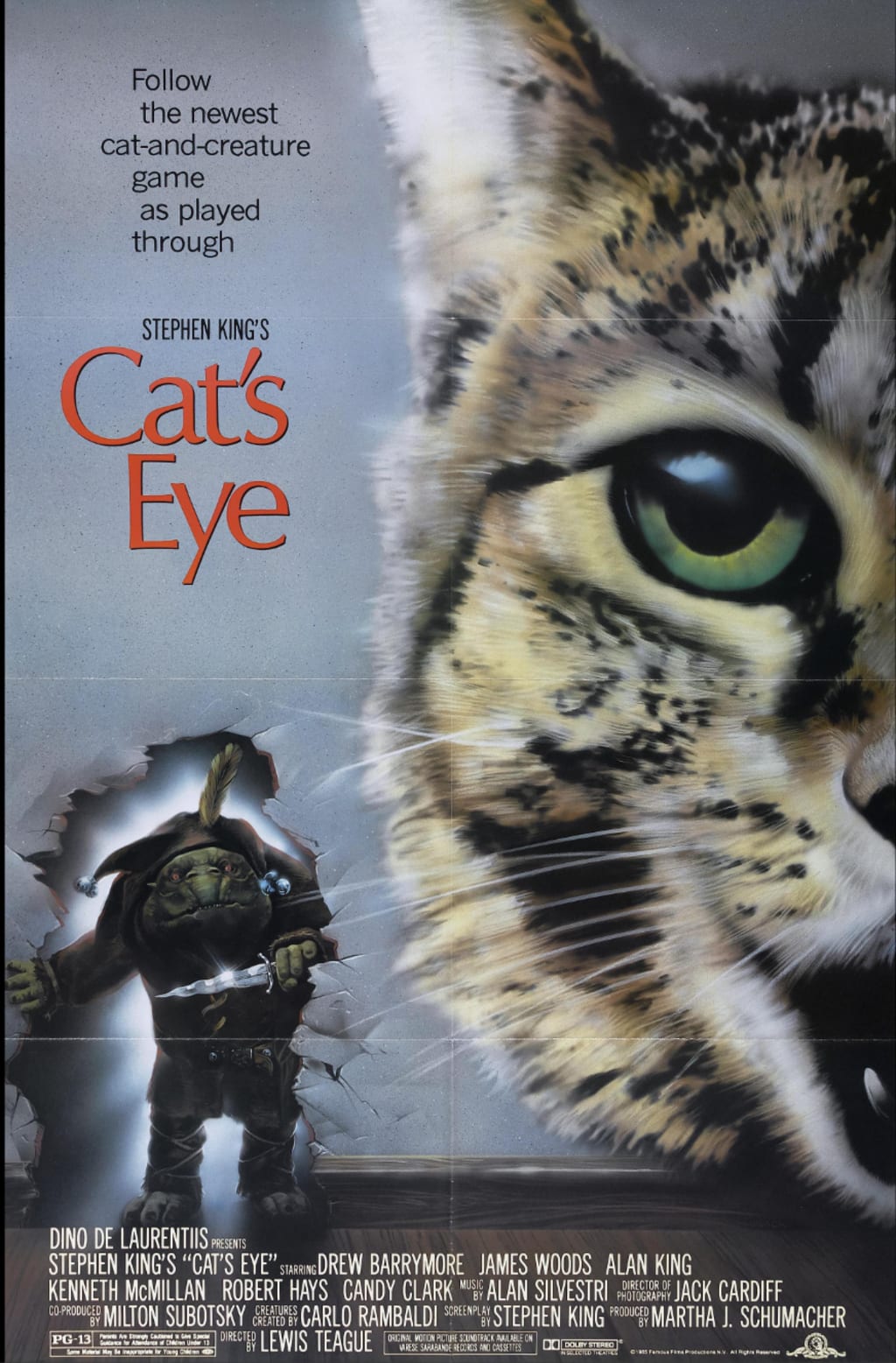
Stephen King, Three Stories, and One Very Important Cat
By 1985, Stephen King adaptations were becoming almost as common as the paperback novels themselves. Hollywood had discovered that King’s particular combination of ordinary people, extraordinary circumstances, and things lurking just outside the bedroom window was remarkably adaptable to the big screen.
There was Carrie, The Shining, The Dead Zone, Cujo, Christine, and Firestarter. And those were just the more prominent entries in an increasingly crowded field.
Into this growing collection came Cat’s Eye, a curious little anthology directed by Lewis Teague, who had already demonstrated his ability to get under an audience’s skin with Cujo (1983).
The film takes three Stephen King stories and connects them through the travels of a stray tabby cat. The first two segments, “Quitters, Inc.” and “The Ledge,” come from King’s 1978 collection Night Shift. The third, “The General,” was written specifically for the movie, with a young Drew Barrymore in mind.
It’s an odd combination. A dark comedy about smoking cessation, a suspense thriller involving a very dangerous wager, and a supernatural bedtime horror story involving a little girl and a particularly unpleasant visitor.
Somehow, it works.
Well, mostly.
What makes Cat’s Eye interesting is that it doesn’t take itself quite as seriously as some of the other King adaptations of the period. There’s genuine suspense, some wonderfully unpleasant moments, and a healthy dose of the author’s familiar dark humor. It’s also a film with an unusually strong production identity, having been made during the brief period when Wilmington, North Carolina, was positioning itself as Hollywood’s next great filmmaking destination.
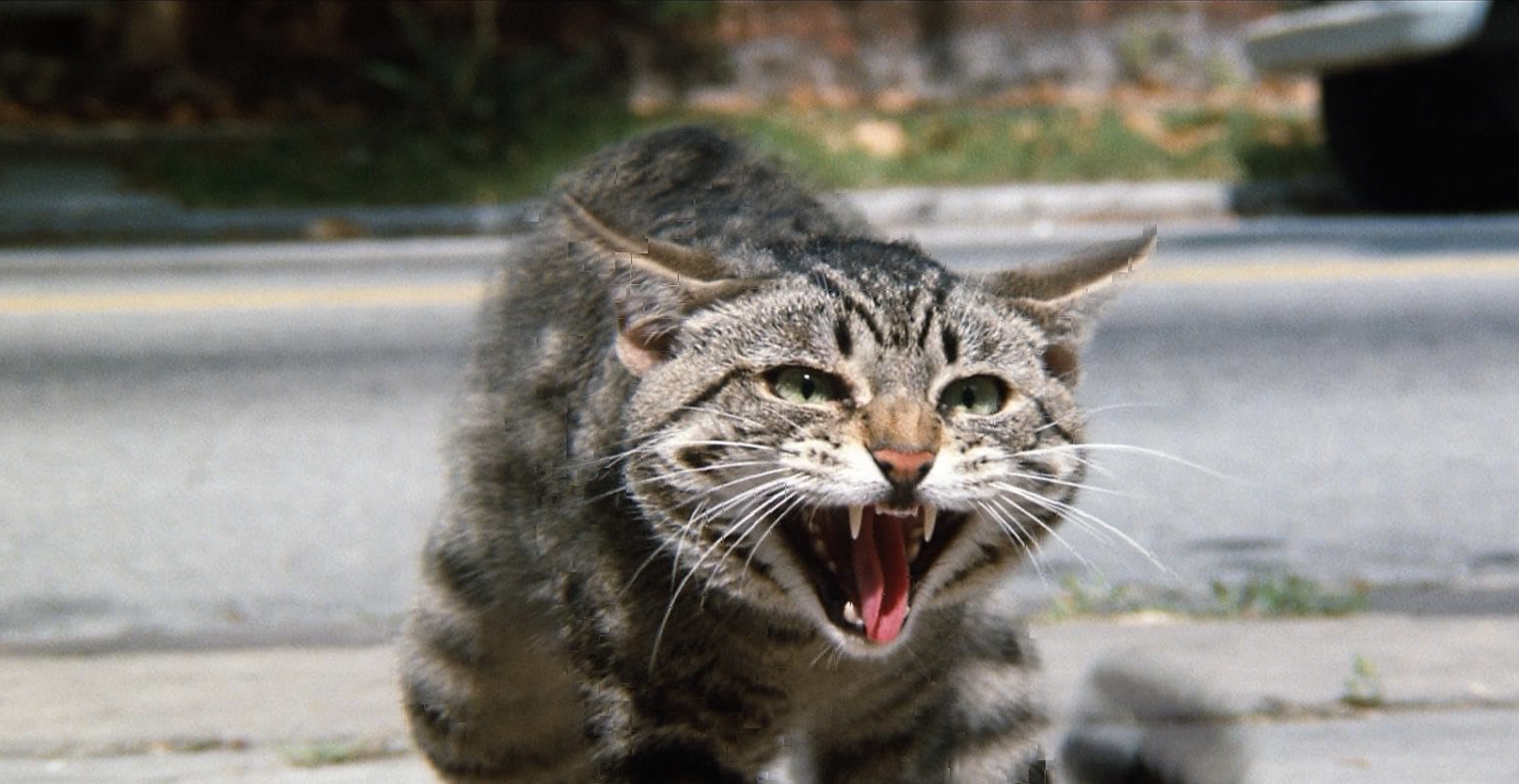
And at the center of it all is a cat who has considerably more courage than most of the human characters.
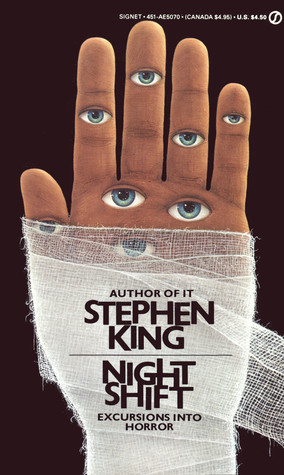
From Night Shift to the Big Screen
The origins of Cat’s Eye go back to producer Milton Subotsky, a familiar name to anyone who spent time watching horror movies from the British production company Amicus.
Subotsky had developed a reputation for anthology horror, including such films as Dr. Terror’s House of Horrors (1965) and Tales from the Crypt (1972). He understood the appeal of giving audiences several different stories within a single movie, particularly when each story offered a different flavor of horror.
He saw similar possibilities in King’s Night Shift.
Subotsky initially acquired material for an anthology project built around King’s short stories, including “Quitters, Inc.,” “The Ledge,” and “Sometimes They Come Back.” The project eventually found a home with producer Dino De Laurentiis, who purchased the relevant rights from Subotsky. Subotsky retained a co-producer credit and contractual input into the resulting production.
There was another important ingredient.
De Laurentiis had recently worked with Drew Barrymore on Firestarter (1984). The young actress had made a strong impression on him, and he wanted to find another project that could capitalize on her appeal.
The solution was to ask Stephen King to write something specifically for her.
King reportedly responded with remarkable speed, delivering the beginnings of a new story featuring a young girl and a supernatural threat. That story became “The General,” the third segment of Cat’s Eye.
The pieces were beginning to fall into place.
Rather than simply presenting three unrelated adaptations, King developed a framework in which the stray cat travels from one story to another. The animal becomes the audience’s guide, occasionally appearing in the background of the human dramas before eventually finding its way to the little girl whose life it is destined to save.
Producer Martha Schumacher explained the thinking behind the structure in contemporary production coverage:
“The movie will all be tied together in the final episode, where the cat saves [the girl] from the troll.”
She also wanted audiences to understand that this wasn’t going to be an entirely grim affair.
“In spite of King’s reputation as the prince of horror, this film will be humorous.”
That was an important distinction. Cat’s Eye wasn’t intended to be another relentless exercise in terror. It was designed to have fun with King’s imagination, even when that imagination took some decidedly unpleasant turns.
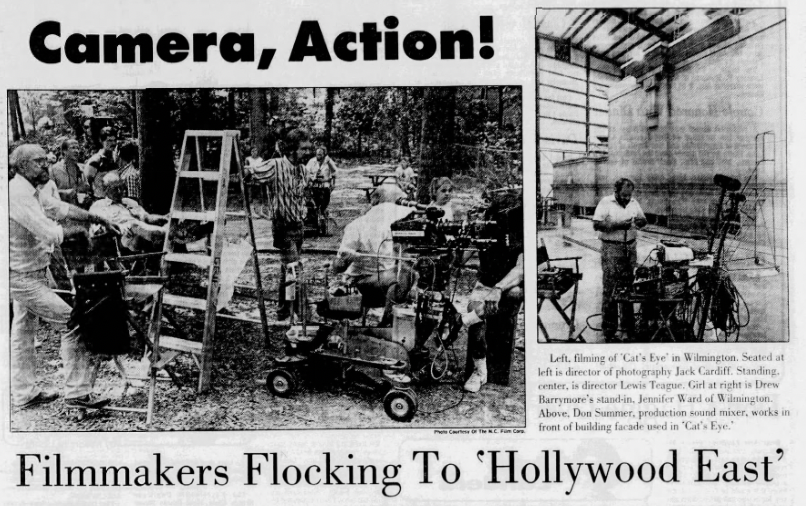
Wilmington Becomes Hollywood East
The production of Cat’s Eye also provides an interesting snapshot of a moment when the movie business was looking beyond its traditional California and New York locations.
Dino De Laurentiis had established an increasingly ambitious production operation in Wilmington, North Carolina. The area offered something Hollywood producers were always looking for: locations that could double for other places, available local labor, and production facilities that could accommodate substantial filmmaking operations.
The local enthusiasm was considerable.
A contemporary production preview announced that principal photography on Cat’s Eye would begin June 4, 1984, with Lewis Teague directing. The nine-week production was scheduled to take place around Wilmington and at De Laurentiis’s expanded 23rd Street studios.
The casting announcements were equally ambitious.
An early announcement identified Drew Barrymore, Candy Clark, and Robert Hays as principal stars, with Alan King, Joe Cortese, Patti LuPone, Kenneth McMillan, James Woods, and James Naughton also announced.
Not every name in those early reports ultimately appeared in the finished film, but the production was assembling a respectable collection of performers.
James Woods would headline “Quitters, Inc.,” while Kenneth McMillan would become the unforgettable villain of “The Ledge.” Alan King would play the sinister Dr. Donatti, and Robert Hays and Candy Clark would appear in the third segment.
The production also generated the sort of local excitement that accompanies any major film shoot in a town not accustomed to seeing Hollywood productions arrive on its doorstep.
There was substantial local hiring, including crew members, extras, stand-ins, and doubles. Even Barrymore’s presence created opportunities for local performers.
And then there were the cats.
Fourteen of them, according to contemporary local reporting.
The filmmakers even organized a contest to name the feline character, adding a little community participation to the production.
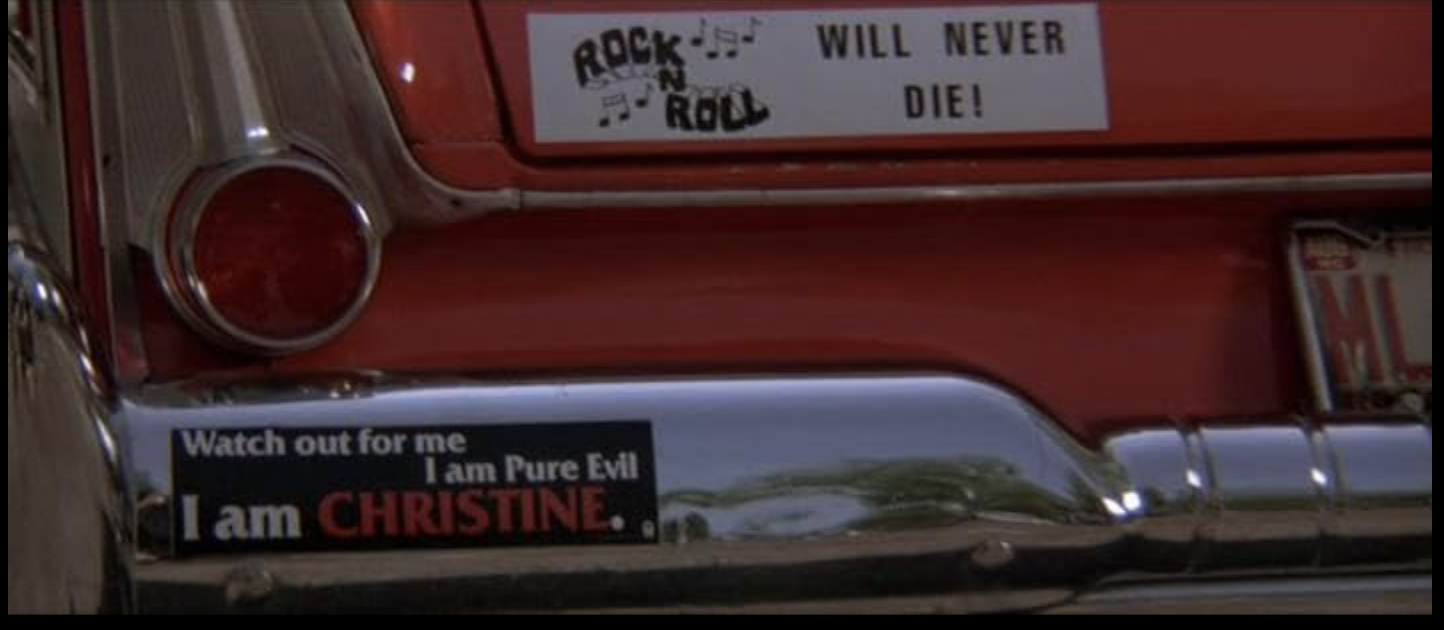
There were other bits of production business that demonstrated King’s fondness for making connections between his stories. The filmmakers wanted to rent a two-door 1958 Plymouth Fury, specifically as a playful reference to Christine, the possessed automobile from King’s 1983 novel and the subsequent John Carpenter film.
It’s a small detail, but it captures the spirit of the project. Cat’s Eye was designed as a movie that would reward King fans who recognized the references without requiring everyone else to know the author’s entire bibliography.
Principal photography ran from June 4 through August 6, 1984. The production utilized Wilmington locations and De Laurentiis’s facilities, although portions of the story also required locations elsewhere.
For Wilmington, Cat’s Eye was another piece of a much larger puzzle.
De Laurentiis was investing in the region and developing a slate of productions that helped establish the area’s reputation as an alternative filmmaking center. The economic benefits extended beyond the studios themselves, reaching local businesses, hotels, restaurants, and workers who suddenly found themselves participating in the movie business.
The Hollywood East experiment wouldn’t last forever in its original form, but Cat’s Eye remains a nice little artifact from that moment when Wilmington was attracting serious attention from the film industry.
Three Stories, Three Different Kinds of Trouble
The finished film opens with the cat wandering through the streets, narrowly escaping danger before finding itself transported into the first of King’s stories.
“Quitters, Inc.” is perhaps the most immediately accessible of the three.
James Woods plays Dick Morrison, a man who decides to quit smoking and seeks help from an organization that promises an unusually effective approach to breaking the habit.
The organization is run by Dr. Donatti (Alan King), whose methods are considerably more intimidating than anything you’ll find in a pamphlet from your local health department.
The premise is classic Stephen King. Take an ordinary situation, introduce one deeply disturbing complication, and then keep pushing until the audience begins to wonder just how far things can go.
Woods is terrific here. He has exactly the right combination of nervous energy, indignation, and desperation. He’s a man who understands that something is terribly wrong but has already discovered that getting out of the situation may be considerably more difficult than getting into it.
The humor is particularly effective because the underlying situation is so unpleasant. King understands that there’s something inherently funny about a supposedly respectable organization operating with the methods of organized crime.
The second segment, “The Ledge,” changes the atmosphere considerably.
Johnny Norris (Robert Hays) finds himself in the hands of Cressner (Kenneth McMillan), a wealthy and thoroughly unpleasant man who has devised an especially cruel test of courage.
Norris must walk around the narrow exterior ledge of a high-rise building. If he succeeds, he gets what he wants. If he fails, well, the consequences are rather obvious.
McMillan is marvelous as Cressner. He’s one of those actors who could make a perfectly ordinary conversation feel vaguely threatening, and here he gets to play a man whose wealth and privilege have apparently eliminated whatever remaining interest he might have had in behaving like a decent human being.
The segment is an exercise in straightforward suspense. There’s no elaborate mythology, no complicated explanation, and no need for much exposition. Just a man, a ledge, and a very long way down.
It’s arguably the film’s most effective sequence.
Then comes “The General,” the story that brings everything together.
Drew Barrymore plays Amanda, a little girl who has developed a relationship with the stray cat. Unfortunately, something else has developed an interest in her.
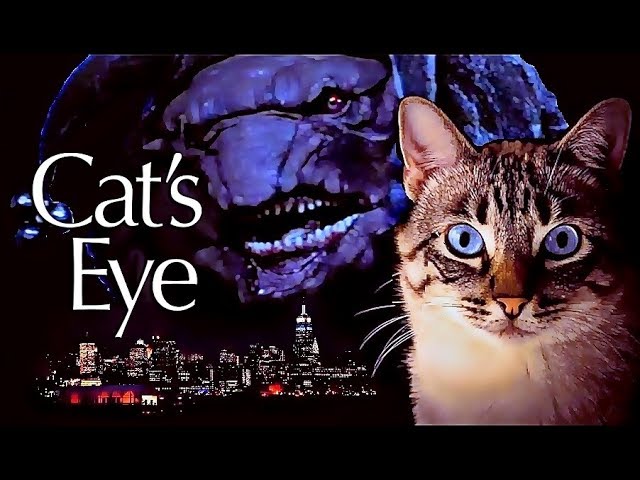
A small troll has been entering her bedroom at night, and the cat seems to understand that Amanda is in danger.
This is where the film’s tone shifts again. The earlier segments are rooted in recognizable human anxieties, even when those anxieties are pushed to absurd extremes. “The General” moves into outright fantasy and creature-feature territory.
Carlo Rambaldi, the legendary effects artist behind the creatures in E.T. the Extra-Terrestrial and Alien, provided the troll effects.
The result is a memorable little monster, particularly for a film working with a relatively modest budget.
Barrymore is charming without being overly precious, and the cat becomes the unlikely hero of the entire production.
There’s something wonderfully old-fashioned about the final story. It’s a child’s nightmare made tangible, with a supernatural creature hiding in the bedroom and a brave animal standing between innocence and something truly nasty.
And yes, the cat gets to save the day.
Lewis Teague and the Art of the King Adaptation
Lewis Teague was a sensible choice to direct Cat’s Eye.
His previous Stephen King adaptation, Cujo, had demonstrated his ability to create tension from relatively simple circumstances. That film understood the effectiveness of limiting a character’s options and forcing the audience to experience the same sense of helplessness.
Cat’s Eye required something a little different.
Teague had to move between three distinct stories without making the finished film feel like three unrelated television episodes accidentally assembled into a feature.
The connecting cat helps, although it’s admittedly a loose device. The individual segments are strong enough to stand on their own, and the transitions occasionally feel more functional than organic.
But the visual approach is attractive, the pacing is generally efficient, and Teague understands when to let a scene play for suspense and when to allow King’s dark humor to take over.
The production benefits from the cinematography of Jack Cardiff, whose career stretched back through some remarkable decades of filmmaking. Alan Silvestri provides the score, adding another familiar name to the credits.
It’s also worth appreciating the practical effects work. Rambaldi’s troll is a product of an era when filmmakers had to build something tangible and make it work in front of the camera.
There’s a particular pleasure in watching those effects today. Not everything needs to be digitally rendered into submission. Sometimes a strange little creature, a carefully constructed set, and a talented effects team are enough.
One production detail deserves special mention: the enormous bed constructed for the final segment. Measuring more than forty feet by twenty feet, it was reportedly recognized by the Guinness Book of World Records as the world’s largest bed.
It’s an appropriately ridiculous piece of trivia for a movie about a cat fighting a troll.
A Stephen King Movie That Didn’t Need to Be R-Rated
Cat’s Eye arrived in theaters on April 12, 1985, distributed by MGM/UA.
The production budget was approximately $7 million, and the film ultimately earned about $13.1 million domestically.
It wasn’t a blockbuster, but neither was it a disaster. It found an audience, and its subsequent life on home video helped keep it in circulation.
One interesting distinction was its PG-13 rating.
By this point, Stephen King adaptations had developed a reputation for R-rated horror. Carrie, The Shining, Cujo, and Christine were not exactly family entertainment.
Cat’s Eye took a somewhat different approach. Although it contains some genuinely nasty material, its mixture of humor, fantasy, and suspense made it accessible to a broader audience.
It became the first theatrical Stephen King adaptation to receive a PG-13 rating, an interesting distinction considering how closely the author’s name had become associated with more adult-oriented horror.
The critical response was generally favorable, although reviewers weren’t entirely convinced that the three stories made a particularly satisfying whole.
The performances received considerable attention, especially Woods, McMillan, and Barrymore. The ledge sequence was frequently singled out for its suspense, while the film’s lighter approach was appreciated by critics who enjoyed King’s more mischievous side.
Today, the film maintains a respectable critical standing, with approximately 69 percent on Rotten Tomatoes and a Metascore of 70.
Drew Barrymore also received a Young Artist Award nomination, while the film earned recognition in the fantasy-film awards circuit.
It wasn’t going to challenge The Shining for a place among the most celebrated King adaptations, but it had found its own audience.
The Cat’s Still Got It
There’s a tendency to overlook Cat’s Eye when discussing the great Stephen King adaptations of the 1980s.
That’s understandable. The decade produced an extraordinary number of them, and the competition was considerable. Some were genuinely frightening, some were ambitious failures, and others became cult favorites through years of cable television and VHS rentals.
Cat’s Eye belongs somewhere in that last category.
It’s not a masterpiece. The three stories aren’t equally effective, and the connecting device occasionally feels like an excuse to get from one Stephen King nightmare to another.
But there’s a lot to enjoy.
James Woods delivers one of those wonderfully frantic performances that made him such an entertaining screen presence during the decade. Kenneth McMillan is deliciously unpleasant. Drew Barrymore brings an appealing sense of innocence to the final segment, and the practical effects give the movie a personality that modern productions sometimes struggle to replicate.
And then there’s the cat.
The General is the real star of the show, a small, scruffy hero who wanders through a collection of human miseries and eventually discovers that his most important assignment involves protecting a little girl from something hiding in her bedroom.
There’s something rather sweet about that.
Cat’s Eye also captures a particular moment in movie history. Stephen King was everywhere, practical creature effects were still an essential part of the horror filmmaker’s toolbox, and Wilmington was briefly becoming a place where Hollywood could imagine building something beyond its traditional borders.
The movie brings all of those things together in a way that feels distinctly 1985.
Sometimes the best way to revisit a decade isn’t through its biggest hits. It’s through the odd little movies that were trying something different, the ones that may not have changed cinema but still have enough personality to make an afternoon with them worthwhile.
Cat’s Eye is one of those movies.
And if you happen to have a cat, perhaps keep an eye on it afterward. You never know what sort of assignments it might have been given.
About the Creator
Movies of the 80s
We love the 1980s. Everything on this page is all about movies of the 1980s. Starting in 1980 and working our way the decade, we are preserving the stories and movies of the greatest decade, the 80s. https://www.youtube.com/@Moviesofthe80s
Enjoyed the story? Support the Creator.
Subscribe for free to receive all their stories in your feed.
Comments
There are no comments for this story
Be the first to respond and start the conversation.