
'Beyond Evil' So Bad it's Good Horror from 1980
John Saxon, Lynda Day George, Pino Donaggio and a possessed Philippine mansion collide in one of the wonderfully strange horror movies of 1980.

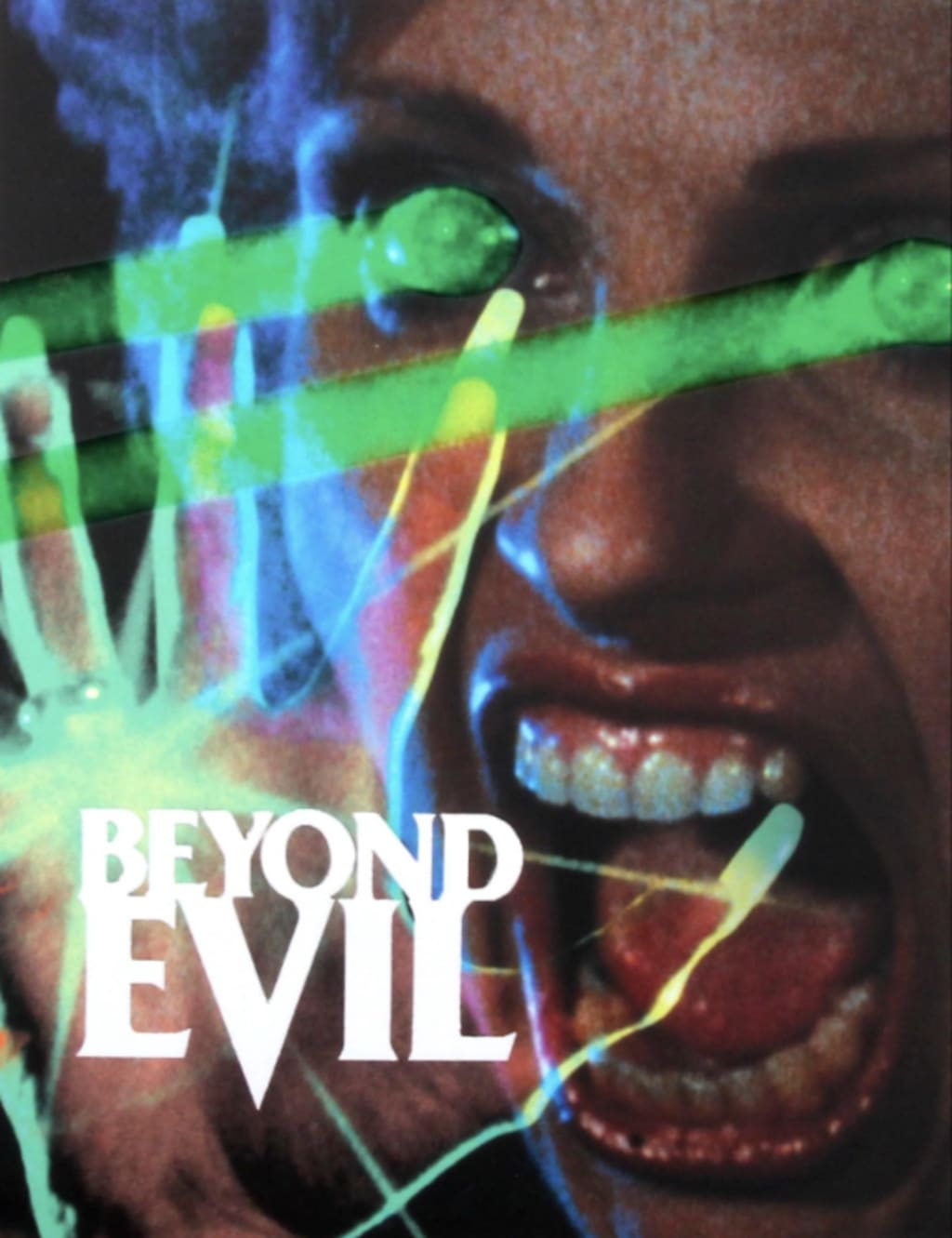
“Even Screaming Won’t Help”
That was the promise.
Another newspaper ad went even further:
“She will possess you. She will take you…”
And if that wasn’t enough, there was always:
“200 years ago, Alma Martín died a horrible death. Now… she’s getting even!”
The advertising department for Beyond Evil understood exactly what kind of movie it was selling.
Unfortunately, the movie itself wasn’t always in on the joke.
Released in May 1980, Beyond Evil arrived during the explosion of independent horror that followed Halloween. It had a familiar recipe: a beautiful young couple, a creepy old mansion, an angry spirit, occultism, murder and a whole lot of ominous music.
It also had John Saxon, Lynda Day George and a score by Pino Donaggio.
What it didn’t have was quite enough money to make all of those ingredients work.
The result is one of those strange little horror movies that seems to exist in the space between genuine supernatural thriller and accidental comedy. Beyond Evil wants desperately to be atmospheric and frightening. Sometimes it actually is.
And then somebody’s eyes turn fluorescent green.
Suddenly, you’re watching something else entirely.
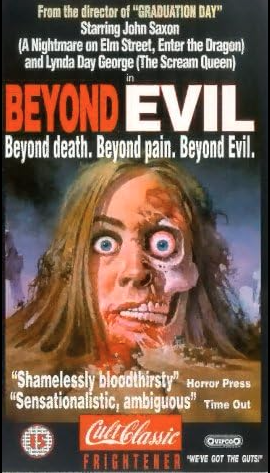
The Rabbi Who Made a Horror Movie
The story of Beyond Evil begins with an unlikely filmmaker.
Herb Freed had actually been a rabbi before entering the movie business. Freed has said that he spent three years as a rabbi before moving into filmmaking, a career change that eventually led him to independent features and the horror film Haunts in 1976. (J. Kevin Tumlinson)
That background helps explain some of the unusual spiritual ambitions behind Beyond Evil.
This wasn’t conceived simply as another bloody drive-in movie. Freed was interested in questions of faith, evil, possession and the relationship between the living and the dead.
The movie just happened to express those ideas with green glowing eyes.
Producer David Baughn, who had previously worked at MGM, became involved with Freed after Haunts. According to later interviews included with the film’s Vinegar Syndrome restoration, Baughn helped develop the story and raise financing for the production. (Blu-ray.com)
The title itself reportedly came from a remark by Baughn. The project wasn’t simply about evil, he suggested. It was beyond evil.
That was apparently enough.
The screenplay was credited to Freed and Paul Ross, with Baughn receiving story credit. (IMDb)
The filmmakers were aiming for something closer to a gothic supernatural thriller than a conventional slasher.
They got there.
Sort of.
Welcome to Casa Fortuna
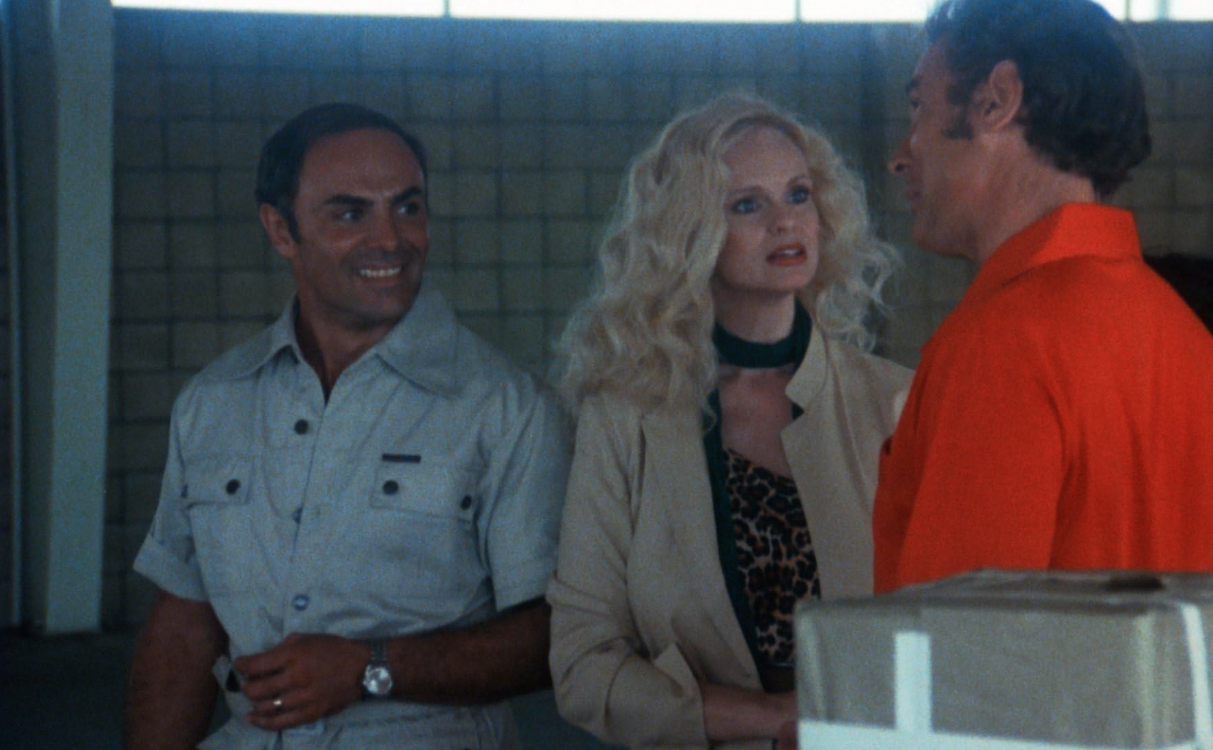
Larry Andrews (John Saxon) and his new wife Barbara (Lynda Day George) arrive in the Philippines expecting to settle into a condominium connected to Larry’s construction work.
Instead, their business associate Del Giorgio (Michael Dante) has arranged for them to stay in a historic mansion called Casa Fortuna.
Naturally, there’s a catch.
The house has a history.
A very bad one.
The mansion was once home to Alma Martín, a woman who became involved with the occult. According to the local legend, her husband Esteban eventually killed her. But death didn’t exactly end Alma’s story.
She returned.
And she wasn’t particularly interested in forgiveness.
Barbara begins experiencing strange visions and increasingly disturbing behavior. Soon there are unexplained injuries, mysterious deaths, supernatural manifestations and the creeping realization that Alma isn’t merely haunting the house.
She wants Barbara.
Possession movies don’t exactly have a complicated formula. Somebody gets possessed. Somebody else doesn’t believe them. Things get progressively worse.
Beyond Evil follows that formula with almost religious devotion.
John Saxon Does Not Need a Shirt
John Saxon was one of those actors who could make a low-budget horror movie feel slightly more respectable simply by showing up.
By 1980, he had already built an impressive genre résumé, and Beyond Evil gave him another opportunity to play the increasingly alarmed husband trying to figure out what the hell is happening to his wife.
Lynda Day George gets the much harder assignment.
She has to play Barbara before and after Alma begins taking control of her.
The movie occasionally gives both actors some surprisingly solid material to work with. Even some contemporary criticism acknowledged that Saxon and George played the material with conviction despite the weaknesses of the screenplay. The Los Angeles Times, while dismissing the movie as “hokey,” “trite” and “silly,” specifically praised the leads, cinematography and atmospheric locations. (AFI Catalog)
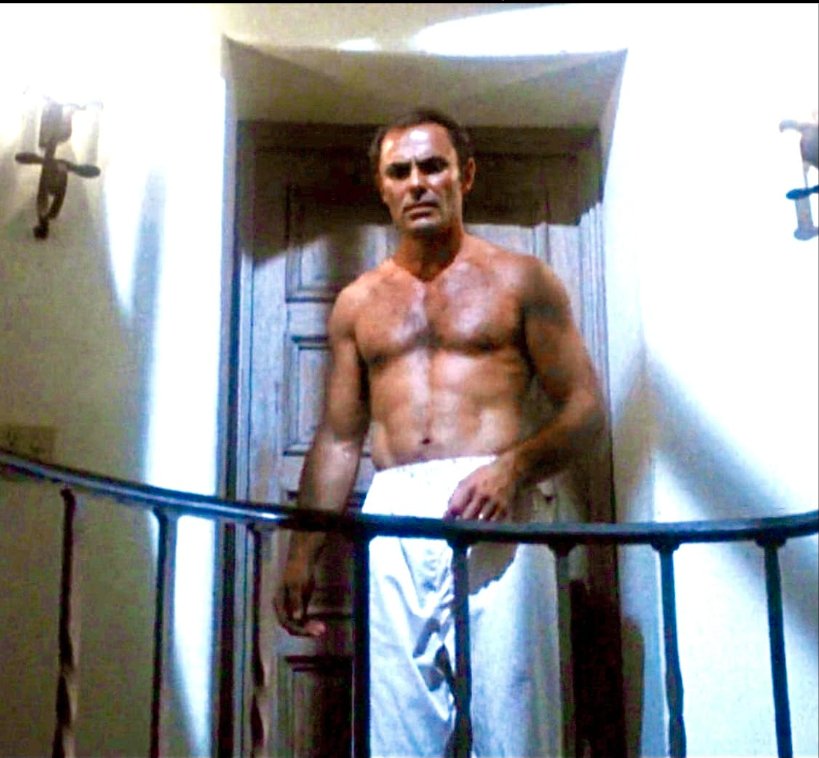
And then there is John Saxon’s physique.
Let’s just say that Beyond Evil was not shy about putting Saxon in situations where a shirt seemed entirely optional.
Later exploitation-film reviews noticed this too. One retrospective described Saxon’s frequent shirtlessness as almost a feature unto itself. (DVD Talk)
The man was 43 when the movie was released.
Apparently the filmmakers felt that was something the audience needed to appreciate.
The Green-Eyed Monster
This is where Beyond Evil earns its place in the Movies of the 80s hall of fame.
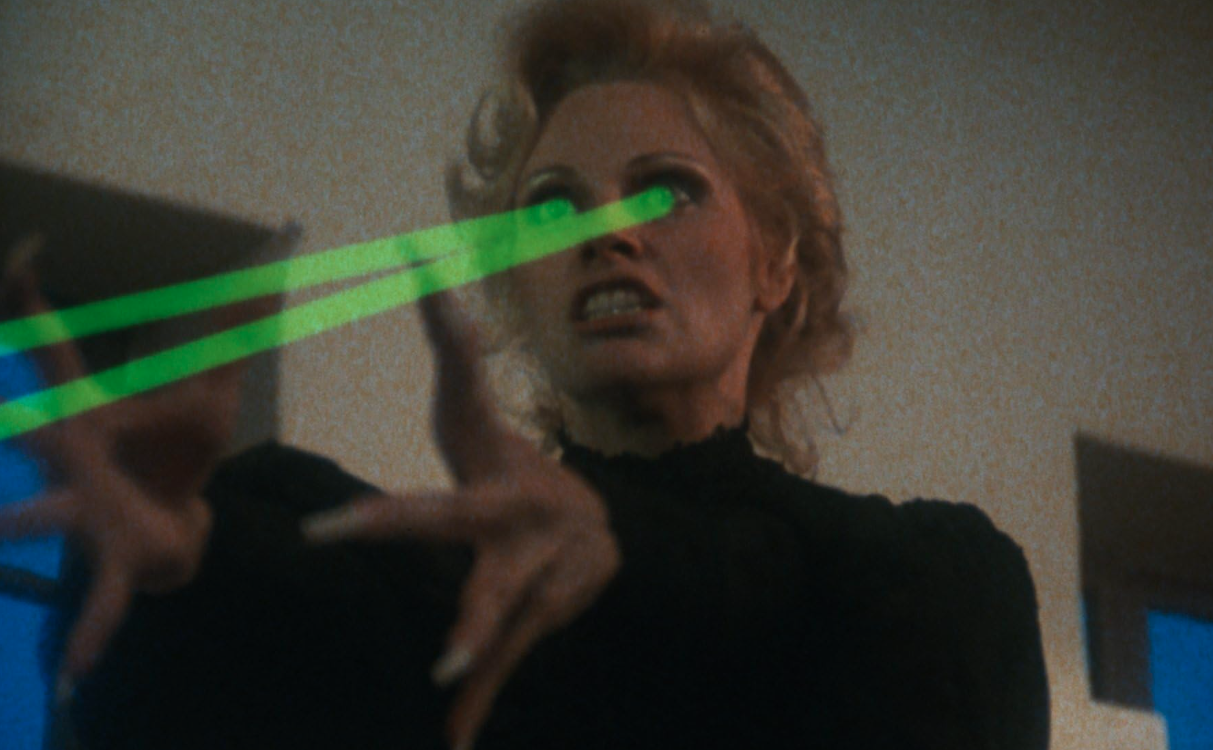
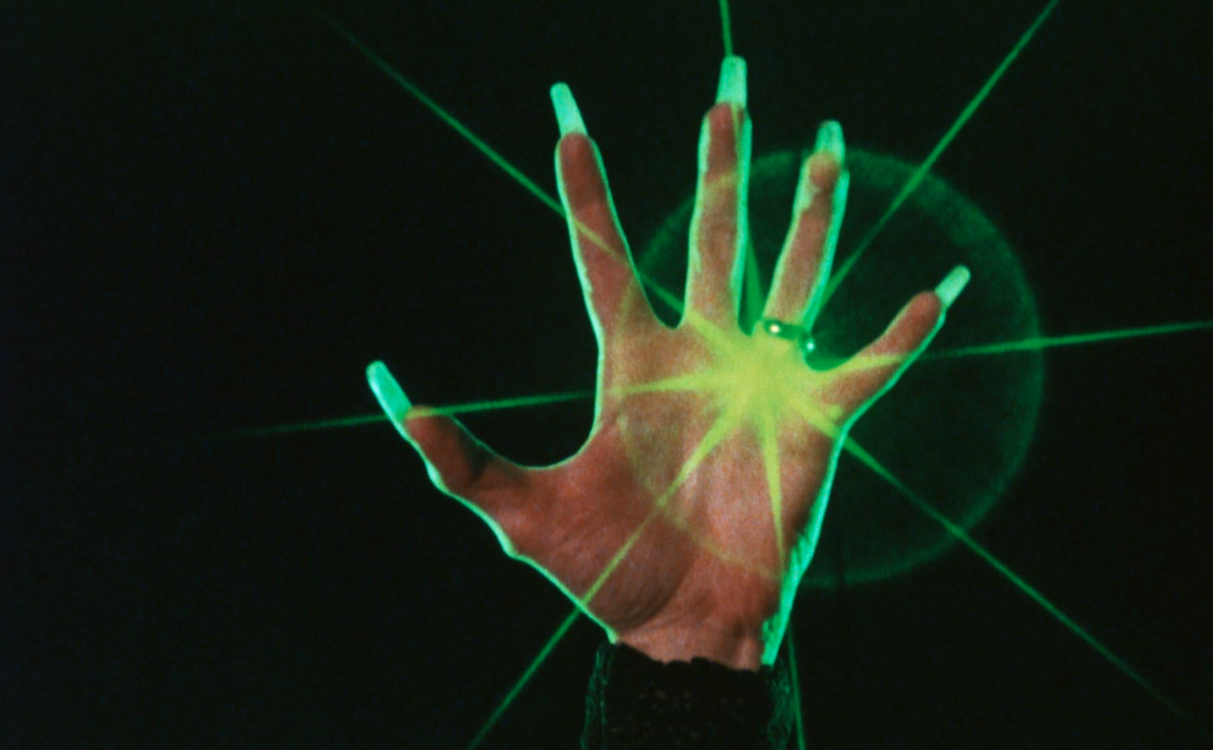
When Alma’s supernatural power manifests itself, the movie frequently resorts to glowing green optical effects around Barbara’s eyes.
The intention is obvious.
This is evil.
This is supernatural.
This is terrifying.
The actual effect is considerably more entertaining.
Those green laser eyes became one of the movie’s most memorable features, and subsequent reviews have repeatedly singled them out as examples of the film’s wonderfully dated visual effects. (Movies & Drinks)
But there’s a reason the effects look the way they do.
According to producer David Baughn, MGM handled the film’s laboratory work and accidentally ruined an entire reel of film. The production had to conduct reshoots, and the problems ultimately contributed to some of the film’s rougher effects and presentation. Baughn later said the poor presentation also cost the film a potential HBO sale. (Movies & Drinks)
In other words, the green laser eyes weren’t necessarily the filmmakers’ grand artistic vision.
Some of this was simply independent filmmaking under pressure.
That doesn’t make them less hilarious.
The Critics Sharpen Their Knives
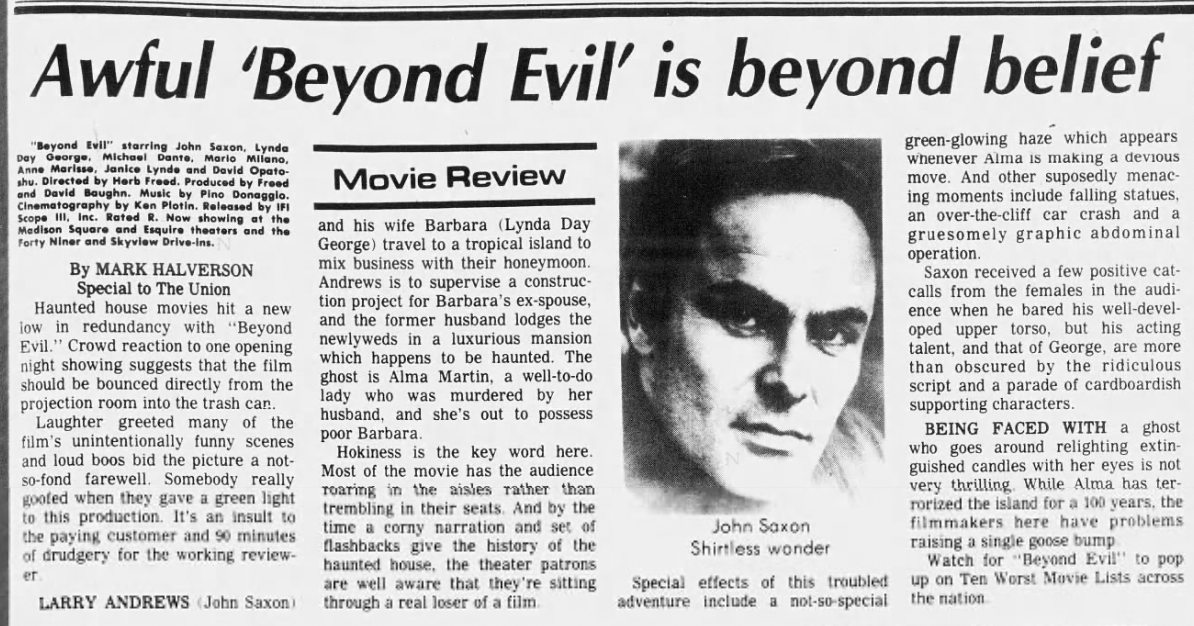
The contemporary reviews of Beyond Evil are almost as entertaining as the movie.
The Los Angeles Times was relatively restrained by the standards of what was coming.
Reviewer Kevin Thomas described the film as a “hokey thriller” that generated more unintended laughs than chills. He nevertheless found things to admire, including the performances, Ken Plotin’s cinematography, Donaggio’s music and the atmospheric locations. His final assessment was considerably less charitable: the material was hopelessly trite and silly. (AFI Catalog)
That wasn’t the only opinion.
Variety, remarkably, went in the other direction, calling Beyond Evil an “above average horror yarn.” (AFI Catalog)
There is something wonderful about those two assessments sitting beside each other.
One publication sees a respectable little supernatural thriller.
Another sees hokum.
The modern viewer gets to watch the movie and wonder how anybody could possibly miss the green lasers.
Other contemporary critics were even less forgiving, and accounts of the film’s early reception describe audiences laughing and booing rather than screaming in terror.
The movie’s unintended-comedy reputation was born almost immediately.
And honestly?
I understand it.
Pino Donaggio Tries to Save Everyone
If Beyond Evil has one element that feels like it belongs in a much better movie, it’s the music.
Pino Donaggio supplied the score.
This is the same Donaggio who would score Brian De Palma’s Dressed to Kill and a long list of other thrillers and horror films. His music gives Beyond Evil an atmosphere and seriousness the movie itself sometimes struggles to maintain.
Vinegar Syndrome’s retrospective materials specifically highlight the score, and contemporary criticism also singled out Donaggio’s contribution. (Vinegar Syndrome)
You can almost feel Donaggio fighting for his life.
The orchestra swells.
The camera creeps through the mansion.
Something terrible is about to happen.
And then—
GREEN LASER EYES.
Donaggio deserved better.
But that’s also part of the charm.
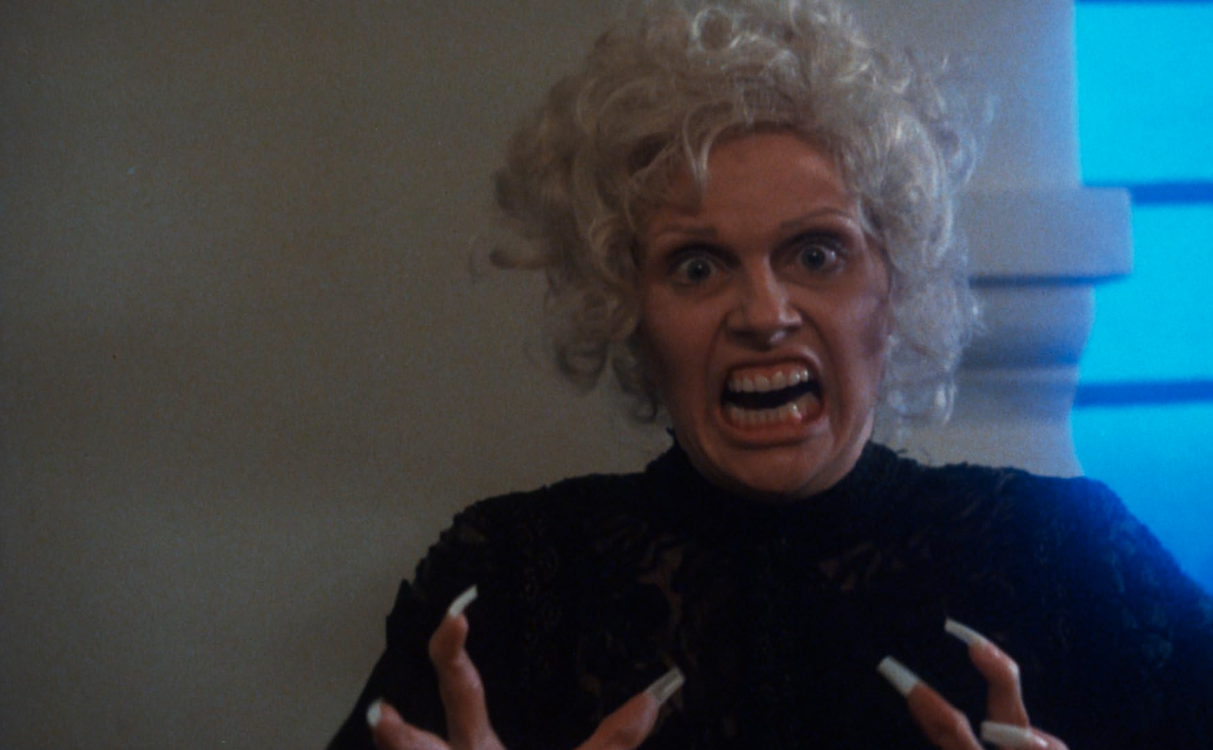
A Small Movie With a Surprisingly Long Afterlife
Beyond Evil opened in Los Angeles on May 9, 1980, at theaters including the Egyptian. AFI records a three-day Southern California gross of $251,461 from 56 theaters. (AFI Catalog)
That’s not the story of a massive theatrical hit.
But it wasn’t simply swallowed whole, either.
The movie eventually found a second life in home video. Troma distributed it on DVD, where it became another strange title in the company’s catalog of cult and exploitation cinema. (Troma)
Then came the much kinder treatment.
In 2019, Vinegar Syndrome released Beyond Evil on Blu-ray and DVD after a new 2K restoration from 35mm elements. The release included new interviews with Freed and Baughn, allowing the movie to be reconsidered not simply as a bad old horror film but as a product of the difficult independent filmmaking world of the late 1970s. (Vinegar Syndrome)
And that context matters.
Because Beyond Evil isn’t completely incompetent.
There are atmospheric locations.
There is a committed cast.
There is a genuinely good score.
There are moments when the haunted-house material works.
And then there are moments when a woman’s eyes glow green like she has just discovered a particularly aggressive brand of contact lens.
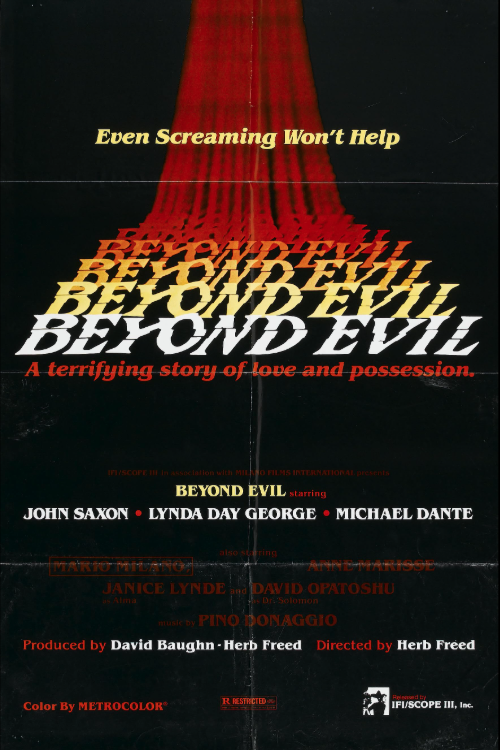
Beyond Evil
Beyond Evil is slow.
It’s talky.
Its supernatural effects have aged spectacularly.
Its plot is assembled from pieces of other horror movies.
And yet I wouldn’t want to lose it.
That’s the funny thing about movies like this.
A perfectly competent horror movie disappears into the enormous pile of perfectly competent horror movies.
Beyond Evil doesn’t.
You remember Beyond Evil.
You remember John Saxon wandering around a haunted mansion.
You remember Lynda Day George trying to convince everyone that something is terribly wrong.
You remember Pino Donaggio desperately attempting to manufacture dread.
And you remember those eyes.
Those glorious, fluorescent, completely ridiculous green eyes.
The movie wanted to make audiences scream.
Instead, it occasionally made them laugh.
But forty-six years later, we’re still talking about it.
That’s not exactly immortality.
But for a little independent horror movie called Beyond Evil, it’s close enough.
Even screaming won’t help.
But laughing might.

About the Creator
Movies of the 80s
We love the 1980s. Everything on this page is all about movies of the 1980s. Starting in 1980 and working our way the decade, we are preserving the stories and movies of the greatest decade, the 80s. https://www.youtube.com/@Moviesofthe80s
Enjoyed the story? Support the Creator.
Subscribe for free to receive all their stories in your feed.
Comments
There are no comments for this story
Be the first to respond and start the conversation.