
Beneath the White Silence
At the bottom of the world, something ancient learned how to knock.
The drilling camp had been a scar on the Ross Ice Shelf for eleven days when Sara first noticed the door.
The door had always been there, a rusted pressure-seal between the sleeping quarters and the equipment bay of Station Voronoi, a relic of the Soviet era repurposed by the Norwegian geological survey three seasons prior. What she noticed was that it stood open. Only slightly. Perhaps two inches. A gap no wider than a man's knuckle.
She had latched it herself the night before. She was certain of this, the door latched, the generator checked, the sat-phone charging in its cradle on the secondary table. She was methodical. Everyone at Voronoi was methodical. You did survive the Antarctic through a constitutional devotion to routine, or you failed to survive it at all.
"Someone left the bay door open," she said at breakfast.
Ted looked up from his breakfast. He was the oldest among them, fifty-three, with a beard gone entirely grey since the previous winter and a manner of absolute stillness that Sara had initially mistaken for wisdom and had since come to understand as simple incuriosity. "Probably Bobby," he said, and returned to eating.
Bobby was twenty-six, enthusiastic, and terminally careless with equipment. He denied it with his mouth full of bread. "I haven't been in the bay since yesterday."
Richard cut in before anyone else could speak. He was the expedition lead, precise, with the authority that required no volume to enforce. "Check your seals before you sleep. That's the rule. That's always the rule."
The matter was always dropped at Voronoi, where the most concerns were ice cores and atmospheric readings and the slow, grinding work of science in a place that denied being studied. The wind that day ran fifty knots out of the south, driving snow horizontally past the reinforced windows so that looking outside was like staring into static, like a television tuned to a dead channel. The world beyond the station was actively hostile.
Sara returned to the bay door, alone, and examined it for a long time.
The latch mechanism was intact. The bolt showed no sign of force. She crouched and looked at the lower seam of the door, where snow sometimes compacted into a wedge and prevented it from closing, and found the seam clean, meaning the door had been opened on purpose, from inside, by someone who had then neglected to close it.
Or it had been opened from the outside.
This was a thought she kept to herself.
That night, Bobby screamed.
A different scream from a nightmare. Sara had heard those before, had a few of her own screams in the darkness of the Antarctic night, where the sun abandoned you for months and the brain began manufacturing horrors to fill the void. Bobbys was a short, sharp sound, the type a person makes when their body reacts before your mind can process what the eyes have seen. Then silence.
She was out of her bunk before the sound had finished echoing through the prefabricated walls. Ted was already in the hallway, holding a flashlight. Richard came last, his face composed into the careful blankness of someone suppressing fear.
Bobby stood in the equipment bay, staring at the exterior wall.
"There," he said. "There was something there."
"Where," said Richard.
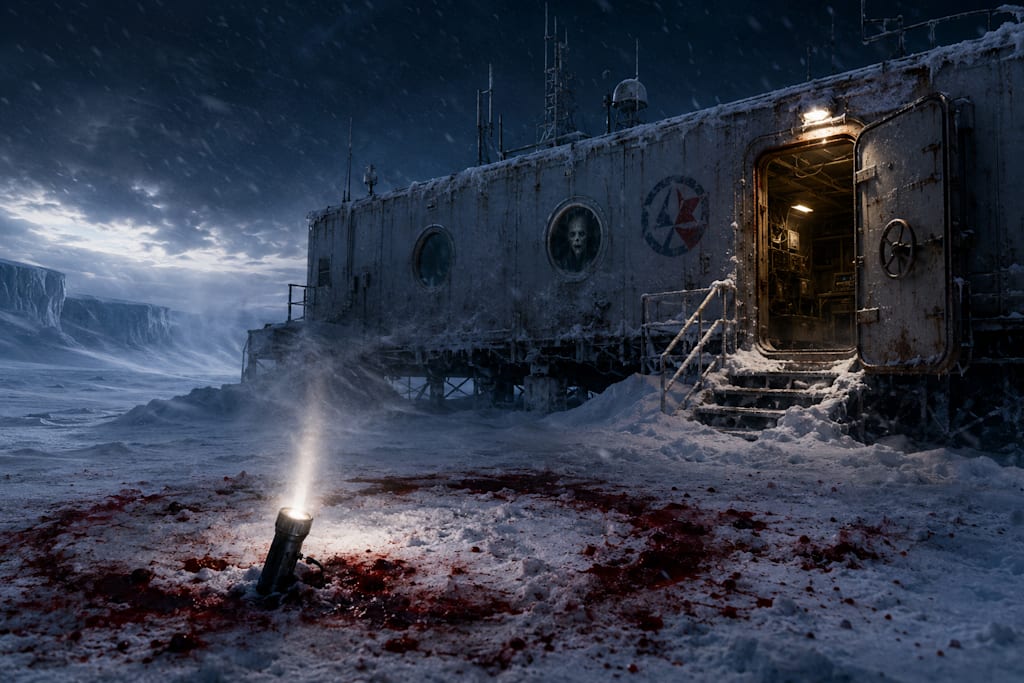
He pointed at the porthole, a small circle of reinforced glass, perhaps eight inches in diameter, set into the wall at eye level. Beyond it lay the black Antarctic night and the driving snow, which in the flashlight's beam appeared as a dense, moving curtain.
"A face," Bobby said. "I saw a face."
The silence that followed the suspension of disbelief, held at arm's length by people trained to demand proof. A face at a porthole, one hundred and fourteen kilometers from the nearest human installation, required extraordinary proof.
"The light plays tricks," Ted said.
"I know what I saw."
"Shapes in the storm."
"It was a face." Bobby turned to them, and Sara saw that he was genuinely afraid, the pale, hollow fear of a man who suspected the world had reshuffled itself into something unrecognizable. "It was looking at me."
They checked the exterior. They suited up fully, immersion suits rated to negative fifty, helmets, tether lines, and walked the perimeter of the station in pairs while the wind tried to murder them with the thoroughness of something that had done it many times before. They found nothing. No tracks. No disturbance in the snow beyond what the storm itself had created.
"The storm would have covered them," Sara said, when they were back inside.
No one answered.
The readings began the following morning.
Richard noticed first, an anomaly in the seismic data, a small rhythmic vibration that failed to correspond to wind load or thermal contraction or any of the other forces that regularly expressed themselves through the ice. It came at irregular intervals. Three pulses, then nothing for an hour, then three pulses again.
"Equipment malfunction?" Ted suggested.
"I've run the diagnostics twice," Richard said. "The sensors are functioning within normal parameters."
"Then what is it?"
He held his answer for a long moment, studying the data with an expression Sara had never seen on him before, something that in a less controlled person would have been called dread. "Something below us," he said at last. "Moving."
Beneath the station, beneath four meters of prefabricated flooring and insulation and the steel framework anchoring Voronoi to the ice, lay the shelf itself, hundreds of meters of compressed ancient ice above four hundred meters of dark, lightless water. Things lived in that water. Weddell seals. Certain species of fish adapted to the cold and the dark in ways that seemed, to Sara's mind, less like adaptation and more like punishment. The readings, Richard said, were consistent with something large. Intermittently large. Something that changed its dimensions between readings.
"That's impossible," Bobby said.
"Yes," Richard agreed. "It is."
That was the afternoon Ted went to check the fuel reserves and failed to return.
They found his flashlight on the ice, forty meters from the station. The beam still burned, pointing straight up into the darkness like a small, futile signal. There was blood on the snow around it, a great deal of blood, more than Sara had thought a body could bleed and still remain ambulatory, arranged in a pattern that suggested intention rather than accident. The blood formed a rough circle, perhaps three meters in diameter, with Ted's flashlight at the center like a votive offering on an altar.
There was no Ted. There was no trail leading away in any direction, because the storm had returned and consumed everything.
Sara stood over the flashlight for a long time, the wind cutting through her suit. She had believed the cold was the worst thing the ice could deploy against her. She understood now that this belief had been a profound and perhaps fatal error.
They pulled her inside. Richard locked the exterior door. Bobby doubled over a supply crate in the corner of the equipment bay, his shoulders shaking.
"The sat-phone," Sara said.
Richard held it up. The screen was cracked, the crack of a point of pressure applied to the center of the glass, spreading outward in spokes. Someone had broken it and on purpose.
"When," Sara said.
"I don't know."
"The radio."
"Also." Richard's voice remained calm. "Both antennas. Sometime in the last six hours."
The three of them stood in the equipment bay of a station now comprehensively and by design severed from everything. No communication. No rescue. The nearest inhabited installation lay a full day's travel by snowmobile in conditions that were lethal.
Something had prepared for this. Something had thought ahead.
Bobby died at 3 a.m.
Sara heard it happen. She had barricaded herself in the sleeping quarters with Richard, the door braced with a steel equipment bar, and she heard Bobby in the next compartment, the equipment bay where they had urged him to avoid sleeping, where he had insisted on sleeping because he feared the suffocating, primal stench of shared panic more than the pitch-black.
She heard the equipment bay door open. She heard Bobby produce a sound, no words, no language, more the sound a voice makes when the mind has traveled somewhere beyond speech. Then a wet, dense impact. The sound of something heavy meeting something that yielded. Then a long, diminishing noise. Then nothing.
Richard covered Sara's mouth before she could make a sound. They sat in the dark together, backs against the bunks, listening to the station settle and creak around them. Sara thought about the door she had latched, about the face at the porthole, about the three pulses in the seismic data, a signal, a counting, a patience so vast it had no analogue in any human experience she could reach for.
Something knocked on the door. Twice. Then, after a pause, once more.
Three times. She then realized this was no polite request for entry; it was a firm statement of presence.
It knew they was in there.
Richard's grip on her arm was the only real thing in the world. They held still. They held silent. They breathed as shallowly as human lungs would permit, and they waited for the door to open or to remain closed, and outside the station the Antarctic wind continued its ancient, indifferent howling, and somewhere in the dark below the ice, something moved through water that had never known light.
In the morning, Richard would find the exterior door open again, the storm was gone, the sky an impossible and blue.
He would be the only one who opened it.
They recovered one survivor from Station Voronoi, seventeen days after scheduled contact was lost. The official report cited extreme weather, equipment failure, and probable psychological deterioration consistent with prolonged polar isolation. The survivor declined to provide a statement. The report noted, in its final paragraph, that the seismic monitoring equipment had been left running, and that the data from the final three days of the expedition showed rhythmic vibrations the reviewing team was unable to classify or explain.
The file was closed.
The ice remains.
About the Creator
Tim Carmichael
Let your becoming be louder than your fear, and your smallest steps become the road you once thought impossible to walk. An Appalachian poet and cookbook author my book Beautiful and Brutal Things is on Amazon, Link 👇
Enjoyed the story? Support the Creator.
Subscribe for free to receive all their stories in your feed. You could also become a paid subscriber, letting them know you appreciate their work.
Comments
There are no comments for this story
Be the first to respond and start the conversation.