
Ballast
A body is weight, and weight goes over the side.

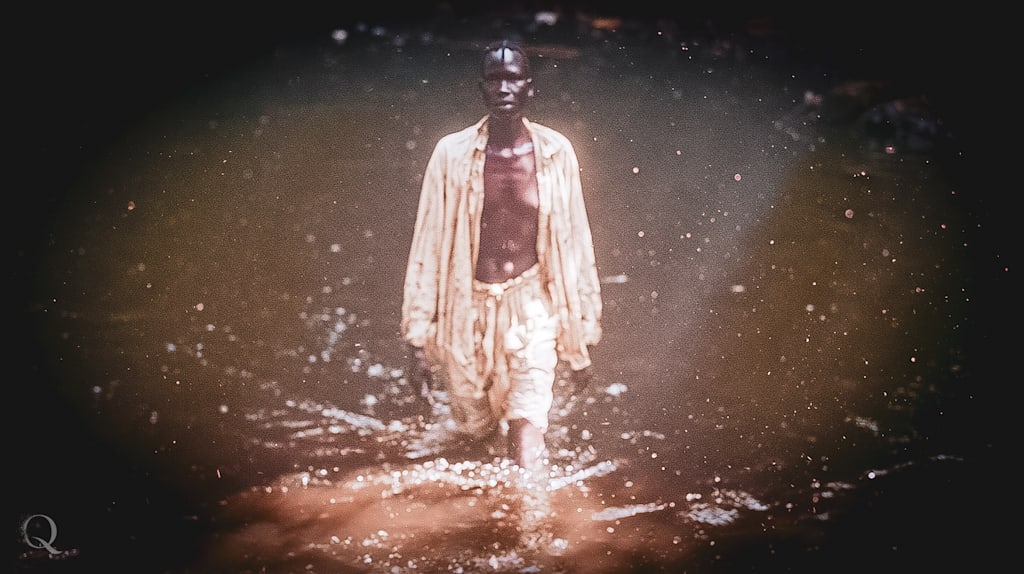
I. The First Water
He is six, and the river is as wide as everything he has a word for.
The line of the walking goes down into it and does not come up the same on the far side, fewer, always fewer, and the grown ones say cross quickly and do not say why, and the water is warm the way a mouth is warm, and something under it is patient. Behind them is forty days of walking and the smell of the thing that walked behind the walking. Ahead is a rumour of a fence and food and a country that counts you. His father’s hand is closed around his wrist. His father’s hand is the only fixed thing in the turning world.
Deng, his father says — his name, which in the old language is also the word the sky makes when it finally breaks and lets the rain down, the same word for the boy and for the weather that saves the cattle, so that to call him is to call for water in a dry year. Deng. Do not let go. Look at me. Only at me. And he looks, and the far bank is a thread of gold, and the people ahead are chest-deep, then chin-deep, then gone.
Below him, through the brown, he can see the others. The ones the river kept. They are walking too. They keep pace with him along the bed, faces turned up, patient as the thing that is patient, and they are not unhappy — that is the worst of it — they have the calm of people who have already arrived. One of them is a boy his own age who lifts a hand. Not to be saved. Only to wave. Only to say soon.
And the current takes his feet, and the gold thread snaps, and his father’s grip becomes water becomes nothing—
and he goes down into the warm, toward the waving, and the rain has his name, and he opens his mouth to it—
II.
Nineteen.
He counts them because counting is a rope and he is a man holding a rope. Nineteen on a boat built, if it was built for anything, for nine. The hull is a plastic skin stretched over the cold, and the cold comes through it into the meat of him by the hour. Somewhere ahead is a coast none of them have seen. Behind is one none of them can return to. Between is this — the between — which is the only country that has ever taken him in without first asking where he was really from.
The water in the bottom of the boat is at his ankles. An hour ago it was not. He has done this arithmetic before, the slow sum of a low place filling, and he knows the answer it is working toward.
He knows the other arithmetic too. He heard it in the dark before they launched, spoken by the men who run these crossings — flat, not cruel, the way you would speak of a sack of grain gone wet. A body is weight. A living man is a passenger; a dead one is ballast, and ballast goes over the side to keep the rest afloat, down into the deep with no name said over it, because a name said over water is a name the water learns. If he dies here he does not arrive. He becomes the thing thrown.
So he stays awake. That is the whole of his work now, the only work left to a man who once had a country’s worth of work refused him. Stay awake. He is thirty-four. He has been counted by a camp for seven years and by the cold country for twenty-one and by the men in the towers for the few that mattered, and now he counts himself, nineteen, eighteen if the woman’s child is already gone still in her arms, and he will not let the number include him.
He ran once before, at twenty, the night the corner came apart, and then he stopped running and called the stopping a life — fourteen years of keeping his head down in the cold country, a job that never asked his history, and then a boy, Bol, small enough still to ride a foot like a boat. He let himself believe the past had drowned. It had not. The past has a brother. Three weeks ago the dead boy’s brother said Deng’s name in a stairwell that had no way of knowing it — soft, patient, the way the river is patient — and a name said by the right mouth is a debt called in. So Deng did the one thing he has ever been good at: he left the boy small, and he went to the water.
The man beside him prays in a language Deng half knows. The cold climbs his shins. He bites the inside of his cheek and tastes the warm copper of himself and thinks, that is the river, that is only the river — and the thought has a hand in it, and the hand draws him down past the waking, into the year it all went wrong.
III. The Night It Went Wrong
In the dream the towers stand up out of the sea.
He is twenty again, made of the certainty that twenty makes, the certainty that is mostly fear in better clothes. He came to the cold country at thirteen, off a plane, into a flat stacked high in a stack of flats, into a school that said his name like an apology and a street that said it like a charge. Inside the postcode his name meant something. Outside it his name meant step out of the car, meant the slow turn of heads on a tram, meant a country that had taken his body in and never stopped asking where the rest of him came from.
The towers were the only room that did not ask the question. So he gave them the loyalty no one else would take, and they gave him a name that meant something on its own ground, and that is a trade a frightened boy will always make and call it love.
On the night it went wrong he was holding the thing that twenty-year-olds hold to feel like more than a question, and the other one came round the corner too fast, also nineteen, also off a plane and out of a camp and into a stack of flats, and it went wrong the way water goes over a lip — all at once, and then forever.
It is one moment. He cannot make it longer or shorter. He cannot make it not be. Afterward the boy is on the ground and the ground is taking him the way the river took the others, and Deng runs. That is the whole of the worst thing he ever did, and it is told flat because there is no other honest way to tell it.
But this is the dream, and the dream is not finished. The boy gets up.
He gets up nineteen. He will be nineteen now in every room, forever. He falls into step beside Deng the way the drowned walked the riverbed, unhurried, turning his face up — and the face is Deng’s own face, the camp face, the six-year-old at the water’s edge waving soon. The dark spreading on him is not blood. It is brown river-water, warm as a mouth. You let go, the boy says, in Deng’s father’s voice. You let go of my wrist.
And far off, in a flat where his son sleeps small and unguarded, a telephone is ringing, and ringing, and Deng is running, and the running is downward—
IV.
Seventeen.
He counts and gets seventeen and the wrongness of it opens his eyes. There were nineteen. He counts the dark shapes again and the cold has made his counting stupid; the shapes will not hold still to be numbered. The praying man is not praying now. The water is at his thighs, and it is no longer climbing, because he is no longer sitting up. He has slid down into the filling low place, and his body has stopped spending heat on his hands, because his body has begun, quietly, without asking him, to choose.
This is the part the cold does that no one warns you about: it is kind. It arrives as warmth. It arrives as a golden thread on a far bank. It arrives as a hand on your wrist saying only look at me. He knows it is the cold lying, and he cannot tell the lie from his father, and the not-being-able-to-tell is itself the warmth, spreading, and the boat tips its gunwale toward the black, and he goes once more under — into the room he has spent the whole crossing trying not to enter. The one at the end of the flat. The one with the chair.
V. The Silent Room
He is old, and the flat is very quiet.
This is how the dream rewards him for everything: it lets him have arrived. The cold country let him stay. The towers are decades behind. The years have worn his name down to a shape the neighbours can nearly manage. There is a chair by a window, and the rain comes down the glass the way it does in the country that took him — thin, grey, without ceremony — and he sits in the chair, and he is forgiven, or at least no longer followed, which after a certain age is the same thing.
His son does not call.
This is the one ache left, and it is an old one, soft at the edges from handling. He left the boy small. He left him the way you leave a coast — because staying meant the slow filling of a low place, because a man being hunted is ballast in his own house. Bol is grown now, somewhere in the same grey city, a man Deng would not know on a tram, and he does not call, and Deng has decided to call that peace.
The telephone rings.
He knows before he lifts it. He has always known. A voice that is official and gentle — the voice they keep for exactly this — tells him there has been an incident. It says a name that is his own name, worn by his own boy. It says nineteen. It says we’re so sorry for your loss.
And the rain on the glass stops being rain and becomes the brown river, running upward. The gentle voice slides out from under itself and becomes the boy from the corner — you let go — and then his father — do not let go — and then his own, flat, very close: a name said over water is a name the water learns. The flat folds along a seam he never saw. The walls breathe inward. The chair dissolves to cold. The window fills. And the rain has his son’s name in it now, and his father’s name, and his, and they are all the one word, the word the sky makes when it finally breaks—
VI. The Deep
He spasms awake into the hold of the world.
There is light. For one whole second there is white light sweeping the water, and an engine that is not their engine, and a voice across the swell through a horn — and the second holds everything, holds the far gold bank, holds arrival. A patrol. A boat with a name and a flag and rules. Coming. Coming.
The hands are on him before he understands the hands.
They are not cruel. He has time to know that — the way the men were not cruel, the way the cold was not cruel, the way the river only did what a river does. He is the low number now. He is the one not sitting up. The patrol means search, means weight measured, means a boat nine-built and nineteen-laden that cannot be found with a dying man aboard to sink it. So the hands do the old arithmetic, gently, and the gunwale turns him out toward the black, and the last thing he hears above the surface is someone — not him — beginning to say his name, and stopping, because a name said over water—
He goes into the deep.
It is warm. Of course it is warm; the cold has been promising him so for hours. The light above becomes a coin, then a fingernail, then the memory of a colour. The pressure comes down like a grown hand laid on a small shoulder. And the others are here — the river-kept and the boat-thrown, walking the floor of all the water there has ever been, faces turned up, patient. The boy his own age is among them. The boy from the corner is among them, nineteen. His son is among them. And none of them are unhappy, and that is still the worst of it, and it is also, now, almost the mercy.
Down is where bodies go. Down was always the lie the cold told — come down, it’s warm. He has believed every lie the water ever offered him, the whole length of his life, from the first river to this last one.
So when the hand closes around his wrist, he believes that too.
It comes up. Out of the deeper dark below him — the dark he is sinking toward — a hand comes up and takes him by the wrist the way it took him at the river when he was six, the only fixed thing in the turning world. And it does not pull him down to walk with the patient ones. It pulls him out. Out of the water altogether, out through a surface that was never overhead, and he is small again, he is six and streaming and held hard against a chest that smells of cattle and smoke and home, and his father’s face is over him, blocking out a light Deng has no word for — not the patrol’s white, not the cold’s gold, not the grey rain of the country that took him — and his father is laughing, the way a man laughs who had let go and caught hold again, and his father is saying it, the word, the one that means the boy and means the sky giving down its water at last and means here, here, I have you—
Deng.
And he opens his eyes.
About the Creator
Ahmet Nazif Sati
The train arrives after midnight carrying soaked commuters and one screaming drunk philosopher. Somewhere at the edge of the observable universe, matter collapses into impossible density. Nobody looks up from their phones.
Enjoyed the story? Support the Creator.
Subscribe for free to receive all their stories in your feed. You could also become a paid subscriber, letting them know you appreciate their work.
Comments
There are no comments for this story
Be the first to respond and start the conversation.