
Baba Yaga
The Witch Waiting at the Edge of the World

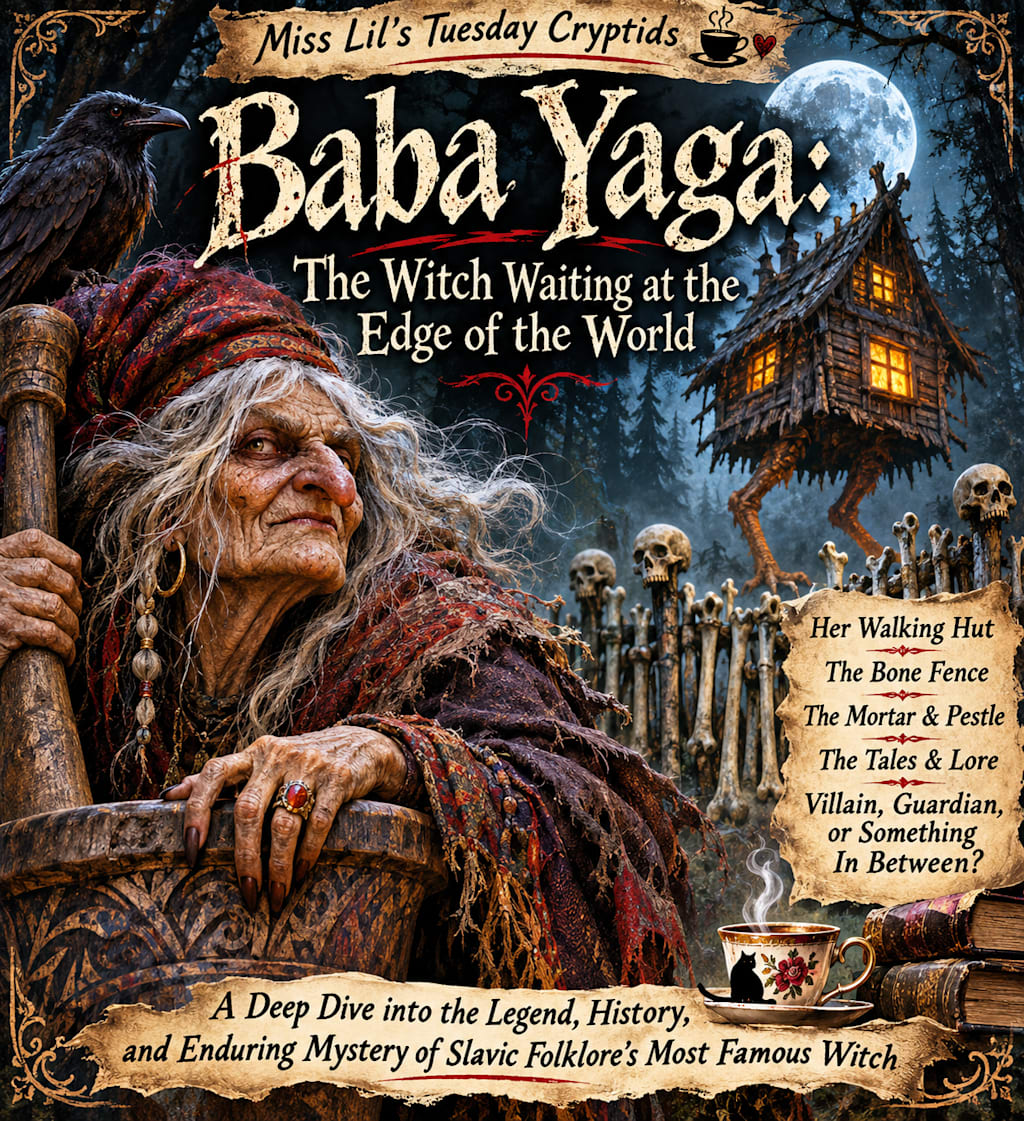
Baba Yaga: The Witch Waiting at the Edge of the World
Miss Lil's Tuesday Cryptids | Ancient Folklore, Legendary Monsters & Things That Go Bump Beyond the Trees
Well, well, well. Look who has decided to join us at the tea table!
Come closer, my friends. Seriously, pull up a chair. Today we are heading somewhere I have wanted to take you for quite some time. Somewhere deep in the forests of Eastern Europe, where the trees grow thick, the paths disappear, and you might want to reconsider that sudden urge to go exploring.
Why?
Because today we're talking about one of my absolute favorite figures in folklore.
BABA YAGA.
Now, I have a soft spot for a good witch. Give me ancient legends, questionable magic, a little darkness, and a woman who doesn't give a flying feather about what society thinks of her, and I'm probably going to settle in for a while.
But Baba Yaga? Oh, she's a whole different kettle of fish.
Imagine an ancient old woman living in a wooden cottage that stands on enormous chicken legs. Her property is surrounded by a fence made of human bones, with skulls perched on the posts. She travels through the skies in a mortar and pestle, uses a broom to sweep away her tracks, and has absolutely no problem turning an unsuspecting traveler into dinner.
Charming, isn't she?
Except here's where things get interesting.
Sometimes she eats people. Sometimes she helps them. Sometimes she tests them, rewards them, or gives them exactly what they need to survive.
And sometimes, depending on which story you're reading, she seems to be the only thing standing between a young hero and certain disaster.
So what exactly is Baba Yaga?
A monster? A witch? An ancient spirit? A guardian of forbidden knowledge? Perhaps something that existed long before the stories we tell about her ever found their way onto paper?
That's what we're going to explore.
Get comfortable, top off that coffee, and whatever you do, don't wander away from the group.
I cannot guarantee everyone who enters Baba Yaga's forest makes it back out.
And honestly, I don't think she would be particularly concerned.
FIRST, LET'S TALK ABOUT WHERE THIS WOMAN CAME FROM!
Baba Yaga is a prominent figure in Slavic folklore, particularly Russian fairy tales, although stories about her and related figures appear throughout Eastern Europe.
Now, when I say old folklore, I mean OLD.
These weren't stories that someone sat down and invented over a weekend because they were bored. They were part of an oral storytelling tradition, passed from generation to generation, long before anyone decided to write them down.
Imagine sitting around a fire hundreds of years ago, listening to your grandmother tell you about a witch who lived in the forest.
Except this wasn't a story about some harmless old woman making herbal remedies and handing out cookies.
This woman could eat you.
And she might.
The precise origins of Baba Yaga are difficult to establish. We don't have a birth certificate, an ancient diary, or a conveniently preserved document telling us exactly when she first appeared.
What we do have are historical references and surviving collections of traditional stories.
Some of the important milestones include:
1755: Russian scholar Mikhail Lomonosov references Iaga Baba in his work on Russian grammar.
1780: Vasily Levshin publishes an early literary account featuring Baba Yaga.
1855–1863: Alexander Afanasyev publishes his extensive collection of Russian folktales, preserving several stories featuring the infamous witch.
19th century: Artists, folklorists, and writers help spread Baba Yaga's image beyond Eastern Europe.
But remember something important: these are dates from her documented history. Her stories were being told long before scholars started collecting them.
Even her name is a bit of a mystery.
The word Baba is generally associated with an older woman or grandmother in Slavic languages. The meaning of Yaga is much less certain. Linguists have proposed several possible explanations, but nobody has conclusively settled the question.
Which is rather fitting, don't you think?
A woman who refuses to explain herself, whose origins are buried in centuries of folklore, and whose name won't even cooperate with historians.
I like her already.
THE HOUSE WITH CHICKEN LEGS. BECAUSE A NORMAL COTTAGE WOULD BE BORING.
Let's get one thing straight.
If I am wandering through the woods and stumble upon a little cottage, I'm probably going to be curious.
If that cottage suddenly turns around and walks toward me on two enormous chicken legs, curiosity is officially over.
I'm going home.
Unfortunately, the heroes in Baba Yaga's stories aren't always given that luxury.
Her hut is perhaps the most recognizable part of her legend. It stands on enormous birdlike legs and has the rather inconvenient habit of facing away from visitors.
In many versions of the folklore, the visitor must speak a magical command to make the cottage turn around.
A commonly repeated translation goes something like:
"Hut, hut, turn your back to the forest and your front toward me."
And the house obeys.
Just imagine that conversation.
You're standing in the middle of an enchanted forest, addressing a walking cottage like it's an unruly farm animal.
And it listens.
Now, why chicken legs?
This is where folklore gets particularly fascinating.
Some researchers have explored possible connections between Baba Yaga's hut and ancient burial customs. Certain interpretations suggest similarities to elevated funerary structures, sometimes associated with placing remains in small containers supported above the ground.
Other interpretations connect the hut with initiation rituals, death, and the transition between the world of the living and the world of the dead.
A more recent scholarly interpretation has also examined possible connections with seasonal transitions and Slavic cosmological beliefs.
Are these theories proven? No. The precise origin of the chicken-legged hut remains debated.
But consider the symbolism.
The hut doesn't sit on the earth like an ordinary human dwelling. It moves. It turns. It stands between the forest and whoever has managed to find it.
Perhaps it represents a threshold between worlds.
And if that's the case, Baba Yaga isn't simply living in a strange house.
She's living somewhere humans were never meant to wander casually.
Personally, I think the chicken legs are a spectacularly effective way of telling visitors they've made a terrible mistake.
THE BONE FENCE: LANDSCAPING BY NIGHTMARE.
Now let's discuss the neighborhood.
Because apparently living in a walking chicken-legged cottage wasn't enough. Baba Yaga also needed a little decorative flair around the property.
Her fence is frequently described as being constructed from human bones.
And those lovely little fence posts?
They're topped with human skulls.
Some versions describe the skulls glowing, almost like lanterns, illuminating the darkness around the hut.
Let that sink in.
Most people put little lanterns along their garden path.
Baba Yaga uses skulls.
I imagine the homeowners' association has some concerns.
But jokes aside, the bone fence is an important part of her folklore.
It establishes that her territory is associated with death, danger, and the supernatural.
A fence is supposed to mark a boundary. It tells you where one person's property ends and another's begins.
Baba Yaga's fence takes that concept and gives it a rather horrifying twist.
It tells you that people have come here before.
It tells you that some didn't leave.
And it strongly suggests that you should think very carefully before knocking on the door.
There are also stories in which a missing skull leaves an empty place along the fence, sometimes waiting for another unfortunate soul.
Now, isn't that a lovely thought?
Imagine arriving at someone's house and realizing there is an empty spot with your name practically written all over it.
I don't care how badly I need directions. I'm finding another route.
THE MORTAR, PESTLE, AND BROOM. WHO NEEDS A BROOMSTICK?
Every respectable witch needs transportation, right?
Well, Baba Yaga apparently looked at the traditional broomstick and decided it simply wasn't enough.
She travels through the sky inside a giant mortar, propelling herself with a pestle.
And to make matters even more interesting, she carries a broom to sweep away the traces of her journey.
Yes, you read that correctly.
A MORTAR.
A PESTLE.
And a BROOM.
I can practically hear the witches' transportation committee having a heated discussion about this one.
But these objects are more than quirky accessories.
The mortar and pestle are traditional household tools used for grinding and preparing ingredients. They are associated with transformation, preparation, and the changing of one substance into another.
In Baba Yaga's hands, they become instruments of supernatural movement.
The broom has its own significance. By sweeping away her tracks, she can conceal her movements and make it difficult for anyone to follow her.
Think about that.
She isn't simply flying through the forest. She's erasing the evidence that she was ever there.
A woman who can appear and disappear, travel between places without leaving a trail, and seemingly move beyond the ordinary limitations of the world.
I don't know about you, but I wouldn't want to be on the receiving end of an unexpected visit.
And if you hear the sound of a giant mortar moving through the night sky?
Perhaps don't investigate.
Some things are better left unexplained.
SO, IS SHE GOING TO EAT YOU OR HELP YOU?
HERE is where Baba Yaga becomes one of my favorite figures in folklore.
Because she is wonderfully, gloriously complicated.
Modern horror tends to enjoy giving us clearly defined villains. They're evil. They do evil things. They have evil plans. Everyone knows they're evil.
Easy.
Baba Yaga doesn't cooperate with that arrangement.
Sometimes she's a cannibalistic monster who threatens to eat children and travelers.
Other times, she is a source of magical knowledge, guidance, or assistance.
She may test a visitor before deciding whether to help. She may give a hero something desperately needed to complete a dangerous quest.
But don't mistake her assistance for kindness.
There are conditions.
There are challenges.
And there is absolutely no guarantee that you will enjoy the experience.
In many stories, Baba Yaga acts as a gatekeeper. The hero must enter her territory, face her tests, and prove something about themselves before moving forward.
She might be dangerous, but she's also a source of things the hero cannot obtain anywhere else.
Now, I find that fascinating.
What if she isn't necessarily interested in whether someone is good or bad?
What if she cares about something entirely different?
Courage? Intelligence? Respect? Resourcefulness?
Or perhaps she simply follows rules that human beings were never meant to understand.
Whatever the answer, one thing is certain.
Baba Yaga is not the sort of woman you can sweet-talk into giving you a magical gift because you complimented her curtains.
Although, considering the curtains are probably made of something questionable, perhaps don't compliment those either.
VASILISA THE BEAUTIFUL: THE GIRL WHO WALKED INTO THE WITCH'S FOREST.
Now, my friends, THIS is where we get to one of the most fascinating Baba Yaga stories.
And if you haven't heard the tale of Vasilisa the Beautiful, settle in.
This one has cruelty, magic, family betrayal, an enchanted doll, and one very unpleasant household visit.
Vasilisa is a young girl whose mother dies when she is still a child.
Before her death, her mother gives her a small doll and tells her to keep it close. Whenever she needs help, she should feed the doll, and it will assist her.
Eventually, Vasilisa's father remarries.
Unfortunately, her new stepmother and stepsisters are about as pleasant as a tax audit conducted by a pack of hungry wolves.
They treat Vasilisa terribly, forcing her to perform endless household chores and making her life miserable.
One evening, they deliberately extinguish the household fire.
And then they send Vasilisa into the forest to obtain a new flame.
Where do they send her?
To Baba Yaga.
Because apparently being a terrible stepmother wasn't enough. They decided to add attempted witch-related child disposal to their list of hobbies.
Vasilisa knows the stories about Baba Yaga. She knows the witch is dangerous. She knows people who enter her forest may never return.
But she has little choice.
So she takes her mother's doll and ventures into the woods.
Eventually, she reaches the witch's home.
And what does she find?
A cottage standing on chicken legs.
A fence made of bones.
Human skulls.
And an old woman who is every bit as terrifying as the stories suggested.
Baba Yaga agrees to give Vasilisa the fire she needs, but there is a condition.
First, she must complete a series of household tasks.
She must clean, cook, and separate enormous quantities of grain. The work is exhausting and seemingly impossible.
And let's be honest, Baba Yaga doesn't exactly sound like the sort of employer who believes in reasonable working hours or employee benefits.
Fortunately, Vasilisa has her mother's doll.
Whenever she becomes overwhelmed, she feeds the doll, and it helps her complete the work.
Baba Yaga notices that the girl is accomplishing tasks that should have been impossible.
She begins questioning Vasilisa.
But the girl is careful about what she reveals.
Eventually, Vasilisa asks about the strange riders she has seen around the hut.
Baba Yaga explains that the white rider represents day, the red rider represents the sun, and the black rider represents night.
Now, isn't that interesting?
This isn't simply an old witch living in a cottage and frightening travelers.
She appears connected to forces that govern the natural world.
Day. Sun. Night.
The passage of time itself.
Eventually, Vasilisa completes her tasks, and Baba Yaga gives her a skull with burning eyes.
The skull provides the fire she needs to return home.
And when Vasilisa arrives, the supernatural fire consumes her cruel stepmother and stepsisters.
Vasilisa eventually finds a better life.
Now, let's pause here.
Baba Yaga could have eaten Vasilisa.
She could have killed her.
She could have refused to help her altogether.
Instead, she tested the girl, and Vasilisa survived through her own resourcefulness, the wisdom of her mother, and the magical assistance of the doll.
Was Baba Yaga helping her?
Was she testing her?
Was she simply amused by the situation?
Perhaps a little of all three.
This is what I love about the story.
Baba Yaga is terrifying, but she also becomes part of Vasilisa's transformation.
She is the obstacle, the examiner, and the keeper of the gift that allows the girl to move forward.
And I have to wonder...
Would Vasilisa have become the woman she eventually became without that terrifying journey into the forest?
Sometimes the most important lessons come from the last person we would ever choose as a teacher.
Although I would still prefer a classroom without the human skull decorations.
WHY DO HEROES KEEP KNOCKING ON HER DOOR?
Seriously, what is it with these people?
You hear a story about an ancient witch who lives in a walking cottage surrounded by human bones, and your first thought is apparently, "I should go visit her."
But Baba Yaga appears in numerous traditional tales, and heroes repeatedly find themselves seeking her out.
Why?
Because she possesses things they cannot get anywhere else.
Knowledge.
Magical objects.
Information.
Sometimes the means to survive a seemingly impossible situation.
In stories such as The Frog Princess, Baba Yaga is associated with the magical knowledge and assistance needed to complete a difficult quest.
Her role varies between tales, but there is a recurring pattern.
A hero leaves the familiar world, enters the wilderness, and eventually encounters Baba Yaga.
She becomes a test.
A challenge.
A barrier between the person they were when they entered the forest and the person they must become to continue.
This is particularly interesting because many of these stories involve young people transitioning into adulthood.
They must learn to make difficult decisions, confront danger, and discover their own strengths.
Baba Yaga represents the terrifying unknown that stands between childhood and maturity.
She isn't a gentle grandmother offering words of encouragement and a plate of biscuits.
She's more along the lines of, "Separate this mountain of grain before sunrise or I'll have you for dinner."
Different teaching methods, I suppose.
But perhaps that is exactly the point.
WAS BABA YAGA ONCE A GODDESS?
Now we're getting into the deliciously murky territory.
One of the most popular interpretations of Baba Yaga is that she may preserve elements of much older pre-Christian Slavic beliefs.
Researchers have explored possible connections between her and ancient concepts involving death, nature, fertility, female power, and the boundary between the living and the dead.
There have also been comparisons between Baba Yaga and other mythological female figures.
One name that frequently enters the conversation is Hecate, the ancient Greek goddess associated with magic, crossroads, night, and transitions.
There are interesting similarities in their associations with supernatural knowledge and boundaries between worlds.
But let's put on our historical thinking caps for a moment.
We need to be careful not to turn an interesting theory into an established historical fact.
There is no conclusive evidence proving Baba Yaga was originally a single ancient Slavic goddess whose identity survived unchanged through the centuries.
Her origins remain debated.
Still, look at the characteristics associated with her.
She lives in the wilderness, separated from ordinary human society.
She has a powerful association with death.
She possesses supernatural knowledge.
She can be dangerous, but she can also provide assistance.
She controls access to magical objects and information.
She appears at boundaries between the familiar and unfamiliar worlds.
Those are some rather impressive mythological credentials.
And perhaps we don't need to give her a divine title to appreciate her significance.
She represents something humans have feared for centuries.
The wilderness we cannot control.
The knowledge we cannot obtain without risk.
The natural world that doesn't care whether we are comfortable.
And the possibility that there are things beyond our understanding.
Honestly, I think there's something rather wonderful about a female figure who refuses to be neatly categorized.
Good? Bad? Goddess? Monster?
Maybe she simply doesn't care what we call her.
THE THREE FACES OF BABA YAGA: VILLAIN, GUARDIAN, OR GATEKEEPER?
If Miss Lil were forced to put Baba Yaga into three categories, this would be my breakdown.
THE VILLAIN
This is the Baba Yaga most people recognize.
She's frightening, hungry, unpredictable, and potentially deadly.
She threatens children, pursues travelers, and lives in a place where human beings can become her next meal.
This version reflects humanity's ancient fear of the wilderness and the dangers hidden beyond the safety of home.
THE GUARDIAN
Now things get interesting.
This version possesses knowledge and magical resources that can help those who demonstrate the ability to survive her tests.
She may provide assistance, protection, or the tools needed to overcome an impossible challenge.
But don't confuse her with a kindly fairy godmother.
She doesn't protect everyone.
She doesn't promise safety.
And she certainly doesn't hand out magical gifts simply because someone asks nicely.
THE GATEKEEPER
This might actually be my favorite interpretation.
Baba Yaga stands at the boundary between worlds.
She controls access to something the hero needs, but reaching her requires leaving behind the familiar and confronting the unknown.
Her hut turns toward those who know how to approach it.
Her tests separate the capable from the unprepared.
Her gifts often come at the end of a dangerous encounter.
She isn't necessarily trying to stop the hero.
She may be determining whether the hero is ready to continue.
And that makes her considerably more interesting than a traditional fairy-tale villain.
Personally, I wouldn't want to be the one responsible for deciding which version of Baba Yaga I was about to meet.
FROM ANCIENT FOLKLORE TO MODERN HORROR: THE WOMAN WHO REFUSES TO DISAPPEAR.
Baba Yaga has managed something rather remarkable.
She's survived centuries of storytelling and found her way into modern literature, music, art, theater, film, and fantasy.
One of the most recognizable artistic interpretations comes from Russian composer Modest Mussorgsky.
His composition The Hut on Fowl's Legs (Baba Yaga) is part of his famous piano suite Pictures at an Exhibition, written in 1874.
The music is energetic, unsettling, and full of movement. It captures the strange, almost frantic energy associated with the witch and her walking cottage.
Artists such as Ivan Bilibin and Viktor Vasnetsov also helped bring traditional Russian folklore to life through their illustrations and paintings.
Today, Baba Yaga continues to appear in modern horror and fantasy.
Sometimes she's portrayed as an ancient witch. Sometimes as a powerful supernatural being. Sometimes as a terrifying creature lurking beyond civilization.
Modern interpretations don't always capture the complicated nature of her traditional folklore.
Some turn her into a straightforward villain, stripping away the ambiguity that makes her so interesting.
But her essential imagery remains recognizable.
The forest.
The hut.
The bones.
The mortar.
The witch.
And that uncomfortable feeling that she knows something you don't.
She has become more than a character in a fairy tale.
She's an enduring symbol of the mysterious and sometimes terrifying world beyond our own.
WHAT DOES BABA YAGA MEAN TO US TODAY?
Now, I want to take a moment and step away from the stories.
Because this is where I think Baba Yaga becomes particularly fascinating.
Why are we still so drawn to her?
Why does a character from centuries of oral storytelling continue to capture our imagination when we have endless horror movies, paranormal documentaries, and monsters practically delivered to our living rooms?
I think part of the answer is that Baba Yaga represents something we haven't quite outgrown.
Fear of the unknown.
The wilderness.
The things we cannot control.
But there's another element I find particularly interesting.
Baba Yaga is old. She's powerful. She's independent. She's unapologetically herself.
She doesn't need a prince.
She doesn't need rescuing.
She doesn't need permission to exist.
And she certainly doesn't seem interested in making herself more pleasant for the sake of other people's comfort.
Now, I'm not suggesting we all start decorating our yards with human skulls and taking up residence in chicken-legged cottages.
Let's not get carried away.
But there is something compelling about a female character who isn't automatically presented as evil simply because she is old, frightening, powerful, or unwilling to follow society's expectations.
Of course, she can be monstrous.
Let's not overlook the cannibalism. I'm not exactly campaigning to make her the next neighborhood watch captain.
But she can also be a source of wisdom and transformation.
She can destroy, but she can also help someone become stronger.
She can be the obstacle, but she can also hold the key.
Perhaps the greatest lesson in Baba Yaga's stories is that the world isn't always divided into neat little categories.
Not every monster is entirely monstrous.
Not every helper is entirely benevolent.
And not every frightening encounter is something we are supposed to run away from.
Sometimes the person you fear possesses the knowledge you desperately need.
And sometimes the most dangerous thing you can do is assume you already understand what you're facing.
MISS LIL'S TEA TABLE: LET'S TALK ABOUT BABA YAGA!
All right, my lovely little gathering of folklore enthusiasts. I've had my say, I've emptied at least one cup of coffee, and now I want to hear what YOU think.
Because I could talk about Baba Yaga for hours, and I suspect some of you have a few theories of your own.
Here are a few things I want to throw into the conversation.
1. Was Baba Yaga originally a goddess or an ancient supernatural spirit?
Could the stories we know today be remnants of much older beliefs? Or is she simply a fascinating character who evolved through centuries of storytelling?
2. Why the chicken-legged cottage?
Do you think there is a connection to ancient burial customs and beliefs about the afterlife, or was it simply one of the strangest and most imaginative details ever created in folklore?
3. Why does she help some people and eat others?
Is she testing their character? Does she reward courage and intelligence? Or is she following a set of rules that humans simply don't understand?
4. Is Baba Yaga actually evil?
Or have generations of storytellers turned an independent, powerful female figure into a monster because she refuses to behave according to society's expectations?
5. Would YOU enter her forest?
Let's say you desperately need something that only Baba Yaga can provide.
You know the stories. You know what might happen.
Are you knocking on that door, or are you finding another way?
And here's my favorite question:
What if Baba Yaga isn't waiting for you to get lost in the forest? What if she's waiting to see what you become when you finally find her?
I genuinely want to hear your thoughts, theories, and interpretations. Don't be shy. This is exactly the sort of conversation I love having around this table.
ONE LAST SIP BEFORE WE GO...
I have to admit, Baba Yaga has always been one of those folklore figures I find particularly captivating.
She's not a pretty fairy-tale witch waiting around for someone to rescue her. She isn't concerned with being charming, making friends, or earning anyone's approval.
She's got her own territory, her own rules, her own magic, and quite possibly the worst hospitality rating in Eastern Europe.
But there's something about her that I absolutely love.
She's complicated.
She's terrifying.
She's unpredictable.
And she doesn't fit into anyone else's little box.
Maybe she's a monster. Maybe she's a guardian. Maybe she's an ancient spirit whose original purpose has been buried beneath centuries of storytelling.
Or perhaps she's all those things, depending on who happens to be knocking on her door.
I think that's why her legend has survived.
Because somewhere deep down, we all understand that there are things in this world that we don't fully comprehend.
There are places where the familiar ends and the unknown begins.
And sometimes, when the trees grow thick, the shadows stretch, and the path disappears, we wonder what might be waiting beyond them.
So, if you ever find yourself wandering through an unfamiliar forest and stumble across a little wooden cottage standing on chicken legs...
Don't assume it's abandoned.
If you see a fence made of bones, perhaps take that as a rather obvious hint.
And if you hear an old woman approaching in a flying mortar?
Well, darling, I suggest you mind your manners.
You might be having tea with a legend.
Or you might be dinner.
Until next Tuesday, keep your eyes on the woods, your mind open to the unexplained, and your tea cup full.
Love, Miss Lil. 🖤
FOR THE CURIOUS MINDS: FURTHER READING
If today's little trip into the forest has left you wanting more, here are some excellent starting points for exploring Baba Yaga and her folklore.
Baba Yaga: The Wild Witch of the East in Russian Fairy Tales, edited and translated by Sibelan Forrester (University Press of Mississippi, 2013). A collection of traditional stories accompanied by scholarly commentary.
Baba Yaga: The Ambiguous Mother and Witch of the Russian Folktale, by Andreas Johns (2004). An important scholarly examination of Baba Yaga's complicated identity and role in Russian folklore.
Russian Fairy Tales, by Alexander Afanasyev. A nineteenth-century collection preserving many traditional Russian stories, including those featuring Baba Yaga.
PBS Monstrum: Baba Yaga: The Ancient Origins of the Famous Witch. An exploration of her historical background, folklore, and possible origins.
University of Florida Center for European Studies: Who Is Baba Yaga? An introduction to her cultural significance and traditional stories.
The Hut on Fowl's Legs (Baba Yaga) by Modest Mussorgsky, from Pictures at an Exhibition (1874). Because sometimes you simply need a little musical accompaniment while imagining a witch flying through the night in a mortar.
A NOTE ON THE HISTORY: Baba Yaga's precise origins, the meaning of her name, and theories connecting her to ancient goddesses remain subjects of scholarly debate. Possible connections to burial customs and ancient religious beliefs are interpretations rather than established historical facts. The traditional stories themselves are our strongest surviving window into her world.
About the Creator
Lilithea Adasia
I dig where others look away. 🖤 True crime, paranormal mysteries, uncomfortable truths, and the beautifully broken human experience. I chase the stories others bury and ask the questions others avoid. Come curious. Leave questioning.
Enjoyed the story? Support the Creator.
Subscribe for free to receive all their stories in your feed. You could also become a paid subscriber, letting them know you appreciate their work.
Comments
There are no comments for this story
Be the first to respond and start the conversation.