

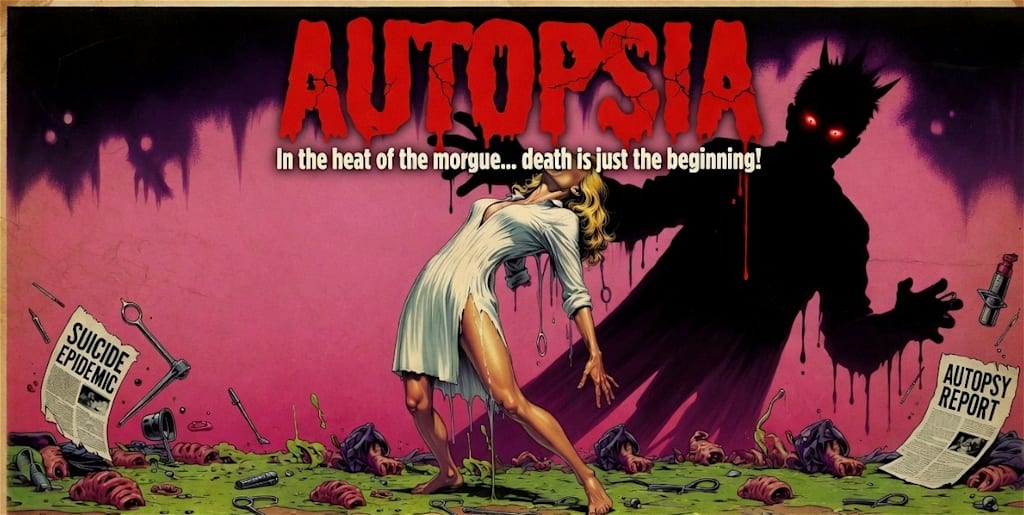
It’s not often that an exploitation picture breaches such heavy, philosophic weight, referencing Kierkegaard, Spinoza, Schopenhauer, and, twice, the Spaniard Miguel de Unamuno. This is a Spanish film, so the latter is understandable. Unamuno’s whole thing about the tragic sense of life fits right in here, that desperate human hunger for immortality clashing hard against the cold wall of death.
Autopsia (Autopsy, 1973) is a grimly dingy little early Seventies production that begins with a montage of a Vietnam war correspondent set against actual file footage and iconic images, like the nude little girl running with her napalmed skin, arms outstretched in a kind of limp horror. Ironically she survived that attack.
The correspondent documents birth and life in the midst of death, but the unit he is embedded with is ultimately hit and he is wounded. This wounding leads him, once back in Madrid, we assume, to explore death as a subject with poets and artists, and with slightly embarrassed men and women in the street. The film ultimately asks the question: What is life? Simple an extension of our own delusions of eternity? One woman claims never to think of death, “only love.” Another notes, strangely, that “If I am eternal, I am nothing.” This cryptic phrase we suppose posits that if there were no end to our earthly sojourn, then life itself would lose meaning, and the living an ultimate sense of identity. It hits on that existential idea that finitude actually gives life its edge.
Pretension aside, these segments, which lend the documentary sense to a film which indeed is a sort of hybrid, with shocking, real-life footage combined with a few story threads, make the film a unique experience. These are intercut further with philosophic, surreal and dream-like scenes: ballerinas and other strange, Felliniesque figures, such as typists, are juxtaposed, like a flicker in the brain of Breton, with the surrounding forest. The forest is perhaps the uncertain wilderness of life, the stark branches of mortal despair hanging like dread fingers over the deluded puppets, gyrating below.
People on the street are interviewed, each with their own appraisal of death. It is juxtaposed against their nonchalance that the brutal finality of life’s inexorable ending takes form. You see them talking casually, but underneath it all you feel the denial we all carry around.What also takes form is the brutal, ugly, hideous and clinically cold grue of the actual autopsy performed here. It is a deeply disturbing scene, one revealing the inner workings of the human, the muscle and musculature beneath the false, deceptive, rubbery layer of skin to look on a par with a cold cut of ham. The human looks like a pig marbled with veins of fat once the skin is stripped to the bone. This is not a pleasant picture, we must warn you, and certainly NOT a film for children. The way it’s shot so matter-of-factly just makes it hit harder.
The Vietnam war correspondent, and his impetuous, plucky, bushy-headed assistant attend the autopsy as part of his journalistic work. Since he was nearly killed in Nam, he has brooded, much as “Dr. Francis B. Gross” (actor Michael Carr) did in the original Faces of Death, which was still a few years off by that point.
The film doesn’t really end so much as dissolve into loose ends, with the photojournalist’s little shaggy-headed partner having an emotional orgasm at a disco, the cheating wife or brother of the autopsied man’s sister subplot going into the autopsy doctor’s own subplot about HIS cheating wife. I’m confused about all of this but I’ve slept since then. Meanwhile the photojournalist himself keeps ruminating after doing street interviews and suffering many voice-over narrative interludes with Gene Jaeger style Faces of Death funereal Seventies elevator muzak playing over the scenes.The final image is rather astute: the photojournalist admires a toy ferris wheel in the window of a shop. The endless cycle of birth, death, rebirth, we suppose. The wheel of life, and death.
And that’s my autopsy of Autopsia.
Directed by Juan Logar. Starring Juan Luis Gallardo, Emiliano redondo, and Jack Taylor.
Author's website:
Author's YouTube
Read my book: Cult Films and Midnight Movies: From High Art to low Trash Volume 1:
Ebook
Read my book: Silent Scream! Nosferatu, The Cabinet of Dr. Caligari, Metropolis, and Edison's Frankenstein--Four Novels by C. Augustine
Ebook
Read my book! Theater of the Worm: Essays on Poe, Lovecraft, Bierce, and the Machinery of Dread
About the Creator
Tom Baker
Author of Haunted Indianapolis, Indiana Ghost Folklore, Midwest Maniacs, Midwest UFOs and Beyond, Scary Urban Legends, 50 Famous Fables and Folk Tales, and Notorious Crimes of the Upper Midwest.: http://tombakerbooks.weebly.com
Enjoyed the story? Support the Creator.
Subscribe for free to receive all their stories in your feed. You could also become a paid subscriber, letting them know you appreciate their work.
Comments
There are no comments for this story
Be the first to respond and start the conversation.