
Are Ghosts Real? What Psychology and Neuroscience Say About Paranormal Experiences
Why people may genuinely feel they have encountered a ghost—even when there may be another explanation

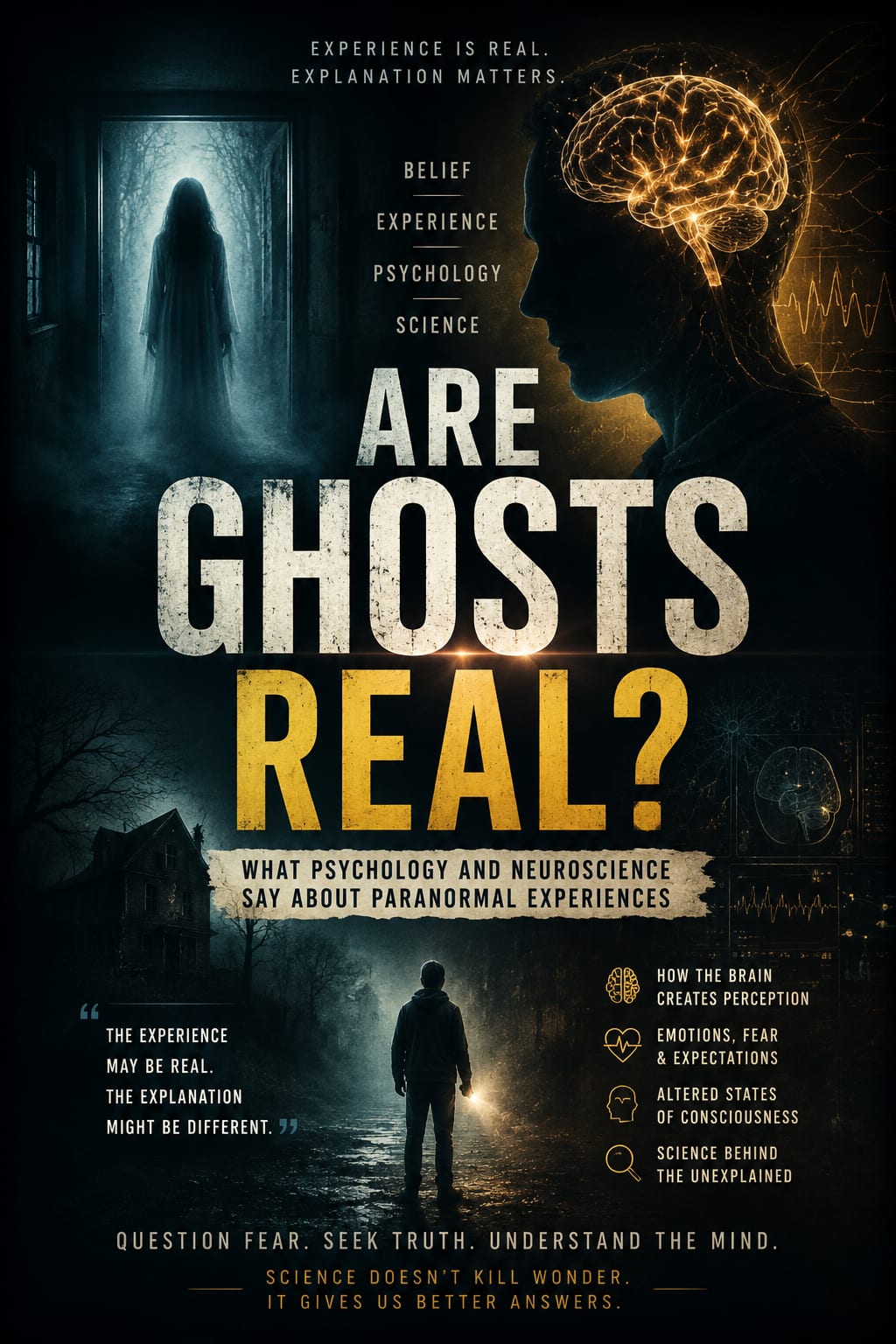
Ghost stories have existed across cultures for centuries. Some people describe seeing mysterious figures, hearing unexplained voices, feeling an invisible presence, or even believing that another spirit has taken control of their body.
For the person experiencing such an event, it can feel completely real.
But does a powerful experience prove that ghosts actually exist?
That is a very different question.
From a scientific and psychological perspective, paranormal experiences can potentially be explored through consciousness, perception, expectation, belief, altered states of awareness, and the functioning of the human brain.
So, are ghosts real, or can the mind create experiences that people interpret as supernatural?
Let us examine the argument more carefully.
What Do People Usually Mean by a Ghost?
When people talk about ghosts, the explanation often follows a familiar pattern.
A person dies, but their soul or spirit is believed to remain behind because of an unfinished desire, emotional attachment, tragedy, anger, or some other unresolved issue.
Different cultures may use different words.
Some call it a soul.
Others may call it a spirit, ruh, or another religious or cultural term.
Although the terminology changes, the basic concept is often similar: a conscious part of a deceased person supposedly continues to exist independently of the physical body.
This immediately creates an important philosophical question.
What exactly is consciousness, and can it exist separately from the brain?
Consciousness Is Not the Same as Physical Matter
People sometimes describe a soul as a form of energy, electricity, air, or another physical force.
But those comparisons create problems.
Air is physical. Electricity involves physical processes. Energy is measurable through its effects and transformations.
Conscious experiences such as thoughts, emotions, memories, fear, love, and sensations belong to a very different category of experience.
You can be hit by a physical object.
You can feel moving air.
You can receive an electric shock.
But you do not physically collide with a thought in the same way that you collide with a wall.
This relationship between the physical brain and subjective consciousness has been one of philosophy's most difficult questions for centuries.
Modern neuroscience has increasingly focused on understanding how changes in brain activity correspond with thoughts, emotions, perception, memory, and behaviour.
Why Ghost Experiences Can Still Feel Completely Real
Rejecting a supernatural explanation does not automatically mean accusing everyone who reports a ghost experience of lying.
That distinction is extremely important.
Someone can honestly describe an experience while being mistaken about its cause.
Human perception is not a perfect recording system. The brain constantly interprets information coming from our surroundings.
Fear, expectations, cultural beliefs, memories, stress, suggestion, darkness, unfamiliar sounds, and unusual states of consciousness can all influence how an event is interpreted.
Imagine someone who has believed in ghosts since childhood.
They enter an abandoned building at night.
They already expect something supernatural to happen.
A shadow moves.
A strange noise comes from another room.
Their heart begins racing.
At that moment, the brain may interpret an uncertain situation using ideas the person already strongly believes.
To that person, the experience may feel unquestionably paranormal.
But the strength of a feeling does not necessarily establish the cause of that feeling.
The Brain and Human Emotions
For centuries, people commonly connected emotions with the heart.
Even today, phrases such as "follow your heart" or "you broke my heart" remain part of everyday language.
The heart certainly reacts when we experience strong emotions. Fear, excitement, attraction, or stress can increase heart rate.
However, the experience and processing of emotions are closely connected with the brain.
This became increasingly important as researchers developed methods for studying brain activity.
Technologies such as EEG measure electrical activity associated with the brain, while modern brain-imaging techniques allow researchers to examine changes related to different mental processes.
These tools helped science investigate something that earlier generations could mainly approach through philosophy and observation: what happens inside the brain when people think, feel, remember, fear, or enter unusual psychological states?
Altered States of Consciousness
Not every state of consciousness feels like ordinary everyday awareness.
People can experience altered states during intense religious ceremonies, meditation, hypnosis, extreme emotional situations, sleep-related experiences, or highly immersive environments.
Someone participating in rhythmic chanting, music, prayer, or another emotionally intense activity may enter a state in which their normal critical attention changes.
The experience can feel powerful, peaceful, frightening, spiritual, or completely outside ordinary reality.
That does not automatically mean the experience is false.
The experience itself is real to the person.
The question is how it should be interpreted.
A spiritual interpretation may describe it as contact with something beyond the physical world.
A psychological interpretation may examine attention, expectation, suggestion, emotion, memory, and changes in awareness.
Those are two very different explanations for what may subjectively feel like the same event.
What About People Who Feel Possessed?
Possession stories exist in many cultures.
A person may suddenly speak differently, behave unusually, report losing control, or believe that another personality, soul, or spirit has entered their body.
These experiences should not automatically be dismissed as deliberate acting.
Some people may genuinely believe that control of their body or identity has changed.
Psychology has studied experiences involving disturbances in identity, awareness, memory, perception, and the sense of self.
However, it is important not to diagnose someone simply because they report a supernatural experience.
Mental-health conditions require assessment by qualified professionals.
What matters for the ghost debate is that psychology provides possible mechanisms through which extraordinary experiences can occur without requiring an external supernatural entity.
Why Culture and Belief Matter
One of the most interesting questions is why paranormal experiences are interpreted differently across societies.
A mysterious experience may be described as a ghost in one culture, a spirit in another, possession somewhere else, or a psychological experience in another context.
Our existing beliefs influence the explanations we consider possible.
If someone has repeatedly heard frightening ghost stories since childhood, unexplained events may naturally be interpreted through that framework.
Another person experiencing the same sound, shadow, or sensation may search for an environmental, neurological, or psychological explanation instead.
In other words, the experience and the interpretation of the experience are not always the same thing.
Why Ghost Stories Remain So Powerful
Ghost stories survive because they connect with some of humanity's deepest emotions.
Death.
Fear.
Loss.
Memory.
The unknown.
And the possibility that consciousness might somehow continue after the body dies.
Science can investigate measurable evidence and possible explanations for unusual experiences, but questions about death and consciousness remain emotionally powerful.
That is why supernatural stories continue to attract attention even in technologically advanced societies.
A frightening personal experience can also feel far more convincing than statistics or scientific arguments.
If someone believes they saw a ghost standing in front of them, simply telling them that ghosts have not been scientifically established may not change their mind.
Personal experience is psychologically powerful.
Are Ghosts Scientifically Proven?
Claims about ghosts have existed for generations, but extraordinary claims require convincing and independently verifiable evidence.
Stories, eyewitness experiences, photographs, strange noises, and unexplained events can certainly be interesting.
However, an unexplained event is not automatically evidence of a ghost.
"Unexplained" simply means that the cause has not yet been established.
There is a major difference between saying:
"I don't know what caused this."
and saying:
"Therefore, a ghost caused it."
That distinction is essential to critical thinking.
The Most Reasonable Conclusion
People can have extremely intense experiences that they interpret as ghosts, spirits, possession, or paranormal activity.
Those experiences should not automatically be mocked or dismissed.
At the same time, sincerely believing that something happened does not prove that the supernatural explanation is correct.
Psychology and neuroscience offer alternative ways to investigate such experiences through perception, consciousness, expectation, belief, memory, altered states, and brain function.
Until strong, independently verifiable evidence establishes the existence of ghosts as external beings, the most cautious position is to separate the reality of a person's experience from the explanation they give to that experience.
Someone may genuinely feel that they encountered a ghost.
The experience may be real.
The fear may be real.
The memory may be real.
But whether an actual supernatural entity was responsible remains a separate question.
And that is where science, psychology, philosophy, and belief continue to meet.
About the Creator
parwinder singh
🎬 Movie & Entertainment Writer sharing reviews, ending explanations, story breakdowns, plot twists and hidden details from Bollywood, Hollywood, South Indian cinema, Korean dramas and OTT releases.
Enjoyed the story? Support the Creator.
Subscribe for free to receive all their stories in your feed.
Comments
There are no comments for this story
Be the first to respond and start the conversation.