
You Can't Hunt Ghosts on the Prairie.
Why Black Myth: Zhong Kui is rejecting the open-world bubble for claustrophobic, exquisitely crafted sandboxes — and why its script, not its map size, will be the franchise's true final boss.
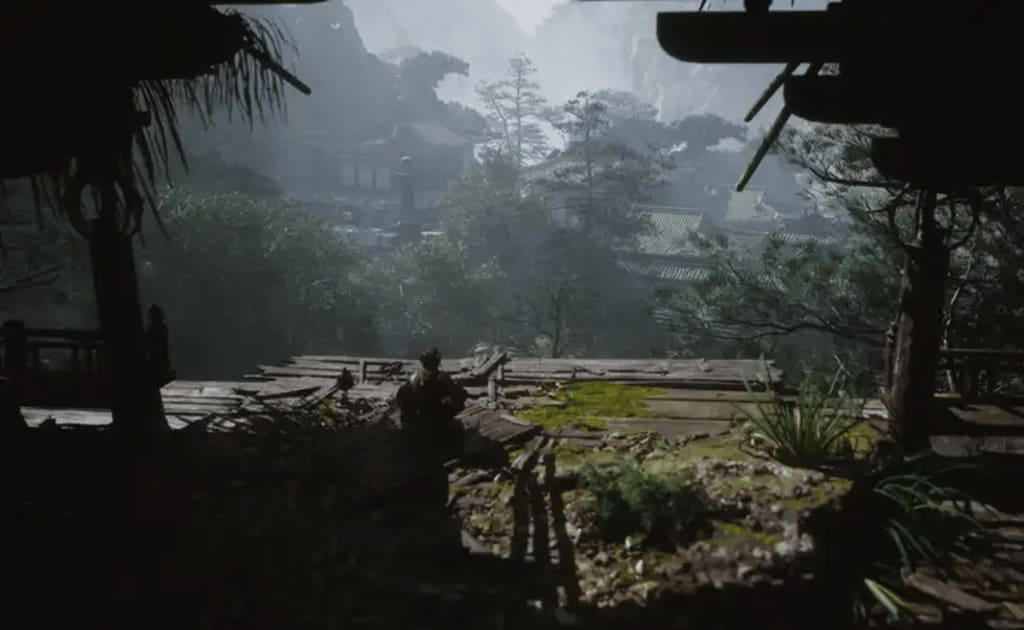
The day the gameplay demo dropped, the single most frequent word I saw scrolling across the bullet-screen comments was: open world?
In those ten-odd minutes of footage, analysts were already dissecting map boundaries and calculating explorable square footage, trying to prove just how vast this netherworld really was. I get the anticipation. After all, "open world" has been shouted so loudly over the past few years that my ears are calloused. Many studios have taken a very straightforward approach to the proposition: make the map bigger, litter it with question marks, and cram identical outposts and collectibles into every square inch of terrain.
Players call it "checklist padding." It looks like everything, but it's actually nothing.
Back to Zhong Kui. If it were to walk that same path, if it made Zhong Kui traverse a seamless, sprawling wilderness day and night, chasing ghost trails across three mountain ridges, the image strikes me as absurd. Zhong Kui hunts ghosts; he's not a marathon runner. His stage should be in a ruined temple, on the cobblestones of a ghostly town, behind the folding screens of a haunted mansion. Those places demand claustrophobia and pressure, not wide-open space.
That lesson, Black Myth: Wukong, already proved once.
In the first chapter, Black Wind Mountain, before you take down the White-Clad Nobleman, almost every boss fight happens outdoors. Not out of laziness. Black Wind Mountain is, at its core, a forest. Layers of autumn color, famous peaks and great rivers — that's the default Chinese impression of "Eastern ambiance." But then you reach the Pagoda Realm, and the space suddenly tightens, winding so dizzyingly that many players cursed it. Yet you have to admit: that suffocating feel is exactly what the level design was going for. It fits the lore; it serves the narrative needs of that place.
Game Science's forte has never been spreading a map as wide as possible. It is about fitting every wall, every Buddha statue, every corner into a finite box, making you want to take a screenshot at each one.
If Zhong Kui were forced into an open world, the costs would be concrete.
First, those high-precision models of ancient Shanxi architecture, spread across a map of tens of square kilometers, simply would not fill it. In the end, procedural generation would take over, and you would see the exact same pavilion three times, the exact same stone lion guarding four different temple gates. That is not Game Science's caliber — but that is the math of open worlds.
Second, the invisible walls that Wukong got flak for over two years were essentially a mismatch between the finely crafted sandbox boundaries and the player's visual intuition that "I should be able to go there." In an open world, that mismatch would amplify a hundredfold. You see a mountain, you want to climb it, you cannot. That is more frustrating than getting lost in the Pagoda Realm.
Third, combat density would be diluted into nothing by traversal. Zhong Kui's thrill of slaying demons comes from high-frequency, high-intensity encounters, not from skirting three waves of trash mobs just to get from point A to B. Once you start padding the vast map with reskinned enemies, "every battle is memorable" becomes "lawn-mowing cleanup."
So if not open world, then what?
My vision: a regional sandbox centered on a City God Temple. A seemingly tranquil old town in the Qin-Jin region — but at night, ghost money flutters through the air, and the stone lions beneath the memorial archways weep blood. Zhong Kui would navigate rooftops and dark alleys in three dimensions, tracking phantoms by sound and shadow. Each self-contained ghost case becomes a modular sandbox: one in a ruined temple, one inside a painted scroll, one in an underground netherworld. They are not connected by running across land; they are switched via "night walk" or "entering a dream."
This preserves Wukong's high-density artistic detail, and it elegantly handles boundary issues: the edges of a ghost domain can be justified by miasma or fog, so there is no more wrestling with invisible walls.
Yet level structure is only skin-deep.
Black Myth: Zhong Kui's ultimate trial is the script.
Wukong succeeded on the back of its dark deconstruction of Journey to the West. Everyone knows Sun Wukong, so Game Science could subvert that shared consensus. Zhong Kui is different. In folklore, his stories are scattered across fragments like "The Three Strange Cases" and "Zhong Kui Marries Off His Sister." There is no unified, overarching narrative backbone.
The challenge is threading these scattered tales into a single compelling line, keeping Zhong Kui from becoming a caricature — not just a sword-swinging brute, not just a vengeance-driven martyr, but something else entirely. And beneath the visceral pleasure of slaying demons, the story must bury a layer of meditation on good and evil, karma, even cosmic justice, yet never spell it out.
These questions are far harder than designing a map. We no longer need to doubt Game Science's artistry or combat design. But the script is a different beast. It demands not just research, but synthesis, creation, finding a Zhong Kui narrative that belongs to this era.
Open world or linear sandbox — for Black Myth: Zhong Kui, it is not a right-or-wrong choice. It is a trade-off. Make the map a little smaller, make the density a little higher, make every ghost domain so chilling that you play with the lights off and feel your spine tingle. That is far harder, and far more worthwhile, than planting a thousand question marks on a prairie.
Zhong Kui hunts ghosts with his eyes.
Never with his legs.
About the Creator
Jin
Writer of reamstories
https://reamstories.com/jin
Enjoyed the story? Support the Creator.
Subscribe for free to receive all their stories in your feed. You could also become a paid subscriber, letting them know you appreciate their work.
Comments
There are no comments for this story
Be the first to respond and start the conversation.