
Xu Song Married His Fan. The Internet Punished Him for Being Ordinary.
A 14-year age gap, four years of silence, and the parasocial contract that broke the moment he chose a real person.
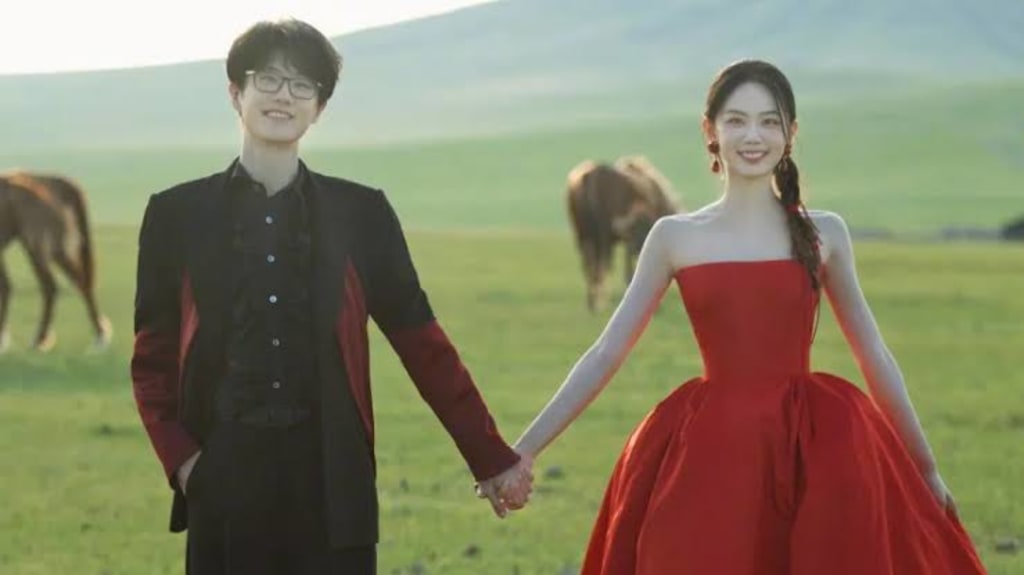
On the night of September 19, Xu Song posted on Weibo: "Our life story has been written into a new chapter. Thank you for your care and blessings." He included two wedding photos taken on a grassland. Feng Xi posted the same caption and the same photos. There was no @, no long essay, and the studio said nothing.
The hashtag exploded. Hundreds of thousands of comments flooded the comment section.
This should have been a quiet ending. In October 2022, Xu Song appeared on Hello, Saturday. On stage, Feng Xi said she had listened to his songs since elementary school. When she heard him sing "Why Not" live, she burst into tears and waved her hand, saying, "Brother Song, don't look at me. I can't sing." A month later, the media photographed the two holding hands. Over the next four years, the images of them that passersby occasionally captured were scattered and ordinary: shopping, eating, Feng Xi accompanying Xu Song's mother out. On New Year's Eve 2023, they appeared on the same stage. The audience below egged them on to marry, and Xu Song smiled and replied, "It's possible to consider." In early 2024, Feng Xi cleaned up some content on social media. Breakup rumors surfaced; staff explained it was just a personal adjustment. Around that time, Xu Song released "A Place of Peace," and some fans noticed that the lyrics contained the character xi from her name. In June this year, the two were photographed eating breakfast in Hangzhou. In July, someone else ran into them on the streets of Shenzhen. Then came September 19, and the official announcement.
The controversy was about whom he married.
A highly upvoted comment on Douban read: "A middle-aged male 208 who marries a woman in her twenties instantly drops to zero in my eyes." Another reply put it more bluntly: "No matter how talented the man is, in the end he married someone so young, so much younger. That is the most essential trait of a man."
These voices all point to the same thing: Xu Song's persona was "a man who is not ordinary." In 2006, he abandoned medicine for music at Anhui Medical University. He handled lyrics, music, arrangement, and production alone. He did not sign on to variety shows or run commercial gigs. The labels fans gave him were "music hermit," "Buddhist singer," "a clear stream in the entertainment industry." These labels piled up into the image of an otherworldly creator.
Then he made a choice any ordinary man might make. He married a young partner who admired him. The filter shattered.
There is a double standard here. When Xu Song previously had rumors with peers closer to his age, fans reacted relatively calmly. When he chose a partner much younger and tagged with the label "fan," the reaction was far more violent. Someone on Douban specifically posted: "Xu Song and Feng Xi have a big age gap. Why do so few people criticize Xu Song for finding someone so young?" The answer was in another comment: "Marrying a fan is the worst outcome among all 'saozi' scenarios. It could be someone in the industry, but it cannot be a fan, because people feel the emotional investment between idol and fan is unequal."
Between fans and idols there is a default contract: fans give unconditional support and love; the idol is the object of admiration; the two sides are not on the same emotional plane. When the idol turns that admiration into intimacy, the contract breaks. The idol steps down from the altar, and fans are forced to face the inequality of their own emotional investment.
The mechanism behind this reaction is called a "parasocial relationship" in fan culture studies. Fans and idols have almost no real-world intersection, but fans psychologically believe they are close to the idol, that they are a member of the idol's social relationships. The fictional nature of this relationship actually makes it easier to reinforce fixed perceptions. Because there is no real interaction to correct the bias, fans' imagination of the idol keeps self-reinforcing in an idealized direction.
Xu Song talked about his criteria for a partner in an interview. He did not require the other person to be proficient in music, but he hoped the other person would support or like music. Otherwise, daily piano playing and arranging would make life seem noisy and trivial; the two needed basic shared interests. This is a creator's practical consideration for a life partner. Feng Xi had listened to his songs since childhood and had a natural emotional connection to his music, while also having her own professional identity and abilities.
Feng Xi did not enter the public eye merely as a "fan." She graduated from the Communication University of China with a major in broadcasting and hosting. In 2021, she won the variety track of Dragon TV's New Hosts. Ten Golden Microphone winners sat on the final judging panel. She was still a senior at the time. Afterward, she joined Hunan TV and co-hosted Hello, Saturday with He Jiong. Her father worked in a grassroots community; her mother managed a private company. A Chongqing girl from an ordinary family, she made it to a satellite TV host through school exams, practicing voiceovers, and running to live shoots.
But in the narrative of "the ceiling of fan achievement," these things were swallowed up. She became "listened to his songs since elementary school," "successfully chased a star," "fulfilled a dream." This label is simple, easy to spread, and fits the public's romantic imagination of the "idol and fan" relationship. At the same time, it compresses a woman's growth path from fan to host into a "dream come true" story.
From the exposure of their relationship in 2022 to the official announcement in 2026, the two always responded to controversy with "not taking the bait." Over four years, all the public could see were images of passersby running into them. The announcement itself was only one sentence and two photos. There was no press conference or flood of press releases. The studio issued no statement.
Xu Song has written songs for nearly twenty years. From "Funeral of Roses" to "Qian Bai Du" being included in a university Chinese textbook, his work has formed a generation's youthful memory. But a person's creation and a person's life are never the same thing. Demanding that a singer's personal life fully match the content of his creations is itself an excessive demand. Extending the coldness, distance, and unworldliness of lyrics into moral judgment of a creator's private choices confuses text with author, work with life.
At forty, Xu Song made an ordinary person's choice. He did not choose the type of partner implied by the persona of "an extraordinary man." He chose someone who had a natural emotional connection to his music, had her own professional abilities, and was willing to accompany him in life.
Two Weibo posts, the same sentence, the same set of photos. No @. No long essay.
His greatest "persona collapse" was proving he writes songs and lives a life.
About the Creator
Jin
Writer of reamstories
https://reamstories.com/jin
Enjoyed the story? Support the Creator.
Subscribe for free to receive all their stories in your feed. You could also become a paid subscriber, letting them know you appreciate their work.
Comments
There are no comments for this story
Be the first to respond and start the conversation.