
Xerox PARC: How to Invent the Future and Let Others Profit From It 💡💰
How the "Suits" in New York Ignited the PC Revolution by Accident

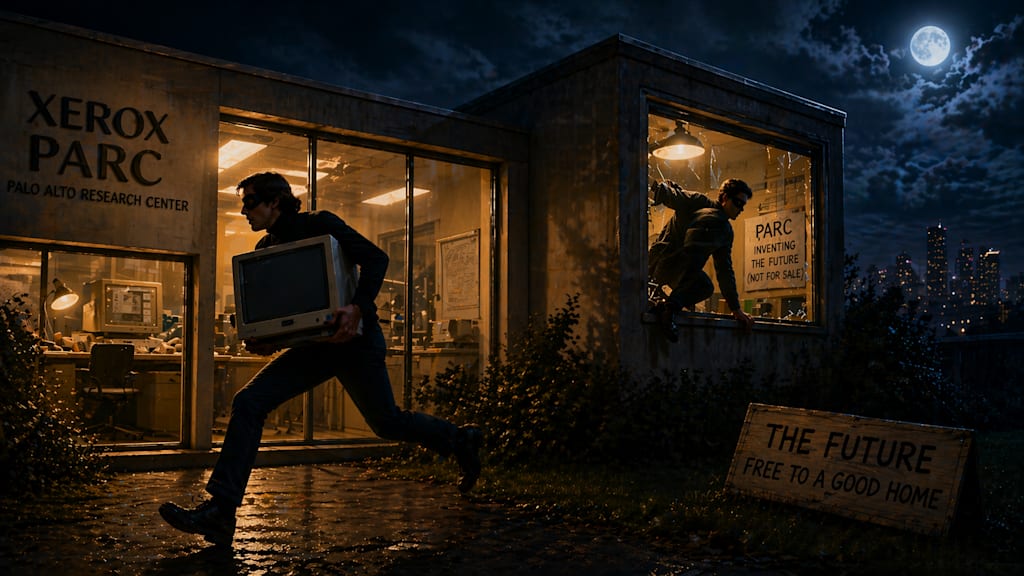
Imagine you own a time machine. You travel back to 1973, step into a sterile laboratory in Palo Alto, and see something that shouldn’t exist for another two decades. On the desks stand computers with vertical, bright screens. People aren’t typing complex text commands—instead, they are sliding a strange plastic box across the table, and the cursor on the screen fluidly follows their movement. They click icons, open windows, and send emails. 📧🖱️
This isn't a sci-fi movie set. This is Xerox PARC (Palo Alto Research Center)—the place that literally designed the world we live in today, and then... gave it all away for free because the corporate board was too busy selling copier toner. 📑❌
A Treasure Trove of Wonders That No One Wanted 💎
As a technology and AI enthusiast, I look at the history of PARC with a mix of admiration and pure frustration. In the 1970s, Xerox was swimming in cash. They decided to create a "dream lab." They hired the brightest minds of the era and gave them one goal: invent the office of the future. 🧠✨
The engineers at PARC did not disappoint. In just a few years, they created the foundations of modern computing:
Xerox Alto: The first true personal computer. 🖥️
GUI (Graphical User Interface): This is where windows, folders, and menus were born—the same ones you navigate today with your finger on a smartphone. 📂
The Computer Mouse: Although the concept existed earlier, PARC turned it into a precision tool ready for real work. 🐁
Ethernet: The protocol that allowed computers to "talk" to each other on a local network. 🌐
Modern Email: The first graphical email client that defined the way we browse our inboxes to this day. 📩
The Laser Printer: The only invention on this list that Xerox actually managed to commercialize successfully. 🖨️
The tragedy of PARC was that Xerox headquarters was located in New York, thousands of miles away. The executives in suits viewed computers as expensive toys that might threaten their core business—paper. They were like an oil giant inventing the electric motor and hiding it in a drawer so as not to spoil gas sales. ⛽📉
The "Heist" of the Century: Enter Steve Jobs 🍏
In 1979, an event occurred that changed the course of history. A young, 24-year-old Steve Jobs, fascinated by rumors of what was happening in Palo Alto, struck a specific deal with Xerox. He allowed them to buy 100,000 shares of Apple for $1 million in exchange for full access to the PARC laboratories. 🤝🎟️
When Jobs saw the operating system on the Alto computer, he had an epiphany. Legend has it that he ran around the room shouting: "Why aren't you doing anything with this?! This is going to revolutionize the world!". The Xerox engineers tried to explain the technical complexities, but Jobs only saw one thing: the future. ⚡😲
He returned to Apple and immediately pivoted the entire team to work on a graphical interface. Thus, the Lisa was born, and later, the Macintosh. Shortly after, Bill Gates, seeing Apple's success, created Windows. When Jobs accused Gates of stealing the idea, Bill responded with one of the most brilliant lines in IT history:
"It's more like we both had this rich neighbor named Xerox and I broke into his house to steal the TV set and found out that you had already stolen it." 📺🥷
A Lesson for the AI Era: Innovation Isn't Everything 🤖
Why, as an AI fan, do I keep coming back to this story? Because I see a striking similarity to today’s world. The story of Xerox PARC teaches us a brutal truth: innovation itself is worthless without a vision for its execution. 🛠️➡️🚀
Look at today's AI market. Do you know who invented the Transformer architecture, which is the heart of ChatGPT? Google engineers did it in 2017. However, it wasn't Google, but the then-small OpenAI, that understood how to package this technology into a product that would capture the world's imagination. Google, much like Xerox, was too heavy and too cautious to risk its core business model (Search) for a new, uncertain technology. 🔍🔄🤖
Xerox had the technology but lacked the courage to become a software company. Jobs and Gates didn't have the technology (at the start), but they had an obsession with how it would change the life of the average person.
A Digital Legacy 🏛️
For me, Xerox PARC remains the most fascinating monument to a "missed opportunity." If the Xerox board had even a tenth of their engineers' vision, you probably wouldn't be reading this text on Windows or macOS today, but on "XeroxOS." 👑
For us tech enthusiasts, PARC is a reminder that brilliant ideas are born in labs, but the world is changed by those who can bring them outside. Innovation is the seed, but execution is the soil, water, and sun. Without the latter, even the most revolutionary idea will remain just a curiosity in a dusty lab notebook. 📓🌱
Xerox invented the future, but others taught us how to live in it. And maybe that's for the best? Thanks to their "blindness," the competition between Apple and Microsoft pushed technology forward at a pace that a single, monopolistic corporation could never have maintained. We, the users, are the ultimate beneficiaries of the most expensive mistake in history. 🏆💻
About the Creator
Piotr Nowak
Pole in Italy ✈️ | AI | Crypto | Online Earning | Book writer | Every read supports my work on Vocal
Enjoyed the story? Support the Creator.
Subscribe for free to receive all their stories in your feed.
Comments
There are no comments for this story
Be the first to respond and start the conversation.