
Winnie The Pooh Is 100! A Look At The Biggest Differences Between Book Pooh And Disney Pooh
Happy 100th, Silly old bear!

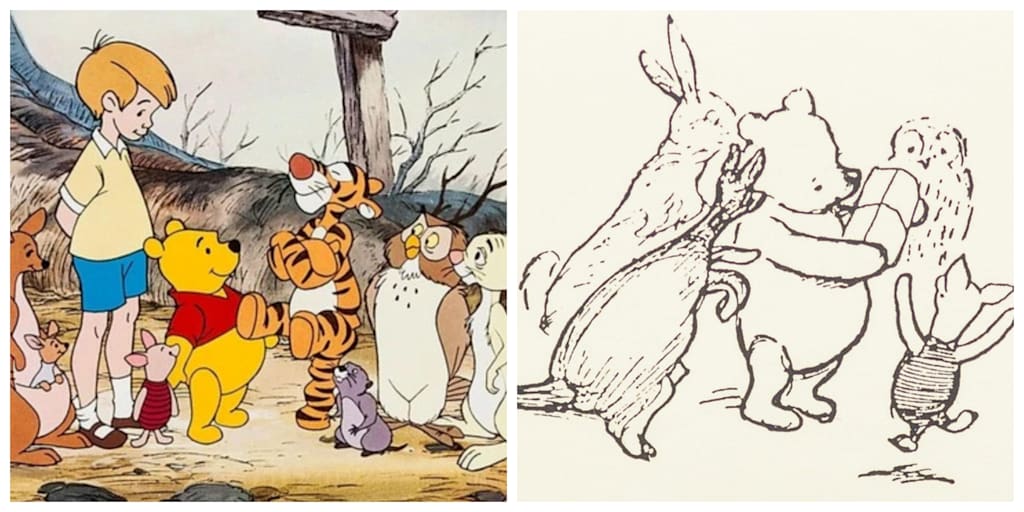
Everyone's favourite bear with very little brain has turned 100! October 14, 2026, marked the anniversary of the publication of A.A Milne's Winnie-The-Pooh, the first book to feature the beloved character. While Disney's animated adaptation of Winnie The Pooh is actually only forty years old (the first Disney Pooh short, Winnie The Pooh and the Honey Tree, was released in 1966), the company have still jumped on board Pooh's 100th Birthday celebrations with events and merchandise.
However, some of the characters in Disney's adaptations are quite different from Milne's original book. Let's look at some of those differences in detail.
Winnie-The-Pooh
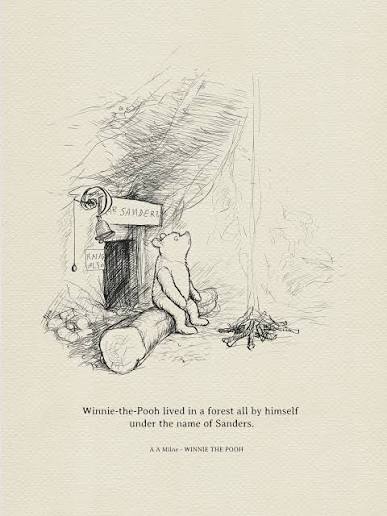
Milne's Winnie-The-Pooh stories were inspired by the real life teddy bear of his son, Christopher Robin Milne. Originally named Edward Bear, the younger Milne's teddy was eventually renamed Winnie-The-Pooh in honour of a real life Black Bear and a swan with whom the boy had become acquainted at the Zoo. To avoid confusion, the book simplifies the origin of Pooh's odd name as the occasionally nonsensical musings of a child. Winnie-The-Pooh was known for gathering hs thoughts through Poems and hums as he roamed the Hundred-Acre Wood. While Pooh is a self-described bear of very little brain, he will sometimes come up with clever ideas, usually born from having a greater common sense than some of the other characters.
While the stories were inspired by Christopher Robin's bear, illustrator E.H Shephard's design was more closely based on a teddy belonging to his own son. Shephard did not usually depict Winnie-The-Pooh wearing clothes, save for a vest in a few The House at Pooh Corner stories set in Winter.
Disney's Winnie The Pooh drops the hyphens in his name from Milne's version. He is usually depicted wearing a red shirt, although has a pinkish/lavender nightshirt for sleeping, and a number of alternate winter outfits across various Pooh projects.
Where the written Pooh hums or recites poems, Disney's Pooh will more likely sing. His love of honey or other sweet treats is also slightly played up compared to Milne's Pooh. Like his book counterpart, Pooh is considered a bear of very little brain, but his IQ shortcomings are more than made up for by his deep love for his friends. Three voice actors have voiced Pooh, with the current actor, Jim Cummings, in the role since 1988.
Piglet
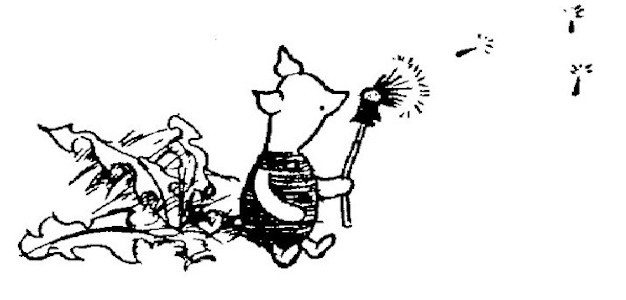
Milne's Piglet, based on another toy of his son's, is first officially introduced in Chapter 3 of Winnie-The-Pooh, though is depicted in one of E.H Shepard's illustrations for Chapter 2. Timid but friendly, the squeaky voiced Piglet is Pooh's best friend among the other animals in the Hundred-Acre Wood. He lives in a house at the base of a Beech Tree, beneath a broken sign reading 'Trespassers W'.
When Owl's house is destroyed in a storm towards the end of the second book, The House at Pooh Corner, Piglet gives up his Beech Tree house after Eeyore accidentally 'finds' it as a replacement home for Owl. Piglet subsequently moves in with Pooh. Shepard's illustrations usually depict Piglet in a sweater, with a scarf added for chapters set in winter. In coloured drawings, the sweater is green.
Disney's Piglet wears a similarly designed sweater, but in pink, adding a scarf and earmuffs when the character appears in cooler weather. Like Milne's Piglet, Disney Piglet is one of Pooh's closest friends, second only to Christopher Robin in the bear's affections.
The Disney version plays up Piglet's tendency to be afraid, but if one of his friends are in trouble, he will not hesitate in facing a fear to help them. After a similar mishap to the book saw Piglet's home taken over by Owl in Winnie The Pooh and the Blustery Day (later the second segment of The Many Adventures of Winnie The Pooh), Piglet moves in with Pooh, and is still living with him in Winnie The Pooh and Tigger, Too!, but later entries in the Disney series return him to his own home.
Despite appearing in promotional material, Piglet was absent from Disney's first short, Winnie The Pooh and the Honey Tree, which greatly upset fans of A.A Milne's books, so Disney ensured he had a prominent role in the sequel short, Winnie The Pooh and the Blustery Day. From this short, until his death in 2005, Piglet was voiced by John Fiedler. His second official voice actor was Travis Oates.
Tigger
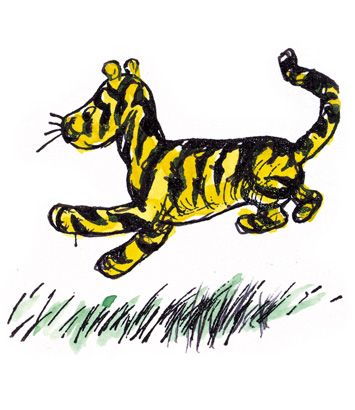
A.A Milne's Tigger did not appear until the second book, The House at Pooh Corner, when he shows up on Pooh's doorstep in the middle of the night as a new arrival in the Wood. After discovering Tigger does not like honey, Pooh sets out to find something he will eat, which proves to be a difficult task. Tigger is eventually discovered to enjoy Extract of Malt, which Kanga keeps for Roo, and so he moves in with them.
Tigger's overly energetic behaviour sometimes irritates his friends, especially Rabbit, and causes accidents like knocking Eeyore into the river. Still, they all remain friends. E.H Shepard's Tigger design is perhaps closest of all to the toy that inspired him.
Disney's Tigger first appears in Winnie the Pooh and the Blustery Day, breaking into Pooh's house during the storm and accidentally inspires his nightmare about Heffalumps and Woozles. For the most part, the residents of the Hundred-Acre Wood embrace Tigger's energy, although Rabbit is often annoyed and exasperated with his behaviour.
While this Tigger does not live with Kanga and Roo, instead eventually shown with his own treehouse, he regularly visits to take Roo out to play. The pair are shown to be close, a relationship key to The Tigger Movie, where Tigger's search for a family ultimately leads to him embracing Roo as a little brother. Originally, Tigger was voiced by Paul Winchell. After years of training and sharing the part, Jim Cummings officially took over in 2005, and has voiced Tigger ever since.
Eeyore
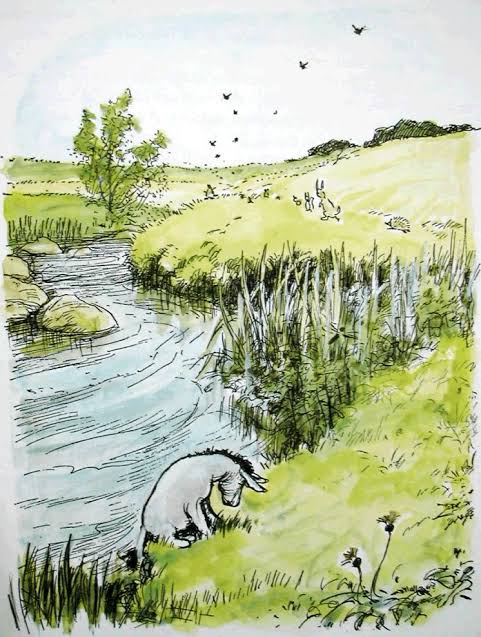
Eeyore, like most of Milne's original characters, is based on a toy owned by his son. He is a gloomy old donkey, with an unfortunate habit of losing his tail, which falls out because he is stuffed with sawdust. The Eeyore of the books is slightly more apathetic and acerbic towards the other characters, often openly complaining about their lack of brains and sometimes seeming irritated by their presence. He also has a tendency to become vain at his own accomplishments. When a poem composed by Eeyore is praised by Pooh, known in the wood for his poetry, he becomes quite insufferable about it.
Pooh and Piglet, at least, eventually win Eeyore over. The second book's titular 'House at Pooh Corner' was built by them for Eeyore.
Disney's Eeyore is probably the most different from his book counterpart, personality wise. Though still gloomy, he is, rather than the book's sometimes grumpy Eeyore, always kind and warm where his friends are concerned. He is also the most likely character to drop genuine pearls of wisdom, particularly in the New Adventures of Winnie the Pooh animated series. In the very first episode, Eeyore teaches Piglet that happiness can mean different things for different people, and in a later episode, he is the only character to still recognise Tigger after he temporarily loses his stripes, because the things that make him Tigger are on the inside.
Eeyore has had four official voice actors over the course of Disney's adaptations. The longest serving and most deeply loved, Peter Cullen, only recently passed away at the age of 85.
Kanga and Roo
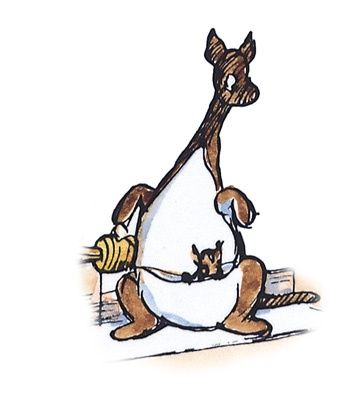
Kanga and Roo, also based on toys of the real Christopher Robin, are introduced in Chapter 7 of Winnie-The-Pooh, as newcomers to the Hundred-Acre Wood. Initially unwelcome by Rabbit who perceives them as strange, they are eventually accepted and welcomed. Kanga is considered by many fans to be the only true 'adult' among the toy animals, as she is a Mother. Being a mother defines a lot of book Kanga's behaviour, often eager to keep Roo close in her pouch, and unofficially adopting Tigger in The House at Pooh Corner.
Roo, often referred to as 'baby' Roo in the books, is the youngest and smallest of all the characters. He tends to serve more as a plot device than an active character in the stories, someone the other characters have to look out for and keep from trouble.
In Disney's Winnie The Pooh, Kanga and Roo already live in the wood when the stories begin, though a flashback in Piglet's Big Movie adapts the story of their arrival, albeit with a slight continuity error as Tigger, who arrived later in both the book and original movies, is seen to have been there before them.
Kanga's maternal nature extends to the Hundred-Acre Wood residents as a whole to a greater extent than her book counterpart. While she does not always accompany them on adventures, she is often prepared with advice, and snacks for the group to take with him. She is also a less smothering Mother to Roo, willing to let him out to play and spread his wings rather than keep him confined to the pouch. She has been noted as the only major female character, a fact that has occasionally brought the previously untouchable franchise under fire in recent years.
Kanga's original voice actor was Barbara Luddy, also known for voicing Lady in Lady and The Tramp, but her most common voice has been Kath Soucie.
Roo is still the youngest character in Disney's stories, but not quite so young as the books, often referenced as 'little' Roo moreso than baby Roo. Though he does not live with them as he does in the book, Roo shares a close bond with Tigger, viewing him as a big brother. This bond is one of the key elements of The Tigger Movie.
Roo is a more active, present character in Disney's Pooh than he ever was in Milne's books. Many of Disney's original stories featuring Roo have him eager to prove he is capable, or accept when he truly needs help. He accomplishes both as the lead character in Pooh's Heffalump Movie.
As a child, Roo, has gone through a lot of voice actor changes. Of his many voices, the most loved is almost certainly Nikita Hopkins, who earned multiple award nominations for his performances in both The Tigger Movie and Pooh's Heffalump Movie.
Rabbit and Owl
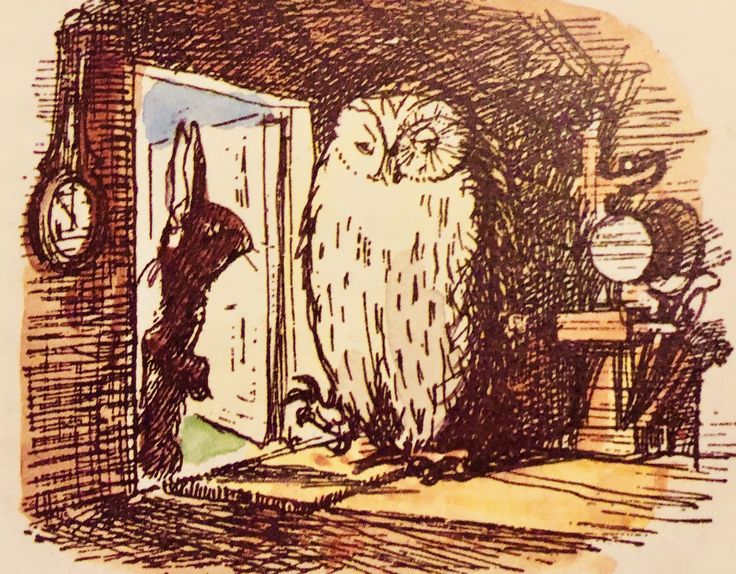
The characters of Owl and Rabbit are unique in Milne's books as the only characters to have been inspired by real-life animals. As Rabbit says to Owl:
"You and I have real brains. The rest just have fluff."
Rabbit.
The book's Rabbit is bossy and likes to be in charge and make the plans, for which he often goes to Owl for help with. Despite their real brains, the plans often go awry due to a missed common sense factor. Rabbit is also the link between the main group and a smaller collection of minor characters known as Rabbit's friends and relations, aka smaller animals and insects living in the Wood.
Owl is friendly to the other residents of the Hundred Acre Wood, but often becomes frustrated through their perceived lack of brains, or if they interrupt his speeches. He considers himself the most intelligent of the group, bu regularly mispells words, including his own name.
Disney's Rabbit is the book version dialled up to eleven, with his eagerness to plan drifting into control freak territory. He often becomes frustrated with the free-spirited, sometimes chaotic nature of the rest of the group, especially Tigger, but still loves them all deeply. In fact, many fan favourites among Disney's Rabbit stories are those that show his softer side, such as the story of Kessie, an orphaned baby bird rabbit raises in an episode of The New Adventures of Winnie the Pooh.
Ken Sansom was Disney's Rabbit's most prominent voice actor.
Disney's Owl is much more friendly and affable, lacking the sharper edges of his book counterpart. The other characters consider him the most intelligent resident of the wood, and he is happy to let them believe so. However, Owl's inability to read or spell leads the group into trouble in both Pooh's Grand Adventure and the 2011 Winnie The Pooh movie, sending his friends on wild goose chases to rescue Christopher Robin from Skull (School) and the Backson monster (Back soon).
A number of actors have voiced Owl over the years, but in what many believe is his most memorable era through the 90s and 2000s, he was voiced by Andre Stojka.
Christopher Robin
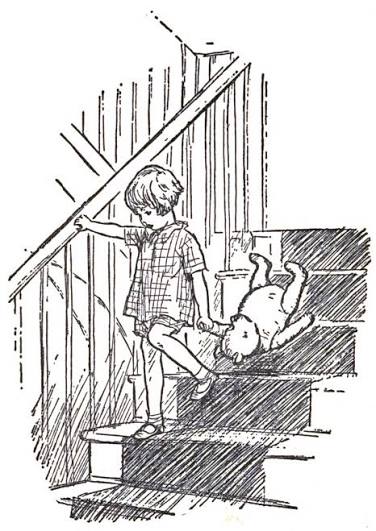
Chistopher Robin is, of course, inspired by Christopher Robin Milne, A.A Milne's real-life son. He is Winnie-The-Pooh's very best friend, and a figure whom all the other characters admire and look up to. Pooh often seeks him out for advice.
Throughout the second book, The House at Pooh Corner, Christopher Robin shows signs of growing up. The book concludes with Pooh and friends throwing him a Going Away party, as he will soon be starting School. The real Christopher Robin began attending Boarding School at age 9.
Disney's Christopher Robin plays a similar role to that of the book, as a best friend, mentor, and source of advice. The ending scene of The Many Adventures of Winnie the Pooh also has him starting school. However, later films and shows reveal that unlike his book and real-life counterparts, this Chrstopher Robin did not go to Boarding School, and still visits his friends after school hours.
Not in the book, but at your service!
As well as moving on from the tales in A.A Milne's books to tell original stories with the characters, Disney also introduced their own original characters into the Pooh universe. The first of these was Gopher, introduced in Winnie The Pooh and the Honey Tree when Owl calls upon him for help freeing Pooh when he becomes stuck in Rabbit's front door. Gopher even jokes about his original character status:
"I'm not in the book, but I'm at your service!"
Disney chose to include Gopher as an All-American figure, in case the short felt too British for U.S audiences. Unfortunately, this alienated British audiences, as Gopher took what should have been Piglet's role, leaving the latter absent from the short entirely. Despite the controversy, Gopher continued to be included in the subsequent theatrical shorts and the New Adventures of Winnie The Pooh TV series, but seems to have been phased out of later films.
The second major original character in Disney's Winnie The Pooh was Lumpy. Heffalumps as a species appear as an offscreen imaginary threat in the original theatrical shorts, and on a few occasions as minor antagonists in New Adventures, but none had become a major character until the introduction of Lumpy in Pooh's Heffalump Movie.
Lumpy's origin story is used to tell an important lesson in not judging those you do not yet know. When unexplained damage and large footprints appear in the Hundred Acre Wood, Rabbit blames the mysterious, dreaded Heffalumps, and the group sets out to capture one. Roo, separate from the others, successfully captures a Heffalump, only to discover that Lumpy is a child around his age, and not scary at all. The pair soon become the best of friends.
For the most part, Lumpy has been far better received by fans than Gopher was in his original appearance. He has since appeared in Pooh's Heffalump Halloween Movie, the Disney Junior series My Friends Tigger and Pooh, and the Kingdom Hearts video game series.
As part of the 100th Birthday celebrations, Disney have revealed that a new Winnie The Pooh film project is in early development.
Happy Birthday, Silly old bear!
About the Creator
Kristy Anderson
Passionate About all things Entertainment!
Enjoyed the story? Support the Creator.
Subscribe for free to receive all their stories in your feed. You could also become a paid subscriber, letting them know you appreciate their work.
Comments
There are no comments for this story
Be the first to respond and start the conversation.