
Windows: The Beautifully Shot Disaster That Ended Gordon Willis’ Directing Career
A legendary cinematographer, a terrific cast, Ennio Morricone, and one of the strangest controversies of 1980 somehow came together in this spectacular misfire.


There are bad movies, there are notorious movies, and then there are movies like Windows.
Released in 1980, Windows should have been almost impossible to screw up.
It had Talia Shire coming off the enormous success of Rocky and The Godfather Part II. It had Elizabeth Ashley. It had Joseph Cortese. It had a haunting score by Ennio Morricone. Behind the camera was Gordon Willis, one of the most celebrated cinematographers in American cinema, the man whose shadowy, controlled photography helped define The Godfather, The Godfather Part II, Klute, The Parallax View, Annie Hall, Manhattan, and a staggering list of other films.
And then there was the little problem of the movie itself.
Windows was Willis’ first—and only—film as a director.
It was also a spectacular failure.
What makes the movie fascinating isn’t simply that it bombed. Hollywood produces failed movies every year. What makes Windows such an extraordinary cinematic oddity is that virtually everything surrounding the production suggested quality, sophistication and prestige.
Instead, Willis wound up directing a psychological thriller that critics hated, audiences ignored, and gay-rights organizations protested because of its depiction of a lesbian character as a psychotic sexual predator.
It became one of those movies that seemed to arrive already carrying a reputation for disaster.
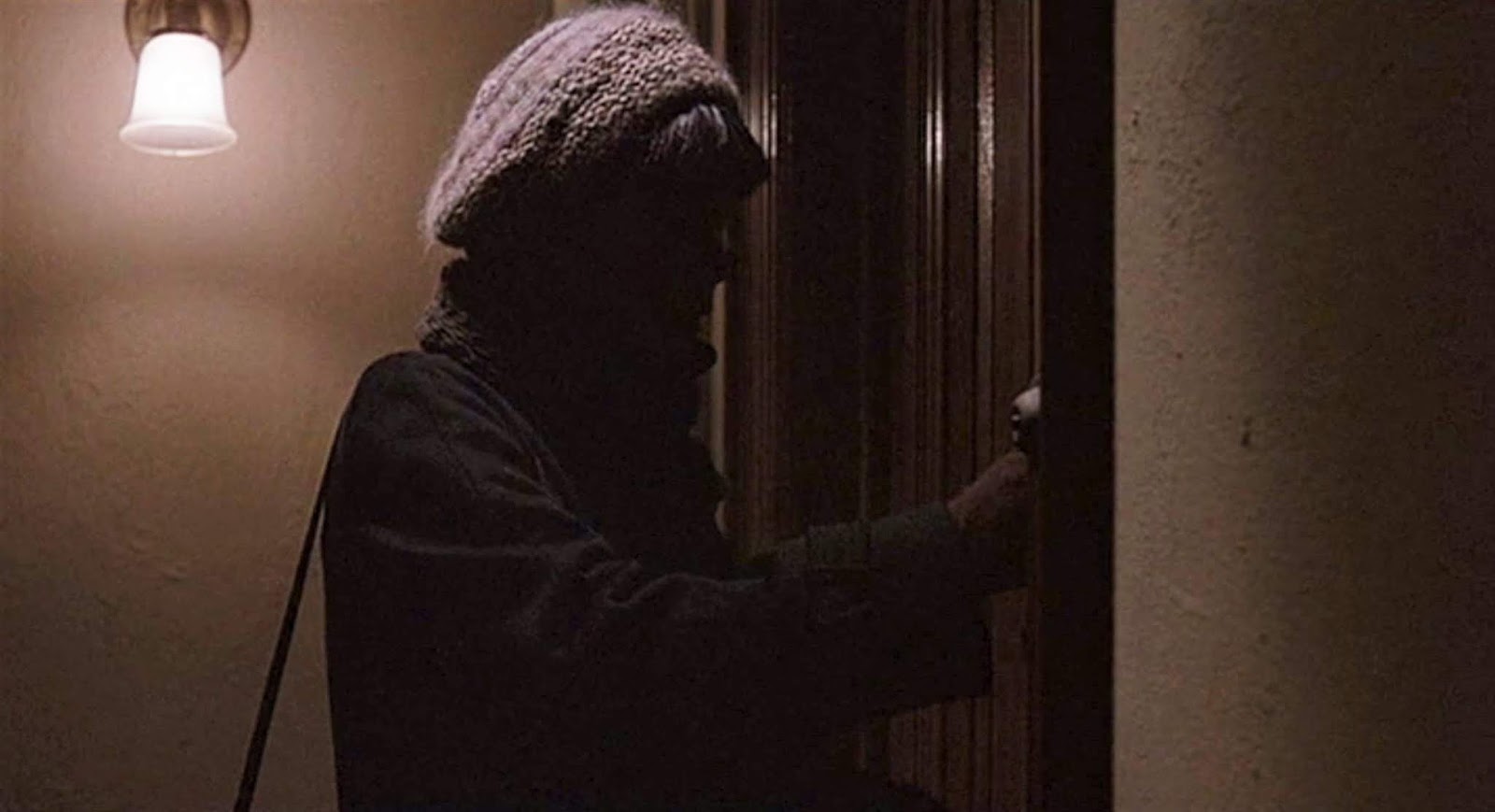
And that is a shame, because Windows looks absolutely beautiful.
From a College Newspaper to Hollywood
The strange history of Windows began several years before cameras rolled.
In 1976, producer Michael Lobell, a former clothing manufacturer, went looking for new screenwriting talent in college newspapers. He eventually connected with student writer Barry Siegel, and the two began developing what they envisioned as a romantic suspense thriller.
The project went through the usual Hollywood development maze.
At various points it was associated with Warner Bros. and Twentieth Century-Fox, and at one stage it was known as Corky. Eventually, United Artists picked it up in 1978.
That’s when Gordon Willis entered the picture.
By this point, Willis wasn’t simply another cinematographer looking for an opportunity. He was one of the most respected visual artists working in American film.
His photography had become synonymous with a particular kind of darkness. Willis understood shadows. He understood negative space. He understood how much information you could hide in a frame—and how much tension you could create by refusing to show the audience everything.
The nickname “Prince of Darkness” wasn’t exactly an insult.
So why not let him direct?
That decision would ultimately produce the only directorial credit of Willis’ career.
A Thriller About Watching
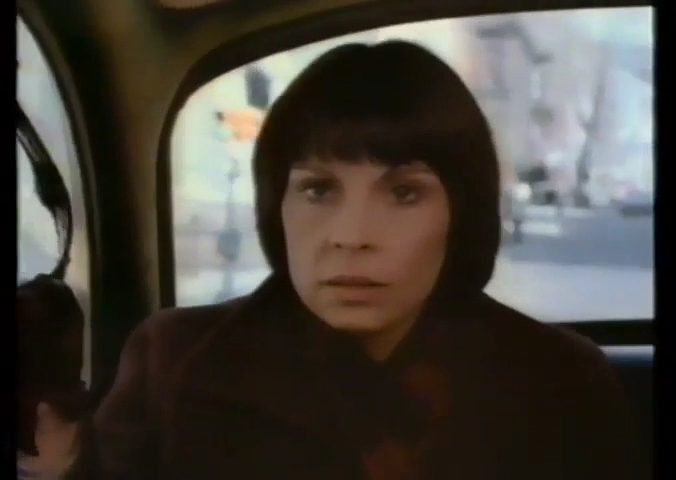
Windows stars Talia Shire as Emily Hollander, a vulnerable divorcee living in Brooklyn.
Emily becomes the victim of a terrifying stalking campaign. Someone is watching her. Someone is following her. Someone has invaded the private spaces of her life.
Naturally, she turns toward someone she believes she can trust.
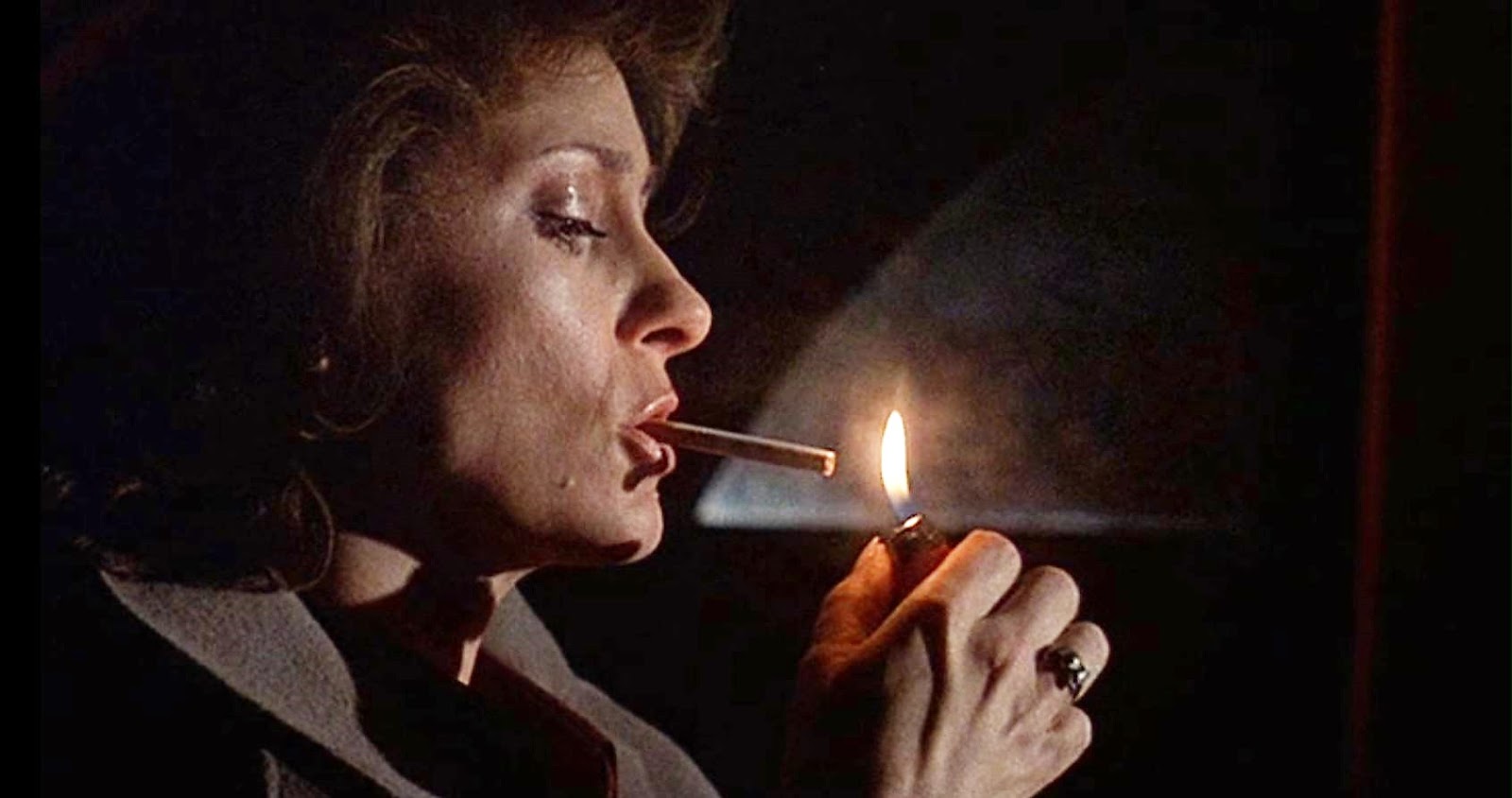
That person is her neighbor Andrea, played by Elizabeth Ashley.
Andrea is wealthy, sophisticated and seemingly sympathetic. She appears to offer Emily exactly what she needs: friendship and protection.
Except Andrea isn’t protecting Emily.
She’s responsible for what is happening to her.
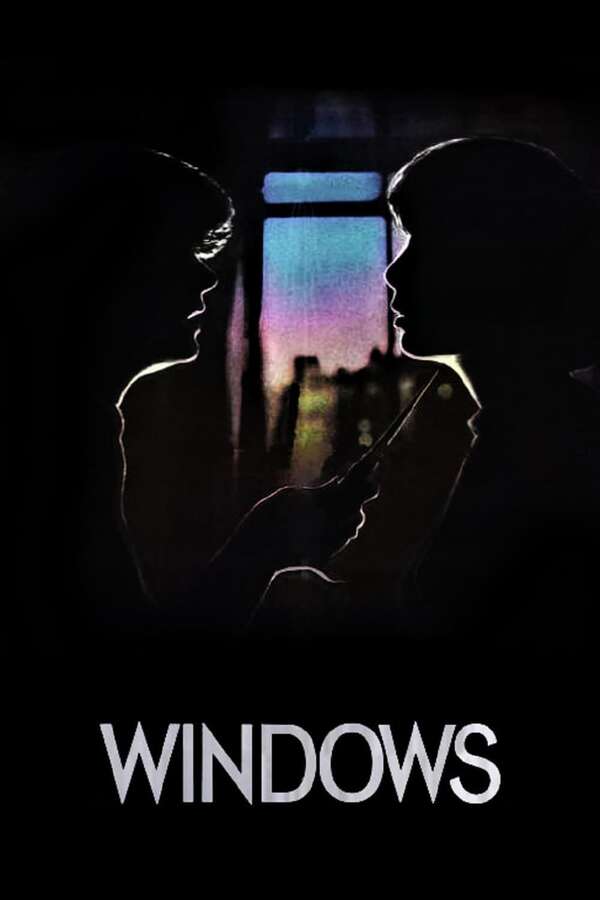
The movie eventually reveals Andrea as a voyeuristic stalker who has essentially constructed Emily’s nightmare around her. What follows is an obsessive cat-and-mouse story that gradually moves toward an inevitable confrontation.
On paper, there is plenty here for a genuinely nasty psychological thriller.
Unfortunately, Windows never quite manages to turn its premise into the sophisticated thriller it appears to want to be.
Instead, the movie became trapped between atmospheric art film and exploitation thriller.
And that gap is where Windows fell apart.
Gordon Willis Gets Behind the Camera
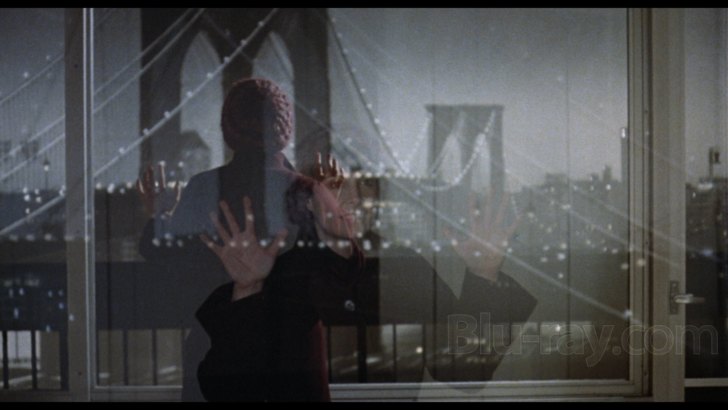
Production began in early 1979, with filming taking place around Brooklyn Heights and various Manhattan locations and studios.
Willis approached the production with the kind of visual control you would expect from someone of his reputation. The sets were reportedly kept closed, particularly during scenes involving the film’s more provocative material, and the production maintained a degree of secrecy surrounding the story.
The irony is almost too perfect.
The man famous for photographing other people’s movies was now responsible for controlling every aspect of one.
Willis could control the frame.
What he apparently couldn’t control was the movie.
That distinction would become painfully important.
Editor Barry Malkin and production designer Mel Bourne were among the other major talents involved, while Morricone supplied the score.
For a movie that ultimately became synonymous with failure, Windows had an astonishing amount of cinematic horsepower behind it.
There was even a paperback novelization by H.B. Gilmour, because apparently somebody in 1980 thought this thing had a future.
It didn’t.
When Controversy Becomes the Movie
When United Artists released Windows in January 1980, it didn’t exactly explode onto the marketplace.
The movie opened in fewer than fifty theaters and earned only about $312,000 during its opening weekend. Its eventual domestic gross barely crawled past $2 million.
For a film with this pedigree, that was a disaster.
But the box office wasn’t the biggest problem.
The controversy was.
Gay-rights organizations objected strongly to the film’s portrayal of Andrea, whose sexual obsession with Emily is intertwined with the movie’s depiction of her lesbianism.
Protests were organized outside theaters, and the film became part of a larger cultural battle over how Hollywood was portraying gay characters at a time when representation was already overwhelmingly negative.
The timing made things even more combustible.
Windows arrived in the same cultural moment as Cruising, another 1980 film that generated intense protests over its portrayal of gay men and homosexuality.
Willis attempted to defend Windows by arguing that the film was about insanity rather than homosexuality.
That distinction didn’t satisfy its critics.
And once the controversy became attached to the movie, it became almost impossible for Windows to escape it.
The Critics Didn’t Like It Either
Even without the protests, Windows had another problem.
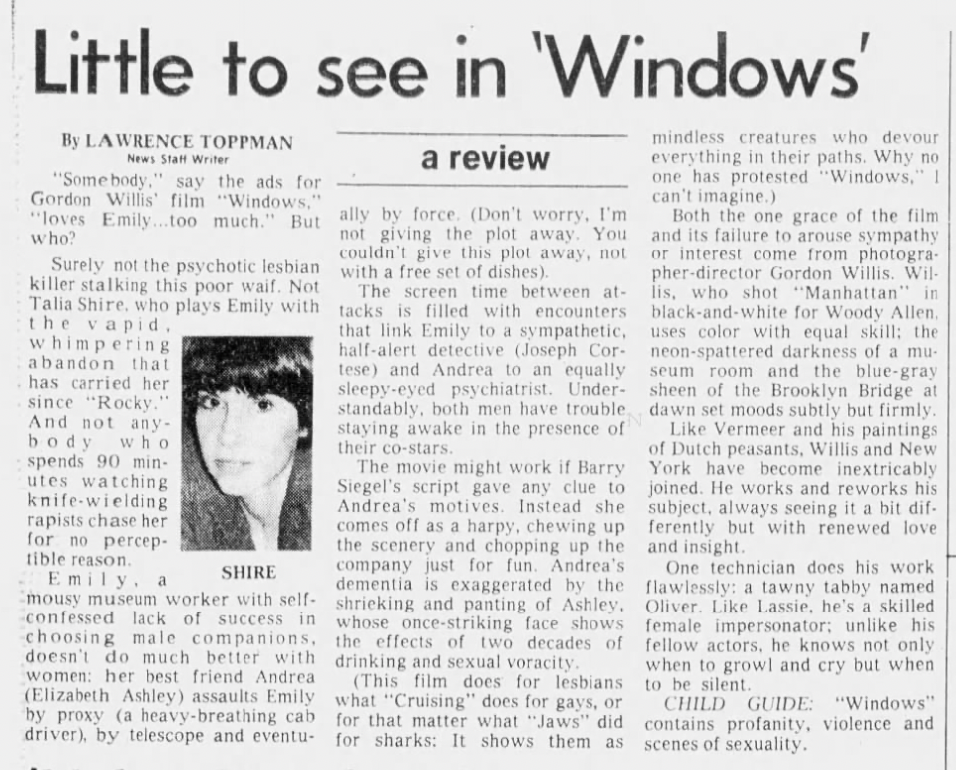
Critics didn’t think it was very good.
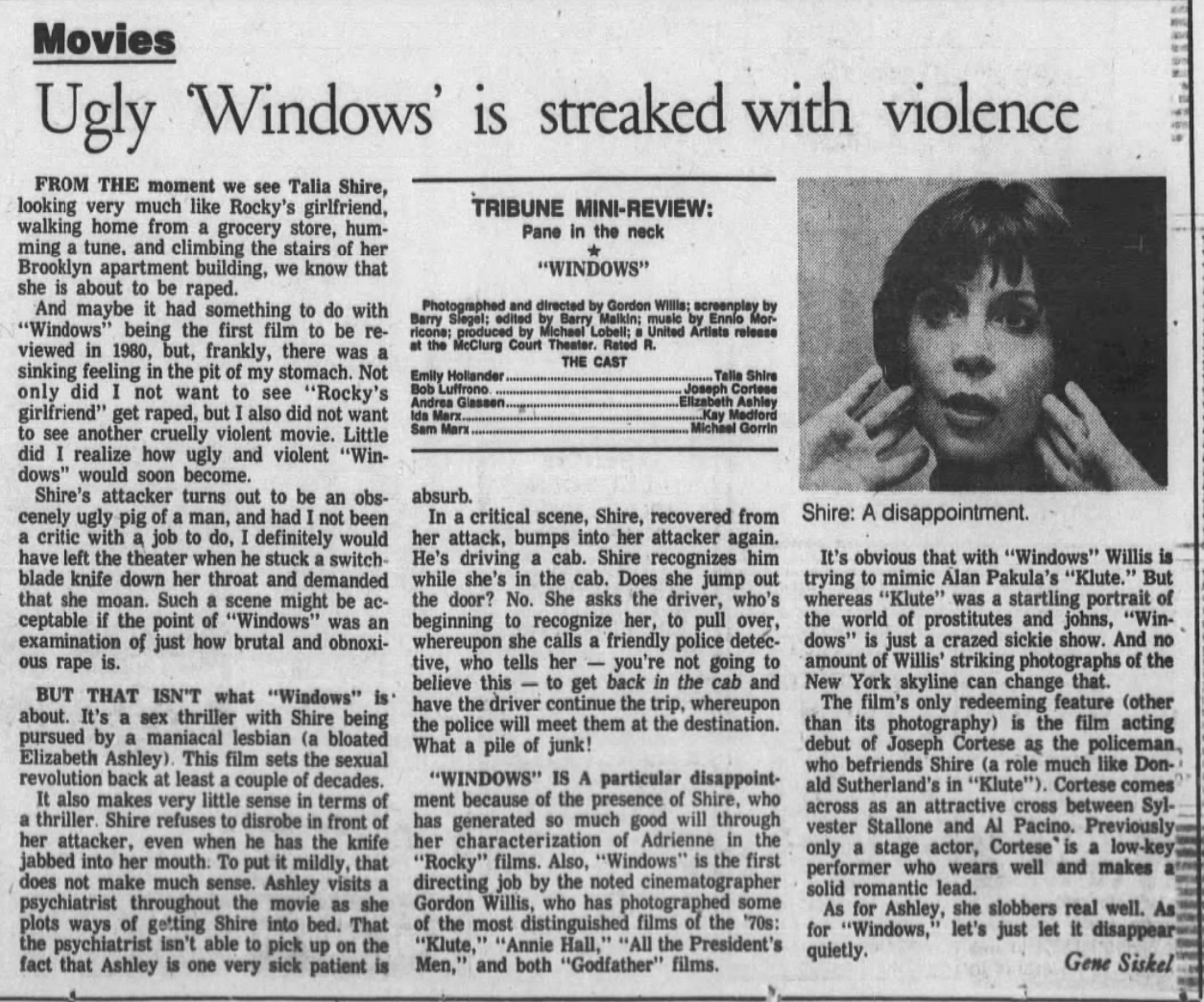
Vincent Canby dismissed the film as ridiculous, while Roger Ebert argued that Willis’ impressive visual work couldn’t rescue a screenplay built around embarrassing clichés.
The reviews weren’t merely negative.
They were often openly hostile.
The movie was criticized for being dull, implausible, tasteless and dramatically inert. The very atmosphere that should have generated suspense instead became, for many viewers, evidence that Windows was simply a beautifully photographed bad movie.
And that’s probably the most interesting thing about it.
You can watch Windows and see Gordon Willis everywhere.
The compositions are controlled. The lighting is striking. The movie has a visual sophistication that many of its contemporaries could only dream about.
But the images are serving a story that simply isn’t working.
It’s like watching a master architect attempt to build a beautiful house on a terrible foundation.
Eventually, the foundation wins.
The Razzie Treatment
The disaster became official enough to earn Windows several Golden Raspberry Award nominations, including Worst Picture and Worst Director.
For Gordon Willis, that had to sting.
This was a man who had spent years making other directors look brilliant.
Now he was being singled out as one of the worst directors of the year.
But Willis wouldn’t spend the rest of his life trying to prove the critics wrong.
Quite the opposite.
He later looked back on Windows with considerable regret and openly called the film a mistake.
Willis reportedly recognized that directing actors wasn’t his strength. His comfort zone was the camera—the composition, the lighting, the visual architecture of a scene.
That was where he belonged.
And Windows became his first and last attempt to prove otherwise.
The Movie Gordon Willis Wanted Us to Forget
The strange thing about Windows is that it isn’t really forgotten.
At least not completely.
Movies this spectacularly strange have a way of surviving.
The film eventually received a DVD release through MGM and later a Blu-ray from Scream Factory in 2017. Its scarcity has only added to its reputation as one of those obscure 1980s curiosities that movie obsessives discover and immediately ask the same question:
How did this get made?
That’s the enduring fascination of Windows.
It’s not simply a bad movie.
It’s a bad movie made by people who were very, very good at making movies.
That’s much more interesting.
Talia Shire was a major star. Elizabeth Ashley was an accomplished performer. Ennio Morricone was one of the greatest film composers who ever lived. Mel Bourne was an enormously respected production designer.
And Gordon Willis?
Gordon Willis was Gordon Willis.
Yet somehow all of that talent converged on a psychological thriller that managed to alienate critics, anger activists, disappear at the box office and permanently end one of the most promising directorial experiments in American cinema.
There is also a darker lesson buried inside Windows. The film’s central idea depends upon a stereotype that now feels painfully dated, and the controversy surrounding it isn’t something that can simply be waved away as another example of easily offended audiences. The movie’s treatment of homosexuality is fundamental to its premise, and that premise is precisely why the film remains so uncomfortable to revisit.
But uncomfortable movies can still be fascinating movies.
And Windows is fascinating.
It is a cinematic car wreck photographed by one of the greatest cinematographers who ever lived.
You can admire the lighting. You can marvel at the compositions. You can listen to Morricone’s score. You can appreciate the extraordinary talent assembled in front of and behind the camera.
And then the story starts.
That’s when the whole thing falls apart.
Gordon Willis spent the rest of his career creating images that helped define what American movies looked like in the 1970s and 1980s. His reputation survived Windows easily.
The movie didn’t.
Today, Windows remains a strange little monument to the hazards of Hollywood ambition—a film that proves having some of the greatest names in cinema attached to a project doesn’t guarantee greatness.
Sometimes it just guarantees that the disaster will look really, really good.
About the Creator
Movies of the 80s
We love the 1980s. Everything on this page is all about movies of the 1980s. Starting in 1980 and working our way the decade, we are preserving the stories and movies of the greatest decade, the 80s. https://www.youtube.com/@Moviesofthe80s
Enjoyed the story? Support the Creator.
Subscribe for free to receive all their stories in your feed.
Comments
There are no comments for this story
Be the first to respond and start the conversation.