
Why Nolan Erased the Gods
The director’s radical take on Homer strips away divine intervention to reveal something far more terrifying: a traumatized man alone with his memories, inventing monsters just to survive his own reflection.
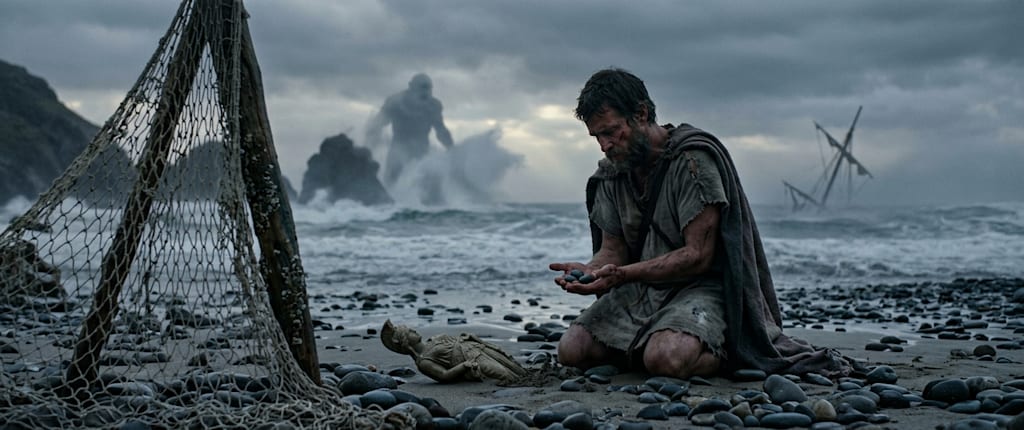
Nolan doesn’t show Zeus throwing a thunderbolt. He shows Odysseus digging his fingernails into the gaps between the ship’s planks. A wave crashes over the deck. He shouts “Poseidon” – but his eyes stay fixed on the snapped rigging. The frayed hemp rope whips back in the wind and lashes his own raw knuckles.
That distinction is everything. To an ancient sailor, the wave was the god. Not a god causing the wave – the wave itself needed a name. Without a name, the bloody stripe across his palm is just a physical cut, something to rinse with salt water and forget. It cannot become an anger he can carry. Nolan makes the gods invisible by putting them back inside human perception. In a storm there is no white‑bearded figure on a cloud. There is only the groaning mast, the tearing canvas, and seawater flooding your nose. Odysseus cries out to “Poseidon” not because he worships a trident‑wielding king, but because screaming “atmospheric pressure differential” does nothing to stop the raw fear of drowning.
That is Nolan’s first move: the divine is a crutch for the mind, not a lever for the plot.
His second move cuts deeper. The Cyclops does not exist. What exists is a charred olive trunk washed onto the beach, its bark twisted with spiral burn scars that look like an eye socket. When Odysseus wakes on the sand, black ash is caked under his fingernails. A dry, rust‑iron thirst scrapes his throat. The manic shout of “No One!” from the night before has faded to a ringing in his ears. Did he kill a one‑eyed monster? That misses the point. He did kill someone – a shepherd, maybe, or a foreign scout. But his memory, so that he can swallow his breakfast of dried figs without vomiting, has reshaped that human face into something that no longer looks like his own reflection.
Remove the divine filter, and Nolan shows you not a “more authentic” history but a rawer one: a general who survived the sack of Troy, still carrying Trojan blood on his tunic, drifting from island to island. Every shipwreck, every act of starvation‑driven cannibalism, every foundering vessel – he re‑crafts each one into a tale he can tell aloud without breaking. The gods vanish so that the act of fabrication itself becomes visible.
The most telling clue is a single name. Around a driftwood fire, a young sailor asks, “Whose cattle were those on the island?” An older hand, chewing on dried meat, mutters, “Apollo’s.” Odysseus sits nearby, not looking up. He is slicing a water blister off his heel with his knife, peeling the dead skin in one clean strip. He does not correct the old man. An omniscient narrator – the kind who later composed the epic – would never confuse Apollo with Helios. But a scarred vagrant who has not slept through a single night in ten years? He would. He stays silent because correcting the name means revisiting the exact sequence of events, and revisiting that means swallowing, again, the taste of sacred beef and the salt of his own broken oaths. He lets the mistake stand.
Nolan’s whole film turns on that silent moment: the error itself is the birth certificate of mythology. The version we now recite as Homer’s Odyssey is almost certainly a misheard line passed from one campfire to the next – one man misremembering a god’s name, another adding the “Nobody” pun for a laugh, a third inserting the pathos of the mother’s ghost because his own mother died while he was away. Generational accretion. Oral sedimentation. What reads like holy scripture probably began as a desperate improvisation – a man making up a story so his comrades would stop asking what he actually ate that night.
The final move lands in Ithaca. On the eve of the massacre, Odysseus tears the small effigy of Athena from his neck – a carved trinket he has worn since Troy – and leaves it on the windowsill, facing the sea. Next morning, he picks up the great bow. His thumb joint trembles as he strings it; the tendon in his forearm flinches. He does not glance back at the statue. The bowstring sings. The first suitor falls backward, an arrow through his throat. Odysseus does not pray. He counts the remaining shafts in his quiver – twelve. Every one he had whittled straight the night before, by a single oil lamp, checking each fletching with his thumbnail.
No god helps him. The divine has receded into absolute silence.
He steps onto the actual sand of Ithaca – left foot first, a small ritual he has repeated in his mind for a decade. He bends down to shake the pebbles out of his leather boot. Three stones fall: white, grey, speckled. He lifts his head. The old fishing net still hangs across the doorframe, its mesh full of holes. The wind passes through those holes and makes a thin whistle. Penelope stands in the doorway, not weeping, not rushing forward. She holds a single strand of unspun linen thread between her thumb and forefinger – the yarn she has been unpicking every night. Neither speaks.
Nolan’s entire film does one thing: it pulls the gods out of the celestial machinery and stuffs them back into a man’s gut – into his fear, his guilt, his starvation, his thirst, and his primal instinct to invent lies at three in the morning just to keep his heart beating. Those golden, gleaming interventions from the epic become, in his lens, nothing more than a human hand shaking from exhaustion. Athena does not guide the arrow; Odysseus’s own sore thumb holds the string. Poseidon does not capsize the raft; the northwest wind simply fills the sail and rips it.
The gods are not deleted from this story. They are returned to the ignorance of that age. And that ignorance – that desperate scramble for explanations in the face of thunder, plague, and starvation – is exactly where the earliest human poetry was born.
About the Creator
Jin
Writer of reamstories
https://reamstories.com/jin
Enjoyed the story? Support the Creator.
Subscribe for free to receive all their stories in your feed. You could also become a paid subscriber, letting them know you appreciate their work.
Comments
There are no comments for this story
Be the first to respond and start the conversation.