
Why Crime Dramas Are Everywhere Right Now
A stable audience, clear censorship rules, and lower production costs made the genre streaming’s safest bet.
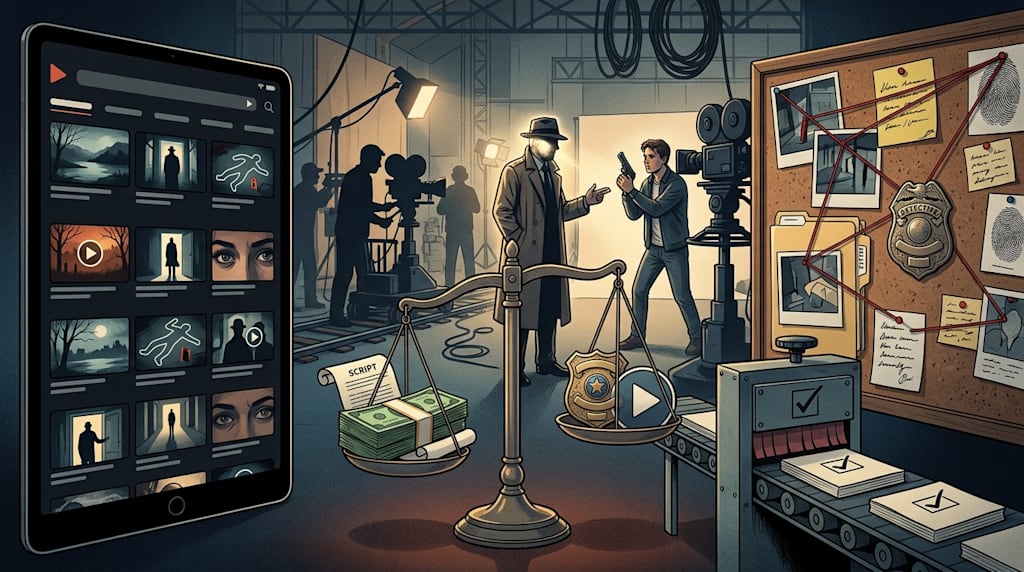
Open a streaming app. The homepage usually has two big categories: costume romances and crime thrillers. A new crime drama appears almost every month. Some are good. Many are not. Viewers complain, then watch the first episode anyway.
Why so many? The stable audience is one reason. There are others. Platforms, censors, producers, and viewers all push in the same direction. Viewers want order. Platforms want watch time. Producers want lower risk. Censors want predictable boundaries. That combination explains the boom.
1. Audience: A stable base that keeps growing
Crime stories fill an old need: crime and punishment, puzzle and answer, chaos and order. As long as people care about justice, the genre has a market.
TV-era shows like Six Groups of Serious Cases, Conquest, and Black Hole built a loyal audience. Those shows were raw. Cases came from real news. Viewers watched to see how a case was solved, and also to see what society looked like. That audience is still here.
Streaming brought younger viewers. Day and Night, Untouchable, and The Long Night pulled in educated, younger users. They care about who did it, but also why it happened and what failed in the system. Under the Skin, I Am a Criminal Police Officer, and Day and Night: Dawn split the audience further. Some shows skew male. Some skew female. The genre is no longer just for older men.
The audience is stable, but the genre keeps changing. It moved from tough cops to sketch artists, forensic examiners, and profilers. It moved from case-of-the-week to serialized stories. It moved from classic whodunits to social-problem dramas. Viewers want a familiar shape with a new angle.
2. Censorship: Red lines, but clear ones
People assume crime dramas are hard to censor because the content is dark. The opposite is true. The rules are clearer than for most genres.
There are red lines. No ghosts. No supernatural. No excessive gore. No detailed instructions for crimes. No negative portrayal of police. Good must beat evil in the end. The shelved Bureau of Strange Cases likely ran into the supernatural ban. That is an absolute limit.
Outside those limits, there is room. Costume dramas can get stuck on historical views, palace politics, time travel, or BL adaptation. Realistic dramas can get stuck on social sensitivity. Crime dramas usually only need to protect the core message: law wins, police are positive, the ending is just. It is dancing in shackles, but the shackles are visible. You can plan the steps.
That makes crime dramas a low-risk choice for platforms. Avoid the supernatural. Do not linger on crime details. Do not make the villain a hero. The show can still work within the rules. That certainty is rare.
3. Production: Cheap to make, quick to return
Crime dramas are cheap compared with costume romances.
A big costume romance spends on effects, costumes, sets, star salaries, and marketing. If it flops, the loss is huge. A crime drama usually uses modern settings, ordinary clothes, and few effects. The money goes to script and actors. Veterans like Chen Jianbin, Dong Yong, and Ding Yongdai cost less than top idols and deliver reliable performances. Shooting is faster. Money comes back sooner.
Platforms are cutting costs. A mid-budget crime drama with a solid script and good actors can become a hit. A big costume romance can trend all week and still lose money. Platforms do the math. Crime dramas usually pass.
4. Actors: A stage for veterans, a training ground for young idols
Crime dramas are built for the old-leading-the-new setup.
Veterans play captains, mentors, and bureau chiefs. Young actors play rookies. Each case can bring in a few guest stars. If a young idol is weak, the role can be written as a learning rookie. The plot and the veterans carry the scene. Viewers get veteran performances and idol growth. Platforms get praise for acting and attention from fan bases.
Veterans get better roles. They are not stuck as generic emperors in costume dramas or strict parents in romances. They can be tired detectives, hidden masterminds, or informants with unclear loyalties. Young actors get a path into serious drama. A good performance can break the “only knows how to date on screen” label.
This ecosystem lets acting talent and fan power exist in the same show.
5. Creation: A big container for social issues
Crime dramas give writers and directors more room than costume romances.
They can be whodunits, social dramas, hard-boiled stories, or documentary-style. They can be episodic or serialized. They can take on juvenile crime, cyberbullying, domestic violence, workplace abuse, or rural governance. Directors can be cold, funny, or stylized. Costume romances are limited by worldbuilding and couple logic. Crime dramas touch the real world.
A good writer can make a social allegory like The Long Night or a workplace drama like Under the Skin. A good director can use a long take for a crime scene or a montage for a killer’s mind. The genre has space for an author’s voice.
6. Platforms: Costume romances cooled, suspense took over
The boom also comes from the cooling of costume romances.
Costume romances became repetitive. Viewers got tired. Policy risk stayed high. Costs stayed high. Platforms needed new growth. Crime dramas have strong plots and fast pacing. They work against short video because they need following, discussion, and guessing. Platforms opened suspense labels: Mist Theater, Light On Theater, X Theater. Branded blocks give steady output. They bring in members and keep them.
Industry watchers say suspense dramas have passed costume dramas in new productions. That is not an accident. It is a platform strategy. When costume romances stopped being reliable, crime dramas became the safer bet.
7. The risk: When the safe bet gets crowded
More shows do not mean better shows.
The formulas are easy to see: a body at the start, a twist in the middle, a killer you did not expect. Logic holes. Weak villains. Mystery for its own sake. Dark content for shock. Viewers get tired. Today’s costume romance problem could become tomorrow’s crime drama problem. When every platform plays safe, the safe bet becomes the most crowded lane.
Crime dramas need new angles. Characters need more depth. Social insight needs to be sharper. Storytelling needs more nerve. A show cannot survive on “who did it” for thirty minutes. It cannot survive on veterans alone. The shows that last will respect the audience’s intelligence and feelings.
Conclusion
The number of crime dramas is not random. Platforms, censors, producers, and viewers all push the same way. The genre is stable, safe, cheap, and easy to talk about. It gives veterans work, young actors a path, and writers room to move.
But a safe bet stops working when everyone makes it. If crime dramas become assembly-line products, viewers will leave. Good shows are not calculated. They are written, acted, and shot.
The genre may have a long run ahead. Whether it does depends on one thing: remembering that viewers do not want gore. They want the moment justice lands, and something to think about after.
About the Creator
Jin
Writer of reamstories
https://reamstories.com/jin
Enjoyed the story? Support the Creator.
Subscribe for free to receive all their stories in your feed. You could also become a paid subscriber, letting them know you appreciate their work.
Comments
There are no comments for this story
Be the first to respond and start the conversation.