
When Stephen Chow Called You God and Feng Xiaogang Called You Garbage: The Real Problem With Chinese Cinema’s Director-Versus-Audience Wars
One filmmaker bows to the box office; another blames the audience for bad movies. Neither is telling you the truth about who really makes a film great.
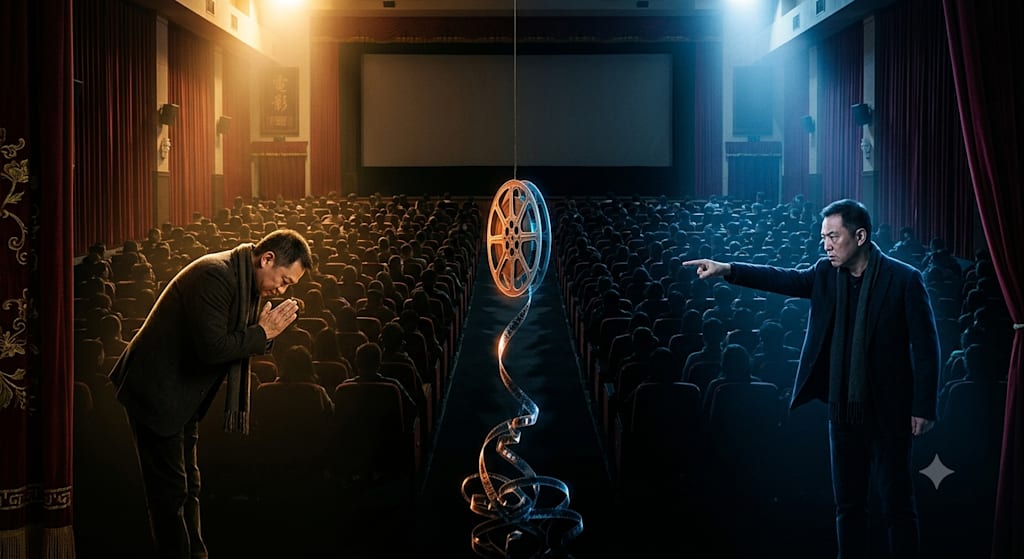
I. One Market, Two Radically Different Postures
In 2026, as Stephen Chow's Kung Fu Women's Football swept the box office, the director—once notorious for his exacting standards—faced the cameras and said: "Every record is broken by the audience. You are the greatest! The box office wasn't created by me—it was created by every single viewer who bought a ticket and walked into the theater."
Around the same time, social media unearthed an old clip from the 2017 Shanghai International Film Festival, where Feng Xiaogang had dropped a bombshell during a forum: "Why are there so many garbage films in China? It's because there are so many garbage audiences. If you stop going to see them, bad films won't have a market, and producers won't invest." Those remarks resurfaced with a vengeance after Catch the Spy failed to win over audiences, and netizens quipped: "This time, Director Feng's 'garbage audiences' voted with their feet."
Two statements, two attitudes, reflecting two opposed creative philosophies in the Chinese film industry. They raise a serious question: when it comes to a film's success or failure, who is ultimately responsible?
II. Feng Xiaogang's "Garbage Audience" Thesis: A Logical Trap, or Misunderstood Clarity?
Let's first return to the full context of Feng's remarks. At that forum, he was actually articulating a market logic: the audience's aesthetic choices directly influence the flow of capital. If large numbers of viewers pay for shoddily made films, capital will read that as a signal that such films have a market and will replicate more of the same. From this perspective, his logical chain is clear—demand-side choices do, in fact, shape the supply side.
But where does the problem lie?
First, a misattribution of responsibility. A film's quality is sealed the moment the director yells "cut." The audience only enters the picture after the work is complete. Blaming viewers for "garbage films" is like a chef who cooks a terrible meal and then scolds the diners: "Why did you order this?" The creator bears primary responsibility for the work's quality—that's not something that can be shifted onto the consumer.
Second, the reality of information asymmetry is ignored. Before buying a ticket, there is no way for audiences to know with certainty whether a film is good. What they see is carefully edited trailers, wall-to-wall marketing copy, stars smiling at promotional roadshows—even public figures like Han Hong endorsing the film. During the Catch the Spy promotional campaign, didn't Feng himself invite Han Hong to vouch for his movie? If viewers walk into the theater because they trusted that promotion, only to find the film falls short of expectations, does that make them "garbage"?
Third, the charge of double standards. On one hand, you use marketing tactics to lure audiences in; on the other, you blame them for not knowing how to separate the wheat from the chaff. This attitude inevitably reeks of wanting to have it both ways. In the era of industrialized filmmaking, no movie survives outside the promotional ecosystem—and when there's a gap between promotion and actual quality, the ones who bear the consequences are the very audiences who were guided by that promotional information. That's not fair.
III. Stephen Chow's "Audience as God": Classy, but Only That
Next to Feng's sharp-edged provocations, Stephen Chow's remarks come across as gracious and humble. From a PR standpoint, it's a textbook risk-avoidance strategy—when your film is raking in money, crediting the audience feels generous and wins more goodwill.
But let's be clear-eyed about this: this is still fundamentally marketing talk. No rational observer would conclude from Chow's words alone that Kung Fu Women's Football is a flawless masterpiece. In reality, many viewers walked out with reactions like "awkward," "loose plot," "old jokes," a far cry from the Stephen Chow of A Chinese Odyssey or The King of Comedy.
I once had a similar experience at a Hong Kong film premiere. The investment company's owner walked over to me—a complete nobody who hadn't written a single word about this film—and said, "It's all thanks to you, the media." I realized on the spot that this was just a polite gesture, a ritual of maintaining good relations with critics. Stephen Chow's attitude is essentially the same. High emotional intelligence deserves praise, but it is no substitute for a fair assessment of the work itself.
IV. The Audience's Dilemma: Making the "Right" Choice in a Fog of Promotion
What's truly worth examining is the predicament audiences face today. In an environment saturated with marketing bombardment, astroturfing, deleted negative reviews, and suppressed authentic voices, how exactly is a viewer supposed to "correctly" choose a film?
Feng's underlying premise is that audiences have both the ability and the responsibility to identify bad films before buying tickets, thereby purifying the market through abstention. But that premise collapses on several grounds:
On opening day, before word-of-mouth has spread, the first batch of viewers is making decisions with minimal information. Are they "garbage"?
What audiences see are pre-Douban-score marketing campaigns, celebrity endorsements on Weibo, highlight clips on short-video platforms—all of which are carefully curated "selective information" produced by the film industry itself. How is the average viewer supposed to see through it?
Even if one waits for word-of-mouth, that "word-of-mouth" itself may be manufactured—who can be entirely certain today that Douban ratings aren't manipulated, that top comments haven't been bought, or that critics haven't been wooed?
Under these conditions, scolding audiences for "not picking good films" is like mocking someone lost in a deliberately designed maze with: "Why didn't you take the right path?" Audiences don't lack discernment. What they lack is the genuine information required to exercise it, which often only becomes available after they've already bought the ticket.
V. Two Kinds of Arrogance and One Kind of Sincerity
If we strip away appearances, both Stephen Chow and Feng Xiaogang share the same underlying reality: a sober awareness of their own situation.
Chow knows, with clear-eyed honesty, that he can no longer make films of the Kung Fu Hustle era. Yet audiences still show up for him. That goodwill is worth cherishing. So he chooses to bow his head and give thanks.
Feng is equally sober, but he took a different path. He saw the absurdity of the market mechanism, yet he chose the most offensive way to express it. The reason that line has been reviled for years has never been merely a matter of logical fallacy—it's the arrogance of his posture. When a director uses the word "garbage" to describe the very people putting money in his pocket, no matter how "right" his argument may be, he has already lost the emotional support of the vast majority.
What truly deserves our admiration are those creators who let their work speak, who do not talk down to their audience, and who treat viewers as equal conversation partners. They don't worship audiences as gods, nor do they dismiss them as trash. They understand that cinema is a dialogue: the director delivers the opening line, and the audience's response is the closing line. A complete artistic cycle has always depended on both sides showing up.
VI. Conclusion: The Value of Cinema Is Completed by the Audience
Let's return to the original question: Stephen Chow or Feng Xiaogang—whose statement is more "correct"?
If measured by "appropriateness," Chow wins hands down. If measured by "internal logic," Feng has a point—but his manner of expression and his arrogant tone turned that point into a punchline.
But at a deeper level, a film's quality is fixed the moment it's completed, regardless of what the director says afterward. Audiences walk into a theater to see images on screen, not a director's interview transcript or social media feed.
The reason Feng's remarks were dragged up again after Catch the Spy underperformed isn't really about "settling old scores"—it's that audiences were answering his question with their actions: when a director classifies viewers into tiers, viewers have every right to respond with their box-office spending.
As for Chow's flattery, pleasing as it is, we should do something else instead: turn our attention from what directors say, back to what their films actually are. No matter how humble or how arrogant the director, neither can alter the quality of the cinematic world already fixed onscreen.
The most sincere creators don't need to put down audiences to affirm their artistic integrity, nor do they need to flatter audiences to gloss over their own shortcomings. They simply make good films, and then return the full power of judgment to the people sitting in the dark.
Cinema, from the moment it was born, was always an art form that requires the audience to complete its final chapter. Audiences are neither garbage nor gods. With every cent they spend on a ticket, they cast a real vote for the cultural ecology of their time. Whether that vote is "right" or "wrong" is not for a director to judge. The only thing a director can do is to make himself worthy of receiving it.
About the Creator
Jin
Writer of reamstories
https://reamstories.com/jin
Enjoyed the story? Support the Creator.
Subscribe for free to receive all their stories in your feed. You could also become a paid subscriber, letting them know you appreciate their work.
Comments
There are no comments for this story
Be the first to respond and start the conversation.