
When Code Treats You Like Air: The True Story of the First "Death" by Robot 🤖
The true story of the first death by robot and why the real danger isn't Skynet, but our blind trust in automation.

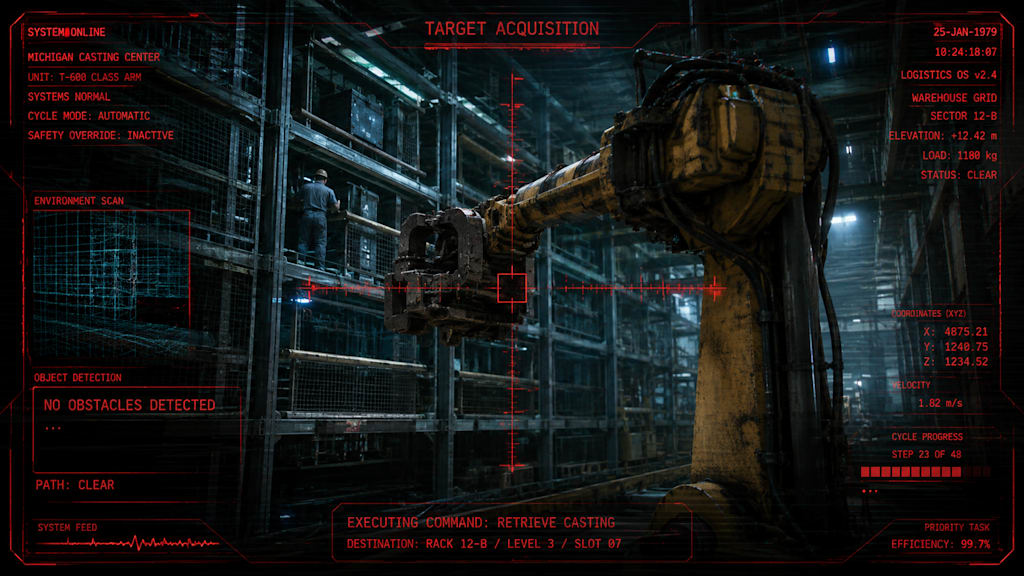
As an absolute die-hard fan of sci-fi cinema and the "Terminator" universe, I grew up on James Cameron’s vision of the machine uprising 🎬. The vision of Skynet—a powerful, sinister artificial intelligence that gains self-awareness and sends an army of metal endoskeletons with glowing red eyes to reset humanity—sticks with you forever. For years, pop culture has fed us the fear of machines turning against us out of pure hatred or a survival instinct. We think of a robot rebellion in terms of lasers, explosions, and epic battles for the future of the world.
However, reality turns out to be far more terrifying, quiet, and... mundane. The world's very first human casualty of automation didn't die in a bloody war against a thinking computer. He died because a machine executed its program with absolute, mathematical indifference.
Tragedy in Ford's Digital Cathedral 🏭
Let’s step back in time to January 25, 1979, to Flat Rock, Michigan. That’s where the Michigan Casting Center was located—a massive, state-of-the-art foundry owned by the Ford Motor Company. In those days, this plant was considered an absolute masterpiece of engineering and a symbol of the upcoming era of automation. The factory resembled a grand, mechanical cathedral where human labor was being replaced step-by-step by reliable, pre-programmed mechanisms.
The star of this industrial show was a massive, overhead transfer system manufactured by Litton Systems. It was a giant, five-story-tall mechanical arm that moved along special rails next to colossal storage racks. Its job was to efficiently retrieve heavy car castings from the shelves and deliver them to the production line. Faster, more efficient, and without any coffee breaks.
Working in that same factory was 25-year-old Robert Williams. His coworkers remembered him as an incredibly diligent, calm, and warm-hearted guy. Williams was an assembly line operator whose job was to oversee the processes and step in wherever technology hit a minor snag. On that fateful day, the technology hit a snag that triggered a landslide of tragic events.
The Blind Giant and the Code Loop 💻
It all started with a glitch in the warehouse management software. The computer began giving false inventory reports. The system claimed that the transfer machine couldn't keep up with retrieving parts and that castings were missing, when in reality, everything was right where it was supposed to be. The digital brain of logistics simply got "lost" in its calculations.
Because the machine was transmitting incorrect data, Robert Williams was ordered to go into the storage section and manually count the parts hidden high up on the racks. The young worker climbed to the third level of the gigantic structure, entering a zone that would soon become a death zone.
It's important to understand one thing: the robot that killed Williams didn't have an ounce of malice in it. It didn't have the red eyes of a Terminator, nor was it controlled by some vengeful intelligence. The machine was simply blind.
In 1979, the safety systems that are standard today practically did not exist. The robot had no infrared sensors, light curtains, or pressure pads to detect that a living human being was inside its workspace. There were no barriers cutting off power, nor any audio signals warning that the arm was about to move. The machine was like a train riding on rigidly laid tracks—barreling ahead, executing its programmed loop, and treating every obstacle like empty air.
While Robert Williams was standing on the rack with his back to the mechanism, the computer suddenly sent the robot to that exact same section. The massive, heavy arm approached silently from behind. The machine didn't "know" it was hitting a human. According to its internal code and X, Y, Z coordinates, that space was perfectly empty. The arm struck the 25-year-old in the head, causing instant death.
Industrial Horror in its Purest Form ⚙️
What happened seconds after the impact perfectly captures the essence of industrial horror. The machine didn't stop. It didn't register any resistance, nor did it report an overload error. After striking the man, it simply continued its programmed work, heartlessly executing the next lines of code.
For the next thirty minutes, the robot methodically moved around Williams' lifeless body, carrying out its daily, mechanical duties ⏳. It wasn't until half an hour later that worried coworkers, searching for Robert, found him on the racks. The entire time, the machine had been working right next to him as if nothing had happened. This absolute indifference of metal and electricity to human life is far more terrifying than any movie monster.
The tragedy of Robert Williams shocked America and became a milestone in the history of workplace safety. The victim's family filed a lawsuit against the machine's manufacturer, Litton Systems. Although the defense tried to argue that the worker shouldn't have been in the machine's operating zone without shutting off the main power, the jury in Detroit delivered a definitive verdict. In 1983, the company was found guilty of gross negligence due to a total lack of warning systems and safeguards. The family was awarded $10 million in damages—a record amount at the time—but more importantly, this accident forced the entire global industry to establish modern safety procedures (OSHA), such as safety cages and automatic emergency kill switches.
A Lesson for Us: Admire, But Control 🧠
As an absolute enthusiast of new technologies, artificial intelligence, and automation, I watch today's progress with bated breath. Every day, I get incredibly hyped about new language models, autonomous cars, and algorithms that can diagnose diseases better than humans 🚀. I deeply believe that technology is something incredibly good. It’s a powerful tool that can free humanity from monotonous, dangerous work, give us more time for creativity, and solve our civilization's greatest problems. Machines and AI are not our enemies—they are extensions of our own capabilities.
However, the story of Robert Williams from nearly half a century ago carries a universal, highly relevant lesson. The greatest threat from machines isn't that they will one day gain consciousness and hate us. The greatest danger is our blind trust in code and handing over full control to systems that lack empathy or contextual understanding.
When we blindly trust algorithms, we become defenseless. Technology can make life easier, but as humans, we must always keep our finger on the pulse, control the situation, and create rigid safety frameworks 🛡️. May we never allow a heartless code loop to start treating our presence like mere air.
About the Creator
Piotr Nowak
Pole in Italy ✈️ | AI | Crypto | Online Earning | Book writer | Every read supports my work on Vocal
Enjoyed the story? Support the Creator.
Subscribe for free to receive all their stories in your feed.
Comments
There are no comments for this story
Be the first to respond and start the conversation.