
What the Thunder Means
Christopher Nolan’s The Odyssey isn't a hero's journey—it's a veteran's reckoning with the cost of victory.
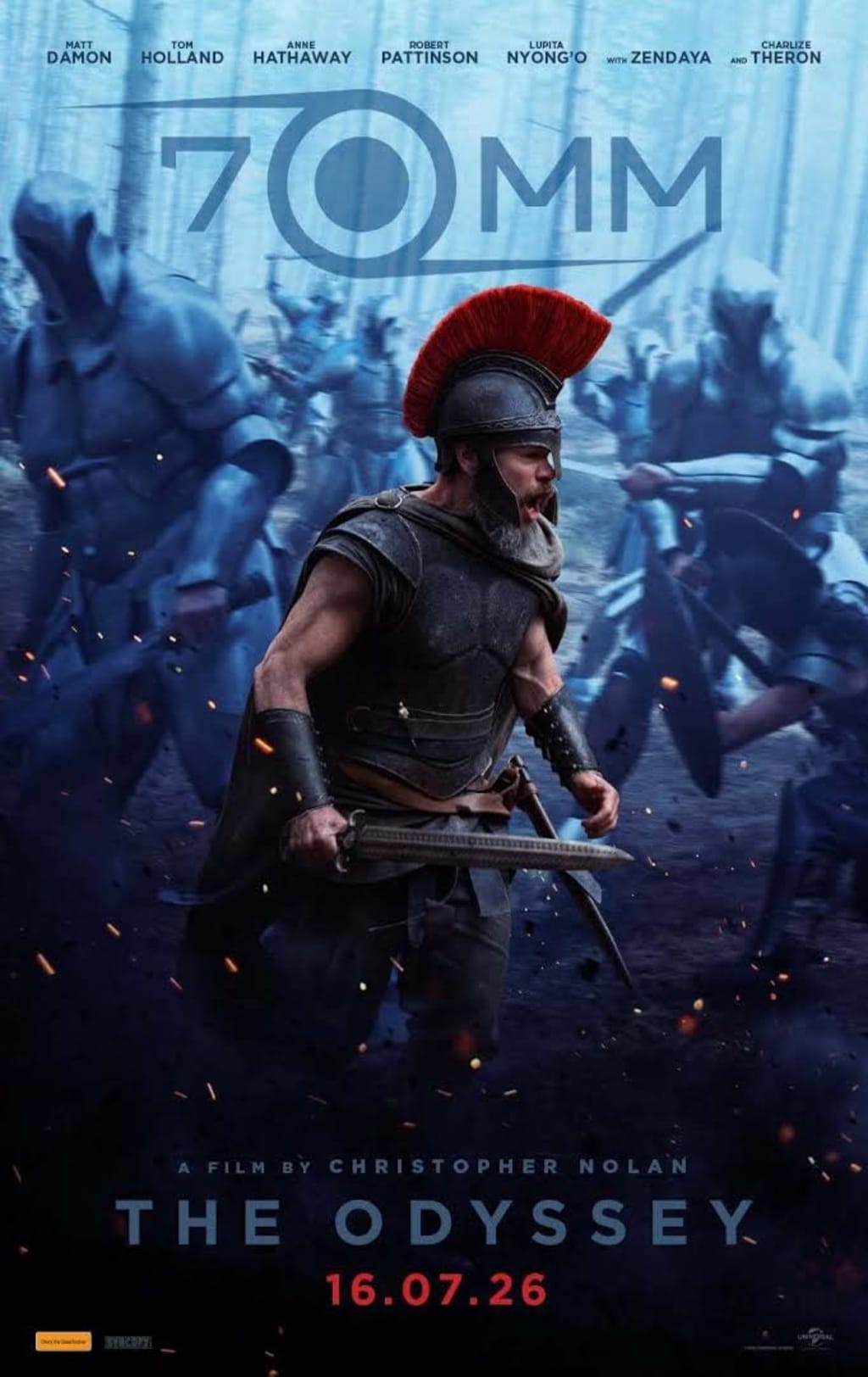
August 2026. Two films appeared on Chinese cinema marquees at the same time.
One was a domestic production, the other a Hollywood import. One was about a Chinese restaurant, the other about ancient Greece. You couldn't find two less related films. But their synopses share the same sentence: a male protagonist leading a team, a story about yearning for home, an anti-war film.
The coincidence wasn't just thematic. Both films had originally aimed for a mid-July release. Welcome to the Dragon Restaurant was delayed by review board issues; Nolan's The Odyssey arrived in China a month later than its global release. They met in the same week of August.
This review focuses on Nolan's film. The coincidence is worth noting for one reason: a three-thousand-year-old Homeric epic and a film about a contemporary Chinese restaurant share the same one-line summary.
This isn't a story about "an epic finally being brought to the screen." Nolan translated Homer's ancient Greek into a language modern audiences can understand. Not word-for-word. Sense-for-sense.
I. The Gods Are Still Here, But Not in Heaven
In Homer's original, the Trojan War was a continuation of the Judgment of Paris. The gods on Olympus reached further than any human general.
Athena descended from the sky, grabbed Achilles by the hair, and told him to hold back. Poseidon raised storms that blew Odysseus's ships off course for a decade. Hermes landed on Circe's island on winged sandals and handed Odysseus a herb that could resist magic. These interventions happened repeatedly and explicitly.
Nolan removed all of them.
Helios didn't appear. Aeolus didn't appear. Hermes didn't appear. The only "god" with a name is Athena, but she appears on screen as the decapitated priestess from Troy: head hanging, a gash across her neck, eyes closed. She recurs in Odysseus's field of vision, silent, watching him.
The gods haven't vanished. They now live inside Odysseus's head.
Calypso's transformation is even more direct. In the original, she's an immortal goddess living in a cave, holding Odysseus for seven years with song and flesh. Nolan shoots her as a woman living on a deserted island, who fishes, dries salt, and hands Odysseus water. She doesn't flirt with him. She asks questions: "Why don't you want to get up?" "What are you hiding from?"
There's no magic on the island. Just one person asking another the questions he refuses to answer.
Nolan said in an interview that to the ancient Greeks, "god" wasn't a metaphor. When they saw lightning, that was Zeus; when they heard thunder, that was Zeus speaking. That wasn't imagination. It was their only framework for explaining the world.
Nolan's film doesn't reject that framework. It just uses it differently. The storm is still a storm. The thunder is still thunder. You just know there's no one behind it giving orders.
II. After the Rules Are Torn Apart
What held ancient Greek society together? One word: Xenia—the guest-host relationship.
In plain terms: if you come to my house, I must host you. If I come to yours, you must host me. The host cannot ask "who are you, where are you from, what do you want" and chase you away; the guest cannot steal from the host, sleep in the host's bed, or insult the host's family. Anyone who violated this rule, Zeus himself would deal with.
This sounds simple, but it wasn't moral preaching. It was survival logic. Ancient Greece was a maritime civilization. City-states scattered along coastlines and islands. Merchant ships, envoys, and wanderers sailing the seas needed supplies and shelter along the way. If every port treated strangers as enemies, maritime trade couldn't function. Civilization would retreat into walled isolation.
Nolan has his characters repeatedly mention "the rules of Zeus." Not as religious faith, but as social contract.
Then he asks a question: what happens when this contract is torn apart?
The Trojan Horse. Odysseus used deception to breach a city. In the original, this is his cunning, his glory (kleos)—a heroic feat worthy of being sung in epics for millennia. But Nolan's camera focuses on something else: streets on fire, old men dragged from windows, children crouching in corners, stone slabs shattered when the statues of gods were toppled.
Homer wouldn't shoot this. He'd write about Achilles's rage, Hector's bravery, the horse being dragged into the city. He wouldn't show you Trojan civilians lying in pools of blood. That doesn't belong in the frame of "heroic narrative."
Nolan showed it. Then he gave Odysseus the next ten years to process what he saw.
III. Sinon: The One the Hero Sacrificed
Sinon doesn't exist in Homer's original. He comes from Virgil's Aeneid—the Greek spy who performed the "feigned desertion" trick and convinced the Trojans to drag the horse into their city.
Nolan borrowed him, then reversed the character entirely.
In the film, Sinon never deceives anyone. He's the one deceived.
Conscription was by lot. Antinous approached Sinon to swap lots, saying he didn't want to go, promising to take care of Sinon's father. Sinon believed him. He went to Troy. Later, his father died. Antinous didn't keep his promise.
The wooden horse was worse. Sinon heard from others that Odysseus had known the full plan all along. Sinon himself would have been the most willing to carry out the beach watch duty, even knowing the horse would burn the city to the ground. But Odysseus never told him. Kept him in the dark. Used him, but never let him know what he was used for.
In the underworld scene, Sinon walks over and returns a conscription lot to Antinous. His father is already dead. This is the lot Antinous took from him.
Then he turns to look at Odysseus.
No fighting. No shouting. None of the heroic roars from Homer appear here. Sinon asks a question, then leaves. Odysseus stands there, silent.
Why does this character matter? Because he's the cost in human form.
Odysseus wants to go home, to reclaim his throne, to be a hero again. But Sinon's presence asks: for all of this, who did you leave behind on the road?
That person isn't even an enemy. He's one of your own. The one who trusted you most. A hero's glory is built on double deception: deceiving the Trojans, and deceiving your own men.
Nolan doesn't let Odysseus answer Sinon's question. He leaves Odysseus in silence. That silence lasts for the entire second half of the film.
IV. War Turns Everyone into Monsters
Odysseus's first enemies on his journey home are the Cyclopes. In the original, the giants live in caves, eat people, and are blinded by Odysseus's "Nobody" trick.
Nolan changed it.
He shoots a group of giant warriors in silver armor, using vines and tree trunks they control to trap Odysseus's men in the dense forest, then slaughter them. Those armored warriors move slowly, heavily, like something inhuman. But look closely: their gait, the way they raise their swords, the hesitation when they step over bodies. They're human.
Then the shot cuts to another group in armor: Greek warriors.
Same armor. Same movements. Same landing, same city-burning, same slaughter.
Nolan shows you both sides of the same action.
The Cyclopes aren't monsters. They're Greeks in armor. They're called monsters only because they stand on the other side. The Greeks in the same armor are called heroes.
The Circe scene is even more direct.
In the original, she's a witch who uses magic to turn Odysseus's men into pigs. Odysseus uses Hermes's herb to break the spell, conquers the witch, and leaves.
Nolan removes the herb, removes Hermes. Circe sits there, listens to Odysseus's accusation, and says one line:
"I didn't turn your men into anything. That's what they already were."
Those soldiers who pillaged and burned in Troy, who raped and plundered in every village along the way—the beast was already inside them. War just stripped off civilization's clothes. Circe didn't cast a spell. She just took the clothes away and let them see what was underneath.
Civilization isn't armor, city-states, or laws. It's that thin layer of "guest-host friendship"—the host treats the guest well, the guest respects the host. Once that contract is no longer honored, once people solve everything with violence, civilization vanishes. What's left is an animal in armor.
The Cyclopes and the Greek warriors wear the same armor. Circe didn't turn anyone into a pig. She just stopped helping them pretend to be human.
V. The Veteran Stays Because He Can't Face Home
In the original, Odysseus spends seven years on Calypso's island. Homer's explanation: the goddess fell in love with him, seduced him with song and immortality, and he was forced to stay, though his heart was always set on home.
Nolan completely reverses this.
Calypso in the film holds no seduction for Odysseus. She's the island's only resident, living by the sea, drying salt, mending fishing nets. She keeps asking Odysseus: "Why don't you go home?" "What are you hiding from?"
Odysseus eats the lotus. In the original, the lotus was a separate episode—a fruit that makes you forget your desire to return home. Nolan merges it into Calypso's island: she hands him the lotus leaves, helps him forget parts of his memory, eases his nightmares.
Homer's Odysseus is detained against his will. Nolan's Odysseus actively refuses to leave.
He saw Troy fall in its entirety. He went to the underworld and saw the dead soldiers—Greeks and Trojans alike—looking at him, not saying hatred, but not saying forgiveness either.
He doesn't know how to go back and face Penelope. Doesn't know how to say "I won, but what I did—I can't explain it to you."
Calypso asks: "Why have you never once actively thought of your wife?"
He has no answer.
Nolan shows what ancient Greece didn't write: what goes on in a veteran's head after ten years of war, a sacked city, and countless dead brothers.
What he's thinking is: I don't deserve to go home.
VI. Helen Rewritten, Penelope Seen
Nolan cast Lupita Nyong'o as Helen. Black. Scarred on the face. She bears no resemblance to "the most beautiful woman in the world."
A whole army besieged Troy for ten years, countless dead, all because Helen was taken by Paris. Nolan lets Helen say it herself: "I was an excuse."
The film's dialogue makes it clear: the root cause of the Trojan War was the struggle for control of maritime trade. Helen was just the pretext put on display. Nolan dismantles the "beauty as disaster" narrative that's run for thousands of years.
He offended a lot of people. But box office didn't suffer, and international reception didn't collapse.
Penelope's transformation is worth a closer look.
In the original, she's a waiter—weaving, stalling the suitors, believing Odysseus will return. The standard template of the "faithful wife."
Nolan gives her a line, delivered through a curtain, to the man she hasn't yet recognized as Odysseus:
"My knowledge, my experience—all less valuable than the few wisps of beard you've just grown. And all because only men can sit on that seat. An empty throne."
She spent twenty years holding Ithaca together alone, facing over a hundred suitors who occupied her house and threatened her, using weaving to stall, using cunning to maneuver. She stopped waiting long ago. She's been ruling.
Odysseus listens on the other side of the curtain. Silent.
He left a wife. He returns to face a queen who carried the crown alone for twenty years.
VII. IMAX for Intimate Moments: Nolan's Obsession
This film is the first narrative feature ever shot entirely on IMAX film.
IMAX film has absurd resolution, an aspect ratio close to square, capable of framing the entire sky and the entire sea at once. But the cost is enormous: the camera weighs like a cannon, the noise is so loud you can't record sync sound, and each magazine holds only three minutes.
Nolan used to save IMAX for spectacle: bombing runs, explosions, city inversions. This time he carried that cannon everywhere—to shoot conversations on islands, silences in ship cabins, Odysseus sitting alone on a reef saying nothing.
Why?
Because the image quality of that machine has weight. When waves, wind, clouds, and faces are captured at a resolution where "every single hair is visible," the audience's attention is anchored in the present moment. You're not watching a symbolic homeward journey. You're watching a man's facial muscle twitch, his fingers clench and release, his eyes look out to sea and look away.
IMAX doesn't serve spectacle. Nolan uses it to shoot pores and glances.
The narrative structure also retains the Odyssey's own nonlinearity. Homer's epic doesn't follow chronological order—Odysseus arrives at the palace of the Phaeacians and tells the king and queen the story of his wanderings. That's a story within a story, a flashback within a flashback.
Nolan said in an interview: "For years I've been sitting in hotel rooms telling people about the non-linear structures in my films as if they were so radical. Then I go back to the oldest literary classic and find that it was written that way all along."
The conscription lot scene: the version Antinous tells and the version Sinon later reveals are completely contradictory. The audience doesn't realize until the second half that the earlier "truth" was false. What cinema does is deceive you once, then let you discover the deception yourself. That discovery hits harder than being told the truth outright.
VIII. What Is the Thunder?
Odysseus returns to Ithaca and stands in the courtyard. Over a hundred suitors surround him.
The weather is bad. Clouds hang low. Wind blows in from the sea. No one makes a move. Then the thunder starts.
One crack after another, growing denser. The men who had their swords drawn kneel, one by one. No one orders them to kneel. They kneel on their own.
The film doesn't explain whether the thunder is Zeus. Nolan doesn't give an answer in any subsequent line.
Order is restored. Penelope walks over. Odysseus stands there, looking at her face.
The film doesn't teach a lesson. It places one question in front of you: What was that thunder?
Some believe it was Zeus, the god's acknowledgment of restored order. Others believe it was the voice in Odysseus's head—the decapitated priestess finally looking away from him.
Both readings work. Nolan doesn't deny the existence of gods. He pulls them down from the sky into the human heart. The divine is no longer an external arbiter of fate. It's whether a person can face what they've done.
Odysseus can go home because he can finally stand in front of his wife and meet her eyes.
After The Odyssey opened, someone counted the expressions of audiences leaving the theater. Most walked out in silence. Not much chatting.
This isn't an exciting film. It doesn't give you that rush of wanting to yell "that was incredible!" It leaves you thinking about something personal: have I ever done something that makes me not quite want to go home and face it?
Nolan took a three-thousand-year-old epic and turned it into the story of a modern man hiding in his garage, smoking half a pack of cigarettes before he can work up the nerve to go upstairs and open the door.
He swapped the "garage" for an island, the "half a pack" for the lotus, and "opening the door" for wading ashore through the surf.
That last thunderclap—who made it? Zeus made it. Odysseus made it. Nolan made it.
All three. All correct.
About the Creator
Jin
Writer of reamstories
https://reamstories.com/jin
Enjoyed the story? Support the Creator.
Subscribe for free to receive all their stories in your feed. You could also become a paid subscriber, letting them know you appreciate their work.
Comments
There are no comments for this story
Be the first to respond and start the conversation.