
What Did Linda Moulton Howe Discover About What Lies Beneath Antarctica?
Military whistleblowers have described enormous structures, strange symbols, unexplained warmth and possible non-human technology beneath the Antarctic ice, although their extraordinary accounts remain unverified
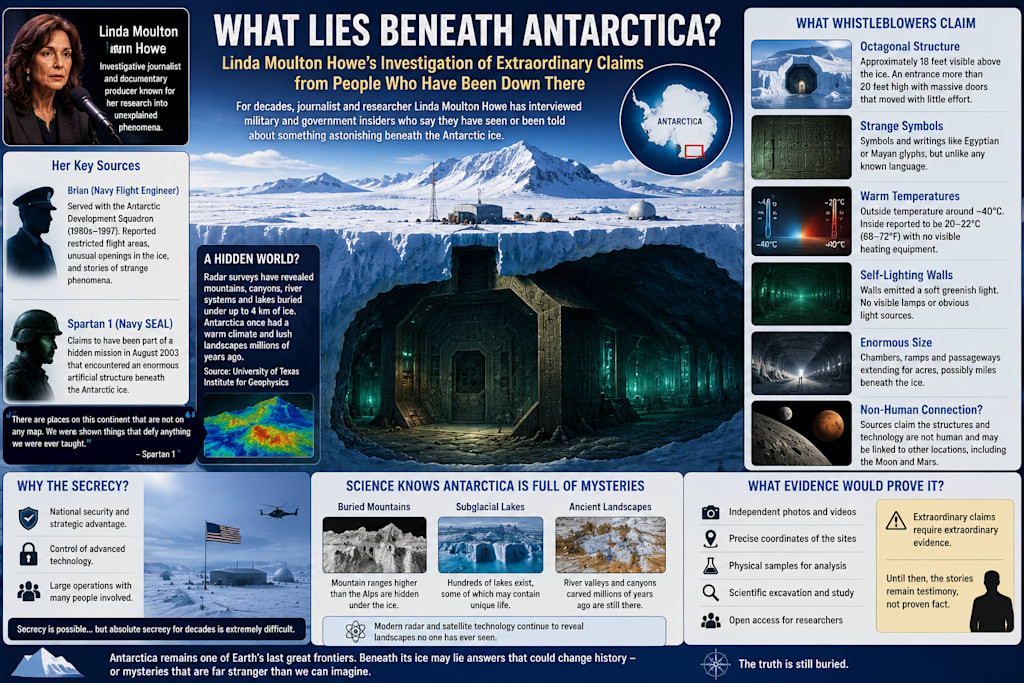
Antarctica is one of the most mysterious places remaining on Earth, partly because almost everything interesting about the continent is concealed beneath an enormous covering of ice. In some regions that ice is several kilometres thick, hiding mountain ranges, valleys, lakes, ancient river systems and landscapes that existed millions of years before Antarctica became the frozen continent we recognise today. Scientists using ice-penetrating radar have genuinely discovered remarkably preserved landscapes beneath the ice, demonstrating that Antarctica contains an enormous hidden world that cannot normally be seen from its surface.
Journalist and documentary producer Linda Moulton Howe has spent many years investigating considerably more extraordinary claims about what might exist beneath that ice. Her reports are based primarily upon people claiming military, intelligence or scientific connections who say they personally encountered unusual structures or learned about secret operations in Antarctica. The key distinction throughout this story is that these accounts are testimony rather than independently verified archaeological discoveries, meaning the extraordinary claims should be examined without automatically treating them as established facts.
The Navy Flight Engineer Called Brian
One of Howe's important Antarctic sources was a retired United States Navy flight engineer whom she identified publicly only as Brian. According to Howe, he served with the Antarctic Development Squadron and participated in numerous missions involving McMurdo Station and other parts of the continent between approximately 1983 and his retirement in 1997.
Brian reportedly described flights over regions where crews encountered things they could not readily explain, including an unusual opening within the ice and restrictions concerning where aircraft were permitted to fly. He also related stories circulating among personnel concerning scientists who had encountered unexplained phenomena in remote Antarctic locations, although such second-hand information obviously provides much weaker evidence than something personally witnessed and documented.
These reports encouraged Howe to investigate whether military personnel working in Antarctica knew about locations that were not simply ordinary scientific research sites. Her later interviews produced claims considerably more dramatic than Brian's original account.
The Whistleblower Known as Spartan 1
During 2018, Howe interviewed a retired United States Navy SEAL whom she identified under the pseudonym "Spartan 1". His face was obscured and his voice altered because he reportedly wished to protect his identity while describing what he claimed had occurred during a classified mission.
According to Howe's “Earthfiles” account, Spartan 1 said that during August 2003 he participated in a special operations mission involving enormous structures beneath Antarctic ice. Howe subsequently produced a documentary called Antarctica: Alien Secrets Beneath the Ice, presenting his testimony and that of another source identified as Spartan 2. Spartan 1's story provides the most extraordinary part of Howe's Antarctic investigation.
An Octagonal Structure Emerging from the Ice
According to Spartan 1, his team encountered the upper portion of an enormous octagonal structure protruding from the Antarctic ice. He described approximately eighteen feet of the structure being visible while considerably more remained buried beneath the surface.
The team reportedly approached an enormous doorway measuring more than twenty feet high, while the doors themselves were described as extraordinarily thick. Despite their apparent weight and dimensions, Spartan 1 claimed that they could be moved with remarkably little effort, almost as though some unknown mechanism perfectly balanced them.
This immediately raised the question of who could have constructed such an enormous building in Antarctica. The structure described by Spartan 1 would have been difficult to reconcile with any known conventional Antarctic construction project, particularly if it had genuinely been buried beneath ancient ice.
Strange Symbols Covered the Interior
Spartan 1 claimed that unusual symbols appeared upon the structure, including markings around its entrance and along internal walls. He compared some of the interior writing with Egyptian hieroglyphics or Mayan glyphs, although he reportedly considered them different from either known writing system.
According to Howe's later account, Spartan 2 claimed that similar symbols had connections with material supposedly encountered elsewhere, including the Moon and Mars. These claims move far beyond anything demonstrated by conventional archaeology, because no independently authenticated evidence currently establishes a common artificial writing system linking Antarctica, Mars and the Moon.
The symbols nevertheless form an important part of the testimony because they suggest that Spartan 1 believed he had entered an artificial construction rather than a strange natural geological formation.
The Building Was Warm Inside
Perhaps one of the strangest details concerned the temperature. Spartan 1 reportedly described the outside temperature as about 40 degrees below zero, while temperatures inside the structure remained between about 68 and 72 degrees Fahrenheit, equivalent to roughly 20 to 22 degrees Celsius.
Such comfortable temperatures would obviously require an extraordinary energy source if a vast building really existed beneath Antarctic ice. Spartan 1 reportedly could not identify any conventional heating equipment capable of maintaining the environment.
The temperature therefore became part of the mystery surrounding the supposed installation. If the account were accurate, either somebody was actively maintaining the structure or technology incorporated into the building itself was producing heat.
The Walls Apparently Produced Their Own Light
The illumination described inside the structure was equally unusual because Spartan 1 reportedly could not identify conventional lamps or other obvious light sources. Instead, the walls appeared to produce a soft greenish illumination that allowed the team to see the enormous internal spaces.
Howe's accounts describe long passages or halls with this unusual light, along with unexplained symbols covering their surfaces. Her “Earthfiles” biography summarises Spartan 1's testimony as involving long glowing green halls containing mysterious hieroglyph-like markings.
If independently verified, self-illuminating architectural surfaces inside an ancient Antarctic structure would obviously represent an extraordinary technological discovery. No independently examined physical samples, photographs or archaeological documentation have been made publicly available that establish such a discovery.
The Structure Was Allegedly Enormous
The scale described by Spartan 1 becomes even more remarkable because the visible entrance supposedly represented only a small part of the complete construction. Accounts based upon his testimony describe an initial chamber covering several acres, with ramps continuing farther down into an installation supposedly extending across dozens of acres beneath the ice.
Spartan 1 reportedly understood that the building he entered was not necessarily unique. Other large structures were allegedly located within the surrounding region, suggesting an extensive complex rather than one isolated building.
Some later versions of these claims describe structures extending miles beneath the ice, although the reported measurements vary between different retellings. That inconsistency provides another reason to separate Howe's documented interviews from increasingly elaborate versions circulating across videos and websites.
Who Could Have Built Something So Large?
This question lies at the centre of Howe's investigation because Antarctica has been covered by substantial ice for millions of years. If a genuinely artificial structure were demonstrated to exist beneath ancient undisturbed ice, determining when it was constructed would immediately become one of archaeology's greatest questions.
Howe has raised the possibility that such structures could predate conventional human civilisation by an enormous period. Her “Earthfiles” material explicitly asks whether structures beneath deeply accumulated Antarctic ice might be tens of millions of years old.
This reasoning requires considerable caution because discovering something beneath old ice does not automatically demonstrate that the object predates the ice above it. Geological processes, ice movement, later access routes and uncertainties concerning exactly where something sits within the ice would all need investigation before determining its age. Proper archaeological dating would require independently documented samples and geological context rather than testimony alone.
The Extraterrestrial Interpretation
Howe's investigation eventually goes far beyond suggesting an unknown ancient human civilisation. Spartan 1 and Spartan 2 reportedly told her that the structures were associated with non-human intelligences and technology extending beyond Antarctica.
Howe's own “Earthfiles” description says that Spartan 1 characterised the architecture as alien and described an alleged extraterrestrial presence connected with other locations. Her biography also records claims from the two sources about non-human humanoids and alleged activity elsewhere in the Solar System.
These are extraordinary claims requiring correspondingly strong evidence. Anonymous testimony can justify asking questions and investigating further, although it cannot by itself demonstrate that extraterrestrial beings constructed Antarctic buildings.
Why Would Governments Keep Such a Discovery Secret?
Another element that appears throughout these accounts is secrecy. If governments discovered technology belonging to an unknown civilisation, especially technology involving energy, propulsion or materials far beyond existing capabilities, there would certainly be powerful national-security reasons for restricting access while the discovery was investigated.
That possibility makes the secrecy argument initially plausible, although it creates a problem that frequently accompanies conspiracy theories. The absence of public evidence can then become interpreted as evidence that the secrecy programme is working, making the claim extremely difficult to test scientifically.
A genuinely enormous multinational operation lasting decades would also involve large numbers of pilots, scientists, engineers, technicians, logistics personnel and government officials. Maintaining complete secrecy becomes increasingly difficult as the number of participants and years involved continues increasing.
Antarctica Really Does Contain Hidden Landscapes
Separating established science from the whistleblower claims makes the story more interesting, not less. Scientists already know that extraordinary things exist underneath Antarctica, although those discoveries involve geology rather than confirmed alien architecture.
Researchers have identified buried mountain ranges, enormous canyon systems, hundreds of subglacial lakes and ancient landscapes hidden beneath kilometres of ice. A major study revealed a preserved landscape of valleys and ridges covering approximately 32,000 square kilometres beneath East Antarctica, apparently created by rivers before the region became permanently ice-covered.
Researchers involved with that work have pointed out that humanity knows surprisingly little about the land beneath Antarctica's ice. Ice-penetrating radar continues to reveal geographical features that have remained invisible for millions of years, meaning substantial discoveries undoubtedly remain possible.
Antarctica Was Once Completely Different
Antarctica was not always the frozen wilderness we recognise today. During much earlier geological periods, its climate was considerably warmer and vegetation existed across parts of the continent.
Eventually changing atmospheric conditions, continental positions and ocean circulation contributed to major cooling, allowing enormous ice sheets to develop. Landscapes containing rivers and valleys consequently became buried beneath accumulating ice and preserved for millions of years.
This genuine geological history inevitably raises fascinating questions about what might remain underneath the continent. Fossils, ancient ecosystems and geological records certainly exist there, while evidence for artificial prehistoric cities or advanced technological civilisations has not presently been established.
Could Structures Really Remain Preserved Beneath the Ice?
Ice can preserve extraordinary things because freezing conditions slow many forms of decomposition. Archaeologists have recovered remarkably preserved human remains and artefacts from glaciers elsewhere in the world, demonstrating that frozen environments can operate as enormous natural time capsules.
Antarctica presents a considerably more complicated environment because enormous ice sheets move under their own weight. Moving ice can crush, scrape and reshape underlying landscapes, although researchers have discovered regions where ancient terrain has survived surprisingly intact.
Consequently, the general proposition that something ancient could remain preserved beneath Antarctic ice is scientifically reasonable. The separate proposition that enormous technologically advanced buildings actually exist there requires evidence that has not yet been publicly verified.
What Evidence Would Prove the Story?
Confirming Spartan 1's account would not necessarily require scientists to accept an extraterrestrial explanation immediately. Researchers would first need reliable geographical coordinates followed by independent radar surveys showing geometric structures inconsistent with natural geology.
Photographs and continuous video from independently identifiable expeditions would provide additional evidence, while several unrelated laboratories could analyse material samples. Archaeologists and geologists could determine whether construction materials were artificial, while dating techniques might establish when the structures appeared.
Writing or symbols would become particularly important because linguists could study genuine inscriptions and compare them with known ancient scripts. Repeated symbols arranged according to consistent grammatical patterns would provide much stronger evidence of intelligent construction than photographs containing ambiguous markings. Eventually, independent scientific teams would need access to the site.
The Biggest Problem Remains Verification
Linda Moulton Howe can accurately report what somebody told her without the underlying account necessarily being accurate. The credibility of the Antarctic story therefore ultimately depends upon the credibility and evidence supplied by her sources.
Spartan 1's hidden identity creates an unavoidable difficulty because independent researchers cannot readily verify his service history, mission records or presence at the claimed location. The absence of publicly authenticated photographs, physical artefacts and independently verified coordinates makes the central claims impossible to establish scientifically from the currently available evidence.
Sceptical investigators have also criticised Howe's approach to anonymous sources and the lack of independent verification accompanying some of these extraordinary claims. That criticism does not prove every source was lying, but it highlights why testimony should remain testimony until supporting evidence appears.
What Did Linda Moulton Howe Actually Find?
Strictly speaking, Howe herself did not travel beneath the Antarctic ice and discover an alien complex. What she found was a collection of people claiming military or government backgrounds who told her extraordinary stories about what they said they had personally witnessed or learned during Antarctic operations.
The most important account came from Spartan 1, who claimed to have entered an enormous octagonal structure containing unusually movable doors, comfortable internal temperatures, unexplained green illumination and unfamiliar symbols. Other testimony supplied to Howe expanded the story to include alleged underground installations, restricted areas, unusual aircraft activity, and possible non-human involvement.
None of this currently proves that an extraterrestrial civilisation exists beneath Antarctica. Neither does the absence of proof establish precisely what motivated every witness who approached Howe.
The most interesting conclusion may therefore be considerably simpler. Antarctica unquestionably conceals an enormous unexplored world beneath its ice, and modern radar continues discovering landscapes that humanity has never directly seen. Somewhere between those genuine scientific discoveries and Linda Moulton Howe's extraordinary whistleblower accounts lies a mystery that would require physical evidence, not testimony, to resolve.
Until somebody produces independently verifiable photographs, samples, coordinates or archaeological evidence, the alleged structures beneath Antarctica remain an extraordinary story rather than an established discovery. If even a small part of the most remarkable testimony were eventually demonstrated to be genuine, however, Antarctica would instantly become the location of one of the most important archaeological discoveries in human history.
About the Creator
Alan Spencer
Have been an author and writer for over 20 years. Have been a journalist, editor, proofreader, and a designer and presenter of training courses. Have written over 100 articles, two books, and around 20 training courses.
Enjoyed the story? Support the Creator.
Subscribe for free to receive all their stories in your feed. You could also become a paid subscriber, letting them know you appreciate their work.
Comments
There are no comments for this story
Be the first to respond and start the conversation.