
The Unseen Grave
Honkai Impact 3rd taught me that the deepest love isn't always the one that gets seen.
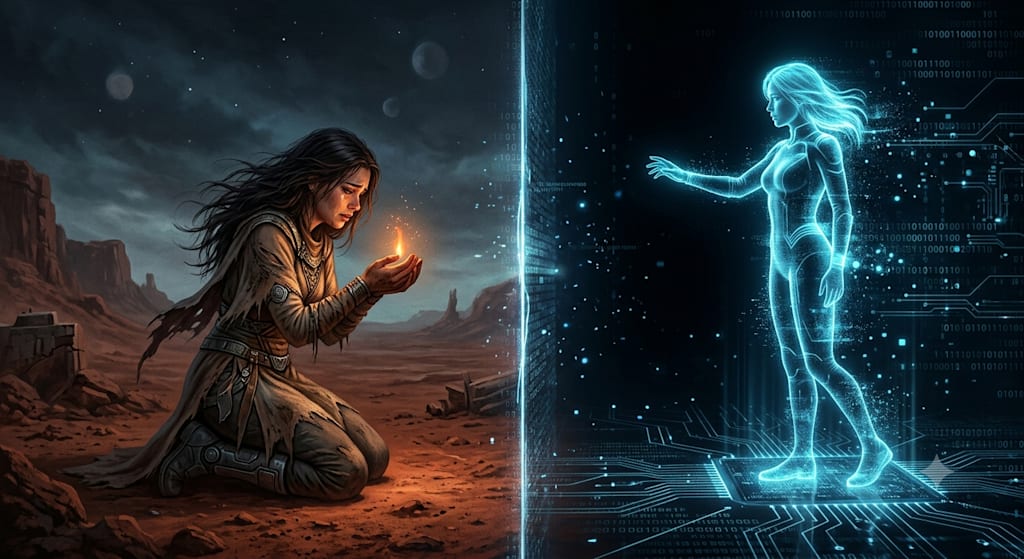
After finishing the game, I didn't close it right away. The screen froze on the final frame of Mars's data layer. The cursor flickered on and off, like the last heartbeat of someone taking their final breath. I stared at it for a long time. I couldn't remember the last time a "happy ending" had left me speechless.
Helia and Coralie completed their mission. Vita cracked her jokes and, when it counted, pulled her weight. Mars survived. The Shadow monsters were purged. The quantum computer shut down. Everything came full circle. By all rights, I should have felt relieved.
But my finger wouldn't press the exit button.
I thought of that Senadina inside the computer. To the very end, she believed Leila's obsession avatar was tormenting her. She looked at that mad, stubborn, unyielding shadow and thought, with regret: how did that child turn out like this? She stared at something that wasn't really Leila, with pity and disappointment, and she never once looked back.
Outside that door, in the real world, the true Leila had long since torn herself in two. Half went mad inside the data layer. Half stood on the ruins of reality, stabilizing the "Shadows" without pause, repeating the same motion for years beyond counting. Her hands shook so badly she could barely steady the console. The system logs read nothing but "stabilization complete" on every single line.
Senadina died believing Leila had "gone wrong." She faded with that judgment. The real Leila was never seen by her.
Leila never turned bad.
That's probably what hurts most about this whole story. She was a good girl from start to finish, crushed into a different shape by the weight of divine duty.
The Senadina of history gave her life to save Mars. That was a god doing what a god should do. But Leila wanted to bring Senadina back. That was a mortal trying to do what no mortal should. The writers did something cruel here. To keep Mars running after Senadina's death, Leila had to rip herself apart. She peeled away every soft, warm, unwilling part of herself and stuffed it into the quantum computer, turning it into that "obsession avatar" we chased down. Her real body stayed outside, wrapped in the shell of a "god," doing one thing day after day: stabilizing the Shadows.
It wasn't that she didn't want to become the "proper god" Senadina had hoped for. It was that, apart from the one goal of not letting Senadina's legacy rot completely, she had no strength left to become anything else.
That mad shadow chasing Senadina inside the computer was Leila's discarded humanity. The expressionless shell outside, holding the line till the final moment, was the armor Leila built for herself. Armor can't have feelings. With feelings, it would break. That's why we saw her crying, shouting, begging Senadina to turn around in the data layer. But the real Leila in reality, the true Leila, was never once seen by us.
One girl lived as two people. One went mad, one held on. Neither was the whole of her. Both were her.
Senadina was looking in the wrong direction.
This is the passage that took my breath away.
Inside the data layer, Senadina saw Leila in that obsession avatar. She looked closely, closely enough to become disappointed. To her very last moment, she wondered: why did that once‑innocent child become a monster of obsession? She regretted that Leila hadn't become a worthy successor.
But she didn't know. She would never know.
Just beyond the direction she was looking, the real Leila was using her two hands, her body, her life, doing in reality exactly what Senadina had done back then. Senadina saved Mars once, in the way of a god. Leila saved it the way a mortal would, clumsily, repetitively, with no grace at all, dragging Mars through the ages by sheer endurance. Senadina was the one who lit the torch. Leila was the one who, after the fire went out, crouched beside the ashes and kept the last ember warm with her own body heat.
The former is an epic. The latter is something no one saw, something that happened every single day, something that could never be spoken aloud.
Senadina faded with the regret that "this child ultimately let me down." Leila exhausted everything and still couldn't make Senadina see what she had done. One person who longed to be seen, facing another who looked in the wrong direction till the very end.
This hurts more than simple "I love you but you don't love me." What was misunderstood was never love: it was the sacrifice.
The narrative maze of Part 2, now I understand what it really was.
Following it was painful. One patch in the data layer, the next in reality, the next jumping back centuries. Flashbacks, interleaving, nesting, every update required ten minutes just to remember what happened before.
But looking back now, that chaos was itself a design choice. The player and the Dreamseeker shared the same state: no god's‑eye view, only fragments to salvage. Today we pick up one piece, tomorrow another, and only at the end do we realize that all those pieces were Leila's worn‑down memories, her memory ground to dust by millions of years of repetitive labor, scattered everywhere. What we picked up along the way were the pieces of herself she kept losing over that endless stretch of time.
That's why the narrative had to be fragmented. Because the one who remembered had long since shattered.
It did sacrifice reading comfort during the serialization. But once the dust settled and those fragments clicked together perfectly, the shock of "so that's how it all connects" had more staying power than any linear story. Because you weren't told a story, you pieced together a person's broken life, one shard at a time, with your own hands.
The ending gave everyone closure except for the two of them.
On the physical level, the Earth team won. Mars survived. That was the resolution for the masses.
On the emotional level, Leila and Senadina were left forever in a place where they could not see each other. Senadina never saw what Leila had done. Leila never made Senadina understand why she did it. Both gave everything. Neither achieved that one wish: to be seen by the other.
This is about doing everything you could and still being unknown. This kind of regret is heavier than tragedy. Tragedy at least lets us see the ending. This regret gives us the truth, but the people in the story die without ever knowing it.
Leila spent a lifetime wanting Senadina to turn around and look at her. Senadina, before she faded, wanted to see Leila grow up properly. In the end, they both carried the version of themselves the other had never seen, separated by the boundary between data and reality, vanishing on their own.
Some loves, even if you spend an entire era on them, can't buy you one accurate gaze.
After closing the game, I sat for a long time.
The monitor went dark, reflecting my own face. I thought of that Senadina inside the computer, staring in the wrong direction to her very last moment, and of that Leila in reality, stabilizing the Shadows alone till the very end.
The game gave Mars a happy ending. But those two didn't get one.
After this "Journey to the Star of Luo," what I remember isn't the victory, the team fights, or the dazzling battle sequences. I remember a person who was never properly looked at, and another who looked in the wrong direction until she died.
What stood between them was more than the distance between data layer and reality. It was a gap that could never close, a gap of "you did so much, but I'll never have the chance to know."
Mars was saved.
But that lonely grave – no one ever saw it from the start.
About the Creator
Jin
Writer of reamstories
https://reamstories.com/jin
Enjoyed the story? Support the Creator.
Subscribe for free to receive all their stories in your feed. You could also become a paid subscriber, letting them know you appreciate their work.
Comments
There are no comments for this story
Be the first to respond and start the conversation.