
The Self-Organizing Mind
How to Automate Your Learning Workflows with AI

We live in an era of digital hoarding. Most of us have dozens of open tabs, bookmarked articles, saved PDFs, and pocketed videos that we fully intend to read "one day." But as the sheer volume of data grows, our ability to actually process, synthesize, and remember it starts to break down.
For both individuals and teams, traditional knowledge management has become a bottleneck. We spend more time collecting information than we do actually understanding it.
To solve this, I’ve been exploring how to build an automated, scalable knowledge base—one that doesn't just sit there collecting digital dust, but actively organizes, synthesizes, and evolves over time. By taking a page out of biology's playbook, we can use AI to build a learning system that adapts to new information almost like a living organism.
Here is a practical look at how to set up an automated learning workflow.
The Vision: A Self-Sustaining Knowledge Loop
When we think of a knowledge base, we usually picture a static wiki or a Notion workspace that requires constant manual updates. If you stop updating it for a week, it becomes outdated.
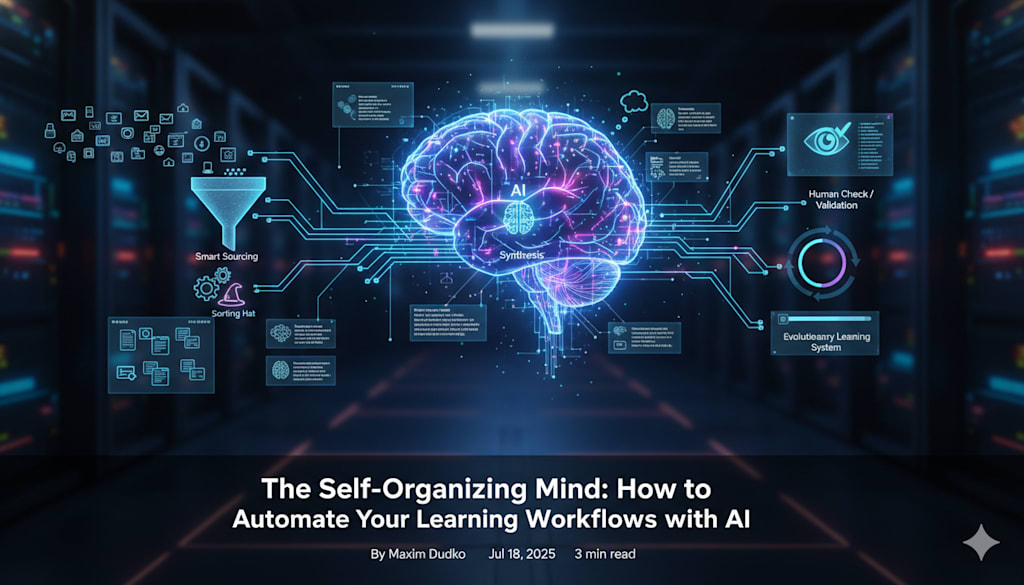
An automated learning workflow flips this dynamic. Instead of relying on manual data entry, the system uses a feedback loop to gather, structure, and refine knowledge with minimal human oversight. The goal is to build a pipeline that handles the administrative heavy lifting so you can focus on high-level comprehension.
To make this happen, a successful workflow needs a few core pillars:
1. Smart Sourcing (The Inputs)
First, you need a way to feed the system. Manually copying and pasting articles is a friction point that will eventually make you quit. By setting up web scrapers, API integrations, or RSS feeds, you can automatically channel relevant research, news, and technical documentation from trusted sources directly into your database.
2. The Sorting Hat (Data Organization)
Raw data is just noise. To make it useful, the incoming text needs structure. By using simple entity recognition and topic modeling, the system can automatically tag, categorize, and link new articles to existing themes in your library.
3. Synthesis (Turning Data into Insight)
This is where AI does the heavy lifting. Instead of forcing you to read a 50-page paper to see if it’s relevant, AI models can generate highly accurate summaries, identify key takeaways, and—most importantly—cross-reference the new paper with documents you already have in your database.
4. The Human Check (Validation)
AI isn't infallible; hallucinations and misinterpretations are real risks. A reliable system must include a quick validation step. Whether it’s flagging questionable claims for manual review or letting users vote on the accuracy of a generated summary, human feedback is the anchor that keeps the knowledge base accurate.
Embracing the "Evolutionary" Approach
One of the most fascinating concepts in modern AI implementation is the Evolutionary Learning System (ELS).
In nature, systems adapt through variation, selection, and inheritance. We can apply these exact principles to our knowledge management. For example, when organizing a complex topic, you can prompt different AI models to draft summaries using various perspectives (variation). You then assess which style is the most readable and accurate (selection), and use that successful framework to generate future summaries (inheritance).
Over time, your system literally learns how you prefer to learn, refining its outputs to be increasingly useful.
To get a feel for this without writing complex code, tools like NotebookLM are incredibly valuable. It acts as an accessible starting point, letting you upload a massive cluster of source documents, notes, and datasets, and then using local context to synthesize, answer questions, and trace insights back to their exact source. It’s an excellent sandbox for seeing how a smart, localized knowledge base behaves.
Three Practical Steps to Start Automating
If you want to transition from passive bookmarker to active system builder, here is how I recommend starting:
Start incredibly small: Don’t try to index the entire internet or your whole industry on day one. Pick a highly specific niche—like "developments in local AI models" or "recipes for a specific dietary style." Master the pipeline on a small scale before expanding.
Build an active feedback loop: If you are sharing this knowledge base with a team, make it easy for users to flag inaccuracies, edit summaries, or add context. A collaborative system naturally filters out noise.
Automate your updates gently: Use webhooks or simple automation tools (like Zapier or Make) to pull in new data from one or two trusted newsletters or sites. Keep the incoming stream slow and high-quality.
Final Thoughts
Building a scalable knowledge base isn't about replacing human curiosity; it’s about clearing away the cognitive clutter. By letting AI handle the collecting, sorting, and initial summarizing, we free up our minds to do what they do best: think critically, make creative connections, and apply knowledge to real-world problems.
Automation doesn't happen overnight, but once you build a system that grows alongside your interests, you'll wonder how you ever managed information without it.
About the Creator
Maxim Dudko
My perspective is Maximism: ensuring complexity's long-term survival vs. cosmic threats like Heat Death. It's about persistence against entropy, leveraging knowledge, energy, consciousness to unlock potential & overcome challenges. Join me.
Enjoyed the story? Support the Creator.
Subscribe for free to receive all their stories in your feed.
Comments
There are no comments for this story
Be the first to respond and start the conversation.