
The Screen in the Living Room Is Waiting for Someone Who Won’t Treat It as a Billboard
Startup ads, nested memberships, and four remotes did not kill the big screen. A business model did.
The Screen in the Living Room Is Waiting for Someone Who Won’t Treat It as a Billboard
At eight in the evening, the TV turns on.
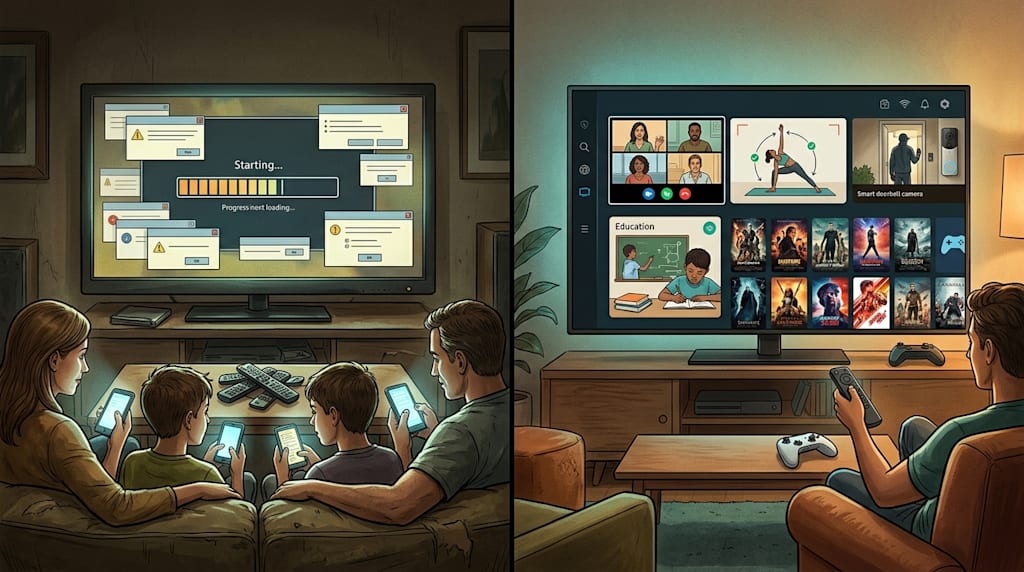
The startup ad has 12 seconds left. The old man holds two remotes, presses a few buttons, and the screen does not move. The young man gets up from the sofa and tries to cast his phone to the TV. A message appears: “This content does not support casting.” The child leans in, taps a cartoon, and a pop-up appears: “Open Kids Membership, first month ¥19.” The old man puts the remote down and says, “Forget it. I won’t watch.”
The TV stays on. The screen keeps glowing, and another ad replaces the first. In the living room, phone screens light up every face.
The TV is still on. It is a billboard.
The phone did not beat the TV. The TV beat itself.
The phone opens and works. The TV opens with an ad. The phone lets you tap what you want. The TV hides content behind memberships. The big screen still wins for movies, sports, games, and fitness. The problem is the cost to start.
Ad. Homepage. App. Membership. Another membership. Casting error. Missing live channels. A child buys something by accident. Four remotes. Nobody knows which one controls what.
This is a paid terminal in the living room.
Users pay for content. They refuse to pay for chaos. If TV sells the first minute to ads, users give the first minute to the phone.
Monopoly does not mean public service.
People think state monopolies lose money to serve the public. Rail lines and power grids do. TV shows another result.
Licensing, content, carriers, and hardware each take a cut. Ads, preinstalls, membership splits, video on demand, casting limits. Hardware margins are thin. Software and ads recover the money.
The model makes money for a while. Then it kills the market. It consumes users. It drives them away. Then the industry asks why nobody watches.
Chinese TVs sell abroad. Domestic software drags them down.
TCL and Hisense sell well overseas. Google TV and Roku run on open systems. Ads are restrained. Content is aggregated. Users buy a TV, not an ad machine.
In China, the same screen feels different. High-end users buy a Sony, an Apple TV, a PS5, and a Blu-ray player. They do not hate Chinese hardware. They hate paying for punishment.
A foreign buyer would not accept forced ads, nested memberships, restricted casting, and a remote that fights back. Many local buyers already avoid it.
China can make screens. The model does not deserve them.
The second life of the big screen
If TV is only a broadcast machine, it declines. If TV becomes a home large-screen computer, it has room.
Clean system
No ads. Startup goes straight to content. One search. One membership. One remote with fewer than ten buttons. Senior mode. Kids mode. The old man presses one button and live channels appear. The child presses one button and cartoons appear. The young man presses one button and casting starts.
Games and movies
HDMI 2.1, VRR, low latency, cloud gaming, Steam streaming, PS5 mode. A weekend night: plug in the console, latency under 10 ms, controller connects. NAS, Blu-ray, Dolby Vision, Atmos, poster wall. Tap Interstellar and it plays. No redirect. No membership pop-up.
Home hub and health
Matter and Thread connect lights, air conditioning, doorbell, calendar. The TV becomes the home assistant. A doorbell rings and the front door appears on screen. Medicine time and the TV speaks. Yoga camera corrects a knee. A fall triggers a message to family.
Learning and work
Online classes, AI practice, eye distance, parental controls. A laptop closes and the TV becomes a second screen. A phone taps and a deck appears. Voice opens a whiteboard. A child sits too close and the TV says move back.
Social and commercial
Remote watch parties, synced movies, voice chat, karaoke. Hotels, showrooms, hospitals, retail. A hotel TV starts with a welcome page. A showroom TV plays product demos. A hospital TV shows queue numbers.
These products already exist. The problem is focus. Many TV makers spend more energy on ad systems and membership splits than on user experience.
The money has to change
Old model: thin hardware, startup ads, preinstall deals, membership cuts, video on demand. Users resent it. Usage falls. Ad value falls with it.
New model: fair hardware profit, ad-free premium, service subscriptions, cloud gaming, fitness, education, enterprise. Ads can exist. They cannot be forced. They cannot slow startup. They cannot ruin a movie.
Users pay for clean, stable, open, low-latency experiences. A unified membership, open aggregation, a low-latency game mode, a voice assistant that works, a home AI hub. These beat startup ads.
TV will not die. Old TV will.
The phone owns private fragments. The big screen owns immersion, sharing, games, fitness, work, control, company.
Broadcast TV, licensing monopoly, nested memberships, ad extraction. That model is done.
The screen works. The billboard model does not.
Future splits: a low-end ad screen that users abandon; a high-end home terminal that returns to the center; a commercial screen for hotels, offices, hospitals, retail. Traditional TV lacks room. Whoever respects users gets the next ticket. Otherwise users bypass it.
At eight, the TV turns on. No startup ad. The old man presses one button. Live channels appear. The child watches a cartoon. The child sits too close. The TV says move back. The young man plugs in a PS5. Latency is low. The TV dims. Phones light up. The user changed screens. This time the TV did not lose to the phone. It did what a screen should do.
About the Creator
Jin
Writer of reamstories
https://reamstories.com/jin
Enjoyed the story? Support the Creator.
Subscribe for free to receive all their stories in your feed. You could also become a paid subscriber, letting them know you appreciate their work.
Comments
There are no comments for this story
Be the first to respond and start the conversation.