
'The Purple Rose of Cairo' (1985): When a Movie Character Walked Off the Screen
Woody Allen’s 1985 fantasy about a woman escaping into the movies became something much more complicated—and much more bittersweet—than a simple love letter to Hollywood.

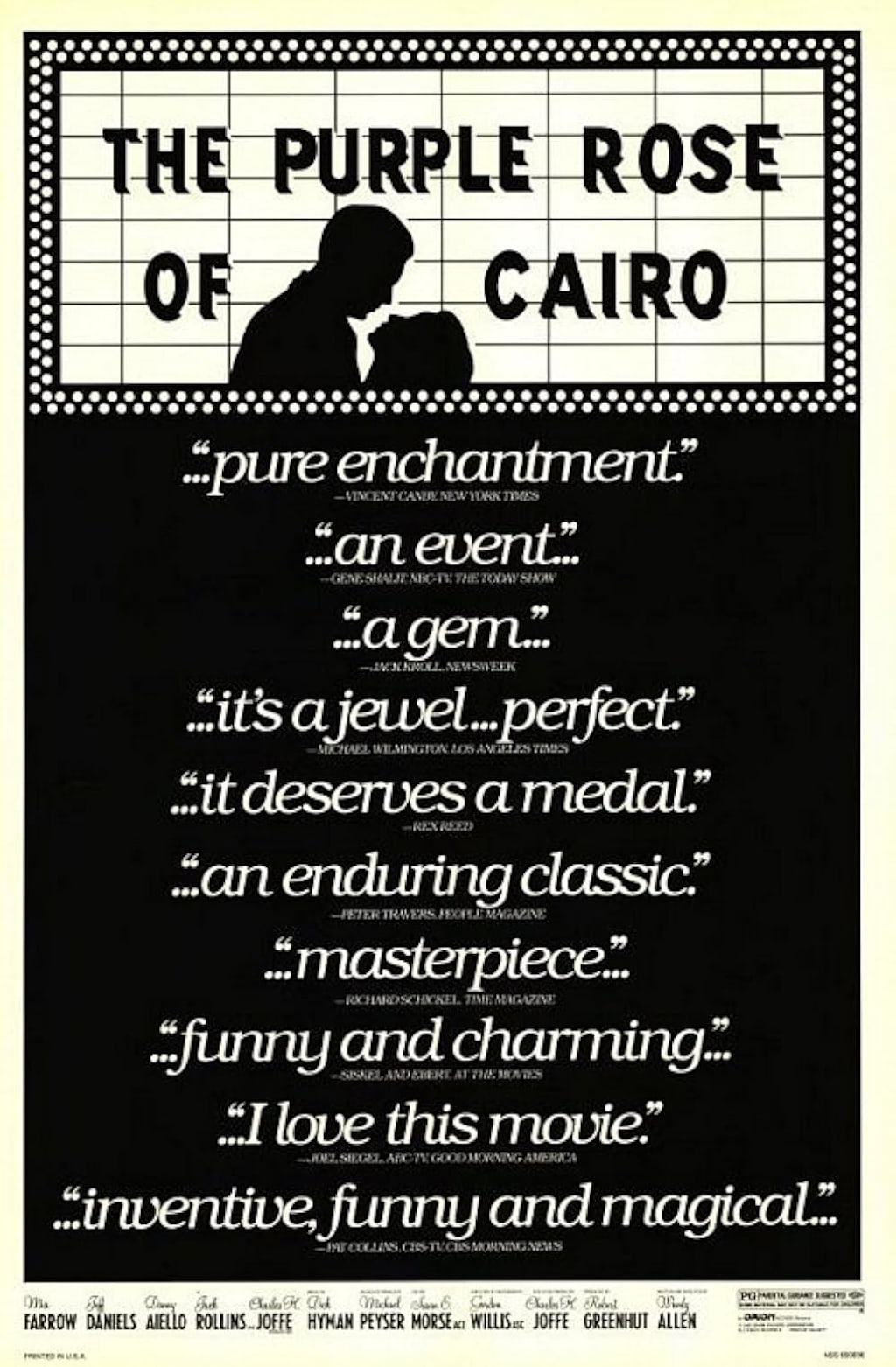
What If the Movie Came Out to Meet You?
There are certain movies that understand exactly why we go to the movies.
Not the respectable reasons. Not the cultural reasons. Not because cinema is an important art form that expands our understanding of the human condition.
I mean the real reason.
Sometimes you just want to get out.
In The Purple Rose of Cairo, Woody Allen takes that simple impulse and turns it into a fantasy.
Cecilia is a Depression-era waitress trapped in a miserable marriage and an even more miserable life. Her husband Monk is an abusive, gambling, philandering loser. Her job isn’t much better. The world around her offers very little in the way of escape.
So she goes to the movies.
Again.
And again.
And again.
The movie she keeps watching is The Purple Rose of Cairo, a black-and-white Hollywood adventure about a dashing archaeologist named Tom Baxter. Tom is handsome, romantic, charming and—most importantly—not Monk.
Then something impossible happens.
Tom Baxter walks off the screen.
Suddenly Cecilia’s fantasy isn’t a fantasy anymore.
It is standing in front of her.
And that is where Woody Allen’s 13th film as a writer-director becomes much more than a clever Hollywood high-concept comedy. (AFI Catalog)
The Purple Rose of Cairo is about movies, certainly.
But it is really about the difference between fantasy and reality.
And about how painful that difference can be.
Spoiler warning: This article discusses the film’s ending.
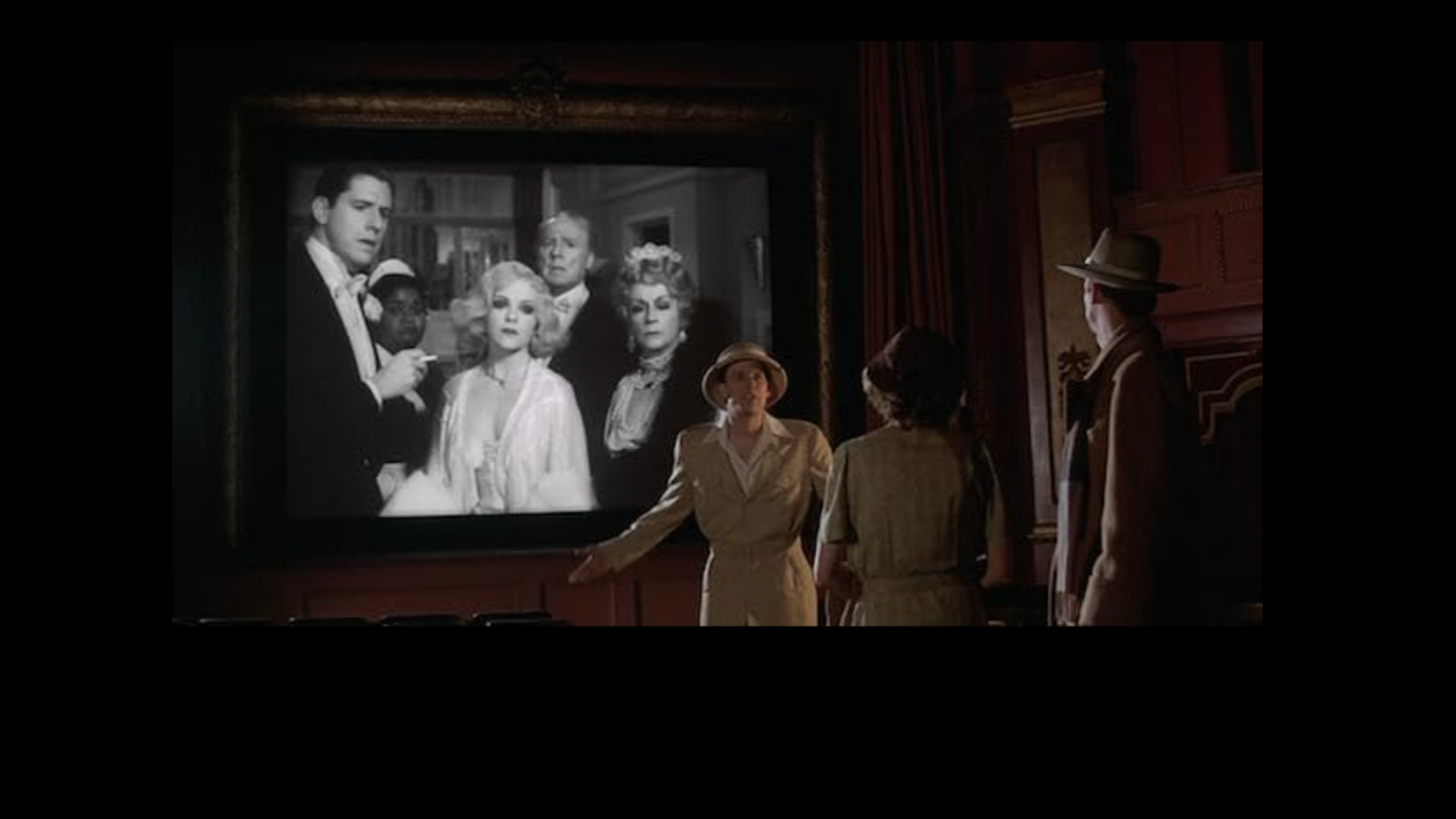
Woody Allen Wanted the Gimmick to Mean Something
The idea sounds like something that could have been written on the back of a cocktail napkin.
A movie character walks off the screen.
Funny.
Allen apparently thought so, too.
But when he initially began working on the idea, he discovered that funny wasn’t enough.
According to Allen’s contemporary conversations with journalist Eric Lax, he locked himself away and wrote roughly 50 pages about a character leaving the screen and getting into various comic adventures. Then he stopped.
Something was missing.
The premise worked.
The movie didn’t.
The breakthrough came when Allen realized that there would be two versions of the same man.
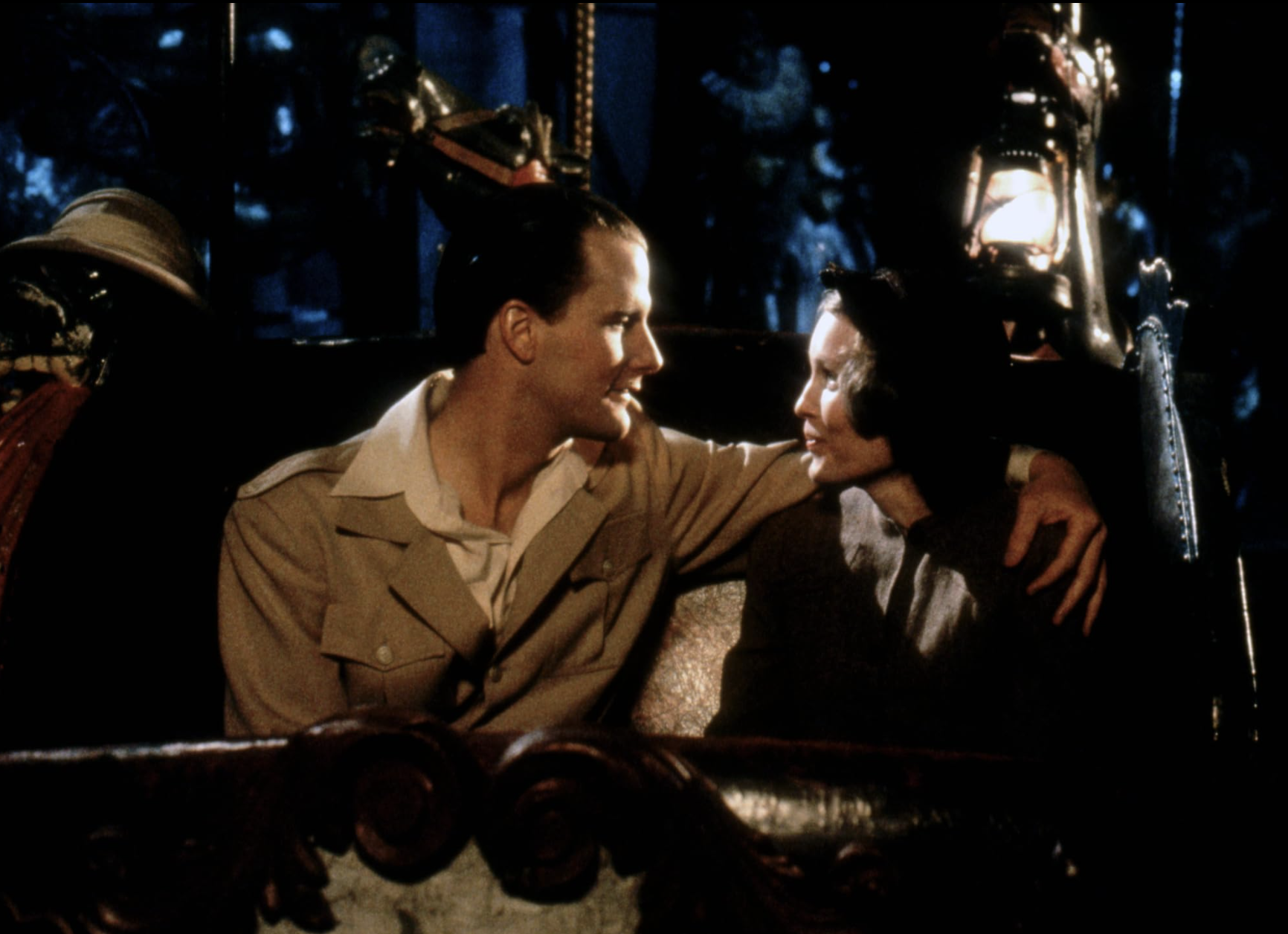
There would be Tom Baxter, the fictional character played by Jeff Daniels inside The Purple Rose of Cairo.
And there would be Gil Shepherd, the real actor who played Tom.
Cecilia could fall in love with the fantasy and then meet the reality behind it.
That gave Allen the movie he had been looking for.
He could use the impossible premise to explore something painfully ordinary: the temptation to choose the person—or life—we imagine over the one actually available to us.
That distinction is what makes the movie work.
Without it, The Purple Rose of Cairo might have been a cute exercise in cinematic magic.
With it, Allen had something much sadder.
The movies could give Cecilia exactly what reality had denied her.
But the movies couldn’t make that gift permanent.
Allen had drawn the line between fantasy and reality.
Then he spent the rest of the movie making us wish there wasn’t one.
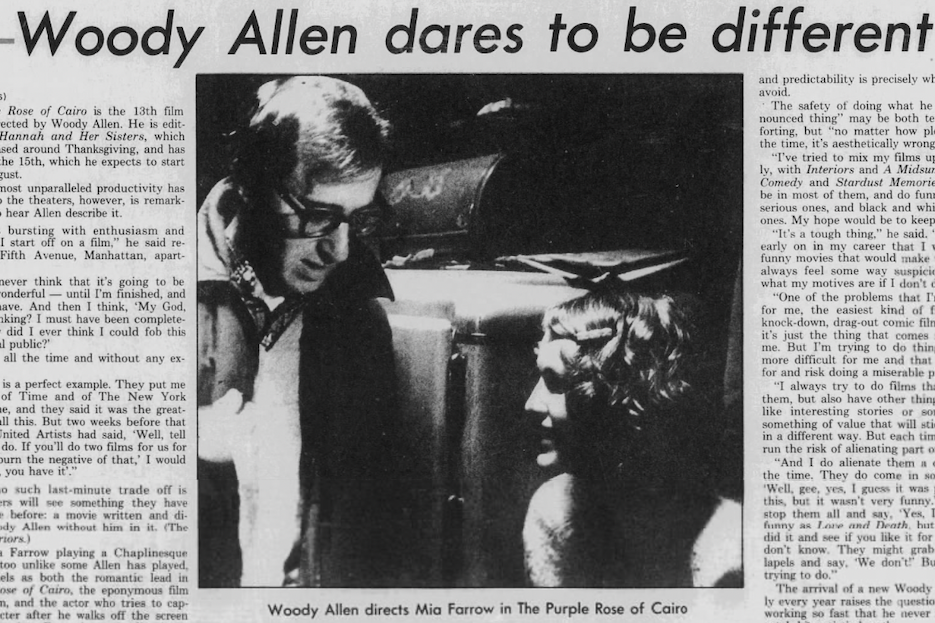
The 13th Film—and Another Risk
By 1985, Woody Allen had already established a filmmaking rhythm that would seem almost absurd today.
He made movies constantly.
While The Purple Rose of Cairo was being prepared for release, Allen was already working on Hannah and Her Sisters. He described beginning another film with the enthusiasm and confidence of somebody who hadn’t yet had the opportunity to discover everything that could go wrong.
That confidence was part of Allen’s method.
He didn’t seem particularly interested in making the same movie twice.
In a contemporary interview with Lax, he explained that it wasn’t particularly difficult to make a movie every year. The challenge was doing something that didn’t simply come naturally to him.
He wasn’t looking for another easy comedy.
He wanted to stretch.
As Allen put it, he was trying to do things that were more difficult for him and risk making “a miserable picture.”
That risk is all over The Purple Rose of Cairo.
It is a comedy that isn’t really a comedy.
A fantasy that keeps reminding us it isn’t real.
A movie about Hollywood that isn’t particularly interested in making Hollywood look wonderful.
And a love story in which the most romantic man in the picture is literally fictional.
Allen had used metafictional ideas before. The concept had precedents in films such as Sherlock Jr. and Hellzapoppin’, as well as Luigi Pirandello’s Six Characters in Search of an Author.
But Allen wasn’t simply trying to make another movie about movies.
The movies were the mechanism.
The subject was reality.
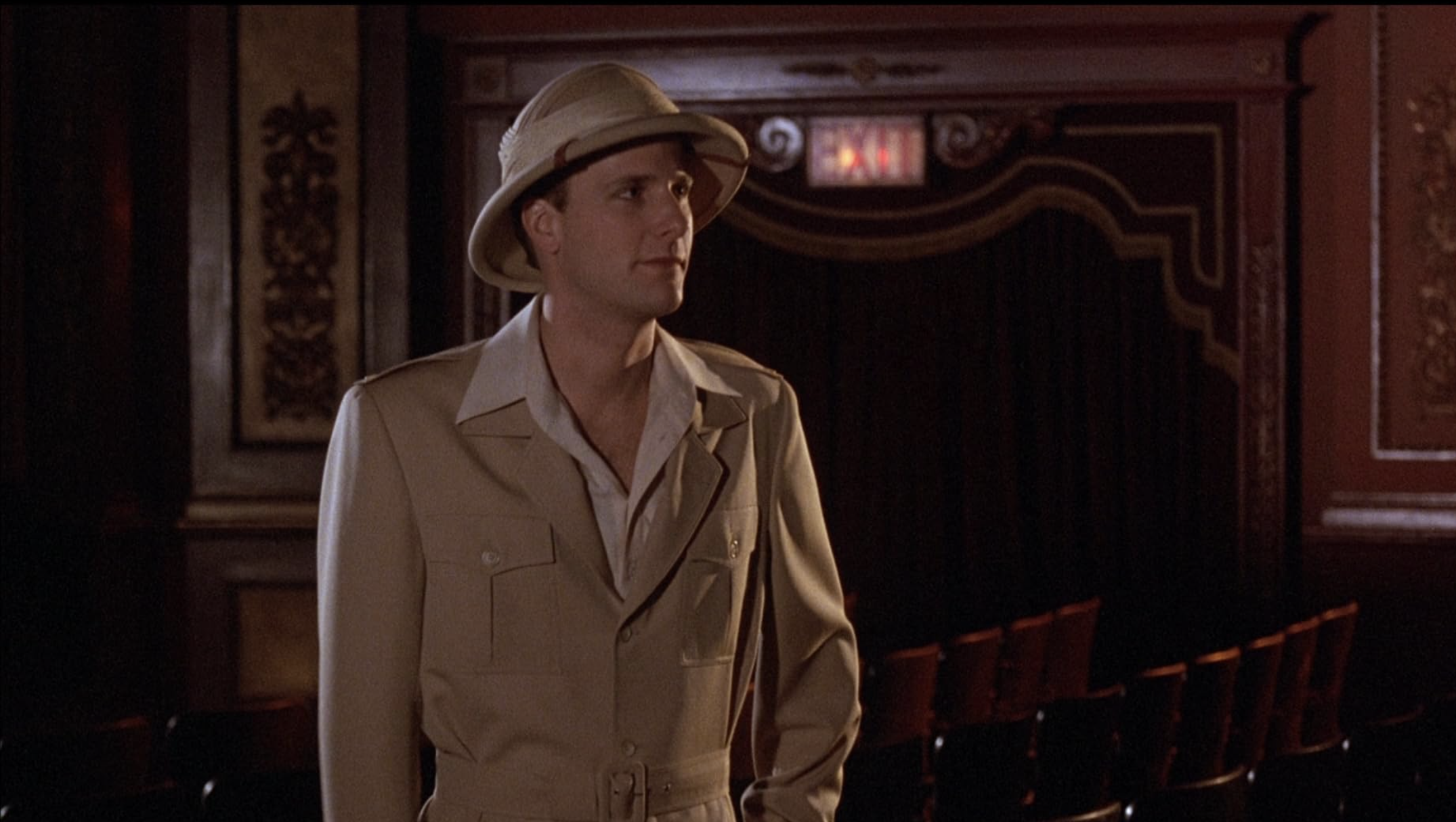
Michael Keaton Was Tom Baxter—Until He Wasn’t
One of the strangest chapters in the production happened before the movie had even found the Tom Baxter we know.
Michael Keaton was originally cast as Tom Baxter/Gil Shepherd.
Keaton was coming off Mr. Mom, and his particular brand of contemporary comic energy was already becoming recognizable. But Allen eventually decided that something about Keaton’s modern presence wasn’t right for the period setting.
After roughly ten days of filming, Keaton left the production by mutual agreement.
Jeff Daniels replaced him.
It wasn’t exactly a minor adjustment.
The production had to absorb the disruption and reshoot material, adding to the cost of an already ambitious project. Contemporary reports placed the eventual budget somewhere in the neighborhood of $8.5 million to $15 million, with later estimates generally settling around $15 million. (AFI Catalog)
And yet Daniels turned out to be exactly what the movie needed.
Tom Baxter has to be ridiculous and sincere at the same time.
He is a movie hero.
He talks like one.
He thinks like one.
He has the moral certainty of a man who has never had to live outside a screenplay.
Then he enters the real world.
Suddenly all of those wonderful qualities become problems.
Tom doesn’t understand money.
He doesn’t understand ordinary human relationships.
He doesn’t understand why people lie.
He doesn’t even completely understand death.
Why would he?
He was written to be a romantic hero.
Romantic heroes aren’t supposed to understand death.
They’re supposed to kiss the girl and ride into the sunset.
Building a World That Looks Like a Movie
The contrast between the real world and the fictional world is one of the film’s great visual tricks.
Allen and cinematographer Gordon Willis create two distinct cinematic spaces.
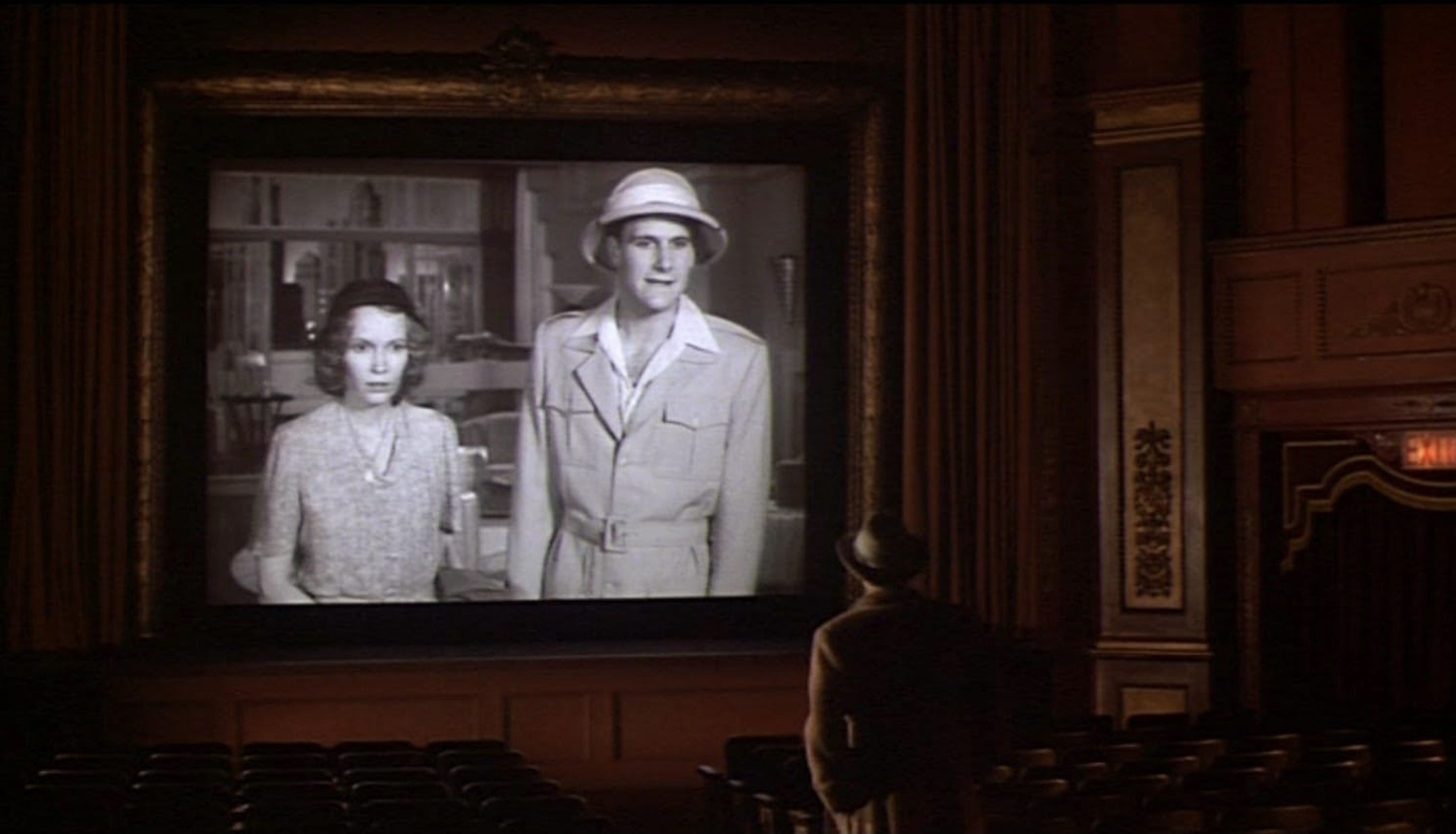
The movie-within-the-movie is lush, polished black-and-white Hollywood fantasy.
The real world is muted and somewhat drab.
Cecilia lives in a place where the Depression is not a historical backdrop. It is a daily reality.
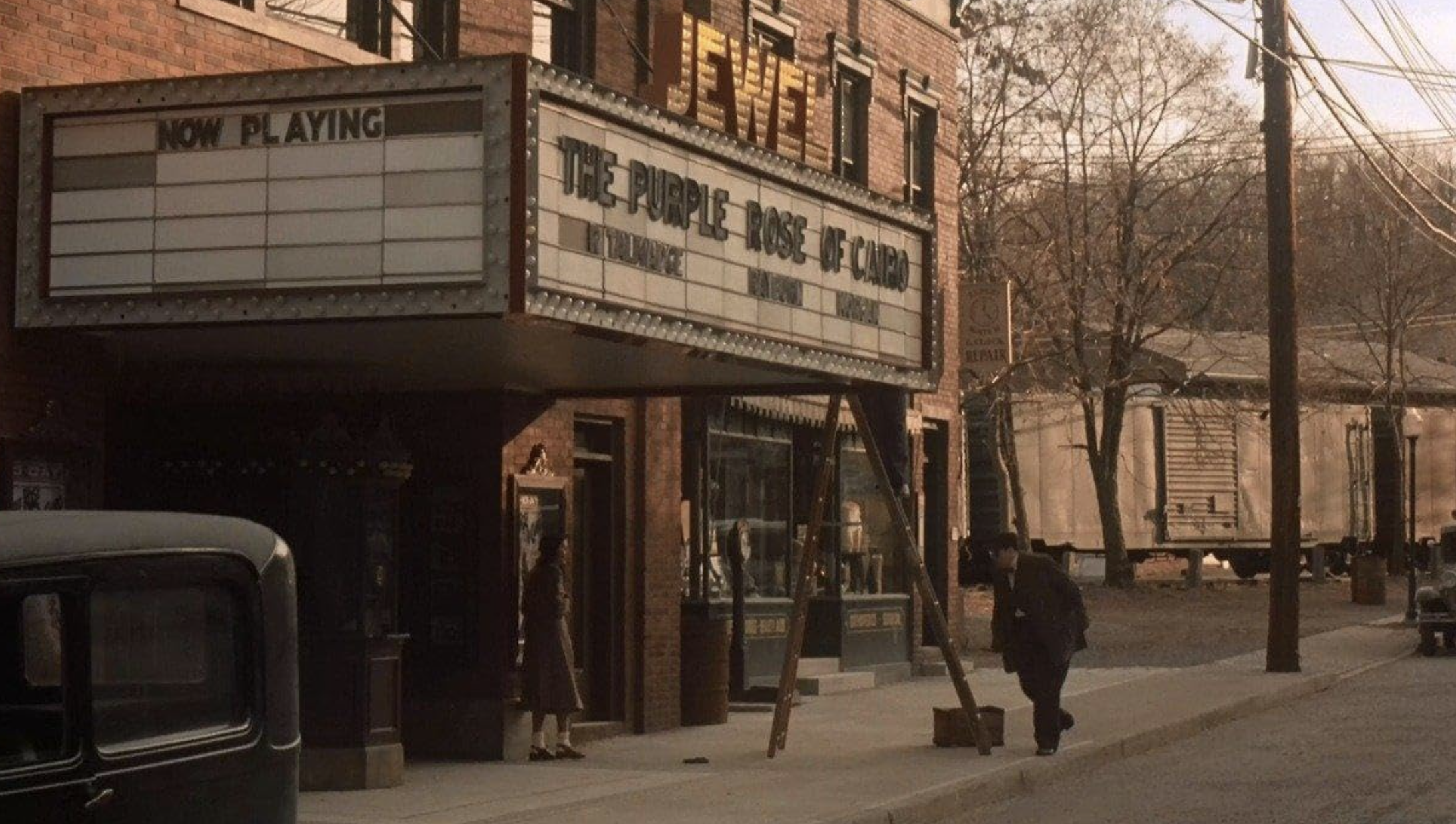
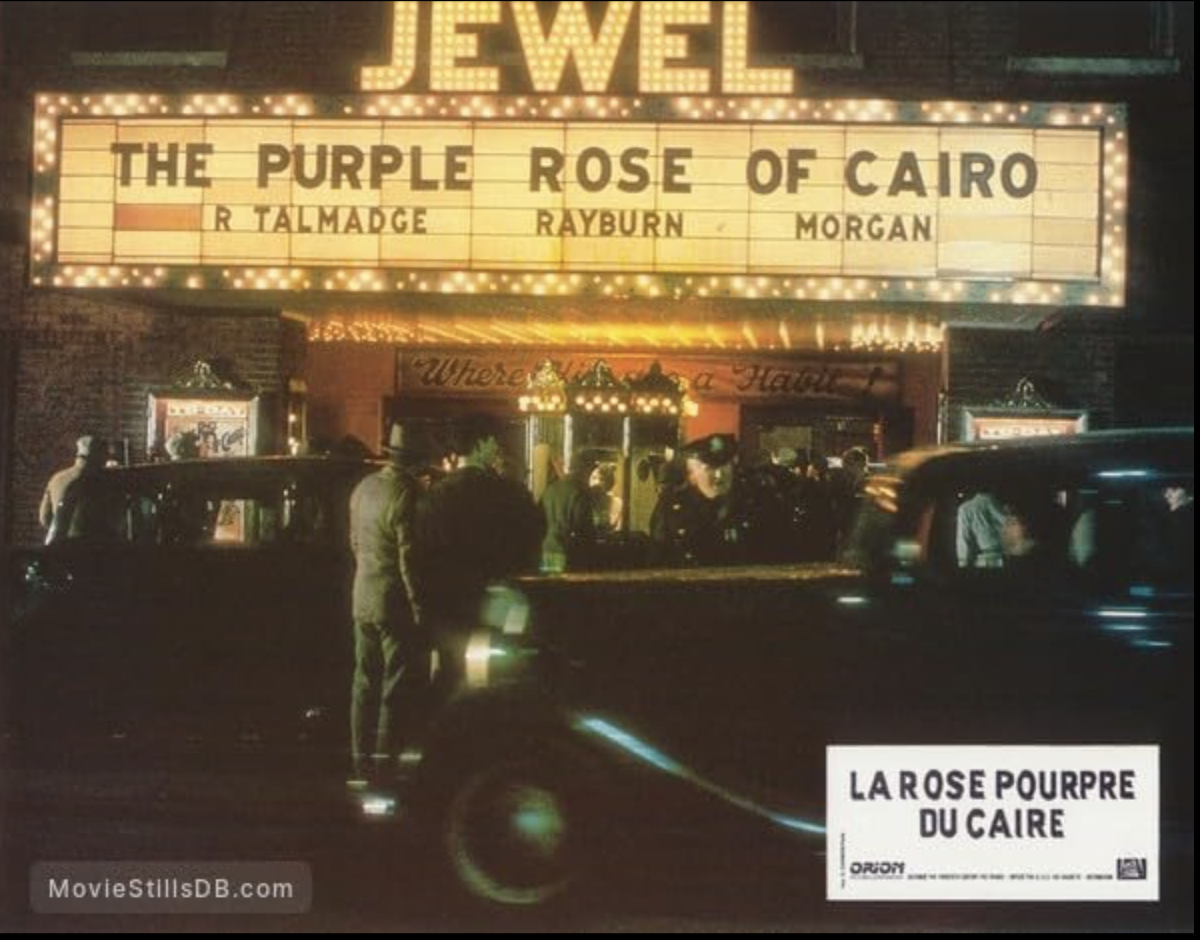
Production took place around New York, including Piermont, where period storefronts were created and a temporary facade for the Jewel Theatre was constructed. Interior theater scenes were filmed at the Kent Theatre in Brooklyn, a location with personal resonance for Allen, who had gone to movies there when he was young. (AFI Catalog)
And that makes the theater itself important.
It isn’t simply a location.
It is a refuge.
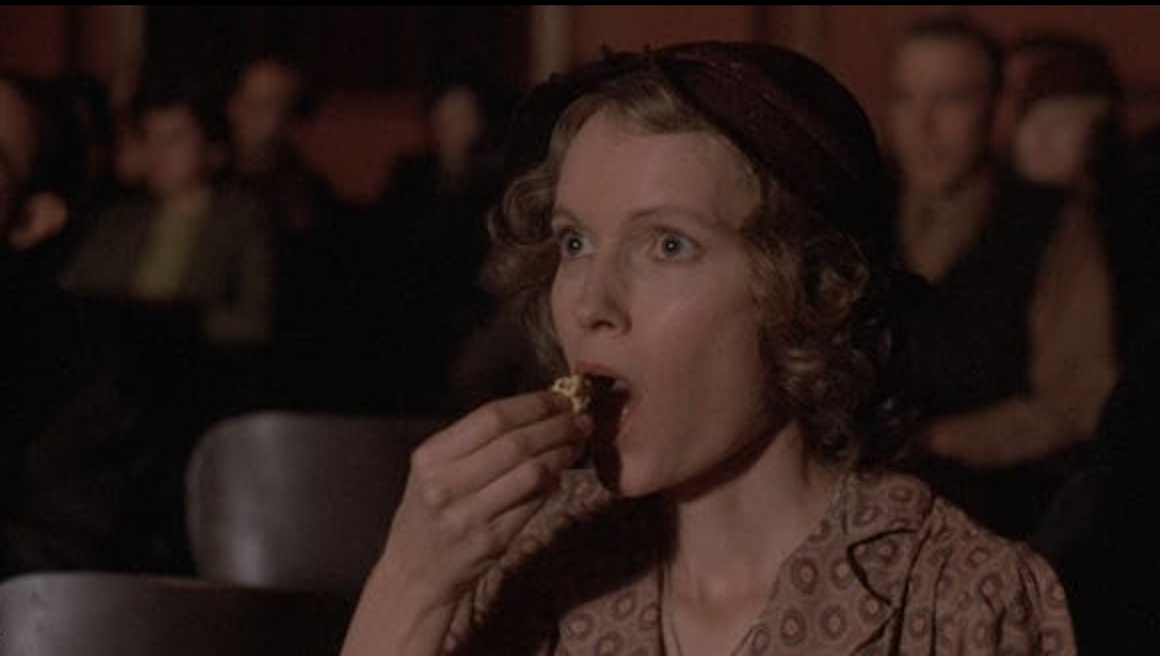
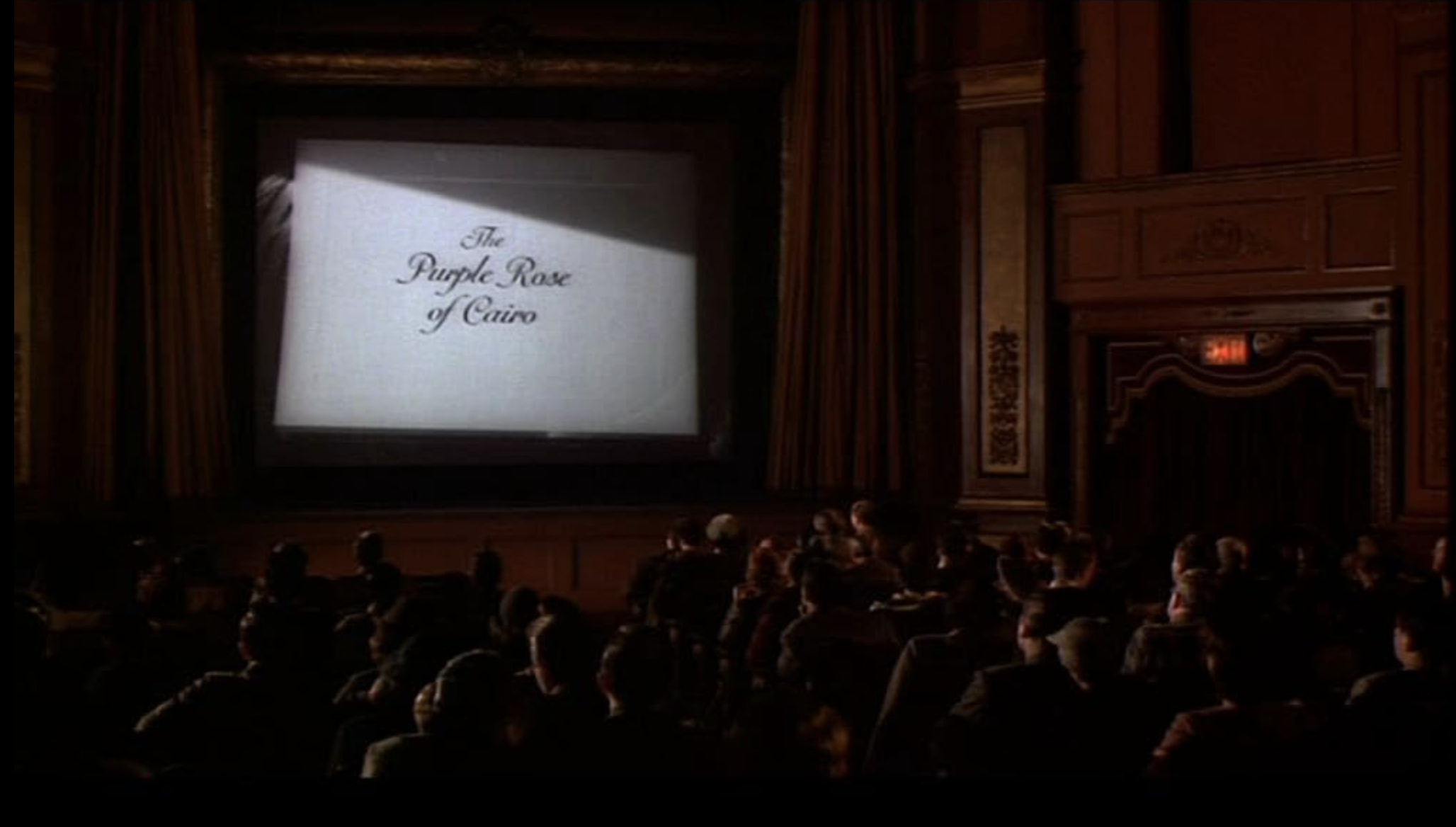
Cecilia sits in the darkness while the world disappears.
For a couple of hours, she isn’t a waitress.
She isn’t a battered wife.
She isn’t broke.
She isn’t stuck.
She is somewhere else.
Allen understood that feeling.
In a contemporary interview, he talked openly about how movies had functioned as an escape when he was young. He had hated school and spent enormous amounts of time in movie theaters.
That makes The Purple Rose of Cairo feel unusually personal without becoming autobiographical.
Cecilia isn’t Woody Allen.
But Allen understands Cecilia.
He understands why the darkness of a movie theater can sometimes feel safer than the light outside it.
Gordon Willis’ Last Woody Allen Film
There is another bit of 1980s movie history hiding in plain sight here.
The Purple Rose of Cairo was Gordon Willis’ final film with Allen.
Willis had been one of the most important visual collaborators in Allen’s career, helping establish the elegant, controlled look of films such as Manhattan, Stardust Memories and Zelig.
Here, his work had to accommodate two realities at once.
The black-and-white Purple Rose footage needed to look like a convincing 1930s Hollywood adventure.
The world outside the screen needed to feel considerably less magical.
That distinction is essential.
The audience has to understand why Cecilia wants to live inside the movie.
If the movie within the movie isn’t seductive, the entire story collapses.
It has to be beautiful.
It has to be ridiculous.
It has to be irresistible.
And it is.
Orion Wanted a Happier Ending
The studio apparently understood the problem.
Orion Pictures was nervous about the movie.
Allen’s previous film, Broadway Danny Rose, had been critically admired but hadn’t been a commercial sensation. The Purple Rose of Cairo was even stranger.
So the studio wanted reassurance.
Among other things, there was pressure for a happier ending.
Allen refused.
That refusal is important because the ending isn’t some cynical twist added to make the audience cry.
It is the entire point.
Cecilia has to choose between fantasy and reality.
And reality wins.
Not because reality is better.
That’s the cruel part.
Reality wins because it is reality.
Allen had already explained the idea in contemporary interviews. The movie was about how seductive fantasy could be—and how painful it could be to live with reality.
He wasn’t kidding.
A Movie About the Movies That Didn’t Make Much Money
The Purple Rose of Cairo premiered at the U.S. Film Festival in Park City on January 26, 1985, before opening in New York and Los Angeles on March 1. (AFI Catalog)
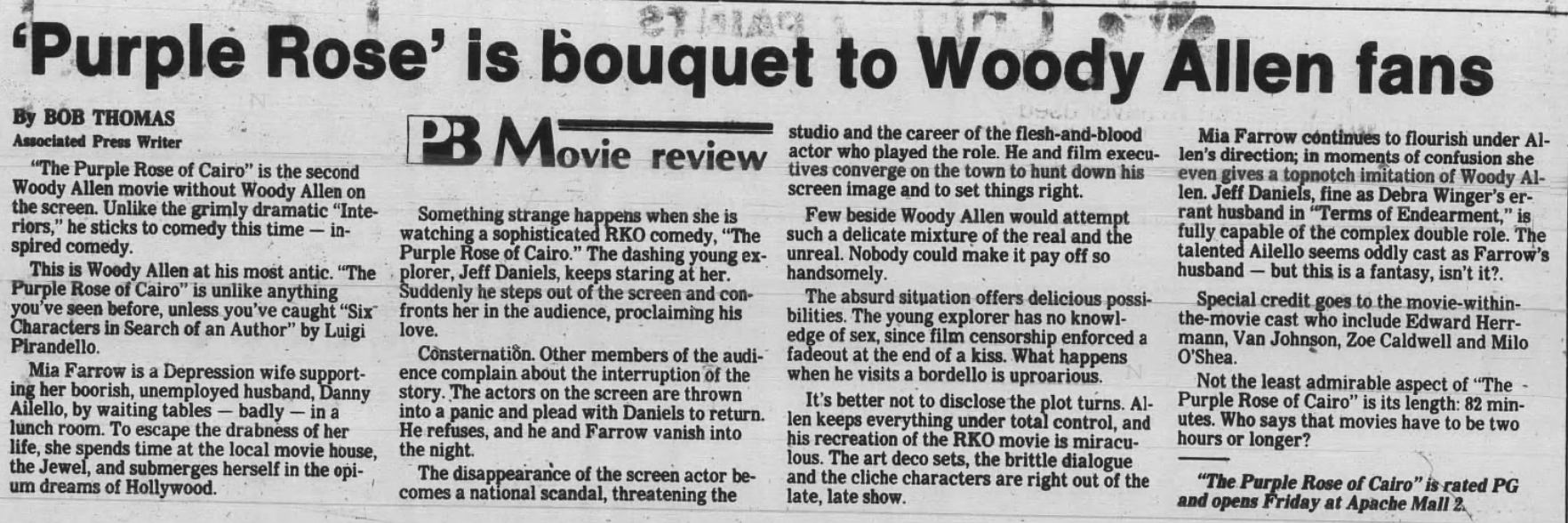
The critical response was considerably warmer than the commercial one.
The movie ultimately earned about $10.6 million domestically against a reported $15 million budget. (IMDb)
For Allen, that was hardly a blockbuster.
But the movie was being made for a different kind of success.
Critics recognized what Allen had attempted.
Roger Ebert gave it four stars, praising its wit and invention but focusing particularly on the way it played with “the very essence of reality and fantasy.” He understood that the movie’s apparent gimmick was actually a philosophical question: What happens when the person we need and the person who exists turn out to be two different people? (Roger Ebert)
That is the strange achievement of The Purple Rose of Cairo.
It makes you laugh at the premise.
Then it makes you feel sorry for the person living inside it.
And eventually it makes you wonder why the fantasy felt so good in the first place.
The Ending Hurts Because the Fantasy Worked
There is no getting around the ending.
Cecilia chooses Gil Shepherd.
The real actor.
The real man.
The guy who can actually exist in her world.
And for a moment, it looks as though the movie has decided to give her what she wants.
Then Gil leaves.
He goes back to Hollywood.
Cecilia is abandoned again.
The final image is devastating precisely because it isn’t melodramatic.
She returns to the theater.
She watches Top Hat.
Fred Astaire dances.
“Cheek to Cheek” plays.
And Cecilia smiles.
The movies are still there.
They haven’t abandoned her.
They just can’t actually come home with her.
That is what makes The Purple Rose of Cairo such a strange love letter to cinema.
Allen doesn’t end by telling us that movies are fake and reality is real, so we should grow up.
He understands that the fantasy has value.
The movies mattered to Cecilia.
They still matter.
They gave her someplace to go when she had nowhere else.
But they cannot become a substitute for living.
Fantasy can comfort us.
It can even save us for a little while.
But eventually the lights come up.
The Critics Saw What Allen Was Doing
The movie received an Academy Award nomination for Allen’s screenplay and won the Golden Globe for Best Screenplay. It also won the BAFTAs for Best Film and Original Screenplay. At Cannes, it received the FIPRESCI Prize. (Golden Globes)
Allen himself remained characteristically difficult to impress.
In interviews, he often described his films as imperfect attempts to reach something he could see in his head but couldn’t completely capture on film.
The Purple Rose of Cairo was one of the exceptions.
He considered it one of the films that came closest to what he had originally imagined.
That seems fitting.
Because the movie itself is about the gap between what we imagine and what we actually get.
Allen spent the entire film exploring that gap.
And, unusually for him, he seemed to believe he had crossed it successfully.
Why The Purple Rose of Cairo Still Works
There are plenty of movies about loving movies.
Some are sentimental.
Some are nostalgic.
Some are basically feature-length thank-you notes to the people who made the movies the director loved as a kid.
The Purple Rose of Cairo is different.
It understands that escapism is both wonderful and dangerous.
Cecilia isn’t stupid because she loves movies.
She’s human.
She wants something better.
Who wouldn’t?
The brilliance is that Allen gives her the impossible thing she wants and then forces her to discover that getting it isn’t enough.
Tom Baxter is perfect because he is fictional.
Gil Shepherd is real because he isn’t.
And Cecilia has to learn the difference.
That is a remarkably sophisticated idea to build around what initially sounds like a goofy comedy premise.
The movie has endured accordingly. It remains one of Allen’s most celebrated films of the 1980s and was later included in Time’s All-Time 100 Movies list.
Its influence also took a very literal form.
Jeff Daniels went on to found the Purple Rose Theatre Company in Michigan in 1991, naming it after the film. The company became a home for original American theater and remains active decades later. (Purple Rose Theatre)
But the film’s most important legacy isn’t a theater company or an awards list.
It is the feeling it leaves behind.
That peculiar ache when the movie ends and you have to go back to your own life.
Sometimes the Movies Are Enough
There is something almost cruel about making a movie this affectionate toward movies and then refusing to let the fantasy win.
But that’s why The Purple Rose of Cairo works.
Woody Allen understood the seduction.
He understood what Cecilia saw when she looked at the screen.
A world where men were romantic.
Where problems could be solved in 90 minutes.
Where the handsome stranger always appeared at exactly the right moment.
Where the music swelled and somebody danced.
Then Allen did something surprisingly brave.
He let the fantasy walk off the screen.
And once it was standing beside Cecilia, he made us realize that fantasy isn’t nearly as simple when it has to live in the real world.
The movies can give us hope.
They can make us laugh.
They can make us forget, for an hour or two, whatever awful thing is waiting outside the theater.
Maybe that’s enough.
It has to be enough.
Because eventually the credits roll.
The lights come up.
And we walk outside.
The genius of The Purple Rose of Cairo is that it never tells us to stop dreaming.
It simply reminds us that, no matter how much we love the movies, we still have to live.
And sometimes that is the hardest part.

Woody Allen’s The Purple Rose of Cairo turned movie escapism into a bittersweet fantasy about reality, love, and why we need the movies.
Tags: Movies of the 80s, The Purple Rose of Cairo, Woody Allen, Mia Farrow, Jeff Daniels, 1980s Movies, Movie History, Orion Pictures, Gordon Willis, Film History
Sources
AFI Catalog, The Purple Rose of Cairo — production history, cast, locations, release information and contemporary source references. (AFI Catalog)
Eric Lax, contemporary interviews with Woody Allen, including the Datebook/Film coverage surrounding the film’s release.
Ron Base, “Lunch with Woody Allen a refreshing experience,” Toronto Star, 1985.
Contemporary 1985 newspaper and trade coverage supplied for this article, including material on the Michael Keaton/Jeff Daniels casting change, production costs and Orion Pictures’ concerns.
Roger Ebert, “The Purple Rose of Cairo,” Chicago Sun-Times, March 1, 1985. (Roger Ebert)
Golden Globes, The Purple Rose of Cairo awards record. (Golden Globes)
Festival de Cannes, 1985 awards archive. (Festival de Cannes)
British Academy Film Awards, 1986 awards records. (Wikipedia)
Box Office Mojo, The Purple Rose of Cairo box-office record. (Box Office Mojo)
The Purple Rose Theatre Company, history and Jeff Daniels materials. (Purple Rose Theatre)
About the Creator
Movies of the 80s
We love the 1980s. Everything on this page is all about movies of the 1980s. Starting in 1980 and working our way the decade, we are preserving the stories and movies of the greatest decade, the 80s. https://www.youtube.com/@Moviesofthe80s
Enjoyed the story? Support the Creator.
Subscribe for free to receive all their stories in your feed.
Comments
There are no comments for this story
Be the first to respond and start the conversation.