
The Pitt Won Six Emmys. Then the Doctors Started Saying Thank You.
Why emergency physicians see their own impossible shifts in HBO Max’s medical drama, and why that recognition matters more than any trophy.
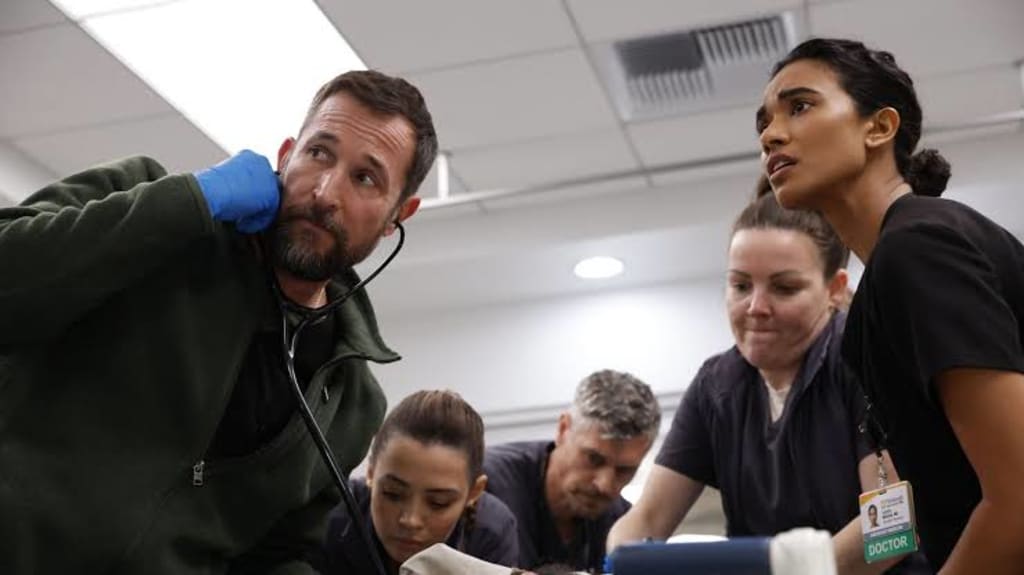
When the ER becomes a mirror: how The Pitt won six Emmys and the respect of working doctors
Noah Wyle stood on the stage, holding the statuette. In the audience were emergency physicians, not film critics.
On the night of September 14, 2026, HBO Max’s medical drama The Pitt led the Emmy Awards with 25 nominations and left with six trophies. Outstanding Lead Actor. Outstanding Drama Series. Outstanding Special Makeup Effects. Outstanding Guest Actor. Outstanding Original Music and Lyrics. Outstanding Casting for a Drama Series. When the list was finished, Wyle did not say, “This award goes to every healthcare worker.” He said something else. Later, someone remembered that he simply lifted the statuette for a moment, the way a doctor in an emergency room might hold up a fresh X-ray.
Among the show’s fans is a group of people who do not tweet much. They finish a night shift, go home, sleep, wake up, open HBO Max, watch an episode, and then go back to work. Dr. Fiona Hunter, vice president of the Royal College of Emergency Medicine in Scotland, put it plainly: “I don’t watch it immediately after a shift. We all need time to decompress and process what we’ve been through. But between shifts, when I have free time, this show is worth watching, and it resonates. It makes me feel that other people might understand these experiences.”
The word “understand,” spoken by an emergency physician, carries a different weight.
One hour per episode, fifteen hours per season
The structure of The Pitt refuses comfort. Each episode represents one hour of a single day. A season has 15 episodes. The viewer is not watching a compressed story with a neat beginning, middle, and end. Instead, the viewer follows a group of people through a continuous stretch of time at the Pittsburgh Trauma Medical Centre. The frame is never silent: the rumble of gurneys, the beeping of monitors, the sound of families crying in the hallway, a nurse shouting a bed number. Complex medical procedures are staged with realism. Bloody details are not avoided, and they are not turned into spectacle.
The protagonist, Dr. Michael Robinavitch, known as “Robby,” is an emergency medicine consultant. Noah Wyle plays him. In the 1990s, Wyle appeared in ER, where he played a young resident. Now he plays the attending who has been ground down by twenty years. He is also an executive producer and a member of the writing team. The writing team includes qualified physicians. That combination does not guarantee a good show, but it guarantees one thing: when the camera sweeps across the emergency department, working doctors will not be pulled out of the story by a detail that rings false.
Dr. Tony Cirillo, president of the American College of Emergency Physicians, said: “We finally feel that what we go through every day has been recognized.” The word he used was “recognized,” not “praised” or “celebrated.” To recognize something is to say: I know what you are showing. That is where I spend my days.
Why working doctors watch
Dr. Rob Perry, a consultant in North Wales, is also a fan. He said: “When you see someone playing doctors and nurses who do a job similar to yours, there is something reassuring about it. The setting isn’t British, but they are trying their best to provide the best care.”
Reassuring, not thrilling. Like hearing your own dialect in a foreign country.
The Pitt even led to Noah Wyle being invited to a medical symposium. The panel discussion had more than 6,000 emergency medicine specialists in the audience. Cirillo described the scene: “When people went up to him, it wasn’t like telling an actor or an athlete that they were great, that they loved their work. People just said thank you.”
After “thank you,” there was no next line. There did not need to be one.
It shows the emergency department as a social space
The series does not stop at whether a resuscitation works or fails. It shows the social and ethical problems that land in the emergency department. A stressed daughter caring for her sick mother leaves her in the emergency department and disappears. Parents desperately hope their child will survive, while the doctor says there is no hope left. Health inequality is written directly into the story: some patients struggle to afford what the American healthcare system demands. Long waits and patients’ frustration make British viewers think of the NHS.
Professor Damian Roland, a practising emergency medicine consultant, pointed out: “Almost every emergency department in the world right now does not have enough space to receive patients.” He mentioned a common plot point in The Pitt: the protagonist argues with hospital management, saying, “I need better patient flow. You can’t just leave these patients here.” Roland said this is a very common problem. In that context, the pressures facing the NHS are not a British anomaly. They are part of a structural crisis in emergency medicine worldwide.
Sarah Tosh, a senior NHS nurse and medical adviser on the show, said: “In my work in the NHS, we all support each other, and I like that this is shown in the series too.” She noted that The Pitt deals with the characters’ daily lives, but the focus is more on their medical work, which patient they are caring for, and what needs to be done next. That choice makes the series feel more like a work record than a soap opera built around romance and personal entanglements.
The actors had to learn
One of the actors, Gerran Howell, was born and raised in South Wales and received an Emmy nomination for Outstanding Supporting Actor for the show. He and other cast members went through an intensive medical training course, including work with mannequins and CPR practice. Asked by BBC Wales whether he would want to train as a doctor, he said: “I have a whole new respect for the medical profession. It may have made me realise I don’t know if I could do this job. I’ll stick to acting.”
The joke has an honest undertone. Acting an emergency physician and being one are separated by more than technique. The difference is what happens when the shift ends and the responsibility does not.
Beyond the trophies
The Pitt winning six Emmys is a television-industry event. But it also let a group of people who make decisions in emergency departments every day see themselves on screen. It did not turn doctors into gods, and it did not turn patients into props. It tried to be honest about failure. Resuscitations do not always work. Decisions carry costs. The system is never adequately resourced, and the people inside it keep going.
Cirillo said people just said “thank you” to Noah Wyle. That thank-you was not only for the actor.
The series does not end with uplift. Robby is still in the emergency department. The next episode is still coming. Doctors finish watching, turn off the screen, and go back to work tomorrow. They know that what the show depicts is true.
About the Creator
Jin
Writer of reamstories
https://reamstories.com/jin
Enjoyed the story? Support the Creator.
Subscribe for free to receive all their stories in your feed. You could also become a paid subscriber, letting them know you appreciate their work.
Comments
There are no comments for this story
Be the first to respond and start the conversation.