
The Odyssey Just Killed the Superhero Era
How a three‑hour Greek myth, shot on 11 miles of film, dethroned Marvel at the box office.
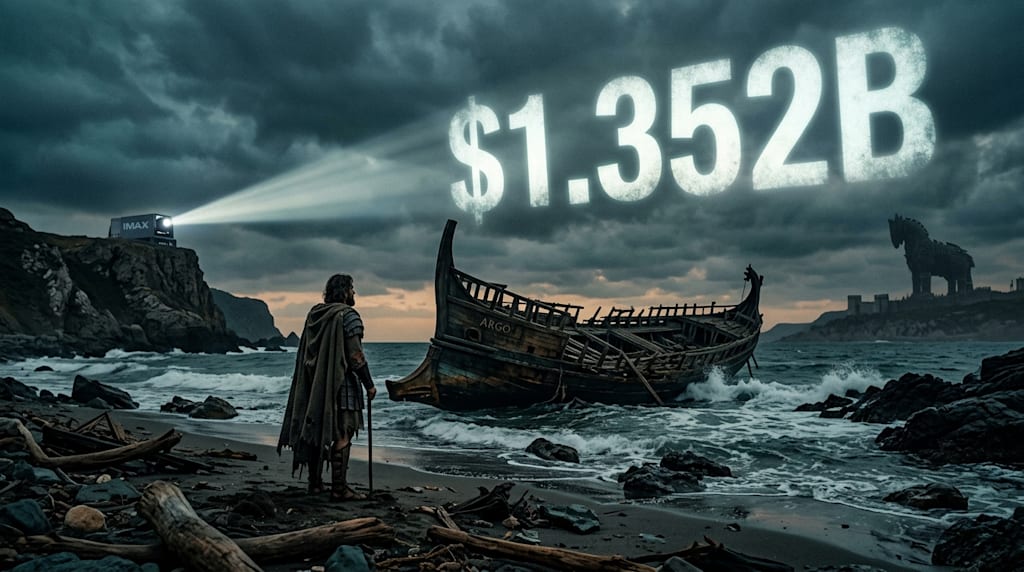
The day The Odyssey locked its global gross at $1.352 billion, Universal Pictures put out a standard press release. The third paragraph mentioned it had become the highest‑grossing R‑rated film in history. The previous record holder, Disney’s Deadpool & Wolverine, which had earned $1.338 billion since its July 2024 release, received no response tweet from the studio. Ryan Reynolds, however, did post on X: “Congrats to the entire cast and crew of The Odyssey on taking the all‑time R‑rated box office crown. That ride is a beast.”
“Beast” in that slang sense refers to something fast‑moving and unstoppable. Applied to Nolan, it works as a double entendre—he really does shoot with old‑school IMAX film cameras, and those machines make so much noise that dialogue has to be looped in post‑production.
About that camera: the public record shows The Odyssey is the first narrative feature shot entirely on IMAX 70mm film. The runtime is 2 hours 47 minutes, and the total film stock runs over 11 miles. Nolan’s previous film shot with the same camera was Oppenheimer, but that one mixed black‑and‑white and colour, so strictly speaking, it wasn’t “entirely” on the format.
Consider what those two data points say together. A Homer adaptation, nearly three hours long, shot on black‑and‑white film, a biopic about the man who built the atomic bomb—$976 million worldwide. The next one, a Greek myth, same film stock, an all‑star cast, an R rating—$1.352 billion.
Nolan’s every new film keeps rising. That trend, more than the single gross number, is what’s worth watching.
I. A string of casting‑season headlines
In early 2025, casting news for The Odyssey trickled out in batches. Matt Damon as Odysseus was a given. Then Anne Hathaway, Robert Pattinson, Charlize Theron, Tom Holland, and Zendaya were confirmed one after another.
Social media picked up a rumour: Helen would be played by a Black actress. The debate lasted about three weeks. Supporters posted screenshots of academic papers on “diversity in ancient Greek populations,” while opponents quoted Homer’s text describing “white‑armed goddess.” Nolan never responded to any of it.
Those who later saw the finished film noticed that Helen appears for less than four minutes total, and two of those minutes are wide shots. In the “black Helen” scene, she stands on the walls of Troy, looking down, backlit by sunlight, her face almost entirely in shadow.
Nolan did at least two things during casting: first, he indeed cast actors of different ethnicities to play Greek characters; second, he shot the most controversial character as a silhouette.
That’s one way to handle controversy—toss the topic out, let the noise burn for a while, then use the image itself to put out the fire. The fire dies because the point of contention becomes narratively irrelevant—you can’t even remember Helen’s face, because her face doesn’t matter. The cause of the Trojan War isn’t her; it’s Agamemnon’s ambition.
There’s another casting‑related detail: the transgender actor playing Sinon, the only character who uses lies to undo the Trojan Horse plan. Sinon does not exist in the original epic—Nolan added him. His dialogue ranks third in screen time, after Odysseus and Penelope.
Some read it as a victory for identity politics, others as a critique of the nature of deception. Nolan said only this in an interview: “Sinon is the most common kind of person in war—the one who stands on the losing side but ends up surviving.”
II. On the dimensions of that wooden horse and the man‑hours behind it
Among the set‑leak photos that surfaced during production, the horse was the most frequent subject. The construction team built a full‑scale wooden horse on an open field in England—about 12 metres tall, with an interior large enough to hold 30 actors simultaneously. During the actual shoot, Matt Damon and seven other actors crouched inside the horse’s belly for six hours.
Nolan’s reason for insisting on a practical build: he said that a CGI horse has the wrong sheen—too smooth, like a toy. The expansion and contraction of real wood under changing humidity alters its light reflection, and IMAX film can capture those subtleties. An IMAX screen is six stories tall; the audience can see dried tree sap in the wood grain.
This connects to the broader conversation around AI‑generated content. During the 2025 Hollywood writers’ strike, the debate over “AI replacing writers and VFX” peaked. Nolan’s remark at the London Film Festival was quoted repeatedly: “Young people rejecting AI garbage—that gives me comfort.”
He never directly said “an AI‑made horse is worse than the real thing,” but The Odyssey’s practical‑effects strategy itself is a statement: spending six months building a horse that can be used for only three days of shooting—that kind of “inefficiency” is almost provocative in today’s industry.
The box office numbers confirm one thing: audiences are willing to pay for that inefficiency. IMAX screenings contributed 38% of The Odyssey’s global gross—about $510 million—setting a new IMAX single‑film record. People who buy IMAX tickets may not know the difference between 70mm and digital IMAX, but they know the mantra repeated across Douban, Reddit, and X in different languages: “Nolan in IMAX is a must‑see on the biggest screen.”
III. A few things Odysseus does on his way home
If you break down The Odyssey’s wandering episodes by genre tropes, it looks roughly like this:
The Sirens sequence: sound design that cuts to sudden silence then erupts into low‑frequency vibration—a horror‑movie jump‑scare technique.
The Cyclops sequence: long tracking shots with the camera kept at Damon’s waist height, simulating the visual angle of a human looking up at something colossal.
The descent into the underworld: the only section shot in black‑and‑white (a nod to Oppenheimer), graded to a dark silver texture.
The slaughter of the suitors after the return: an abrupt shift in editing rhythm—average shot length drops from 6.2 seconds to 1.8 seconds.
Each episode uses a different cinematic language, but they share the same emotional logic: at every checkpoint, Odysseus faces not a monster but a part of himself—fear, pride, guilt, rage. Nolan made deliberate cuts in the editing: we never hear the Sirens’ song, only the thud of the ship hitting the rocks; we never get a full shot of the Cyclops, only close‑ups, so the audience, like Odysseus, never sees the whole picture.
This “restricted perspective” holds throughout the film. The audience knows less than Odysseus does, and even less than Penelope. In the scenes where Penelope weaves in the palace, the camera reveals a hidden compartment beside her loom—inside it, a dagger. Odysseus doesn’t know it’s there, and neither does the audience, nor do we know whom that dagger is meant for. Only in the final scene, after Penelope confirms that the returned man truly is her husband, does she push the dagger back into the loom’s secret slot. She never draws it.
That single action carries more weight than any line like “I waited for you twenty years.” Because what the audience sees is a concrete choice: she has a weapon, but she decides to trust. Trust isn’t built on eye contact and swelling music—it’s built on a gesture that points back in time: placing it back, not pulling it out.
IV. A dinner‑table scene about the rules of Xenia
The longest interior dialogue in The Odyssey takes place around a long table. Odysseus, disguised as a beggar, returns to the palace and sits among the suitors, eating bread. Across from him sits a young suitor boasting about his archery skills.
The scene runs seven minutes—shot‑reverse‑shot, no score, only the sound of chewing and the crackle of burning firewood. The young suitor asks the beggar: “You’ve wandered so many places—have you ever seen a city better than Ithaca?”
Odysseus swallows his bread and says: “I saw one city where they invite strangers to eat first, and only ask their names after they’re full.”
The young suitor laughs: “Then they must never have been robbed.”
Forty minutes later, the slaughter begins. Odysseus shoots that young man—an arrow through his throat while he still has bread in his mouth.
Nolan doesn’t shy away from blood in the massacre scene, but before every splash of blood, the camera lingers on something: a clay pot smashed by a suitor, a piece of fabric trampled into the mud, an overturned flask of olive oil. Each object was made by Penelope over those twenty years—if the audience remembers the earlier scenes, they’ll recognise that pot from her first weaving sequence.
The logic of the massacre shifts accordingly: it’s no longer just “the hero returns for revenge,” but “the invaders destroyed every single concrete day of her twenty‑year wait.”
In parallel, the film cross‑cuts to the sea—the wreckage of Odysseus’s fleet is sinking. It’s not the suitors’ ships; it’s his own. In the process of coming home to exact revenge, he loses his last ship.
Nolan uses parallel editing to say one thing: settling accounts works both ways. You reclaim your home, and in the same motion, you burn your last retreat.
V. Three numbers about the box‑office rankings
As of August 2026, Nolan’s total directorial gross stands at roughly $7 billion. The top two on the all‑time director list are Steven Spielberg (~$10.9 billion) and James Cameron (~$10.6 billion). The gap is about $3.6 billion.
Nolan’s output frequency is one film every three years. From Following to The Odyssey, twelve features, average interval about 2.7 years. At that pace, if each subsequent film averages 60% of The Odyssey’s gross—around $800 million—it would take about 13.5 years to catch Cameron’s current number. At the Oppenheimer level—roughly $970 million—about 11 years.
But Cameron and Spielberg aren’t standing still. Cameron still has three more Avatar films in the pipeline; Spielberg maintains at least one production project per year.
There’s one variable in Nolan’s path to the top: he very rarely makes sequels. Apart from the Batman trilogy, all his works are originals or one‑off adaptations. That means his box‑office growth doesn’t rely on franchise multiplier effects—every film starts from zero to build audience trust. The downside: no guaranteed baseline. The upside: each film’s rise or fall directly reflects the current value of the name “Nolan.”
The Odyssey outgrossed The Dark Knight Rises by about $380 million—and that one had the Batman IP. Which means the “Nolan” brand has already surpassed his own earlier creation.
VI. One remark during the writers’ strike
In 2025, the WGA strike lasted 147 days. During that period, Nolan attended a small director roundtable and was asked about “streaming’s compression of the theatrical window.” His exact response: “Films should be seen in cinemas—that’s not an opinion, it’s a physical fact. The grain pattern of 35mm film projected on a big screen, reduced to a phone screen, is just a mosaic.”
That line later became a meme. The most circulated version showed Nolan adjusting focus next to an IMAX camera on the top half, and an iPad playing The Odyssey trailer on the bottom, captioned “mosaic.”
Before The Odyssey opened, Nolan asked Universal to extend the IMAX 70mm release window to eight weeks—three weeks longer than the standard version. That meant for those eight weeks, some screenings were film‑only, with digital versions delayed. Some theatre managers complained about “pressure on occupancy,” but the final data showed an average IMAX occupancy of 91% over those eight weeks—the highest for any format in that chain that year.
Audiences voted with their feet, proving that Nolan’s “physical fact” wasn’t just a talking point—they were indeed willing to pay an extra $5 for a ticket and drive an extra 20 minutes to the only theatre equipped for 70mm projection.
VII. The final frame
The last shot of The Odyssey is not the embrace between Odysseus and Penelope. It’s the beach. The beach of Ithaca, the camera slowly tilts up from the sea—a ship lies beached on the sand, its mast broken, its sail soaked in seawater, half‑submerged. That is Odysseus’s last ship.
The shot holds for twelve seconds. No music, just the sound of waves. Then cut to black.
Nolan also ended Oppenheimer with a silent long take—the slow fall of ash after the bomb. The beach shot in The Odyssey is another kind of silence: the silence of survival at a cost, and the cost is rendered as one specific thing—not abstract time or memory, but a ship. The wood is waterlogged, the canvas is rotting; it cannot be repaired.
Underneath the $1.352 billion gross, that frame is what Nolan left on screen. He spent three years building a ship, shot it sinking at the end, and cut to black. When audiences walked out, they argued about “why did the ship break?”—some said it was the storm, some said Odysseus scuttled it himself, some said Penelope sent someone to burn it so he wouldn’t leave again.
Nolan never answered that question in any interview.
About the Creator
Jin
Writer of reamstories
https://reamstories.com/jin
Enjoyed the story? Support the Creator.
Subscribe for free to receive all their stories in your feed. You could also become a paid subscriber, letting them know you appreciate their work.
Comments
There are no comments for this story
Be the first to respond and start the conversation.