

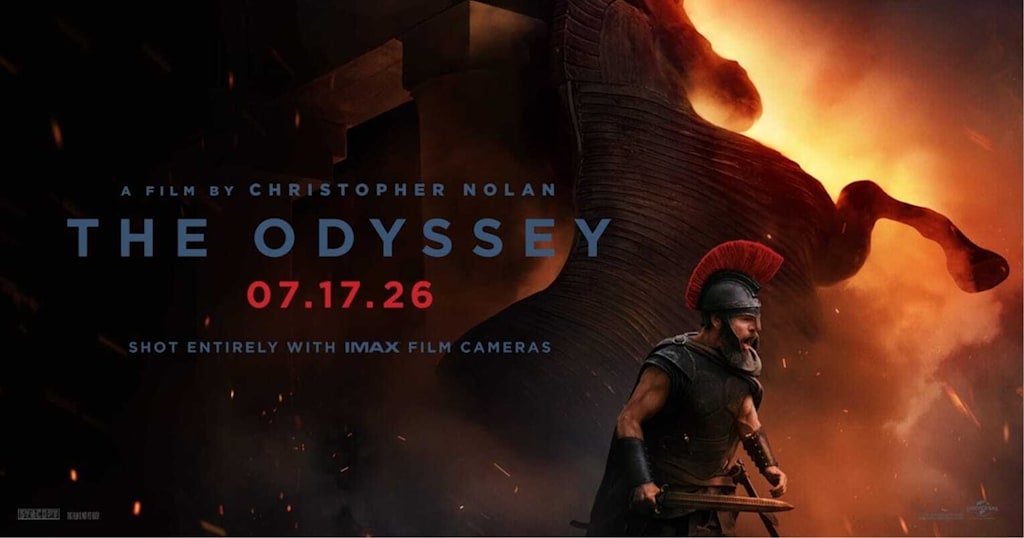
Today is my son's birthday but he had to work, so I gave him a present of watching a 7 am show of The Odyssey in a true IMAX 70mm format, the way Christopher Nolan intended it to be seen.
There are only 25 theaters in the US that can show the movie in this format, and the tickets to them have been sold out for months in advance. Our show was completely sold out, not a single empty seat.
I've managed to get pretty decent seats for the 7 am show: third row from the top, not exactly in the middle of the row but not on the edges either, where the picture gets distorted because of the row and screen curvature. You can find some funny reels from the people in IMAX 70mm theaters seating either on the row's end or in the first row, closest to the screen. But here's one from The Odyssey that will make your head spin:
The screen for the IMAX 70mm film is monstrously large. When I looked at it closely, I didn't see any seams so I was wondering what kind of a machine could produce a continuous, uninterrupted canvas of that size. Must be some proprietary IMAX technology as well.
Before Nolan's Oppenheimer came out, there were only 19 screens in the US capable of showing IMAX 70mm films. So IMAX had refurbished and updated some of the older theaters to increase the capacity, but 25 is still too few for a country with 340M people population. The map and list of all 25 US locations is here:
There's only 41 of such theaters all over the world, and a lot of them are located within the science or technology museums:
25 in the United States
9 in Canada, where the technology was invented
3 in the United Kingdom
3 in continental Europe: one in Belgium, one in France, and one in Czechia (I guess that one serves the entire Eastern and Central Europe)
1 in Australia, at the IMAX Melbourne Museum.
The only IMAX 70 mm theater in the state of Georgia is a 45-min drive from my home in Atlanta, so we had to get up very early. The good thing is that they usually don't show any ads or previews and go straight into the movie because very few movies are shot in this format and previews for other films would look funny on this huge screen because of the different ratio.
We were lucky to be shown a clip from the upcoming Dune: Part III that was shot on 70mm IMAX film. It was massive and mind-blowing.
I've never seen a movie in this format before so I'm glad I had this experience with my son, who is also a big movie buff. When I told him it was my birthday present for him he was stoked, even though it was this early in the morning.
What's all the fuss about it, you'd ask? It's the analogue technology that Nolan and several other directors are trying to keep alive. Most films today are shot on digital cameras, but there are several directors who still believe that analogue film gives a much better, truly cinematic and authentic experience. Quentin Tarantino (but he is a die-hard 35 mm film director), JJ Abrams (Star Wars), and Denis Villeneuve (Dune) are among them.
Because IMAX 70 mm film is two times wider than the usual 35 mm film, it produces a picture of exceptional quality, the highest in the analogue format. Nolan has used it for large-scale scenes in Oppenheimer and Dunkirk, but The Odyssey was short on 70 mm entirely. It presents a challenge for the director and actors because despite the fact that the roll of the raw film is long, it moves at an incredibly high speed and one roll of film lasts only about 3 minutes. In one of his interviews, Nolan said that he'd often have to stop the actors for reloading of the film often in the middle of the scene, saying, "Hold that moment, we need to reload."
Of the entire $250M production budget for The Odyssey, $3M was spent on raw IMAX 70 mm film alone. Nolan may be single-handedly saving Kodak that remains the only company producing film for analogue movies (35 mm as well) from going into obscurity in the digital age.
Because of the sheer volume of 70mm film used for The Odyssey, the finalized theatrical reels stood six feet tall and weighed over 500 pounds. Imagine that - every IMAX 70mm film received a literal truckload of The Odyssey to project in the theater.
The ticket for our early morning show was $35 per person, the evening shows run at $50-60. Some theaters even have a 3 am show on the weekends for those night owls who don't have to go to work next morning.
Was it worth it? Absolutely, every penny. I felt that I was completely immersed in the story. It was not too loud either: A lot of people who watched it in digital versions complained about the volume level. I took my noise-cancelling headphones with me but ended up not using them. Now I want to watch the movie in a regular digital theater to see how different the experience will be.
Notice that I didn't say anything about how much I liked or disliked the movie? I'll leave it for another story. But I'd strongly encourage everyone to watch it so that we could continue talking about it.
About the Creator
Lana V Lynx
Avid reader and occasional writer of satire and short fiction. For my own sanity and security, I write under a pen name. My books: Moscow Calling - 2017 and President & Psychiatrist
@lanalynx.bsky.social
Enjoyed the story? Support the Creator.
Subscribe for free to receive all their stories in your feed. You could also become a paid subscriber, letting them know you appreciate their work.
Comments
There are no comments for this story
Be the first to respond and start the conversation.