
The New York Times Named the 100 Best TV Shows of the 21st Century. Its Top 10 Is a Map of Who Holds Power in TV.
Breaking Bad won. The Wire came second. The list reads like a self-portrait of the American television industry, drawn by the people who make it.
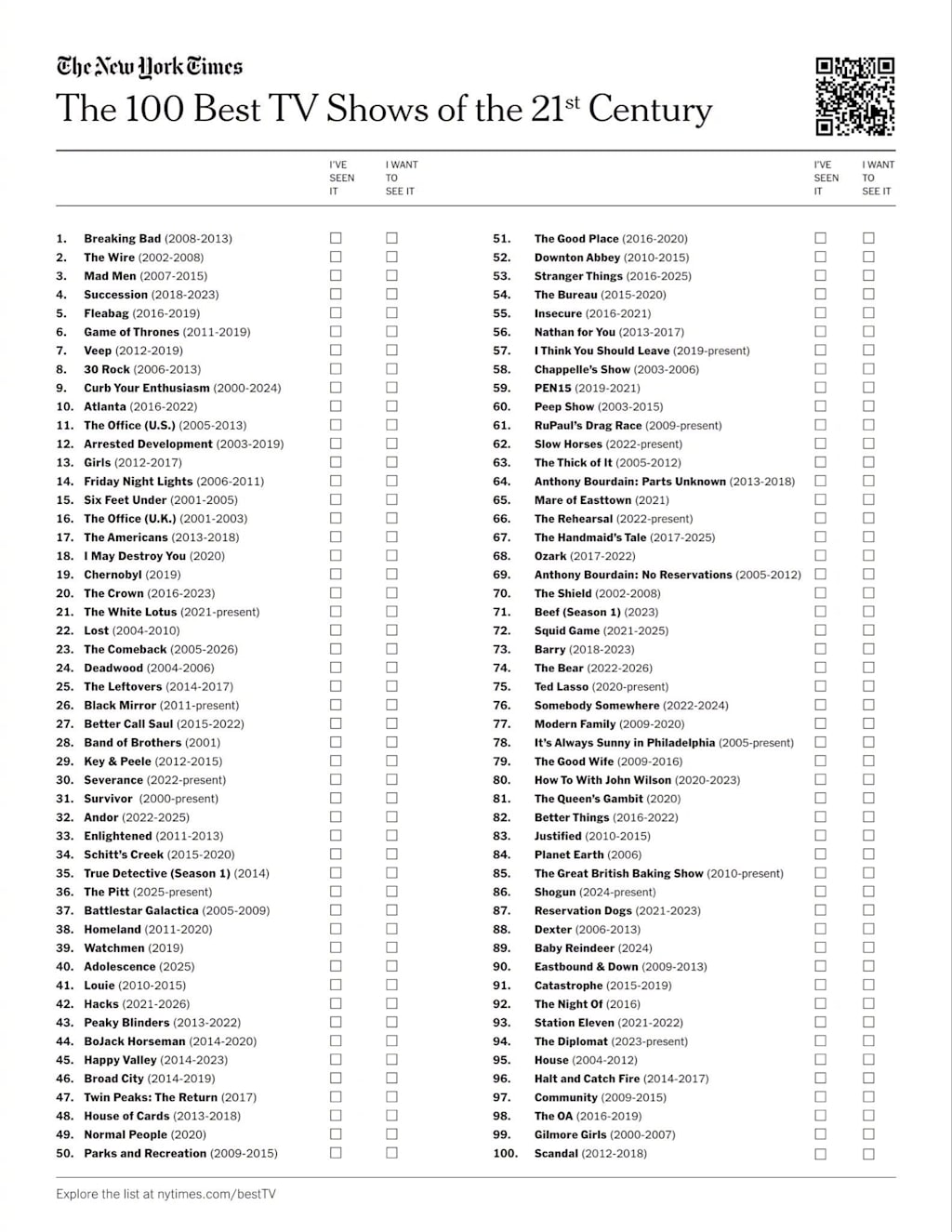
The New York Times asked more than 500 television professionals to vote. Actors, writers, producers, showrunners. They picked the 100 best TV shows of the 21st century. The top ten: Breaking Bad, The Wire, Mad Men, Succession, Fleabag, Game of Thrones, Veep, 30 Rock, Curb Your Enthusiasm, Atlanta.
Nine American shows. One British show. That ratio tells you most of what you need to know.
The voters chose their peers. They also chose the version of television they want to be remembered for. Breaking Bad won because it has no weak spot. The Wire came second because it is too cold for a wide vote. Mad Men came third because it is the auteur drama. Succession came fourth because it is the new show that feels most like an old classic. Fleabag came fifth because it is British in origin and American in rhythm. Game of Thrones came sixth. The ending still sparks arguments, but the first six seasons changed what a TV production could look like. Veep, 30 Rock, Curb Your Enthusiasm, and Atlanta fill out the top ten. Four comedies. Four writer-driven shows with dense language and strange characters.
Why Breaking Bad first
Look at Walt’s starting point. High school chemistry teacher. Wife does not work. Son has a disability. A second child is coming. He works part-time at a car wash. His brother-in-law is a DEA agent who talks up his job at family dinners. Walt gets lung cancer. At a drug bust, he runs into a former student, Jesse Pinkman. Every part is in place.
He cooks meth to leave money for his family. He kills to stay alive. He goes deeper into the drug trade so he will not be killed. He strikes first to protect himself. He sinks further to prove he still matters.
At the end, he says:
I did it for me. I liked it. I was good at it. I was alive.
No noble cause. No family speech. He admits the work gave him power, skill, a pulse. The title says it: Breaking Bad. A man breaks his own rules, then breaks worse ones. A film has two hours. A TV show has dozens. That length lets you watch the change happen.
The Wire came second
The Wire is about Baltimore. Drugs, docks, unions, schools, newspapers, politics, police. It does not build a Walt. It builds a city. It shows how much of a life is decided by block, system, and timing. You can call it a documentary with a plot. You can call it a social essay with jokes. Either way, it does not flatter a voter.
It is slow. It is ensemble. It is institutional. It is often hopeless. Breaking Bad has a strong lead, strong conflict, a strong ending, strong feeling. In a vote by industry professionals, that is the safer pick. You can dislike The Wire. It is hard to say Breaking Bad is bad.
This list is American
Last year’s NYT film list looked more global. Parasite took first. In the Mood for Love took fourth. Crouching Tiger, Hidden Dragon and Yi Yi made the list. This year’s TV list puts one British show in the top ten. English-language shows dominate. Squid Game and Shogun are the main non-English entries. Both have American companies behind them. Chinese-language TV gets nothing.
TV is bound by language, market, industry, and habit. American TV has the biggest English-language market. The voters are mostly American professionals. The NYT is not ranking all television. It is ranking TV Shows, a category that includes documentaries and reality competitions. Planet Earth, Survivor, RuPaul’s Drag Race, and The Great British Bake Off all appear. The line between scripted series, documentary, and game show is thin.
Still, the list shows something true. American TV in this century reflects the country better than American film does. New York in a superhero movie is a stage. Baltimore, New Mexico, Manhattan ad agencies, media dynasties, small towns, and Chicago kitchens in TV are messier. American film sells a dream. American TV keeps opening the door on the mess.
Industry taste
Auteur comedies dominate the middle of the list. Veep, 30 Rock, Curb Your Enthusiasm, Atlanta, Arrested Development, The Office, Parks and Recreation, The Good Place, Hacks, Barry, The Bear, Louie, Broad City, Pen15. These are writer shows. They live on language, odd characters, and tight structure.
The American Office beats the British Office. The British version ran 2001 to 2003. Sharper, shorter, colder. The American version ran 2005 to 2013. Longer, warmer, easier to live with. Americans have nerve. The American version kept the core and built its own life. The US TV machine can turn a premise into a long-running business.
New shows climb fast. Severance at 30. Andor at 32. The Pitt at 36. Adolescence at 40. Some of that is recency bias. Some of it is real change. Streaming has altered form, pace, and subject matter. The voters are not only looking backward.
Missing shows and strange calls
The Sopranos is missing. It premiered in 1999. If the rule is a premiere after 2000, its absence makes sense. If the rule is any show that aired in the 21st century, it belongs high. It helped start the golden age. Without it, Mad Men, Breaking Bad, and The Wire would look different.
Better Call Saul at 27 is low. Plenty of viewers think it matches Breaking Bad. It is a prequel. It is slow. It carries a tragic ending the audience already knows. Those facts likely pushed it down.
True Detective is marked as Season 1. Good. Later seasons fall off.
The White Lotus at 21. Season 1 in Hawaii. Season 2 in Sicily. Season 3 in Thailand. The first two seasons are sharp satirical comedy. Season 3 targets the modern self. Every character is trapped in his or her own head. Even inside a family, no one listens. The theme works. The show does not. It becomes as bored as the people it mocks.
Twin Peaks: The Return at 47. David Lynch directed every episode. It is strange in a way network TV rarely allows. Cahiers du Cinéma put it first among its 2017 films. It plays like a long movie.
Shameless did not make the list. After Fiona left, the story broke. It lost the feeling that life is bad but someone is still holding it together. It turned into a montage of South Chicago poverty. If Fiona had stayed, it could have reached the top three. Downton Abbey has the same wound. When Matthew left, the show lost its bridge between old money and a new middle class. He simply quit.
On the British side, Adolescence, Douglas Is Cancelled, and Tiptoe write like problem sets. Incel culture, cancel culture, gender politics. You can see the thesis. You can see the stage machinery. The characters still convince. Prima Facie and Non-Exhaustive List do not. They stay at the level of idea. They feel like feminist model plays. The drama is thin.
Number 100
Scandal.
About the Creator
Jin
Writer of reamstories
https://reamstories.com/jin
Enjoyed the story? Support the Creator.
Subscribe for free to receive all their stories in your feed. You could also become a paid subscriber, letting them know you appreciate their work.
Comments
There are no comments for this story
Be the first to respond and start the conversation.