
The Most Unfair Matchup in Comics Isn’t a Fight—It’s an Erasure
When the Beyonder meets Daredevil, the question isn’t who wins. It’s who ceases to exist.
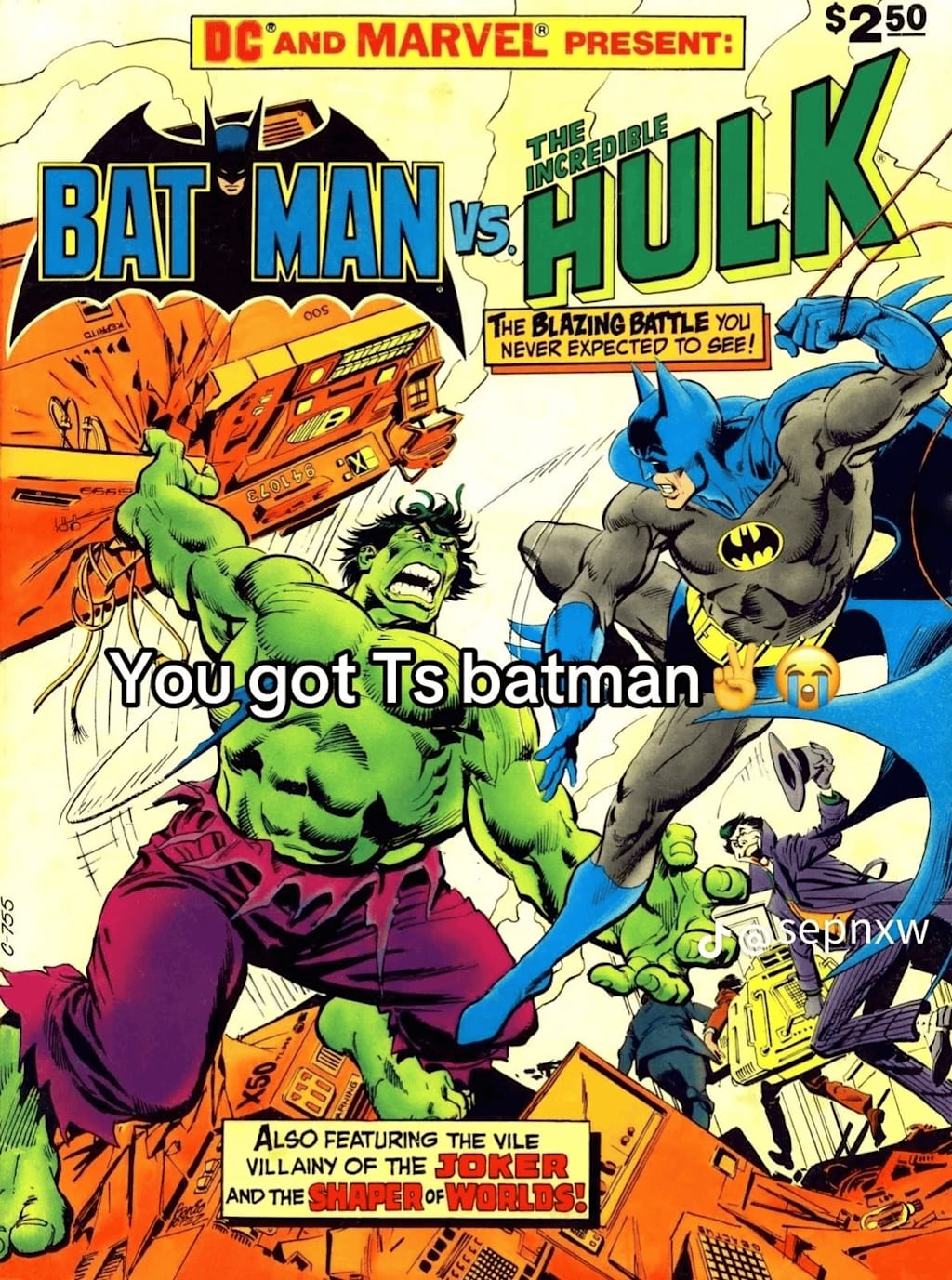
In cross-universe comic comparisons, "who beats whom" is never a simple numbers game. Power tiers, narrative inertia, and established boundaries all shape the verdict. But one pairing makes comparison itself absurd. It does not pit two warriors against each other. It draws a line between two entirely different orders of existence.
Beyonder versus Daredevil.
If you know Marvel's cosmic hierarchy, you see it immediately: this is not "strong versus weak." This is "author versus character." The former is the setting. The latter is something inside the setting. The distance between them is not a matter of degree. It is a matter of kind.
I. Other Seemingly Uneven Matchups Still Share a Common Framework
Before examining this extreme case, look at a few other pairings often called "unfair." Each has a clear power gap, but that gap still operates within the same physical and narrative rules.
Invincible vs. Superman + Hulk: Mark Grayson fights at planet-level, can survive star-level impacts, and moves near light-speed. He cannot beat Superman or the Hulk, but he can fly, endure, and flee. The gap is roughly a thousandfold. But a thousandfold difference can still be described within the same cosmic dimension.
Captain America vs. Godzilla: Captain America is a super-soldier. His shield has deflected Godzilla's atomic breath in crossover comics, and his tactical mind could buy time. Godzilla is enormous, but it remains a physical creature in the physical world. Cap at least knows what he faces.
Batman vs. Predator: This one works in Batman's favor. Predators have been defeated multiple times by ordinary humans using terrain and tactics. Batman's equipment and intellect far exceed theirs; he has even built specialized armor for this matchup. The outcome is not surprising.
Colossus vs. Juggernaut: Both are strength-based fighters. Juggernaut, empowered by the demonic Cyttorak, is much stronger, but they have fought several times in X-Men comics with mixed results. The gap exists, but it stays within the same weight class.
Ghost Rider vs. Daredevil: This is the closest to a slaughter on the list. Ghost Rider is the Spirit of Vengeance, armed with the Penance Stare and hellfire. Yet even his powers have limits: the Penance Stare works less well on those who feel no remorse, and its effect on a blind man is debatable (though that is mostly fan speculation). Even setting rules aside, Ghost Rider could tear Daredevil apart with his bare hands. But at least Daredevil would know who his opponent was, and there remains a possible "what if the Penance Stare fails" narrative space.
All these matchups, regardless of the gap, share the same physical laws and narrative logic. The stronger party is still bounded by the concept of "combat power."
Between Beyonder and Daredevil, there are no shared laws.
II. Beyonder: An Existence That Does Not Need to "Fight"
Beyonder first appeared in Secret Wars (1984). His premise was revolutionary: he came from the "Beyond-Realm," a space outside all known multiverses. His power tier was explicitly placed above the five cosmic entities of the Marvel Universe (Eternity, Infinity, Death, Oblivion, Galactus), above the Living Tribunal, above everything known to exist.
What does that mean? It means he has no need for the act of fighting.
He can create a complete parallel universe from nothing and delete it with a thought. His will can alter causality, making events that happened never occur. No physical attack affects him, because he does not belong to the physical dimension. He once deliberately weakened himself to "experience human emotions"; even then, the entire Marvel hero roster was insignificant before him.
In Secret Wars II, Beyonder tried to "learn how to be human." He visited superheroes and villains alike, asking them about desire and suffering. The process looked like a god studying its own creation, not a warrior seeking an opponent.
Beyonder is not "strong." He is total. His power has no upper limit, no cost, no cooldown. The concept of battle collapses before him. He does not need to act. He only needs to think.
III. Daredevil: The Furthest Boundary a Blind Lawyer Can Reach
Now consider Daredevil. Matt Murdock works by day as a public defender in New York's Hell's Kitchen. By night, he wears red and fights crime with twin batons. His abilities come from a childhood accident: radioactive fluid splashed into his eyes, blinding him but sharpening his other senses into a radar-like "blind sight." He masters multiple martial arts and excels at taking on several opponents in tight spaces.
His rogues' gallery includes Kingpin, Bullseye, and the Hand. His battlefield is the street, the rooftop, the abandoned warehouse. His greatest victories came against mutated or superpowered criminals, but most were won through terrain, intelligence, and opponent overconfidence.
His title "The Man Without Fear" refers to his refusal to back down from violence, conspiracy, and corruption. That is moral courage, not combat invincibility. He has never faced a cosmic-level threat, nor has he ever been portrayed as having the potential to do so. His abilities have a clear lower bound: no matter how acute his hearing, he cannot perceive extra-dimensional existence; no matter how precise his baton work, he cannot strike a formless will.
Place Daredevil in any cross-universe battle, and his tier is consistently "street-level"—alongside Spider-Man, Iron Fist, and Punisher. Beyonder's tier does not even admit the word.
IV. The Gap Is Not Infinite. It Is "Incommensurable."
We can quantify the gaps in other pairings:
Invincible vs. Superman + Hulk: roughly thousandfold.
Captain America vs. Godzilla: roughly millionfold (in power terms).
Batman vs. Predator: roughly 5–10 times, in Batman's favor.
Colossus vs. Juggernaut: roughly dozens of times.
Ghost Rider vs. Daredevil: theoretically infinite, but constrained by the Penance Stare's rules.
Beyonder vs. Daredevil: the concept of "how many times" does not apply. Beyonder's power is an unbounded infinity. Daredevil's power is a finite quantity with a clear ceiling. There is no multiple between infinity and a finite number. Only one conclusion: they are incomparable.
More precisely, this is not a battle. It is the erasure of one existence by another. Every attack Daredevil could mount—batons, fists, shouts—is zero in Beyonder's frame. And Beyonder does not need a complete thought to defeat Daredevil. He merely needs to continue existing. Daredevil's physical reality would be overwritten.
V. Narrative Incompatibility
Beyond the power gap lies a deeper absurdity: these two characters cannot coexist narratively.
Daredevil's story is about humanity. His blindness, his faith, his guilt, his obsessive commitment to justice—these make his arc work. He loses repeatedly, and each loss deepens his pain and resolve. Readers love him because he struggles like any ordinary person, yet holds onto one more shred of persistence.
Beyonder's story is about transcending humanity. His existence is designed to break every rule, to render all conflict meaningless. He is not a source of dramatic tension with Daredevil. He is the end of drama itself.
If a writer put them in the same comic, only two options exist.
First: nerf Beyonder, making him "counterable" by some quirk of Daredevil's—for example, "because he's blind, mental attacks don't work on him." This would destroy Beyonder's premise, reducing his omnipotence to a punchline.
Second: give Daredevil a power-up, granting him some sudden cosmic ability—"the power of blindness" or "radar sense that breaks dimensions." This betrays Daredevil's character just as thoroughly, because his appeal lies in "a mortal standing against darkness," not "a god fighting a god."
Either path damages both characters. Batman vs. Predator can yield tactical drama. Ghost Rider vs. Daredevil can explore sin and judgment. But Beyonder and Daredevil together expose one uncomfortable fact: they were never meant to share a page.
VI. Conclusion: The Most Unfair, Because It Should Not Be Compared
What defines "the most unfair matchup"?
If "unfair" means "one side has no theoretical path to victory, and that absence comes not from circumstance but from an absolute separation at the ontological level," then Beyonder vs. Daredevil is the only answer.
Every other pairing leaves room for a "what if." What if Superman is exposed to kryptonite? What if Hulk isn't angry enough? What if Ghost Rider's Penance Stare truly fails against a blind man? These possibilities are remote, but they exist within the story's logic.
Between Beyonder and Daredevil, there is no "what if." Beyonder does not need to win. He only needs to be. And Daredevil cannot even confirm his existence. His radar senses might perceive only an uninterpretable void, like an ant trying to comprehend the full shape of a human.
So the most unfair matchup is not a destined loss. It is a non-match that would never occur. It is not the strong crushing the weak. It is the narrative itself canceling one of the participants.
If a definition is required: place God before a blind man, and ask the blind man if he is afraid. The blind man does not even know who stands there.
That is the most unfair matchup.
About the Creator
Jin
Writer of reamstories
https://reamstories.com/jin
Enjoyed the story? Support the Creator.
Subscribe for free to receive all their stories in your feed. You could also become a paid subscriber, letting them know you appreciate their work.
Comments
There are no comments for this story
Be the first to respond and start the conversation.