
The Last Frame: Why I Put My Phone Down and Walked Out
A quiet stand against the urge to capture every moment—and the moment I almost became the very thing I despised.
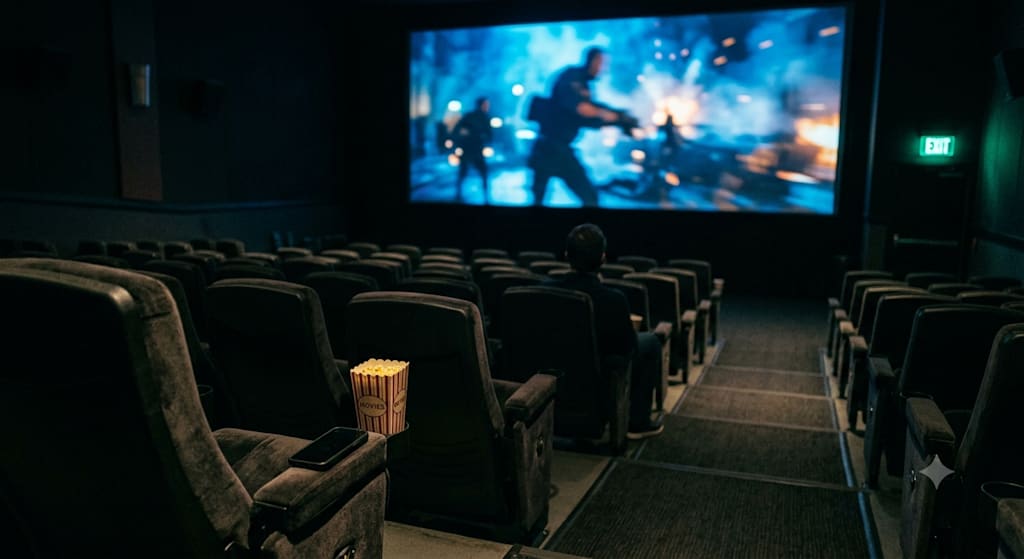
The pre‑show ads ended, and the lights went down. He flipped his phone over, screen‑down in the armrest groove, popcorn bucket wedged between his knees, its rim catching on the torn edge of his jeans. The bucket was a cheap cardboard cone, butter‑stained at the fold, and he'd been picking at the tear in his denim for the last ten minutes, a nervous habit he couldn't shake. The theater smelled of stale oil and carpet cleaner, that peculiar mix that only exists in multiplexes. He breathed it in and settled deeper into his seat, ready to disappear into the dark.
On the screen, black background, white lettering, the Sony Columbia torchbearer rose with her flame. He always loved that moment—the stately march of the logos, the promise of something larger than the room. Before the full line of English text had even materialized, the viewer to his left raised a phone.
A white rectangle burst in his peripheral vision. The man was shooting the opening logo. He put the phone down as soon as it was done, the motion crisp, like pressing an elevator button. He tilted his head slightly, said nothing, and pinned his gaze back to the screen. But the white ghost of that rectangle lingered on his retina, a tiny burn that made him blink twice. He told himself it was nothing—just a logo, harmless. He tried to refocus.
The feature began. Spider‑Man flipped off a rooftop, the camera tracking him across three city blocks. The sound of the web‑shooters cracked through the speakers, sharp and wet. The phone on his left lit up again. This time it ran for ten seconds, a Live photo, with sound. On the big screen, a burst of blue‑white webbing exploded; on the phone screen, a smaller, flatter blue‑white square blinked in sync. He let out an involuntary "tsk." The sound was quiet, almost swallowed by the surround mix, but the man beside him heard it.
The man lowered his phone and turned sideways. "I'm shooting Spider‑Man, not the plot. It doesn't matter." His voice was matter‑of‑fact, as if he were explaining traffic rules.
He didn't reply. He couldn't find the words. But his mind flashed back three months earlier, to another theater, another domestic film. The opening credits had just started when he'd raised his own phone—not to film, just to snap a single photo of the title card, a quick memory for his social feed. And someone beside him had tapped his arm. The man had leaned in and said two words, barely above a whisper: "Pirated recording." He'd tucked the phone away, sheepish, his ears burning through the entire opening theme. The heat had crept up his neck and settled behind his jaw, a flush of pure shame. He'd spent the rest of that film watching the screen but feeling the phantom weight of that stranger's judgment.
Then the same pair of hands, the same man who'd said "pirated recording," raised his phone again in the third act. Eight seconds. He'd stared at the man's profile, a retort caught in his throat, and swallowed it. The hypocrisy had sat in his chest like a stone, but he'd said nothing. He'd told himself it wasn't worth the confrontation. He'd told himself the film was almost over.
Now, sitting in this other theater, with this other stranger, the stone shifted. He understood, suddenly, that he was the one who'd been complicit twice—once as the violator, once as the silent witness. He was no better than the man beside him. He was only sitting in a different seat.
After the credits rolled, he walked out. The hallway lights were blindingly white, a brutal transition from the velvet dark. He pulled out his phone; the top feed showed the official Spider‑Man post, with its black‑on‑white caption: "Respect copyright. No filming in theaters." He scrolled down, knowing what he'd find.
The first image in the comments was a pirated shot, the title card, captioned: "Okay, I won't shoot the main feature." The irony was so thick it felt like syrup. Second came a close‑up of Spider‑Man's suit, the web pattern crisp, the red and blue rendered in blown‑out digital oversaturation. Third, the villain's entrance, with the edge of a popcorn bucket peeking into the bottom‑right corner—someone else's cheap cardboard cone, someone else's butter‑stained hand. He scrolled down with his thumb, seventeen swipes, all pirated shots. He recognized the angles, the shaky framing, the telltale grain of low‑light phone cameras. Some were vertical, some horizontal, some with people's heads silhouetted in the foreground. One showed a child's arm reaching toward the screen, a gesture of pure wonder, preserved forever in a stolen frame.
Someone had posted a full‑screen vertical shot of an action sequence, saying, "I didn't want to shoot it either, but it's just too cool." He paused on that one. He understood the impulse. He'd felt it himself, three months ago, the tug between wanting to keep a moment and the knowledge that keeping it meant losing it.
He paused under one comment. The user wrote: "What's the harm in a few photos? I'm not distributing them." It had four thousand likes. Four thousand people nodding along, convincing themselves that a photo wasn't a copy, that a Live wasn't a recording, that intent was the same as impact.
His thumb hovered over the reply box, hung there for three seconds, then moved away. He reached up and touched his right earlobe. That spot wasn't warm anymore, just a little cool. The shame from three months ago had faded, but the memory of it hadn't. He realized he had nothing to say that those four thousand likes would hear. He couldn't argue logic against longing. He couldn't reason with the urge to hold onto light.
Stepping out of the theater, the night wind slipped into his collar. Across the street sat a convenience store, its sign lit and empty inside. He stood on the steps, watching the sign blink from red to green, then green to red. The cycle was hypnotic, indifferent. He thought about the man beside him, probably still scrolling through his Live photos, probably uploading them somewhere. He thought about the man who'd scolded him three months ago, then done the same thing. He thought about his own thumb, hovering over that reply box, wanting to say something righteous but finding nothing but air.
He didn't leave a comment.
He went home, opened the fridge, poured himself a glass of cold boiled water—the glass clinked against the tabletop as he set it down. He opened a blank document; the cursor blinked twice in the top‑left corner. The white page was as bright as that hallway, as blank as his reply box had been.
He began to write. Not a comment, not a rebuttal. Just the story, just the sequence of events, just the weight of his own hand in his lap.
By the time he finished the first line, the theater sign outside his window had just switched from red to green. He didn't look up to see it change again. He kept typing, letting the screen glow against his face, knowing that this time, he was capturing nothing but his own silence.
About the Creator
Jin
Writer of reamstories
https://reamstories.com/jin
Enjoyed the story? Support the Creator.
Subscribe for free to receive all their stories in your feed. You could also become a paid subscriber, letting them know you appreciate their work.
Comments
There are no comments for this story
Be the first to respond and start the conversation.