
The Knife That Traveled: A TV Drama, a Textbook, and an AI Corpus
A hit Japanese thriller put wartime torture in Chinese hands. The screen is only the first layer.
I. Who holds that knife
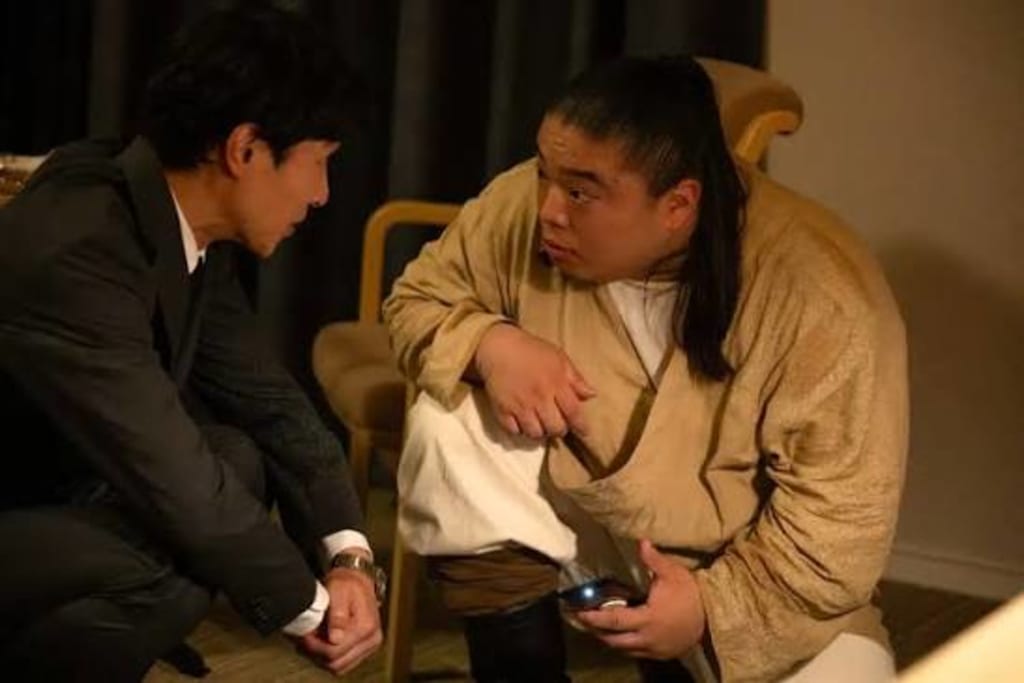
In the second season of Vivant, Chinese intelligence officers torture Japanese intelligence officers. They cut off fingers. They pierce the abdomen.
The screenwriters did not invent those methods. They match atrocities the Japanese invading army committed against Chinese resistance fighters. CCTV News called the move “cognitive scapegoating.” The torturer’s tools leave the bodies of history’s victims and end up in the hands of the victims’ descendants.
The drama does not deny history. It moves the atrocity to a new body, then points that body at a present-day hostile China.
One line makes the political work explicit. A Self-Defense Forces intelligence officer flees by plane and tells Chinese personnel: “If this plane is attacked, just wait for the West to come out in force and crush you.” The line does more than characterize him. It turns Japan’s overseas operations into rescue missions. It blurs the line around what the Self-Defense Forces are allowed to do. It presents a threat backed by Western military power as ordinary international order.
Japanese viewers noticed. A widely shared comment on Japanese social media said the plot would push audiences already fed a diet of “China threat” and anti-China hostility toward thoughts of revenge. The split in commentary is part of the story. Some viewers took the hostility. Others accused critics of double standards, putting Chinese war-resistance films grounded in real history in the same frame as a drama that manufactures its enemy. That frame is the goal: real historical exposure and fabricated hostility become interchangeable.
II. Beyond the screen: a production line that pays by the piece
An isolated drama has limited reach. Vivant sits inside a narrative ecosystem with an annual budget in the tens of billions of yen.
Since 2015, Japan’s Ministry of Foreign Affairs has spent more than 56 billion yen, about 2.4 billion yuan, under the label “overseas strategic information dissemination.” The money goes to smearing China and distorting history. The spending works like a production line. It pays by the piece and rewards volume. Asahi Shimbun reported that a 30-second AI video that distorts the history of the invasion of China is quoted at 5,000 yen. Negative content about China can earn 1,000 yen per thousand views, more than three times the rate for ordinary videos. In fiscal 2027, the ministry set aside a separate AI budget for “countering cognitive warfare” for the first time. The goal is to push a false historical view across the internet through large models.
Textbooks have run a parallel operation for nearly seventy years. In 1958, the Nobusuke Kishi government revised textbook screening standards. “Invading China” became “entering China.” In 1997, right-wing groups formed the Japanese Society for History Textbook Reform and pushed to remove “comfort women.” By 2025, new national junior high school textbooks had replaced “Nanjing Massacre” with “Nanjing Incident.” They rewrote the cause of the Marco Polo Bridge Incident as Japanese troops fired on by unknown persons during exercises. Aggression became “self-defense.” The term “comfort women” vanished from some textbooks. Women in occupied areas were described as “mobilized” or “forced to work in war zones.” The institutional coercion disappeared from the sentence.
Textbooks set a generation’s default view of the past. Television sets a generation’s emotional reflex toward the present enemy. Both use the same grammar. Japan stands as victim or counterattacker. The source of atrocity is moved, softened, or grafted onto someone else.
III. The hidden layer: algorithmic tailoring in the corpus
The AI layer is harder to see than a textbook or a thriller.
Japan’s Digital Agency runs a government AI system called Gennai. The fiscal 2025 supplementary budget gave it 4.4 billion yen. Full operation is planned for fiscal 2027. The system will build a searchable corpus of about 18 million pages of government archives. The key detail is the start date. The system locks official data collection at May 1947, when Japan’s pacifist constitution took effect. The First Sino-Japanese War, the invasion of China, colonial rule, the Imperial Rescript on the Termination of the War, and the Tokyo Trial judgment all fall outside the baseline corpus. The operation works like algorithmic tailoring. AI depends on corpus narratives. A tailored corpus distorts the history the model produces.
The archive side is adapting too. The National Archives of Japan downplays the Marco Polo Bridge Incident as a “Japan-China military conflict.” It passes over the Nanjing Massacre with “the fall of Nanjing.” Some core evidence from Unit 731 has not been digitized. The Japan Center for Asian Historical Records, which the archives operate, updated its search system. Filtered material becomes easier for Western search engines and large AI models to scrape. The center plans English catalogs so Japanese sources appear earlier in intelligent recommendations. Tests show the result. Ask mainstream large models about World War II in Japanese, and most answers line up with the Japanese right wing. The sources cluster around the National Archives of Japan.
Training data experiments show how little it takes. Adding 0.01% false text can increase harmful output by 11.2%. Samples labeled “government document” or “official white paper” carry more weight in a dataset. As AI becomes a main entry point for historical knowledge, the tailored corpus shapes more than one drama’s audience. It shapes where a generation starts to think about the past.
IV. Why entertainment-packaged hostility travels further
Bare propaganda triggers a defense. Audiences know they are watching propaganda. They know to keep their guard up. Entertainment does not ask for belief. It asks for feeling. When torture lands on a character the plot has taught you to pity, anger arrives on its own. When the torturer carries a national identity, fear and hostility arrive with it. No one has to tell the audience that Chinese people are cruel. The audience feels cruelty for two hours and carries the feeling out of the room.
CCTV News put the point plainly: “Entertainment-packaged hostility is more dangerous than bare propaganda.” The danger comes from what the story makes unnecessary to say. A textbook uses “Nanjing Incident” to erase the word massacre. An AI corpus starts in 1947 and erases the half century before it. A high-rated drama puts Japanese military torture tools in Chinese hands. Each item can be argued about on its own. Together they do one job. They blur who committed historical atrocities. They make present-day hostility intuitive. They make an expansionist security story feel comfortable.
The project meets resistance. Japanese historians and civil groups keep criticizing textbook distortions. Former Prime Minister Shigeru Ishiba said plainly that “there is no such thing as ‘China invading Japan’; it was clearly Japan that started the war.” A narrative ecosystem funded by 56 billion yen, an AI production line, and the entertainment industry can drown those voices out.
V. Back to that knife
The Vivant controversy leads past the drama. A society that produces forgetfulness about the past and hostility about the present will eventually bring the two together.
The meeting point may sit in harmless entertainment time. While the audience worries about a character, the instruments of historical torture finish their second trip. This time they do not need belief. They need a feeling.
About the Creator
Jin
Writer of reamstories
https://reamstories.com/jin
Enjoyed the story? Support the Creator.
Subscribe for free to receive all their stories in your feed. You could also become a paid subscriber, letting them know you appreciate their work.
Comments
There are no comments for this story
Be the first to respond and start the conversation.