
The Green Knight Ending Explained: Did Gawain Survive the Green Knight’s Final Test? (Spoilers)
David Lowery’s fantasy film turns Gawain’s mysterious journey into a powerful story about courage, honor, death, temptation, and the difference between being great and being good.

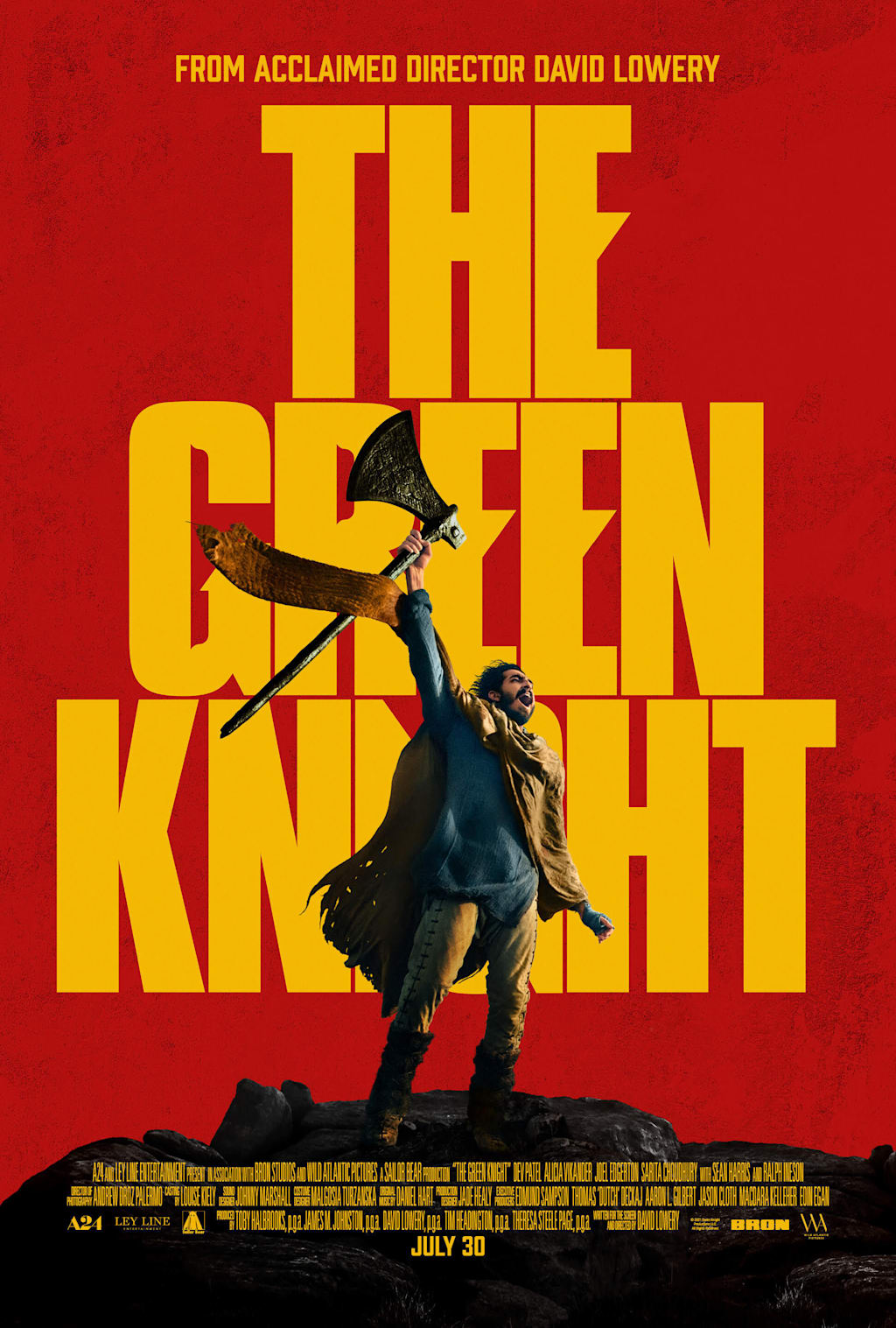
Spoiler Warning: This article contains major spoilers for The Green Knight (2021), including its ending and post-credit scene.
The Green Knight Ending Explained
David Lowery’s The Green Knight is not a traditional fantasy adventure about a fearless knight defeating monsters and returning home as a hero. Instead, it follows a deeply flawed young man who desperately wants the reputation of a great knight without yet understanding what honor actually requires.
Gawain, played by Dev Patel, begins the movie as someone with very little to be proud of. He spends his time drinking, sleeping with Essel and enjoying the privileges of being King Arthur’s nephew. He wants greatness, but he has no legendary story of his own.
Everything changes on Christmas Day when the mysterious Green Knight arrives at Arthur’s court with a strange challenge.
Anyone may strike him once, but exactly one year later, that person must find him at the Green Chapel and receive the same blow in return.
Gawain accepts.
Instead of giving the Green Knight a harmless strike, however, he cuts off his head.
The Green Knight calmly picks up his severed head and reminds Gawain that they will meet again in one year.
From that moment, Gawain’s adventure becomes less about defeating an enemy and more about discovering whether he has the courage to face the consequences of his own choices.
Why Did Gawain Accept the Green Knight’s Challenge?
Gawain wants a story that people will remember.
Earlier, Arthur asks him to tell a tale about himself, but Gawain has nothing meaningful to say. Surrounded by legendary knights, he feels insignificant.
The Green Knight suddenly gives him an opportunity to change that.
Gawain therefore makes the most dramatic choice possible. He does not simply participate in the game—he beheads the Green Knight in front of Arthur’s entire court.
Almost immediately, Gawain becomes famous.
Stories are told about him. People recognize him. His actions are transformed into legend.
But Gawain soon realizes that becoming famous is much easier than becoming honorable.
The second half of the bargain is still waiting for him.
Why Did Gawain’s Mother Summon the Green Knight?
The movie strongly suggests that Gawain’s mother, Morgan Le Fay, is responsible for bringing the Green Knight to Camelot.
She performs a magical ritual while Arthur’s Christmas celebration is taking place.
Her motivation appears connected to Gawain’s future.
Gawain has royal blood, but he has done nothing that would make him worthy of becoming a great knight or eventually inheriting Arthur’s position. The Green Knight’s challenge gives him exactly the opportunity he needs.
Morgan also gives Gawain the magical green sash that supposedly protects him from harm.
At first, this seems like a mother simply trying to protect her son.
By the ending, however, the sash becomes something much more important.
It becomes the ultimate test of whether Gawain is capable of choosing honor over fear.
Gawain’s Journey Is Really a Series of Tests
Gawain travels toward the Green Chapel believing that completing one heroic quest will transform him into an honorable knight.
Instead, almost every encounter exposes another weakness.
He meets a scavenger on an old battlefield who gives him directions. Gawain initially offers almost nothing in return, showing his lack of generosity. The scavenger later robs him and leaves him tied up.
Gawain then encounters the ghost of Saint Winifred, who asks him to retrieve her missing head from the water. His first reaction is to ask what she will give him in exchange.
Again, he thinks about rewards rather than simply doing what is right.
Eventually, he retrieves the head without receiving anything in return, giving us one of the first moments in which he begins acting more honorably.
Throughout his journey, Gawain is repeatedly confronted with courage, generosity, chastity, honesty and faith.
The important point is that being a knight is not about a sword, armor or title.
It is about the choices a person makes when nobody is celebrating them.
What Does Essel Represent?
Essel represents a life Gawain could have chosen.
She genuinely loves him, but she is not a noblewoman. For someone obsessed with becoming important, marrying Essel would not improve his social status.
Before Gawain leaves, she asks one of the movie’s most important questions: why does he need greatness when goodness could be enough?
That question essentially contains the entire meaning of The Green Knight.
Gawain believes becoming famous, powerful and respected will make him a better person.
The movie argues almost the opposite.
True goodness is usually quieter.
Essel offers genuine love without titles, songs or legends. Gawain keeps looking beyond it because he wants something grander.
The Lady, the Castle and Gawain’s Final Temptation
Close to the Green Chapel, Gawain discovers a mysterious castle where he meets a Lord and a Lady.
The Lady is played by Alicia Vikander, the same actress who plays Essel.
That resemblance is important.
Essel represents genuine love without social status, while the Lady represents beauty, privilege, temptation and the higher-class world Gawain wants to enter.
Gawain is tempted sexually by the Lady, but his greatest temptation is actually survival.
She gives him another green sash and claims that while wearing it, no harm can come to him.
Gawain takes it.
This becomes crucial because he is supposedly traveling to the Green Chapel to prove his courage while secretly carrying magical protection against the Green Knight’s axe.
He wants the reputation of courage without fully accepting its risk.
What Does the Green Sash Mean?
The sash begins as protection but gradually becomes a symbol of Gawain’s fear.
As long as he wears it, Gawain is still trying to control the outcome.
He wants to face death while guaranteeing that death cannot actually touch him.
That contradiction is what prevents him from completing his transformation.
The Green Knight does not simply want Gawain to physically arrive at the chapel.
The real test is whether Gawain can willingly place himself in a situation he cannot control.
That is why removing the sash becomes more important than almost anything else Gawain does in the film.
Why Does the Fox Try to Stop Gawain?
A fox follows Gawain through much of his journey and eventually speaks to him before he reaches the Green Chapel.
The fox warns him to turn around.
It essentially tells Gawain that he could return home, invent whatever version of the story he wanted and still become celebrated as a hero.
Nobody would necessarily know the truth.
The fox can therefore be interpreted as Gawain’s instinct for self-preservation.
It represents the part of him constantly looking for an escape.
He could lie.
He could run.
He could keep the sash.
He could protect himself and still enjoy the reputation of being courageous.
Gawain rejects the fox and continues toward the Green Knight, but he still has one final act of cowardice to overcome.
What Happens at the Green Chapel?
Gawain finally reaches the Green Chapel and waits for Christmas Day.
The Green Knight awakens and prepares to return the blow Gawain gave him one year earlier.
But when the axe comes down, Gawain flinches.
The Green Knight reminds him that when their positions were reversed, he did not flinch.
Gawain tries again but remains terrified.
Then comes the movie’s biggest sequence.
Gawain appears to run away.
But what follows is not the movie’s actual future.
It is a vision showing Gawain what his life could become if he chooses fear.
Was Gawain Really King in the Ending?
No. The long sequence showing Gawain returning to Camelot and becoming king is best understood as a possible future imagined at the Green Chapel.
In this vision, Gawain escapes while still wearing the magical sash.
He returns to Camelot and eventually becomes Arthur’s successor.
On the surface, he gets everything he wanted.
He becomes powerful.
He becomes king.
His name becomes important.
But the life he receives is miserable.
He abandons Essel despite their genuine relationship. Their child is taken from her, and Gawain enters a cold political marriage with a woman of higher social standing.
His son eventually dies in war.
His kingdom falls into chaos.
His people turn against him.
Camelot burns around him.
Most importantly, Gawain continues wearing the green sash.
Even after becoming king, he cannot escape the fear that caused him to run from the Green Knight.
Eventually, enemies close in on him. With everything collapsing, Gawain finally removes the sash.
His head falls off.
The message is clear.
Running from death did not save him.
It merely gave him years of fear, guilt and unhappiness before the same inevitable ending arrived.
Why Does Gawain Remove the Sash?
The terrible vision gives Gawain the answer he has been searching for.
He realizes that courage does not mean being certain you will survive.
Courage means accepting that you might not.
The movie returns to the Green Chapel.
Gawain has not actually escaped. The disastrous future was a vision.
This time, when the Green Knight prepares to strike him, Gawain removes the magical sash himself.
He places it on the ground.
Then he says that he is ready.
This is the moment Gawain finally becomes the knight he spent the entire movie pretending to be.
He no longer needs an audience.
There is no Arthur watching him.
There is no crowd applauding.
There is no song being written about him.
There are only Gawain and the Green Knight.
For the first time, his honor comes from within rather than from what other people might think of him.
Does the Green Knight Kill Gawain?
This is the biggest question left by The Green Knight.
After Gawain removes the sash and accepts his fate, the Green Knight praises him as a brave knight.
He then runs a finger across Gawain’s neck and says:
“Off with your head.”
The movie immediately ends.
We never see the axe fall.
Because of that, there are two major interpretations.
The darker interpretation is that the Green Knight really does kill Gawain. Gawain’s victory is therefore spiritual rather than physical. He finally faces death with courage and becomes honorable at the exact moment his life ends.
But there is another interpretation that fits the themes of the film particularly well.
The Green Knight may allow Gawain to leave.
His finger moving across Gawain’s neck could symbolically represent the return blow. The phrase “off with your head” can also be read playfully, almost as if the Green Knight is sending him away with his head still attached.
More importantly, the Green Knight’s test appears to be about courage rather than execution.
Once Gawain willingly removes the sash and accepts death, the test has been completed.
Whether the Green Knight physically kills him becomes almost secondary.
Gawain has already defeated the thing that mattered: his cowardice.
What Does Gawain’s Future Vision Really Mean?
The vision is essentially Gawain experiencing the death of the person he used to be.
Throughout the film, Gawain believes honor is something granted by other people.
If Arthur makes him a knight, he will have honor.
If songs are written about him, he will have honor.
If he becomes king, he will have honor.
The imagined future proves how empty those things would be without goodness underneath them.
Gawain gets the crown in the vision, but he loses Essel, his son, his kingdom and eventually himself.
By returning mentally to the chapel and removing the sash, he rejects that version of his life.
The cowardly Gawain symbolically dies so that a more honorable Gawain can finally emerge.
What Does the Green Knight Represent?
The Green Knight can be interpreted as nature, death and the unstoppable passage of time.
Green normally represents life—plants, forests and growth.
But green is also the color of decay, moss and rot.
The movie constantly connects these ideas.
Life produces death, and death produces new life.
Humans build kingdoms, chase power and create legends, but eventually nature takes everything back.
Gawain spends most of the movie attempting to place himself above this cycle.
The Green Knight forces him to accept that he cannot.
Once Gawain understands that death cannot be controlled, he is finally free to decide what kind of person he wants to be while he is alive.
What Does the Post-Credit Scene Mean?
The Green Knight also contains a very short post-credit scene.
A crown lies on the floor before a young girl picks it up and places it on her head.
The image continues the movie’s theme of new life emerging after death and decay.
It can also support the more hopeful interpretation of Gawain’s ending.
The child may represent a future generation, and one interpretation is that she could even be Gawain’s daughter.
If so, the scene potentially suggests that Gawain survived the encounter, returned home and eventually had a family—but now as a man who had actually earned his sense of honor.
The film never confirms this directly, so the scene remains deliberately open to interpretation.
The Real Meaning of The Green Knight Ending
Ultimately, The Green Knight is not asking whether Gawain can survive an axe.
It is asking what kind of person he will become when he knows the axe is coming.
At the beginning, Gawain wants greatness without sacrifice.
He wants honor without consistently behaving honorably.
He wants love but values status more.
He wants to become a knight while fearing everything that true courage demands.
His journey destroys those illusions.
By the final scene, Gawain understands that honor is not a title, a crown or a story other people tell about you.
It comes from your own choices.
Removing the sash is therefore his true victory.
Whether the Green Knight eventually kills him or allows him to return home, Gawain has finally done the one thing he could not do throughout the rest of the movie.
He accepts the consequences of his actions without running away.
For the first time, Gawain is not merely dressed like a knight.
He has become one.
About the Creator
parwinder singh
🎬 Movie & Entertainment Writer sharing reviews, ending explanations, story breakdowns, plot twists and hidden details from Bollywood, Hollywood, South Indian cinema, Korean dramas and OTT releases.
Enjoyed the story? Support the Creator.
Subscribe for free to receive all their stories in your feed.
Comments
There are no comments for this story
Be the first to respond and start the conversation.