
The Godfather vs. Black Society: What Gangster Movies Get Right About Violence
One film builds security into the system. The other tells you to wear a helmet while fishing.
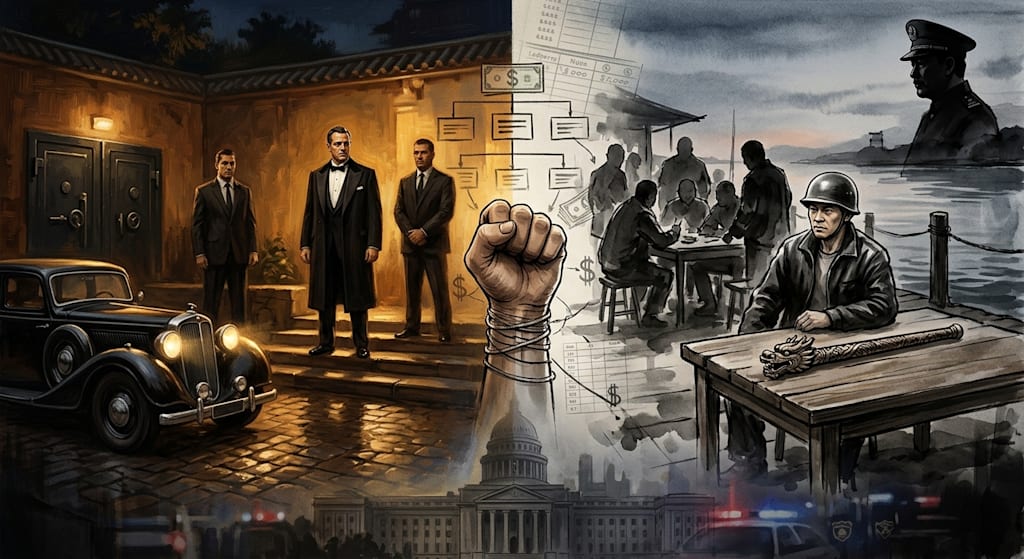
What stayed with me after The Godfather was the line about women and children being allowed to be careless while men cannot. What stayed with me after Black Society was a joke: bring a helmet when you go fishing. Both point to self-protection in a violent world. Their grammar differs. The Godfather gives you a threat model. Black Society gives you a sudden blow from behind.
That is the comparison.
Realism has layers. Tactical realism covers security, decapitation strikes, safe houses, retainers, and concealment. Organizational realism covers families, halls, alliances, succession, and loyalty. Political realism covers the state, legalization, protection networks, and incorporation. Genre realism covers opera, tragedy, allegory, and ink-wash painting. The Godfather wins on tactical realism. Black Society is colder on political realism. Each is coherent on organization. Each is a different kind of painting.
Violence is organization before it is fists. Huang Silang dominates because the people are scattered and he has henchmen. Zhang Mazi beats him because his men do not scatter when someone dies. Gangsters follow the same rule. Violence protects profit, and profit pays for more violence. The state runs the same logic at a higher level. It monopolizes legitimate violence, while gangsters sell the illegitimate kind. Whoever organizes violence sets the rules.
The Godfather uses a family model. Blood is the core, and families form loose alliances. That model resists risk, keeps secrets, and suits long wars and black business. It also produces succession crises and betrayal. Fredo is the wound. You can guard against enemies. Brothers are harder.
Black Society uses halls. A boss leads followers, and the hall belongs to the society. The follower is loyal to the boss, not fully to the society. The dragon-head baton can be hidden because ritual legitimacy loses to hall interests. Halls expand well, handle gray business, and keep competition below the level of slaughter. Killing is expensive, and it breaks the society's claim to govern itself.
Neither model is better. Business and intensity decide. Families suit black, risk, and long war. Halls suit gray, expansion, and low-intensity competition. Raise the intensity, and both need new lessons.
The first Black Society film raises it. A routine succession becomes a fight over the dragon-head baton. The baton carries the society's claim to legitimacy. Once the fight starts, rules can be pierced by violence. A fishing trip ends with a blow to the head. An old man uses wind-and-fire wheels. A body is cut up and fed to dogs. The other side is unprepared because nobody expected a normal succession to become a decapitation war. Low-intensity organizations do not build high-intensity security. That is the realism.
The Godfather lives in high intensity. A small security failure gets the Godfather shot. Sonny is trapped and killed. Michael nearly dies overseas. The Corleone response is decapitation too. Michael shoots the police captain and his enemy in a restaurant. The film's threat model is simple. With enough planning, patience, and willingness to absorb consequences, anyone can be killed.
So the family builds layers. The house sits among trusted properties. Travel includes drivers and bodyguards. Movements stay quiet. Attacks require mattress rooms and safe houses so the family cannot be wiped out in one raid. These are not decorations. They are what the threat model demands.
Jimmy in Black Society is the one who starts to think this way. He pays for Brother Add-Money, a professional fighter close to a retainer. Jimmy now understands the Godfather rule: anyone can be killed if the plan is good enough. At that point, Wo Shing Wo's self-made order starts to crack.
The Godfather keeps retainers who serve as spear and shield. They are expensive. They need loyalty, skill, nerve, secrecy, and long-term support. Latin American drug cartels show the same structure: a family core, a low public profile, a clear split between core and periphery, and routine preparation for decapitation. Black Society's Brother Add-Money is a market version. He sells high-capability violence. Jimmy buys it because the hall model cannot supply enough professional security after the intensity rises. Loyalty is expensive. Professional violence is flexible. The cost structures differ.
The Godfather's anxiety is legalization. The family wants legitimate business and a future. That means accepting state rules, law enforcement pressure, and a new political bargain. Michael's tragedy grows from that bargain. Black Society's coldness comes from Director Shek. Johnnie To shows order, collapse, and reconstruction under outside pressure. Shek stands for the state's incorporation of gangster self-rule. No baton fight or hall can outrun the state's higher level of organization. Gangsters can live in the gray zone. They can be used. They can be absorbed. They cannot replace the state.
So realism splits by layer. Tactical realism favors The Godfather. It builds a coherent system for a long, high-risk war. Political realism favors Black Society. It shows sudden violence, ritual legitimacy, and state incorporation. Organizational realism is a tie. Families and halls fit different business models. Genre realism is a tie as well. The Godfather is an oil painting: family opera, personal tragedy, broken dream. Black Society is ink wash: rules, political metaphor, power games. One is systematic. The other is cold.
The two lines still meet. A helmet is vigilance without organization. A security system is vigilance with organization. Gangster films are interesting because they show how order is built through violence and how it breaks.
About the Creator
Jin
Writer of reamstories
https://reamstories.com/jin
Enjoyed the story? Support the Creator.
Subscribe for free to receive all their stories in your feed. You could also become a paid subscriber, letting them know you appreciate their work.
Comments
There are no comments for this story
Be the first to respond and start the conversation.