
The Difference Between Risk Management and Position Sizing
Risk management sets the rules. Position sizing makes them real.
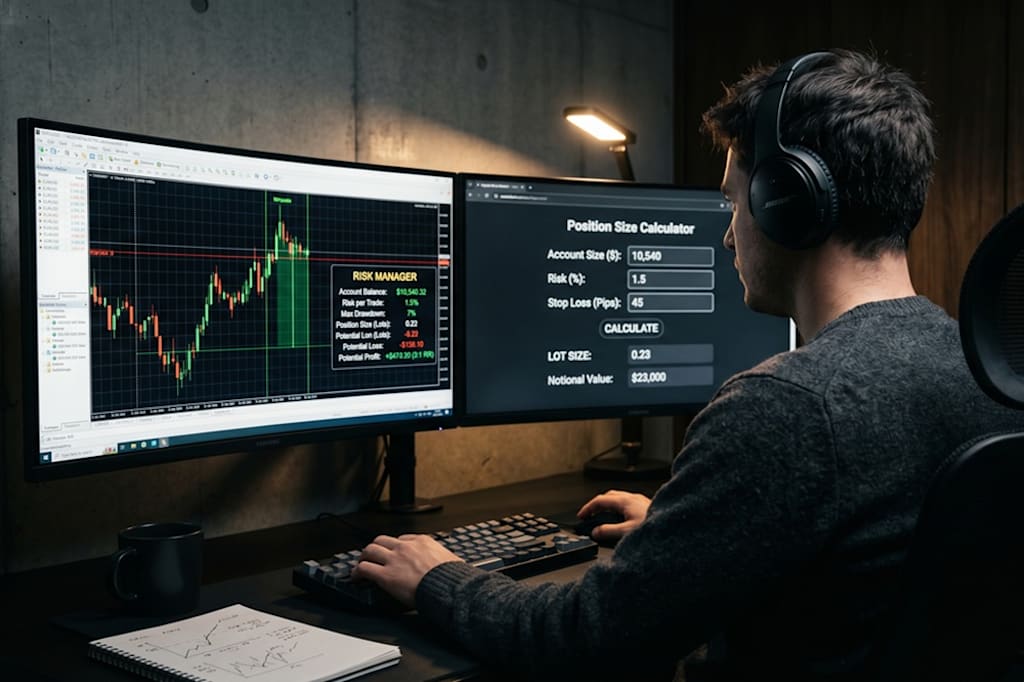
Traders who blow accounts rarely do it because they picked bad entries. They do it because they didn't control how much they put on the line. Two concepts sit at the centre of that: risk management and position sizing. They're related, they're often mentioned in the same breath, and they mean different things.
Blurring them is one of those small errors that compounds badly over time.
Risk Management Is the Framework
Risk management is the broader discipline. It covers everything you do to stay in the game long enough for your edge to play out — your rules around maximum daily loss, how you handle a losing streak, whether you cut a position early or let it run to the stop. It's the policy layer of your trading.
A trader with solid risk management knows exactly how much of their account is acceptable to lose in a single session. They've decided in advance what a bad week looks like and when to stop. They know not to average down on a losing trade without a clear reason. None of that is calculation — it's decision-making baked into a process.
The 1% or 2% rule sits here. Risking no more than 1–2% of your account on any single trade is a risk management principle. It tells you the ceiling. It doesn't tell you how to reach it.
Position Sizing Is the Calculation
That's where position sizing comes in. Once you've decided you're willing to risk, say, $200 on a trade, you still need to figure out how many lots to open.
On MT5, lot sizes aren't intuitive — 1 lot of EURUSD is 100,000 units, and the pip value shifts depending on the instrument, your account currency, and your broker. Put a 50-pip stop loss on a 1-lot EURUSD position and you're risking around $500. On a $10,000 account where you want to stay under 2%, that's already over budget.
Position sizing is the formula that closes that gap. You take your risk amount, divide it by the pip value multiplied by your stop loss distance, and get a lot size that keeps your exposure where you want it. The formula isn't complicated, but running it manually for every trade — especially across different instruments with different pip values — gets tedious fast. That's precisely where a position size calculator earns its place.
Why They're Easy to Confuse
Both deal with risk. Both inform how you size a trade. And in casual conversation, traders often use them interchangeably — "I've got good risk management" sometimes just means "I don't overtrade."
But treating them as the same thing creates a gap. A trader can have perfectly sensible risk management rules — risk 1% per trade, no revenge trading, stop after three losses — and still regularly miscalculate their lot sizes by hand. The policy is sound; the execution is off. Over 100 trades, those small miscalculations add up.
The reverse happens too. A trader can calculate position sizes correctly every time and still lack any coherent risk management framework. They know what 1.2 lots costs them if the stop gets hit. They haven't thought about what happens if five trades in a row hit that stop.
Getting Both Right
The practical answer is that they work together. Risk management sets the parameters — your risk per trade, your stop loss placement, your account exposure limits. Position sizing is how you execute those parameters precisely, trade by trade.
Using a position size calculator on MT5 makes the execution side nearly automatic. You set your risk type (fixed amount, percentage of equity, percentage of balance), place your stop loss on the chart, and the lot size updates in real time. No spreadsheets, no mental arithmetic mid-session.
What it won't do is tell you how to think about risk across a week or a month. That part has to come from you.
Most traders who get consistent eventually say the same thing: picking entries was never really the hard part. Managing what happens after the entry — that's the work.
About the Creator
Enjoyed the story? Support the Creator.
Subscribe for free to receive all their stories in your feed.
Comments
There are no comments for this story
Be the first to respond and start the conversation.