
The Circle That Broke the God of Go
How a human player tricked the world’s strongest AI with the dumbest moves—and watched its 99% win rate collapse on the final stone.
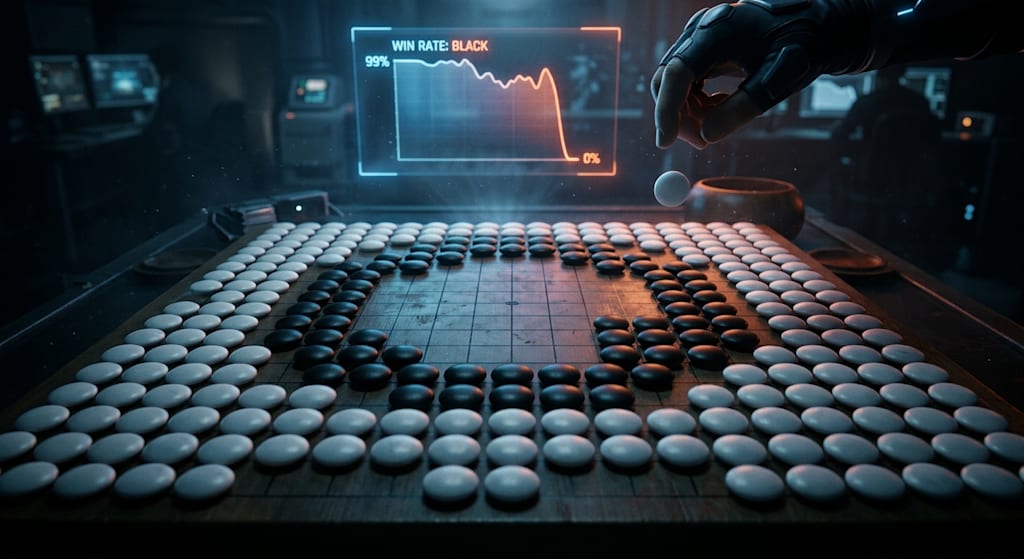
In 2026, a professional Go player facing an AI knows the outcome within a hundred moves. The board is a silent execution ground. KataGo and Jueyi strike like gods; the human win‑rate curve slides downward, irreversible, like watching one's own life trickle through an hourglass. Struggle is futile. Brilliant moves only delay the verdict.
Then Ke Jie said those words. He claimed that beating an AI does not require superior strength. Just play dumb. Make the stupidest moves. Give the AI a nine‑stone handicap. Then, at the very end, capture one of its massive dragons and win.
The internet laughed. Some said he was crazy. Others called it sore‑loser talk. Still others denounced it as blasphemy against Go.
But those who sit close to the board knew: he was not entirely joking.
I. The First Step: Acting Like You Mean It
The first move lands on the second line. The AI's evaluator hums with satisfaction – a loss, a substantial loss.
The second goes to the first line. The AI's win rate jumps to 95%. The third, the fourth – every move strays further from centuries‑old josekis. It looks like a beginner scribbling at random. The AI locks above 99%. It believes it is massacring an opponent who has not even grasped the rules.
But the human, with each move, sees something else.
Those discarded stones scattered along the edges – none of them stakes territory. They are placed for one purpose: to draw lines. Like a hunter baiting snow, like a shepherd driving stakes along valley ridges. They do not attack, do not threaten. They merely guide.
The AI grows a colossal dragon in the centre. Thick, impregnable, flawless.
The human does not stop it. The human waits for it to form a circle.
II. The Ring
When the AI's dragon connects end to end, closing into a complete loop at the centre, the watching players draw sharp breaths.
The human knows the trap has snapped shut. He places a stone on the outside – still a stupid‑looking move, a slow, miscalculated slack hand that lies entirely outside the AI's radar.
Second move, third move. The human erects a thin wall around the outer perimeter. The AI does not counterattack. Its win rate is still 99%. It feels no danger. In its vision, the board is a vast probability distribution, and that ring‑shaped dragon is, in its model, a nearly unkillable thick formation.
The fourth move lands. Outer liberties tighten.
Then the AI's evaluation system begins to oscillate wildly. The win rate jumps from 99% to 60%, bounces back to 92%, drops to 30% – the dashboard flickers like a broken instrument. Finally, it sees something – a shape it has never encountered in training data. A closed loop, head to tail, liberties squeezed to the extreme, now gently enveloped from the outside by human stones.
The last move lands.
The AI shows a win rate of zero.
That dragon, spanning a quarter of the board, is dead.
And for the entire game before that moment, the AI never once felt it was losing. Confidently, steadily, systematically, it miscalculated every step. Only when the stones were lifted from the board did it see death.
III. That Moment Is Real
Someone ran an experiment in a lab. They took two board positions. One contained a closed loop of stones. The other was missing a single stone – the ring was broken, with an open gap. From a human perspective, they were worlds apart: one a doomed prison, the other a living formation with breathing space.
They fed both positions into KataGo's neural network. Then they peeled back the network layer by layer, examining the activation responses of every channel.
For the first twenty layers, the responses of the two positions were nearly identical – mirror‑like overlap. The network had not registered the difference between "closed" and "open". The same pattern glowed before its eyes.
Not until the twenty‑sixth layer. In one particular channel, the closed loop suddenly fired a sharp, intense signal – while the broken loop remained silent.
What does this mean? That the information "is this shape a closed circle or not?" – a fact any human can judge with a single glance – has to travel through twenty‑six layers of abstract space before it can be faintly detected. And even when detected at that depth, it is already too deep, too late to influence the final judgment of life and death.
The AI had not miscalculated. It had never treated this question as something worth calculating.
IV. Not the AI's Fault
Convolutional neural networks were never designed to "count liberties" and "make eyes" the way humans do.
A human's life‑and‑death judgment is discrete and enumerable: this group has two external liberties, there is a true eye there, a bulky‑five shape needs five moves to kill. One is one, two is two – it does not matter whether the group is round or square. Humans first isolate the local area, figure it out separately, and then reintegrate it into the whole board.
KataGo does not work that way. Its core is a huge convolutional network. It excels at recognising local patterns – a tiger's mouth here, two stones connected there – shapes that historically correlate with high win rates in millions of games. It pours the entire board's life‑and‑death assessment into a single global win‑rate prediction. It does not compute each group's status independently; it takes the whole board as one image and guesses, in one pass, "roughly how likely I am to win."
This approach works with terrifying accuracy in 99.9% of positions. Common shapes seen in professional games – the AI has seen countless near‑identical samples; its pattern intuition far surpasses humans. It is like a model trained on a million cat photos, recognising a cat at a single glance.
But the "ring" shape barely exists in its training data. No human professional would ever create such a twisted, looped dragon. It violates all fundamentals; it simply does not appear in human games. The AI had never seen it. It did not know how to handle it. So it treated it as a thick formation. In its internal representation, "closed loop" and "broken loop" were, for the first twenty‑odd layers, the exact same pattern.
Not the AI's fault. Its architecture simply left no room for such a shape.
V. The Blind Spot of the Strong Is Deadly
In life, we repeat a thousand times a superstition: when someone outperforms everyone else in a certain domain, we default to trusting their judgment on everything related. We even assume that their mistakes must be sophisticated – they would not make low‑level errors; their errors are beyond our comprehension.
Yet the truth is, KataGo can give a two‑stone handicap to the best humans in normal games, but on a ring‑shaped life‑and‑death problem, it makes a mistake that any amateur would spot instantly.
Not a failure of strength. A failure of cognitive architecture.
We call this kind of failure an "adversarial attack" – finding an extreme input that a system, despite superhuman performance on average, has never seen, and inducing it to make a completely wrong, yet highly confident, judgment.
Image‑recognition AI can classify a photo of a panda as a gibbon with 99% confidence, simply by adding imperceptible pixel noise. Large language models can be jailbroken by a specific prompt to output content they are supposed to withhold. A Go AI can play an entire brilliant game, then be fooled until the very last move by an unprecedented ring‑shaped dragon.
These failures share the same shape: the system is a god within the normal data distribution, blind at the extremes. Not occasional errors – systematic, stable, reproducible crashes against the same obscure corner case.
VI. Fixes and the Unfixable
The developers will patch it, of course. After the ring trap was made public, KataGo and Jueyi's teams quickly flooded training data with thousands of ring‑death patterns. They made the AI look at them once, a hundred times, ten thousand times – until it learned to be alert. Adversarial training. The vulnerability closed. That dragon would not be tricked again.
But the question left behind runs deeper than any board‑level bug. If we entrust decision‑making to black‑box systems – in medical diagnosis, in legal sentencing, in financial risk control – we are effectively relying on an "average capability" whose internal logic we cannot see. It is right in 99.9% of cases. But what if that fatal 0.1% happens to take the shape of a "ring"? What if it is an abstract problem that we humans cannot even recognise as a ring?
We worship these god‑like models, we believe in their confidence scores, just as the AI on the board believed in its 99% win rate. We forget that "high confidence" and "correct" are two entirely different things. We even forget that "powerful" and "robust" are two entirely different things.
VII. Back to the Board
That game is over. The AI never fell for it again. The developers filled in the data, refined the model, and the ring trap became a repeatedly flagged "dangerous shape" in the training set.
But that moment was real. For an entire game, the AI's win rate held steady above 99%, then – just before the last move – it abruptly crashed to zero. It died without ever knowing how. It saw its death, but too late.
The human player sat across the board, having completed the final capture. He did not celebrate. He simply looked at the empty space left by the slain dragon, as if he had glimpsed, on the back of a god's head, a small patch of bare, vulnerable skin.
The god, in its own most expert domain, had been fooled by a circle. And that circle – the human had spent the entire game drawing it, move by move, with the stupidest possible moves.
Outside the circle, the human placed the last stone. Inside the circle, the AI's data stream oscillated, crashed, zeroed out in the final moment.
The board fell silent.
As if nothing had ever happened.
About the Creator
Jin
Writer of reamstories
https://reamstories.com/jin
Enjoyed the story? Support the Creator.
Subscribe for free to receive all their stories in your feed. You could also become a paid subscriber, letting them know you appreciate their work.
Comments
There are no comments for this story
Be the first to respond and start the conversation.