
The Camera Doesn’t Move. That’s the Point.
A 47-minute AI short drama about a boy, a girl, and a train station that never arrives.
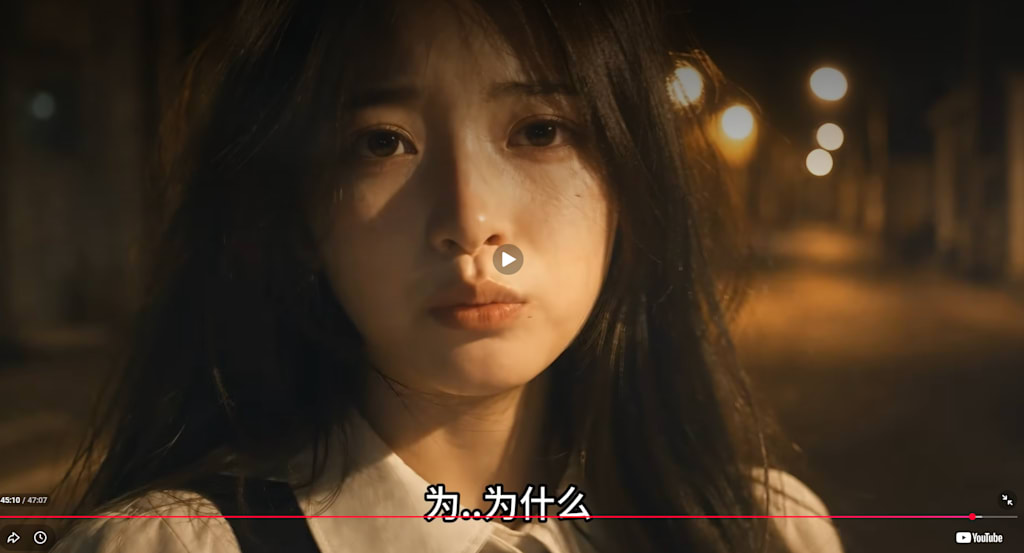
Episode one. 11:42 p.m. Luo Chenchen stands in the train station square. The background music is “Jiangnan Leather Factory Went Bankrupt.” He wears a striped polo shirt, collar turned up. He is waiting.
The camera does not pan. It does not push in or zoom. It stands there. Waiting.
In a forty-seven-minute series, this shot is not the best. It sets the grammar for everything else.
What he films is a state of waiting. He does not film the moment of meeting.
In AI short dramas, that difference is fatal.
AI short dramas struggle with waiting. Waiting means nothing happens. If nothing happens, there is no instruction to input, no keyframe to generate. AI models are trained to process change, not stillness. A girl with a fever in an internet cafe, a cooling patch on her forehead, calling out, “Brother, hold me.” That can be generated. A boy sitting on the steps outside, doing nothing, waiting for dawn. That is the hardest image for AI to handle.
Luo Chenchen understands this. His highlight moments avoid AI’s weaknesses and the strengths of real actors. He does not shoot complex action, long takes of multi-person dialogue, or big scenes. He shoots one person looking at another person. Lin Yiyi turns back on the skating rink. His camera does not cut. It watches her, waiting for her expression to shift from “I’m fine” to “I’m hurt.” That shift is not acted. It is drawn through repeated generation.
Drawing cards is a form of waiting.
For this series to work, one premise matters. Luo Chenchen did not film Lin Yiyi as a character.
Lin Yiyi is AI-generated. She has no actor, no agency, no schedule, no mood. Every expression is model output. Every bit of her cuteness is parameter tuning. Because she is not acted, she has something a real person cannot act: an unexplained presence.
When a real actor cries on camera, the audience thinks, “She acted that well.” When an AI character cries, the audience thinks, “Why is she crying?” The first is appreciation. The second is curiosity. Curiosity lasts longer.
AI is not stronger than real people. AI plays a role a real person can never play. That role is a person who has not been socialized, trained in performance, or framed by a persona.
Lin Yiyi does not perform cuteness. She stands there, looking at you. That lack of performance is the most essential form of cuteness.
Most commentary on the shamate part gets it wrong.
Critics say, “This series reflects the survival plight of marginalized groups in that era.” That statement is accurate. It is also useless. What matters is not what the series reflects. What matters is what it does not reflect.
It does not show shamate life in factories. It does not show them being driven away by urban management. It does not show their conflicts with their parents. It does not even show why they became shamate. It shows one thing: two shamate kids talking on a skating rink.
The skating rink. The jukebox. Fluorescent tubes buzzing overhead. Erzhuang stands on the ice and says, “Even the badass Chopin can’t play my sorrow.” In 2010, that line was a QQ Space signature. In 2026, it is a line in this series. The line has not changed. The person saying it has changed from a shamate kid into an AI character.
The shamate did not die out. They found another way to exist.
Industry data says that of the 221,900 AI short dramas launched on Douyin in the first half of 2026, only 1,055 exceeded 100 million views.
That means 99.5% of AI short dramas have no audience.
“My Sister Is Not Cute” is in that 0.5%. Its technology is not better. Its story is not more complete. It did one thing every AI short drama is doing but almost none do right. It treats AI as a limitation, not a capability.
Most AI short drama creators ask: What can AI do?
Luo Chenchen asks: What can AI not do?
The first question produces the illusion that AI can do anything. The second produces the honesty of “AI can only do this.”
Honesty is scarce. In the AI short drama track, honesty is even scarcer. AI gives everyone an illusion. You can shoot anything. Costume drama, sci-fi, suspense, romance. You do not need actors, locations, or lighting. You only need a prompt.
All great works come from limitation. From “what I cannot shoot.” From “I can only shoot this.”
“My Sister Is Not Cute” can only shoot a boy and a girl, in a county town, standing on a skating rink, looking at each other. It cannot shoot anything else. It does not want to shoot anything else.
You said, “Sexiness is worthless in the face of cuteness.”
That statement is half right. A more accurate version: Sexiness can be generated. Cuteness cannot.
Sexiness is something algorithms can deconstruct. Facial proportions, body curves, clothing texture, lighting angles. All can be modeled, rendered, optimized. Cuteness is not. Cuteness is an unstable state that can collapse at any moment. It is not fully parameterizable. It exists when a person does not know they are being watched. It exists in the zero-point-three seconds after someone says the wrong thing. It exists in the movement of someone who wants to come closer but takes a step back.
Lin Yiyi’s cuteness comes from the fact that she does not know she is cute. Luo Chenchen did not write an instruction that says “be cute.” He wrote: “The sister waits for her brother at the train station. When she sees him coming, she does not run over. She stands where she is and pulls her scarf up a little.”
That action is the grammar of the entire series.
Finally, about “the death knell of live-action drama.”
The death knell will not ring one morning. It will go through a long, quiet stage. In that stage, live-action drama is still being shot, still airing, still making money. Everyone is having a tacit dream. This might be the last one.
Then one day, a work appears that needs no actors, no locations, no post-production. It is not better than live-action drama. It is enough. And “enough” is the only need most audiences have most of the time.
This looks like a tragedy. It is not even a death. Call it a differentiation. Live-action drama will become a luxury, like handmade leather shoes, vinyl records, film cameras. It will not disappear. It will no longer be the default option.
AI short drama will become the default option. It is faster, cheaper, more available. It also lets a person named Luo Chenchen, with one computer, film the summer in his memory.
In that summer, a girl stood in the train station square, waiting for someone who would never come.
Luo Chenchen filmed her with AI. She came.
About the Creator
Jin
Writer of reamstories
https://reamstories.com/jin
Enjoyed the story? Support the Creator.
Subscribe for free to receive all their stories in your feed. You could also become a paid subscriber, letting them know you appreciate their work.
Comments
There are no comments for this story
Be the first to respond and start the conversation.