
The Bride Ending Explained: Frankenstein’s Fate, Ida’s True Identity and the Brain Attack Revolution (Spoilers)
The Bride ending reveals the fate of Frankenstein and Ida while exploring identity, female rage, consent, Mary Shelley’s influence, and the deeper meaning behind the Brain Attack movement.

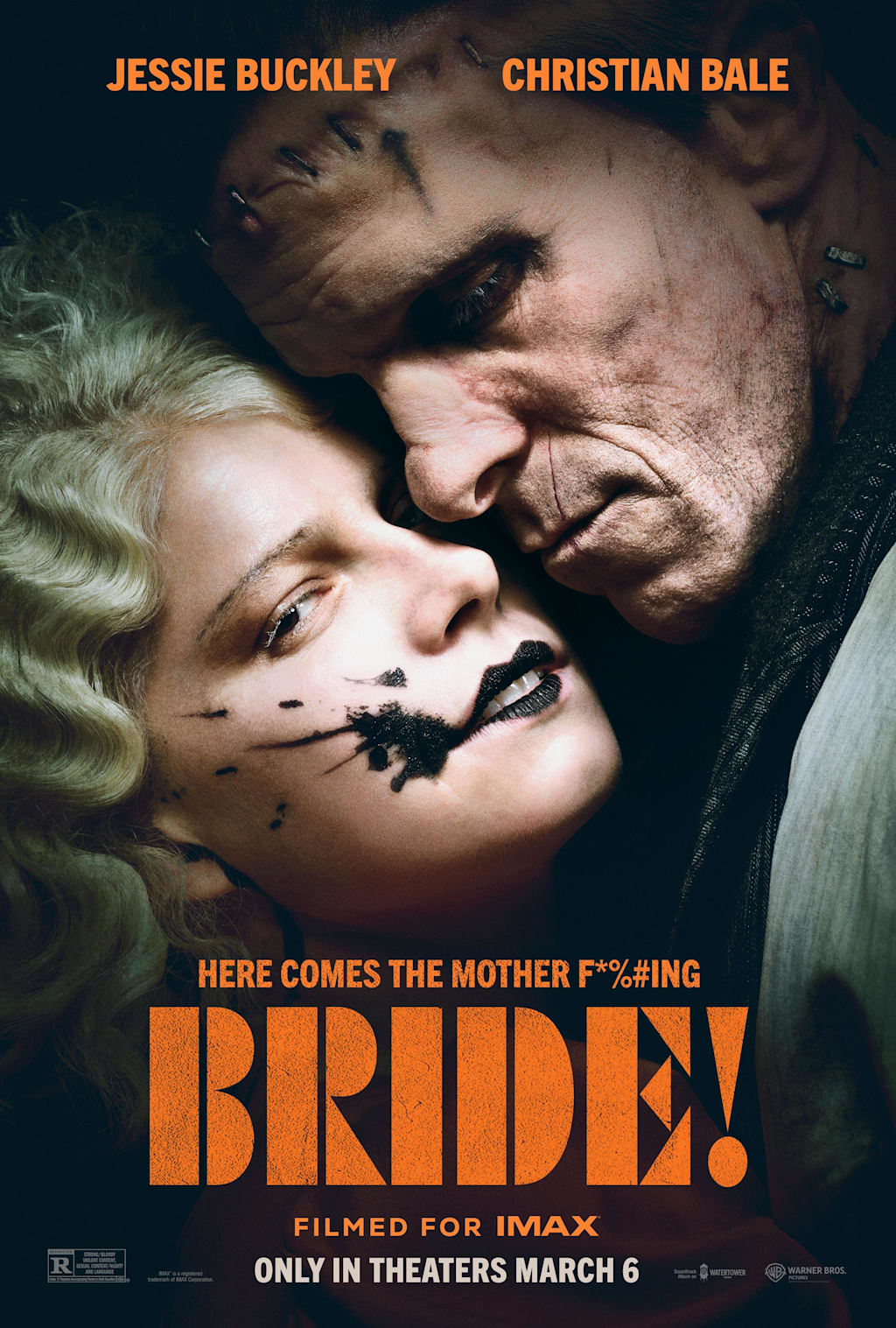
Spoiler Warning: This article contains major spoilers for The Bride, including its ending and post-credit scene.
The Bride Ending Explained
The Bride is an American Gothic horror story inspired by the legacy of Bride of Frankenstein, but its central idea is much bigger than simply bringing Frankenstein’s companion back to life.
At its core, the movie is about identity, control, loneliness, suppressed anger and what happens when someone who has spent their entire existence being defined by other people finally chooses who they want to be.
The story begins with Mary Shelley in the afterlife. Shelley feels as though part of her story remains unfinished, and she discovers an opportunity to continue expressing herself through a woman living in Chicago in 1936.
That woman is Ida.
Ida lives under the control of gangsters connected to mob boss Lupino. During one disturbing moment, Mary Shelley appears to possess Ida, causing her to suddenly speak with a British accent while exposing the crimes and hypocrisy of the men around her.
Lupino decides she has become dangerous.
Two of his men, Clyde and James, take Ida outside. Although Clyde initially appears sympathetic toward her, he pushes her down a staircase.
Ida dies.
But death is only the beginning of her real story.
Why Frankenstein Wants a Bride
More than a century after Frankenstein was created, the creature remains desperately lonely.
By 1936, Frankenstein has spent decades living without someone who truly understands him. He eventually approaches scientist Dr. Cornelia Euphronius after reading about her experiments involving reanimation.
He wants one thing from her.
A companion.
Cornelia initially refuses to bring a dead woman back to life. Frankenstein, however, reveals how deeply isolated he has become. He even tells her that she is one of the first people to treat him with basic kindness.
Cornelia eventually agrees.
The pair visit a graveyard and retrieve the body of a recently buried woman.
That body belongs to Ida.
Frankenstein immediately finds her beautiful and even worries that someone like her could never want someone who looks like him.
Cornelia continues with the experiment anyway.
Electricity, chemicals and a crystalloid solution are used to bring Ida back.
It works.
Ida wakes up alive, but her memories are gone.
Marks created during the resurrection process remain visible across her face and body, becoming one of her most recognizable features.
Instead of telling Ida what really happened, Cornelia and Frankenstein give her a new story.
They tell her she is Frankenstein’s bride and that an accident caused her memory loss.
It is the first of several identities other people attempt to force onto her.
Frankenstein and Ida Escape
Ida quickly becomes uncomfortable with Cornelia experimenting on her.
She wants freedom.
Eventually, Ida and Frankenstein escape together and begin travelling.
Frankenstein introduces her to his favorite movie star, Ronnie Reed.
Ronnie has enormous personal significance for Frankenstein. He reportedly suffered from polio during childhood and was told he might never walk normally, yet eventually became an admired dancer and movie star.
Frankenstein sees himself in Ronnie.
To him, Ronnie represents hope.
If society learned to love someone who was once treated as physically different, perhaps one day society could accept Frankenstein too.
Unfortunately, Frankenstein eventually discovers that the person he idolized is not as compassionate as he imagined.
Why Ronnie Reed Rejects Frankenstein
During their journey, Frankenstein and Ida unexpectedly find themselves at a glamorous party attended by Ronnie.
Frankenstein is overwhelmed with excitement.
He tells Ronnie how much his movies mean to him and explains that Ronnie helped give him hope during some of the darkest periods of his life.
But Ronnie reacts with disgust.
Instead of recognizing Frankenstein’s humanity, he focuses on his appearance and smell and makes it clear that Frankenstein does not belong in his world.
The rejection is devastating.
There is also a deeper irony behind it.
Ronnie was once an outsider himself.
However, after becoming accepted by society, he appears to have lost empathy for those who are still excluded.
Frankenstein begins performing Ronnie’s famous dance, and Ida joins him.
Soon the party descends into chaos.
Mary Shelley’s strange influence appears again, spreading beyond Ida as several people begin participating.
Ida then begins exposing the abusive behavior of the powerful men attending the party.
When the police intervene, violence follows.
Ida kills an officer while protecting Frankenstein, and the pair escape.
Their reputation quickly grows.
What Is the Brain Attack Movement?
Newspapers turn Frankenstein and Ida into notorious fugitives.
But something unexpected happens.
Women begin identifying with Ida.
They copy the dark marks across her face and body and begin protesting against the restrictions placed upon them.
The movement becomes known as Brain Attack.
What originally appeared to be physical damage on Ida becomes a symbol of resistance.
That distinction matters.
Ida never chose those marks.
They came from the experiment that resurrected her.
But other women deliberately recreate them.
Something society might describe as a flaw becomes a badge of rebellion.
The Brain Attack movement therefore represents women reclaiming the things society uses to shame or control them.
Ida becomes more than a wanted criminal.
She becomes a symbol.
Why Detective Myrna Is Important
Detectives Jake Wills and Myrna Mallow are assigned to hunt Frankenstein and Ida.
However, the movie repeatedly establishes that Myrna is actually the more observant investigator.
She discovers patterns Jake misses and eventually realizes that Frankenstein is travelling to places connected to Ronnie Reed.
Yet she remains treated as an assistant largely because she is a woman working inside a male-dominated institution.
Her story parallels Ida’s.
Ida is fighting against people deciding what kind of woman she must become.
Myrna is fighting against an institution deciding what a woman is capable of becoming.
Eventually, that changes.
Jake steps aside and Myrna becomes the lead detective.
It is one of the clearest indications that the rebellion inspired by the Bride is not limited to protests in the streets.
Change is reaching institutions too.
Jake’s Secret Connection to Ida
One of the biggest revelations occurs when Jake finally calls Ida by her real name.
Until then, Frankenstein has invented different names for her, including Penelope.
But Jake knows exactly who she was before her death.
Ida had secretly been working for him.
She had infiltrated Lupino’s organization and gathered information about the mob.
Eventually, the authorities possessed enough evidence to move against Lupino, but the case collapsed, apparently because of Lupino’s influence.
Jake and Ida had also become emotionally and romantically involved.
Before Jake could truly protect her, he learned that she had been killed.
That explains why Jake behaves differently whenever he sees Ida after her resurrection.
He is not simply looking at a wanted criminal.
He is looking at someone he once believed was dead.
Why Ida Rejects Her Old Names
Frankenstein eventually admits the truth.
Ida was dead.
Her body was taken from a grave.
She was resurrected because Frankenstein wanted a companion.
The revelation damages their relationship because Ida finally realizes how much of her supposed life has been fabricated.
She was never naturally Frankenstein’s bride.
She never chose Penelope.
She never chose the role other people created for her.
Eventually, she reaches a powerful conclusion.
She refuses every identity placed upon her.
She is not Ginger.
She is not Penelope.
She is not Pretty Penny.
She is not even simply Ida anymore.
She chooses a new name for herself.
The Bride.
But the meaning has completely changed.
She is not Frankenstein’s Bride.
She is simply The Bride.
The difference is crucial because the name becomes something she owns rather than something imposed upon her.
Does Frankenstein Die?
Just as Frankenstein appears ready to propose to the Bride, Clyde catches up with them.
Clyde has been hunting her because Lupino threatened his family and ordered him to eliminate her.
He fires a shot.
The bullet hits Frankenstein directly in the head.
The Bride manages to escape with Frankenstein’s body and takes him back to Cornelia’s laboratory.
She begs Cornelia to resurrect him.
Cornelia refuses at first.
She tells the Bride that Frankenstein is truly dead.
But the conversation soon reveals something important about Cornelia herself.
What Happened to Dr. Cornelia’s Husband?
Cornelia reveals that she once had a husband named George.
The couple loved each other deeply and experimented with radical scientific ideas involving relativity, time dilation and the curvature of spacetime.
When George died, Cornelia did something very similar to what she later did with Ida.
She brought him back.
But George returned without his original memories and struggled to maintain a stable mind.
Eventually, Cornelia was forced to kill the resurrected version of the man she loved.
That experience explains why she is reluctant to resurrect Frankenstein again.
She knows resurrection does not guarantee that the same person will return.
Sometimes the body survives while the identity disappears.
What Is “Disobedient Geometry”?
Cornelia also introduces one of the movie’s most important ideas when she talks about disobedient geometry.
She explains that she and George wanted to move beyond what scientists considered “well-behaved geometry,” a reality where established rules continue functioning normally.
They wanted to see what existed beyond those rules.
According to Cornelia, when she finally witnessed something resembling that disobedient geometry, it looked like the Bride.
The phrase works as a metaphor for the entire movie.
Society has its own version of well-behaved geometry.
Women are told how they should behave.
How they should look.
Whom they should love.
What roles they should accept.
And how much anger they are allowed to express.
The Bride refuses those rules.
She is therefore “disobedient geometry” in human form.
She exists outside the system that attempted to define her.
Do The Bride and Frankenstein Die?
Clyde eventually reaches Cornelia’s laboratory.
Myrna is also there.
Clyde shoots the Bride, and arriving police officers continue firing despite Myrna trying to stop them.
The Bride collapses on top of Frankenstein’s body.
For a moment, both appear dead.
The police leave, while Myrna remains suspicious about what has happened.
Then lightning flashes around Cornelia’s laboratory.
Inside, something moves.
Frankenstein’s fingers begin twitching.
Then the Bride’s fingers move too.
Their hands slowly reach toward each other.
They hold hands.
That moment confirms the ending.
Frankenstein and the Bride have been resurrected.
Cornelia ultimately performs another experiment and succeeds in bringing them back.
The film ends without fully revealing what condition they are in, but the movement of their hands makes their survival clear.
The Post-Credit Scene Explained
The story continues after the credits.
Jake appears surrounded by women wearing the Bride-inspired makeup associated with the Brain Attack movement.
They have captured mob boss Lupino.
This is especially symbolic because Lupino maintained a grotesque collection of severed tongues belonging to people who spoke against him.
Throughout the movie, tongues represent silencing.
Lupino literally removes the voices of people who challenge his power.
Now he has been captured by women inspired by someone whose entire journey is about finding her own voice.
The women begin applying Bride-style makeup to Lupino.
The implication is ominous.
Lupino is finally facing the rebellion created by the woman he once believed had been permanently silenced.
Mary Shelley’s Possession Explained
Mary Shelley’s presence is much more than a supernatural subplot.
Her possession of Ida represents suppressed voices finding another way to speak.
Whenever Ida becomes overwhelmed by control, exploitation or injustice, Mary’s voice emerges.
The possession therefore functions as a metaphor.
A voice that could not fully express itself during one lifetime returns through another woman.
Mary’s influence also spreads beyond the Bride during the party sequence.
That suggests the anger represented by Mary cannot remain trapped inside one person.
Other people begin responding to it.
Eventually, an individual act of rebellion becomes a collective movement.
That is essentially what happens with Brain Attack.
Why the Bride’s Facial Marks Matter
The Bride’s black facial markings are initially presented as damage caused by the resurrection process.
But their meaning changes dramatically.
The women participating in Brain Attack begin intentionally recreating them.
A mark created without the Bride’s consent becomes something other women consciously choose.
The symbolism is powerful.
Something considered ugly, abnormal or shameful is transformed into a sign of solidarity.
The Bride does not become powerful by hiding what happened to her.
She becomes powerful when she stops allowing other people to determine what those marks mean.
The Bride and the Theme of Consent
Consent sits at the center of the Bride’s story.
She does not consent to being resurrected.
She does not consent to becoming Frankenstein’s partner.
She does not choose the identity initially given to her.
She wakes inside a life constructed by other people.
That is why her eventual decision to call herself The Bride matters so much.
She takes the label originally designed to define her relationship to a man and transforms it into an independent identity.
She turns possession into ownership.
Instead of being “the bride of Frankenstein,” she becomes simply “The Bride.”
Frankenstein’s Tragic Search for Acceptance
Although the Bride becomes the movie’s central revolutionary figure, Frankenstein has his own emotional journey.
He does not primarily want violence.
He wants acceptance.
His obsession with Ronnie Reed reveals how desperately he wants evidence that someone considered different can eventually become loved.
When Ronnie rejects him, that hope collapses.
The scene demonstrates that gaining social acceptance does not automatically create empathy.
Someone who once existed outside society can eventually become part of the same system that excludes others.
Frankenstein must therefore stop looking toward celebrities or society to validate his existence.
His most meaningful connection comes from the Bride, another person created and judged by forces outside her control.
What The Bride Is Really About
On the surface, The Bride is a Gothic horror story involving resurrection, gangsters, detectives, murder and Frankenstein.
Underneath, it is a story about identity.
Ida repeatedly receives identities from other people.
Mary Shelley speaks through her.
Frankenstein invents names for her.
Society calls her Frankenstein’s bride.
The newspapers turn her into a criminal celebrity.
The Brain Attack movement transforms her into a revolutionary symbol.
But eventually she refuses to let any of those identities completely define her.
She chooses herself.
That is the meaning behind her declaration that she is The Bride.
Not somebody’s bride.
Not Frankenstein’s property.
Not a dead mob informant.
Not an experiment.
The Bride.
Final Meaning of The Bride Ending
The final resurrection of Frankenstein and the Bride gives the story a surprisingly hopeful conclusion.
Both characters have repeatedly been treated like unnatural creations who do not belong within ordinary society.
Yet even death fails to permanently erase them.
At the same time, the Brain Attack movement continues without the Bride physically leading it.
That may be the movie’s most important message.
Once an idea becomes larger than the person who inspired it, killing that person cannot necessarily destroy the movement.
Lupino helped kill Ida once.
The police apparently kill the Bride again.
Neither act succeeds in silencing what she represents.
By the ending, Frankenstein and the Bride are alive again, Myrna has become the lead investigator, Lupino has been captured, and women inspired by the Bride continue their rebellion.
The woman who began the story without control over her body, her name or even her second life ultimately becomes the person who changes everyone around her.
And that is why the ending is not simply about whether Frankenstein and the Bride survive.
It is about something much larger:
the moment a person who has always been defined by others finally defines herself.
About the Creator
parwinder singh
🎬 Movie & Entertainment Writer sharing reviews, ending explanations, story breakdowns, plot twists and hidden details from Bollywood, Hollywood, South Indian cinema, Korean dramas and OTT releases.
Enjoyed the story? Support the Creator.
Subscribe for free to receive all their stories in your feed.
Comments
There are no comments for this story
Be the first to respond and start the conversation.