
The Beautiful Tragedy of the 'Amazing Spider-Man 3' That Never Was
Andrew Garfield wants a "weird" road-trip movie. Hollywood wants a billion-dollar franchise. Here's why walking away might be the most heroic thing Peter Parker has ever done.
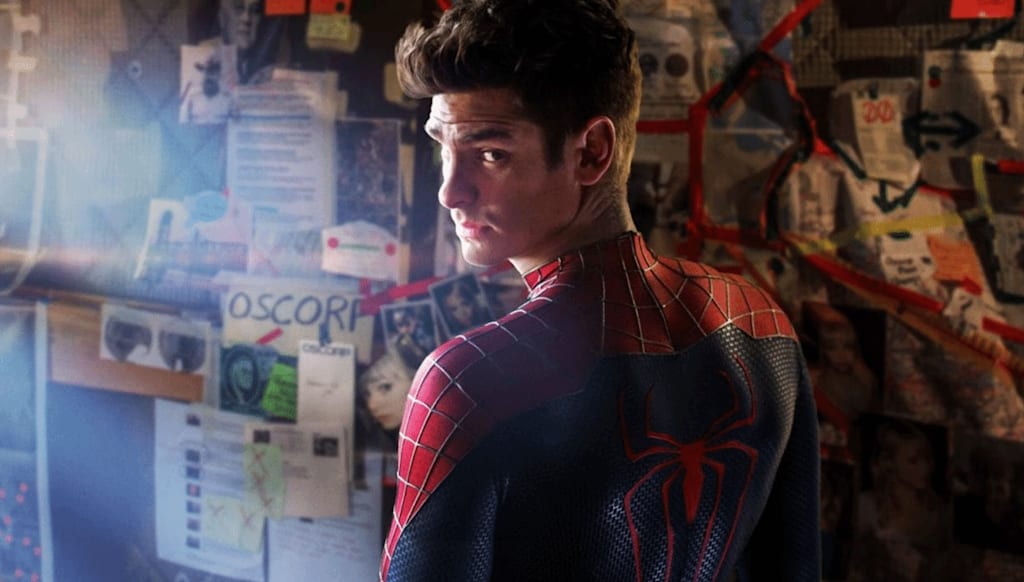
In August 2026, Andrew Garfield told The Playlist that if The Amazing Spider-Man 3 happened, it would have to be "very, very strange" and "completely unexpected." He suggested a road movie.
The quote traveled across social media in screenshots and translations. Some commenters cheered. Others ran the numbers on Sony's balance sheet. A few just remembered Gwen Stacy falling.
But almost nobody asked the concrete question: what does Garfield's "strange" actually look like?
1. First, understand what Garfield is asking for
He isn't negotiating salary. After The Amazing Spider-Man 2 in 2014, Garfield starred in Hacksaw Ridge (Oscar nomination), Silence, and The Eyes of Tammy Faye. He no longer needs a superhero franchise to prove himself. In 2021, he appeared in Spider-Man: No Way Home for less than fifteen minutes. In that one scene where he catches MJ, he caught the Gwen he failed to catch ten years earlier. Audiences felt that ache for him.
So when he sets conditions, he is not asking for more fight choreography or a better suit. He said: "I don't want to do a traditional Spider-Man sequel."
Translation: no more villains, no more city-wide destruction, no more CGI third-act brawls. He already closed that chapter in No Way Home. If he comes back, it has to be for something else.
What something? He told us: a road movie.
Peter Parker leaves New York after Gwen's death. He drives a beat-up car through the American heartland. No skyscrapers to swing from; he moves across plains and deserts in a clumsier way. In each small town, he stumbles into small troubles. Not world-ending conspiracies, but ordinary people's conflicts. He helps, then leaves. He might not even change into the suit.
This is not the Spider-Man you know. This is not even a typical superhero movie. It sounds like Nebraska mixed with The Straight Story, except the protagonist can climb walls.
That is Garfield's "strange": first a movie, then a Spider-Man movie.
2. Why the Amazing series was cancelled
Online nostalgia for the Amazing series runs deep. On Douban, Weibo, and Xiaohongshu, fans regularly edit Garfield and Emma Stone clips to slow ballads, earning tens of thousands of likes. The barrage of comments read "unfinished sorrow" and "this is the real Spider-Man."
But memory softens things.
When The Amazing Spider-Man 2 opened in 2014, Rotten Tomatoes gave it 52%. That makes it the only Spider-Man film since 2000 rated "Rotten." Critics panned the messy dramatic structure, the inconsistent Peter Parker characterization, and the clunky romantic turns. Audiences remembered two things: Electro's visual effects and Gwen falling. The hour and a half in between was packed with plot but empty in retrospect.
The box office tells a blunter story. It grossed $202 million domestically. That is the only Spider-Man film that failed to cross $300 million in North America. With a production budget north of $200 million plus global marketing, the profit margin was thin. Sony did the math: reboot, recast, and hitch a ride on the Marvel machine. That gave us the Holland version, with costs tightly controlled and box office climbing steadily.
Two filters drive the nostalgia for the Amazing series. First, Garfield and Emma Stone's off-screen romance bled into their on-screen chemistry. No script could manufacture that sweetness. Second, the Holland version leaned heavily on Iron Man, creating an illusion that the Amazing series might have been better if it continued.
But that illusion does not solve the real problem: they killed the female lead in the second movie. What do you do in the third? Introduce Mary Jane as a replacement? Would fans accept that? If Gwen's death is the emotional peak of the Amazing series, it is also its biggest narrative burden. Walking forward with that weight risks a landmine at every step.
3. What a "strange Amazing 3" might look like
If Sony actually greenlit Garfield's "strange" condition, the film could take several shapes.
Possibility one: Peter Parker on the road.
He leaves New York. Not because someone is hunting him, but because he cannot stay. He stuffs the suit in the trunk, gets into an old car, and drives. Along the way, he passes through small towns. He meets an old gas-station owner, a woman too scared to report domestic abuse, a kid stealing cars. He helps in his own way, then moves on.
The movie might have only two action sequences, and neither on a "save the city" scale. The heart of a road movie is the change inside the person on the road. It does not matter if the scenery changes; what matters is the person in the car. He might return to New York. He might not. The point is that he remembers Gwen's name in a new way.
Possibility two: psychological horror.
If "strange" takes another turn, shoot it as horror. Gwen's death is not past tense. It becomes a tangible entity haunting Peter. Perhaps a multiversal entity feeding on his guilt, or his own subconscious projecting a version of Gwen who confronts him about his failure.
Peter swings between skyscrapers, but he is not running from a gun-toting villain. He is running from his own mind. Superpowers do not help much here. This treatment places Spider-Man in an unfamiliar genre framework. Imagine the figure appearing at the end of the hallway in The Shining, except it is Gwen.
Possibility three: a stranger in the multiverse.
No Way Home already opened the multiverse. But Garfield's "strange" might not be the fanfare of three Spider-Men together. It could be the opposite: his Peter Parker falls into a universe without superheroes. There, his spider-powers do not work. He is just an ordinary man with a change of clothes, a wallet, and a heap of regret. He has to survive. He has to find a way home.
When a person loses the thing that defined them, for Peter, that thing is "Spider-Man"; what is left? That is the core question of this premise. It strips away every comic-book element, leaving just a human being.
What these three possibilities share: they are first stories, then Spider-Man stories. They tear off the genre label and replace it with road-movie, horror, or survival textures. Spider-Man's powers become supporting players. The protagonist is the human being.
That is probably what Garfield wants.
4. Reality is less romantic
We have been talking about "if" for a while. Now for the "but."
In 2026, Spider-Man: Brand New Day set a new record for the biggest domestic opening weekend in history. The Holland version has firmly established itself. Sony and Disney are making serious money from this franchise. At this point, would Sony spend $200 million to make a "road-movie Spider-Man"? A Spider-Man with no traditional villain? A Spider-Man that average audiences might call boring?
Unlikely.
Sony's Spider-Man Universe has already expanded: Venom, Morbius, Kraven the Hunter — a whole slate of projects queued up. Resources are finite. Why make way for a series that was cancelled a decade ago, had mixed reviews, and saw shrinking box office?
More brutally, Garfield's own condition is box-office poison. A "strange Spider-Man" might appeal to critics, but what about the global general audience? They buy tickets on a Friday night to see a guy in a red-and-blue suit swinging between skyscrapers, not to watch him drive a junker through the desert reflecting on his life.
Garfield cannot be unaware of this. So when he sets the "strange" condition, on the surface it is "I will come if you give me this." In essence, it says: "I know this series is not coming back, and I will not let it come back for nothing."
He is using his own standard to protect the last shred of dignity of that version of Peter Parker.
5. Stopping at "to be continued" might be the best ending
In No Way Home, Garfield's catch of MJ already closed his biggest regret. In that moment, audiences were not watching the Holland story or the Tobey story. They were watching his own: the one he failed to catch back then; this time he caught. The blonde girl who fell at the base of the clock tower ten years ago was, in that cross-universe instant, saved.
So the Amazing series already has an ending. It is not a third film. It is a cameo of less than fifteen minutes. But it is good enough. Good enough that audiences do not need a full feature to gild the lily.
Some stories are more beautiful left in a state of "to be continued" than hurriedly given a mediocre conclusion. Garfield understands that, which is why he uses "strange" and "non-traditional" as luxury filters to block every mediocre sequel that might come his way.
If The Amazing Spider-Man 3 never gets made, it will not be because it is not good enough. It will be because it is not strange enough. And that standard was set by Garfield himself. With that move, he tells everyone: my Peter Parker does not live in those formulas.
The beat-up car that never hit the road, the desert highway that was never traveled, the "strange Spider-Man" that was never filmed — let them stay in the imagination. Things that stay in the imagination do not get botched endings.
About the Creator
Jin
Writer of reamstories
https://reamstories.com/jin
Enjoyed the story? Support the Creator.
Subscribe for free to receive all their stories in your feed. You could also become a paid subscriber, letting them know you appreciate their work.
Comments
There are no comments for this story
Be the first to respond and start the conversation.